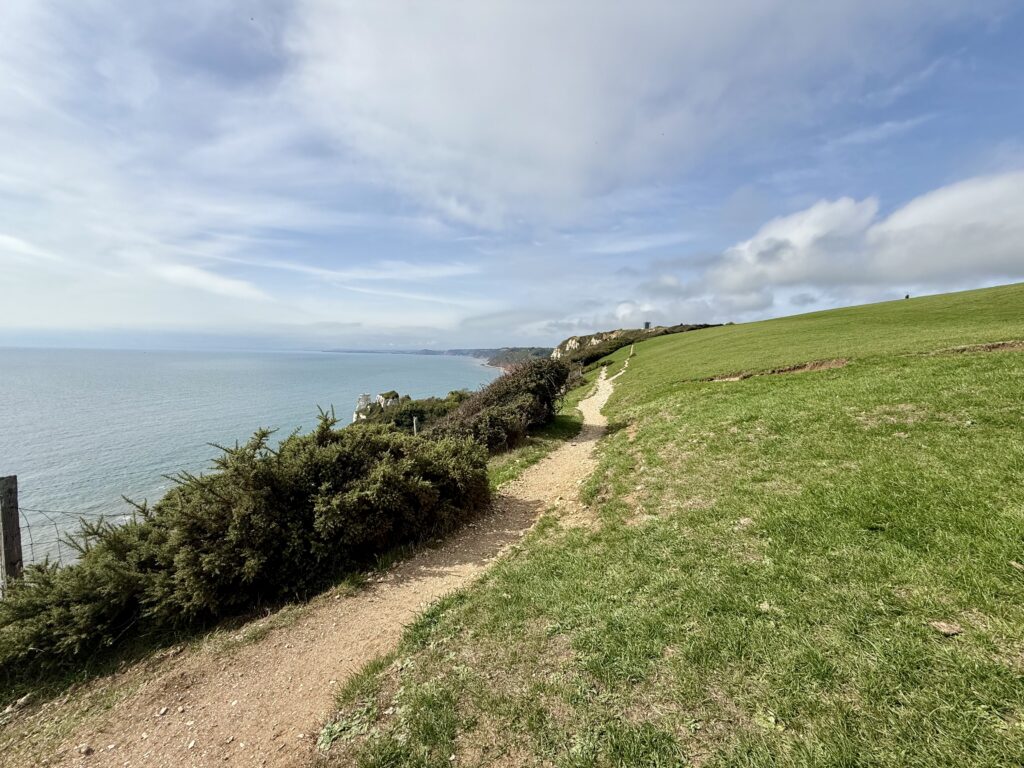
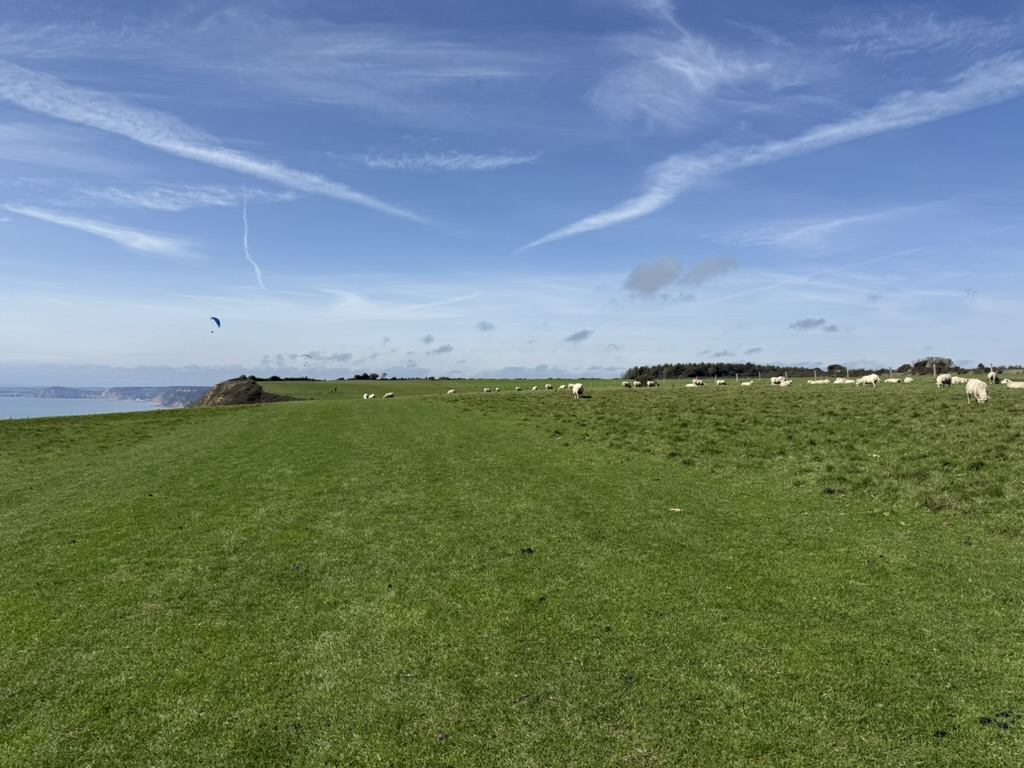
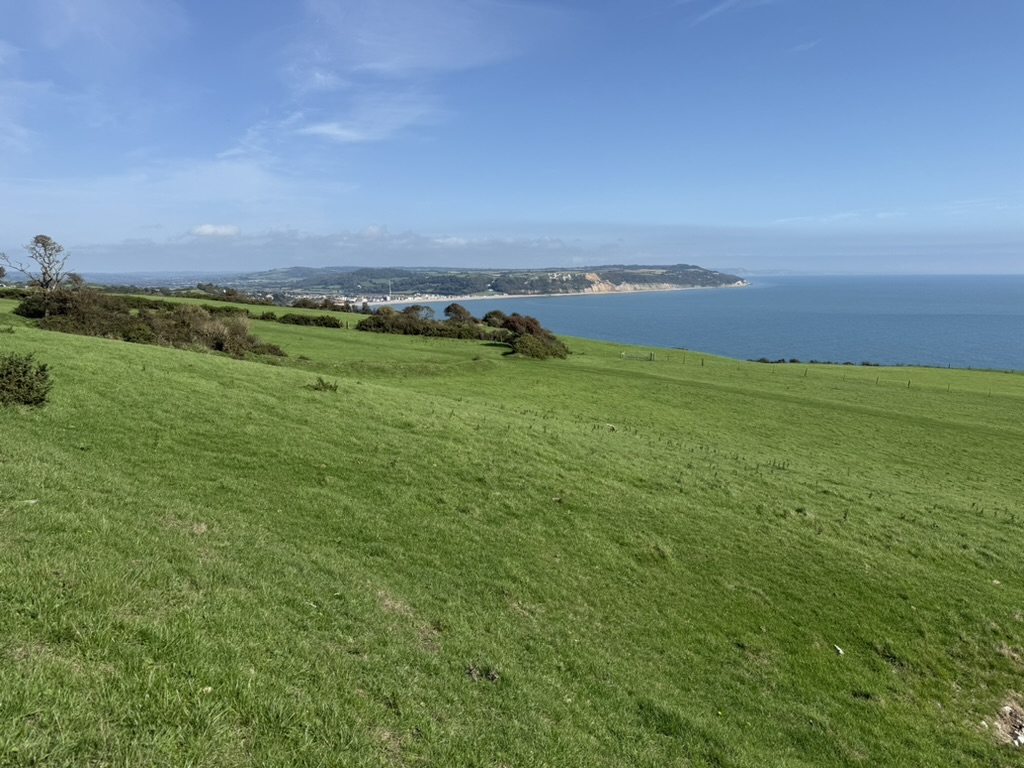
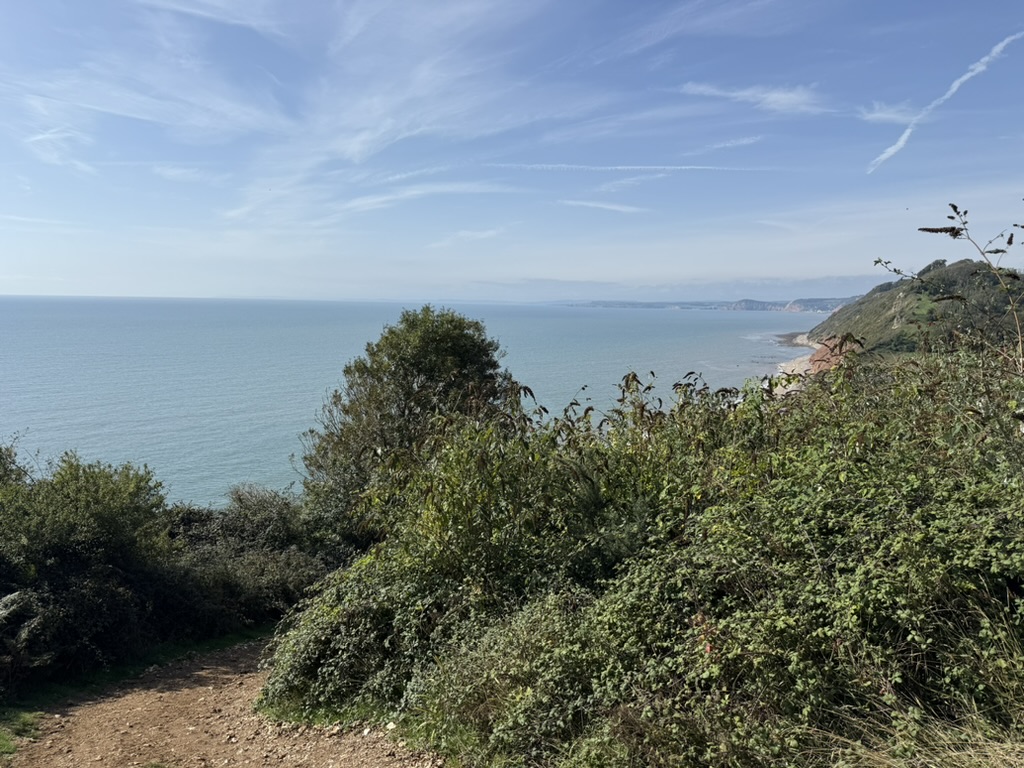
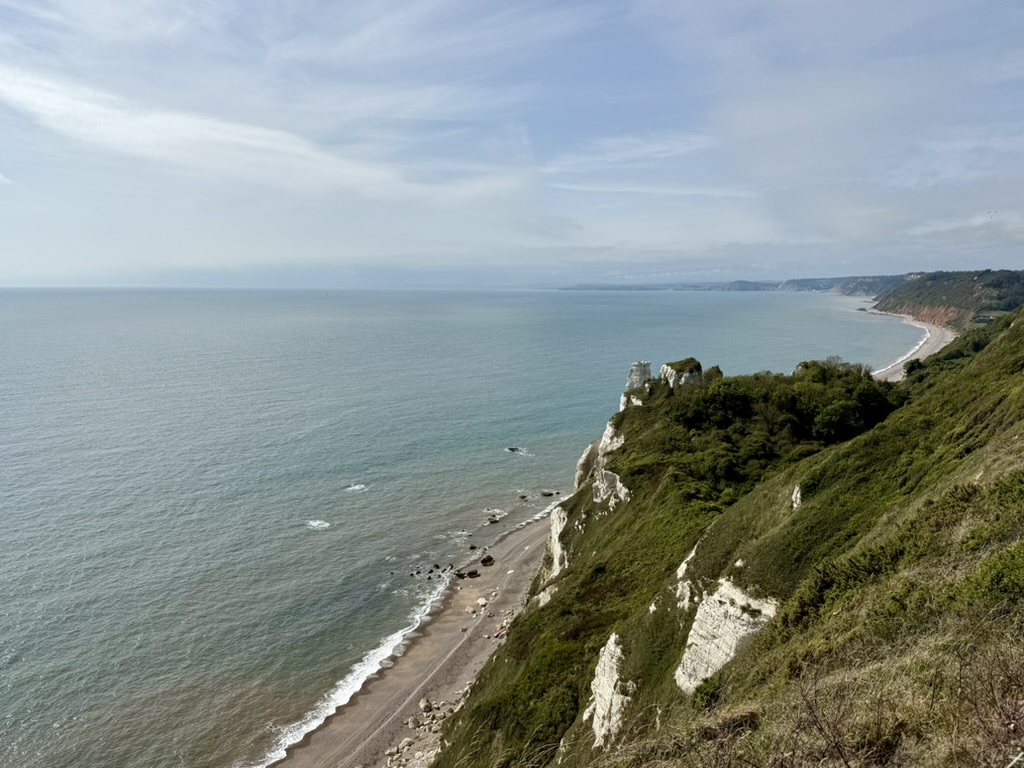
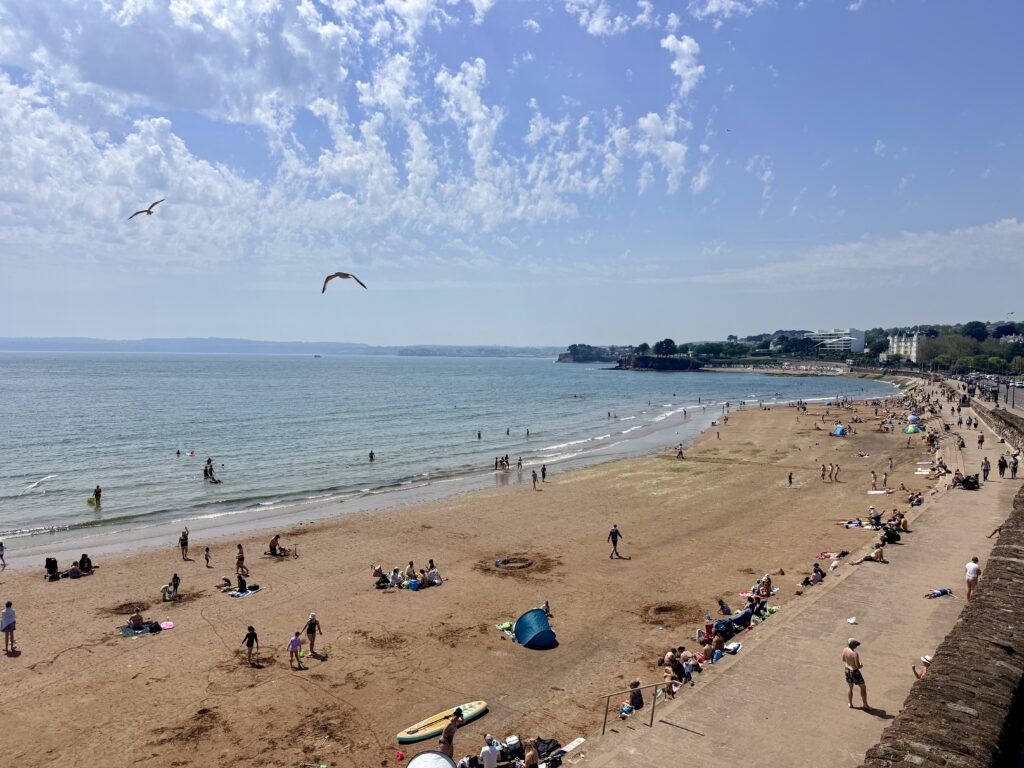
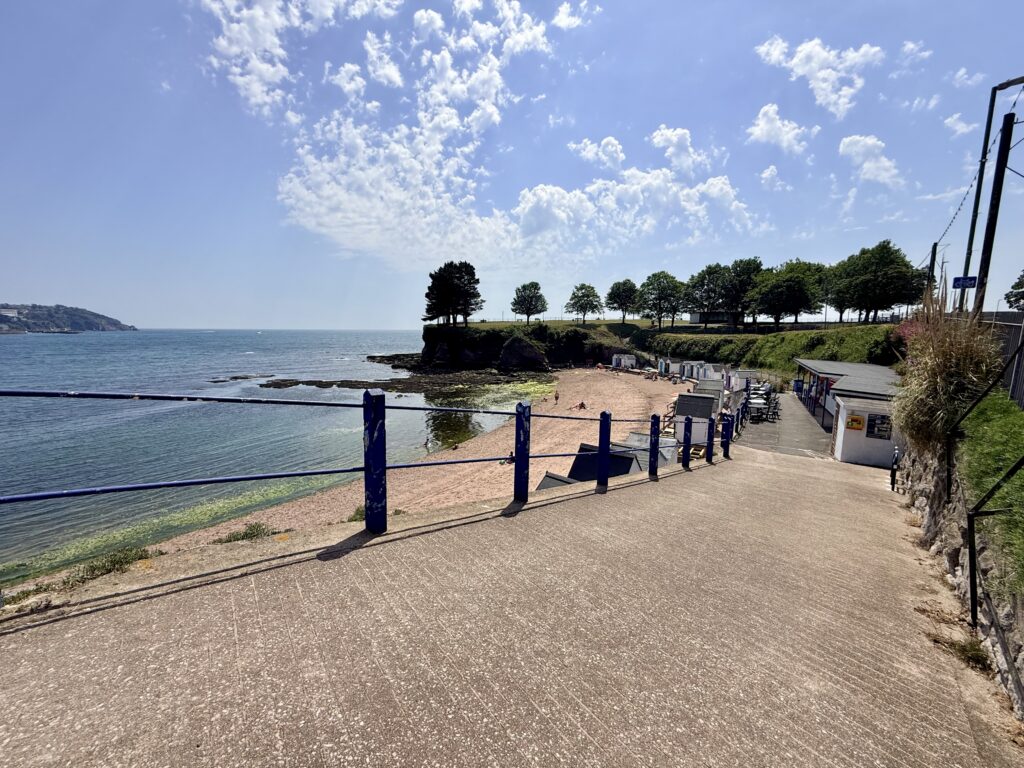
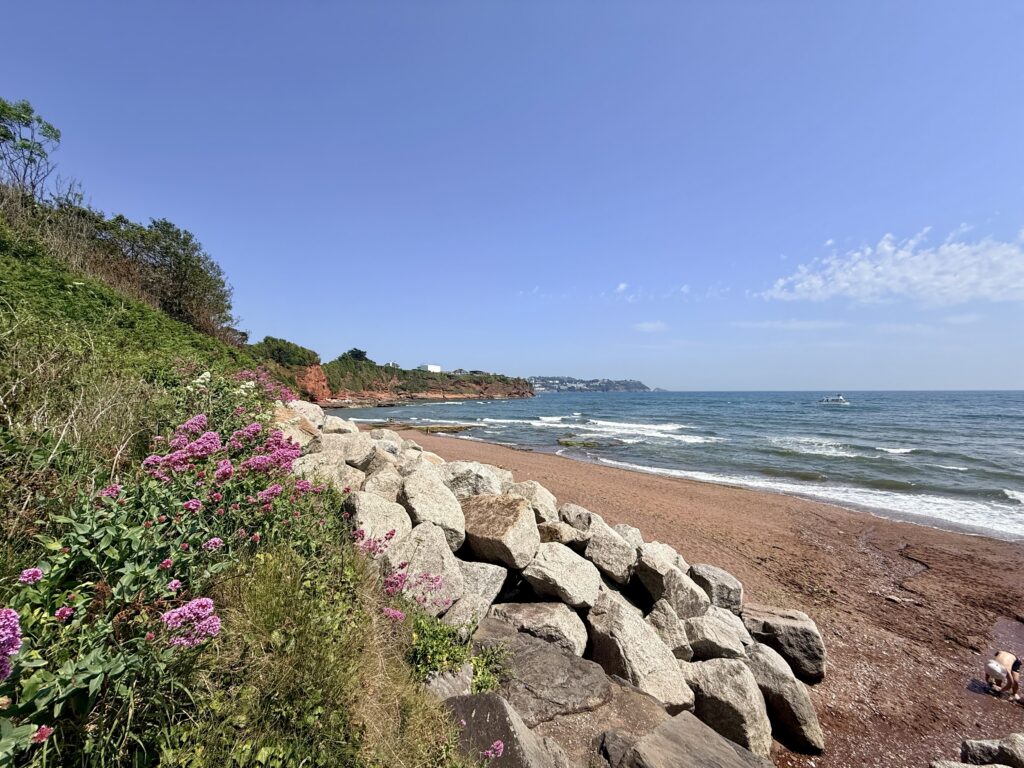
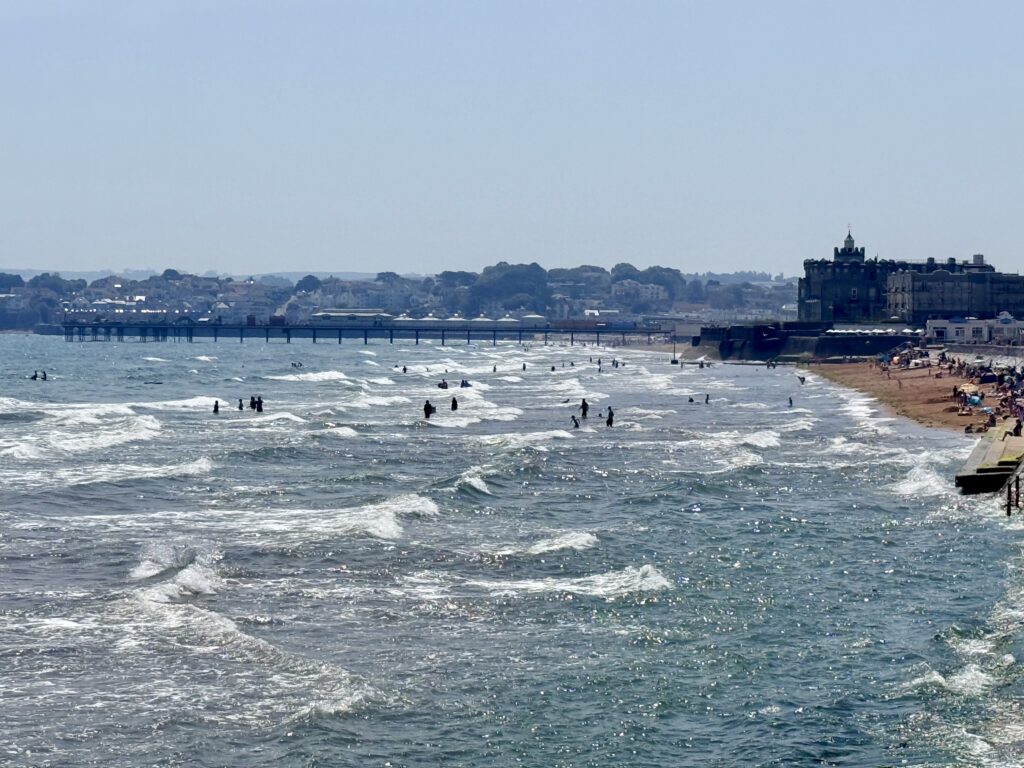
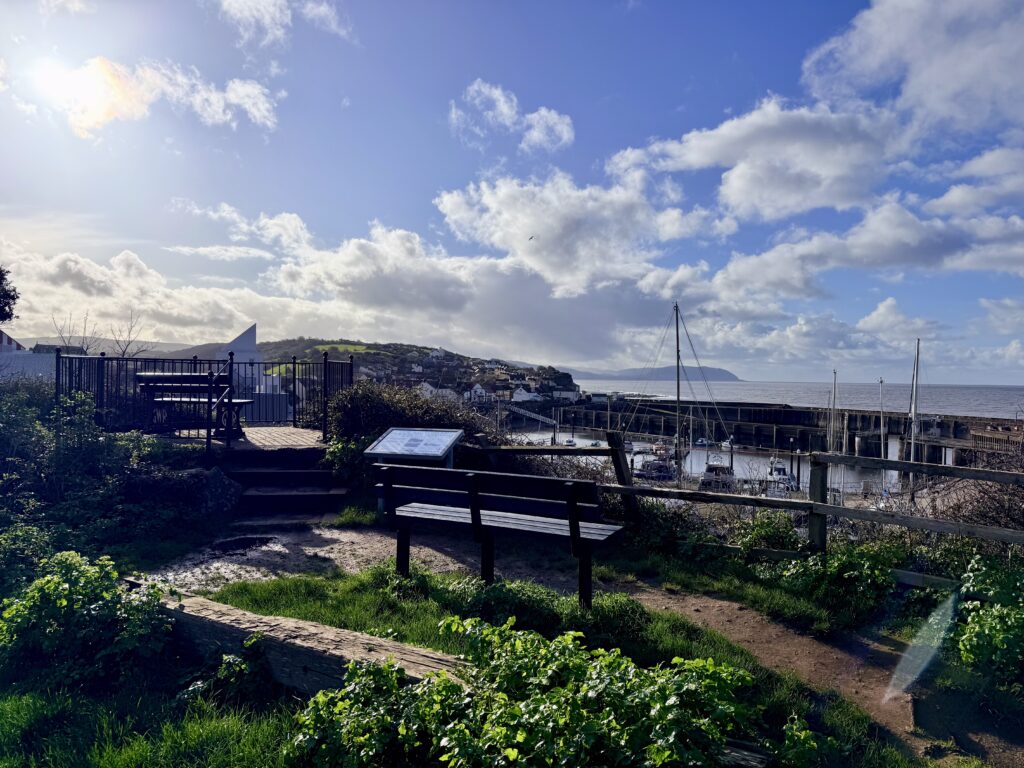
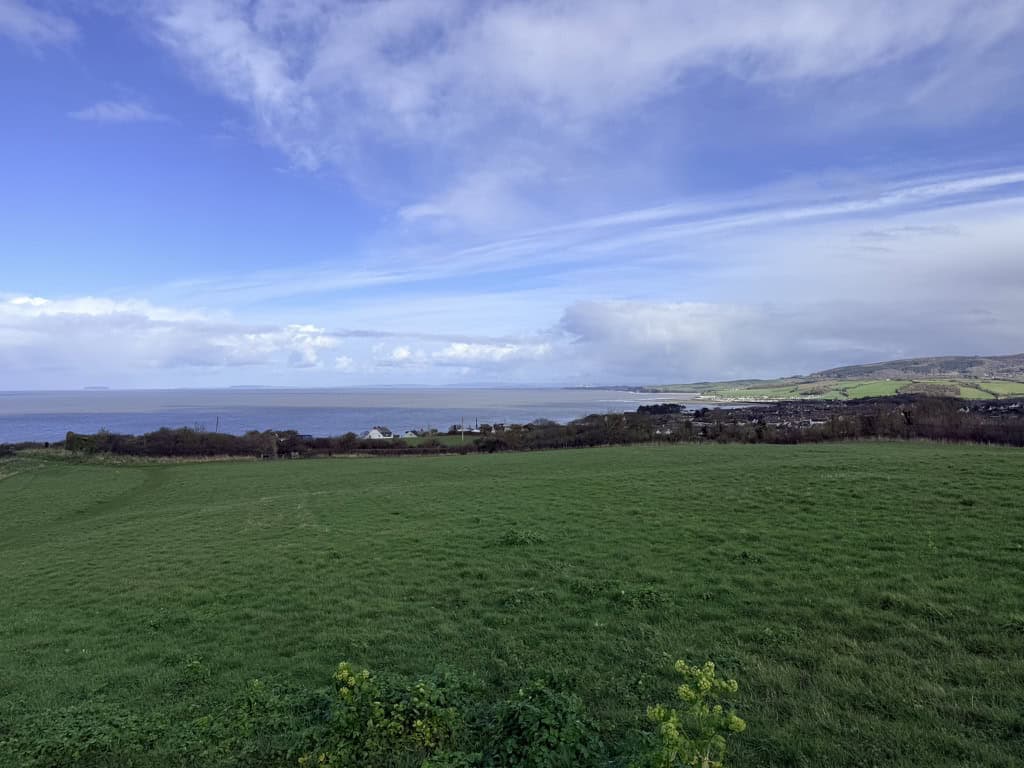
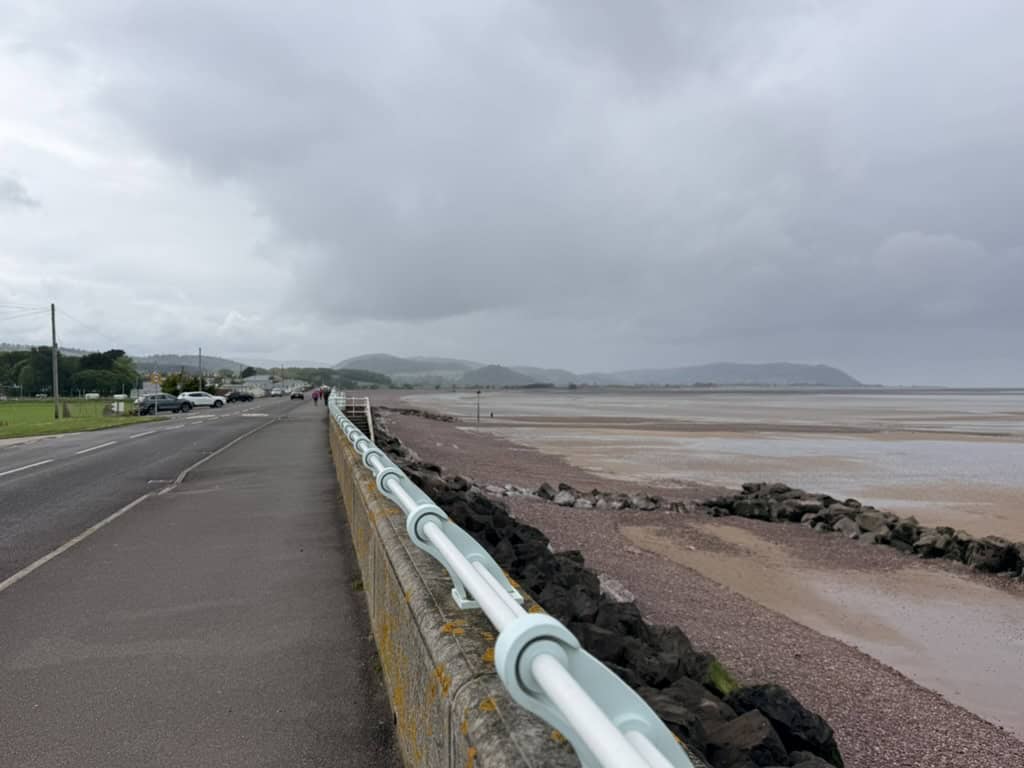
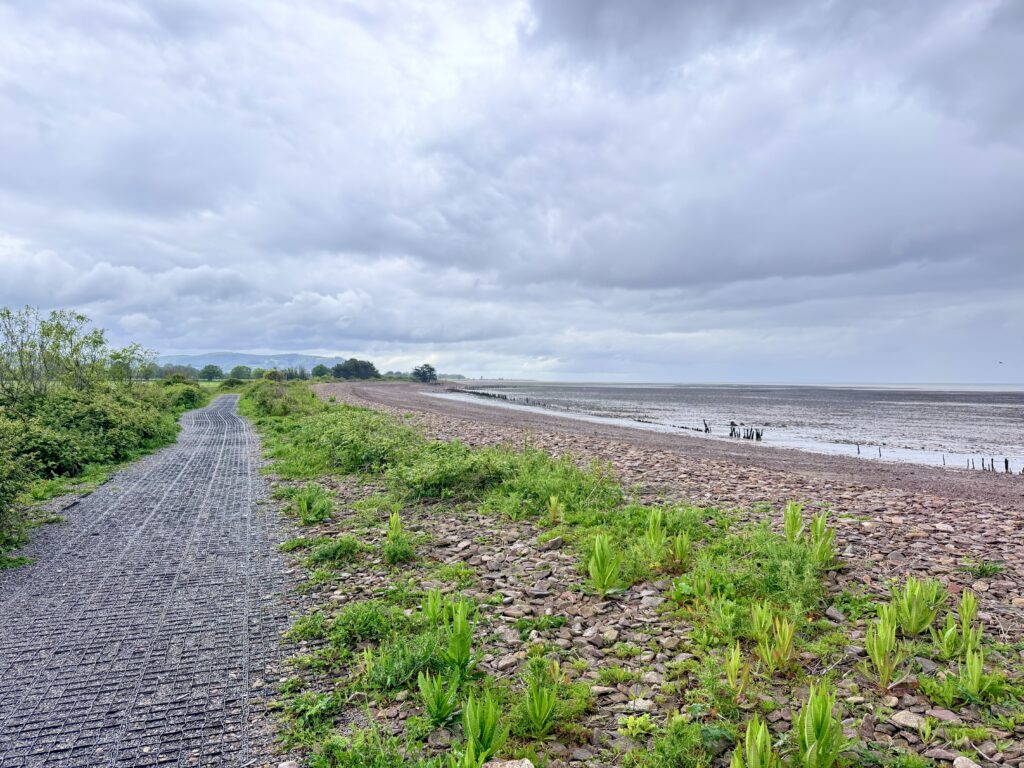
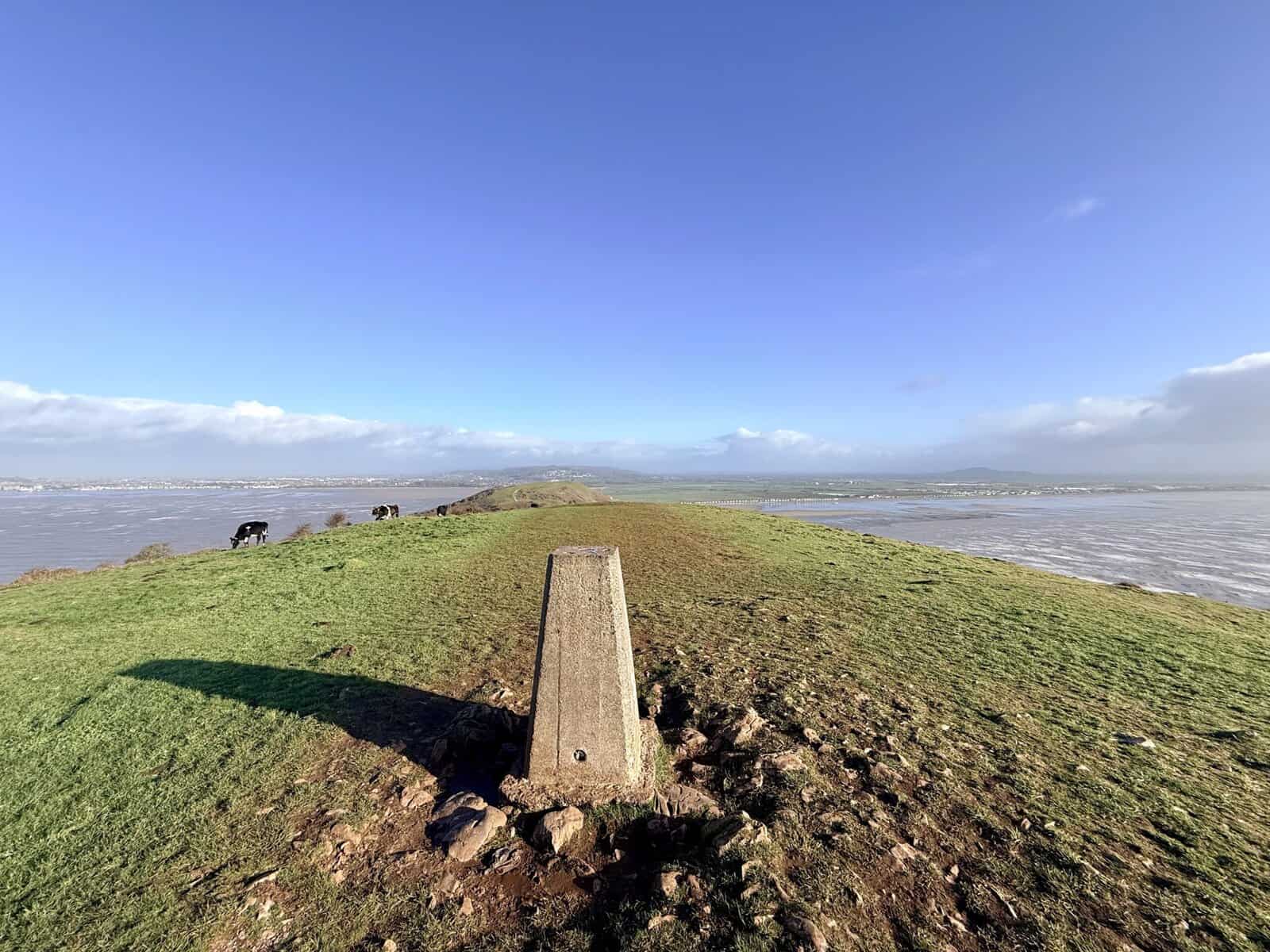
The clifftop coast path between Branscombe and Beer. (Credit: ThisIsSouthWest)
The Beer to Branscombe walk links two of East Devon’s most attractive villages across the open clifftops of Beer Head. Along the way, you’ll find far-reaching views across Lyme Bay, ancient earthworks, a lost Napoleonic gun battery, and the extraordinary landscape of Hooken Undercliff.
We have walked between Beer and Branscombe many times, in summer and winter and in both directions. For us, it would be difficult to visit or stay in either village without exploring the other.
The two villages have quite different characters. Beer is the larger, with a sheltered beach, fishing boats, shops and plenty of places to eat and drink. Branscombe is quieter and more scattered, stretching inland through a peaceful National Trust valley.
The walk between them is moderate, not easy. There is a steady climb out of Beer and a much steeper descent into Branscombe, but the route is straightforward enough, suitable for most, and the views make the effort worthwhile.
🥾 Beer to Branscombe Walk at a Glance
This moderate Beer to Branscombe coastal walk links two of East Devon’s loveliest villages by way of Beer Head, open clifftops and the steep path down East Cliff. The same route can also be followed as a Branscombe to Beer walk.
📍 Starting point
Beer Beach, although the walk can also begin at Branscombe Beach.
🚗 Parking in Beer
Clapps Lane car park, Beer, EX12 3EN. For a shorter walk that avoids Common Hill, use Cliff Top Long Stay Car Park, also known as Beer Head Car Park, EX12 3AQ.
🅿️ Parking in Branscombe
Branscombe Village Hall, EX12 3DB, where parking is by donation. Paid ANPR parking is also available beside Branscombe Beach.
↔️ Distance
Just over 4 miles for our return route between Beer and Branscombe.
⏱️ Walking time
About two hours without stops. Allow at least three hours, or longer if you plan to explore Branscombe.
⛰️ Total ascent
Approximately 800 feet.
🥾 Difficulty
Moderate. Common Hill is the longest climb, while East Cliff above Branscombe is shorter but considerably steeper.
🌿 Terrain
Village roads, field paths, wide clifftop tracks, gates and a steep coastal path. Some sections can become muddy and slippery in winter.
🐕 Dog friendly
Yes, although dogs should be kept on leads around livestock and under close control near cliff edges.
👨👩👧 Suitable for children
Suitable for active children, but the climb back up East Cliff can be challenging.
♿ Accessibility
The full route is not suitable for wheelchairs or pushchairs because of steep gradients, steps and uneven ground.
☕ Refreshments and toilets
Available in Beer and Branscombe, although some cafés and attractions open seasonally.
🚌 Return by bus
The Axe Valley 899 connects Beer and Branscombe. Check the current timetable before setting out.
⚠️ Hooken Undercliff route update:
the lower coast path beyond Hooken Beach was closed because of subsidence during our latest visit. Hooken Beach and the undercliff remain accessible as a worthwhile detour, but walkers continuing to Branscombe should follow the signed upper clifftop route.
Disclosure: Some links on this page are affiliate links. If you follow one and make a booking or purchase, we may receive a small commission at no extra cost to you. This helps support our independent guides. We also link to non-affiliate websites that we believe will be helpful. As an Amazon Associate, we earn from qualifying purchases.
Beer to Branscombe Walk Route Map
Our Beer to Branscombe walk route map shows the outward coastal path across Beer Head and East Cliff, then our return to Beer via the bridleway near the Lookout Tower and Common Hill.
Starting the Walk in Beer
Beer Beach, the starting point for the walk to Branscombe. (Credit: ThisIsSouthWest)
For convenience, we begin the walk at Beer Beach. It is easy to find and places the start close to public toilets, cafés, pubs and village shops.
Beer has several car parks, but we usually use Clapps Lane car park, EX12 3EN. This is the main long-stay car park and is only a few minutes’ walk from the beach.
Occasionally, on-street spaces may be available on Long Hill or The Causeway, although parking is certainly not guaranteed and restrictions may apply. Our complete guide to things to do in Beer has more information about parking, places to eat and other attractions in the village.
Public toilets are situated just above the beach. A water tap is also at the bottom of Sea Hill, on the right-hand side. We believe this provides drinking water, although it would be sensible to check the signage before filling a bottle.
From Beer Beach, walk uphill along Sea Hill towards the Anchor Inn. Turn left beside the pub and continue up Common Hill.
This is the longest climb of the walk. Common Hill is fairly steep, but the gradient eases as you leave the village and approach Beer Head.
Little Lane and Beer Memorial Avenue
Before reaching Beer Head Holiday Park, turn left from Common Hill into Little Lane. Look out for the coast-path signs.
If you miss the turning, continuing up Common Hill and Common Lane will still bring you towards the clifftop, so it is difficult to go too far wrong.
A large car park soon appears on the right. This is Cliff Top Long Stay Car Park (pay and display), also known locally as Beer Head Car Park, EX12 3AQ.
You can begin the Beer to Branscombe walk here if you want a slightly shorter route and would prefer to avoid the steep climb up Common Hill. Starting here means missing the walk through Beer and the initial views as you leave the village, but it puts you closer to the coast path.
Before continuing around Beer Head Holiday Park, take a few moments to visit Beer Memorial Avenue beside the car park.
The avenue consists of 30 small-leaved lime trees planted in November 2019 to honour people from Beer who served during the First World War. Plaques remember local residents who were killed, while two of the trees recognise more than 200 men and women who served and returned.
An information board recounts several personal stories, including those of Beer men who lost their lives at the Battle of Jutland. This moving, relatively little-known place is tucked away just beyond the village.
Climbing Towards Beer Head
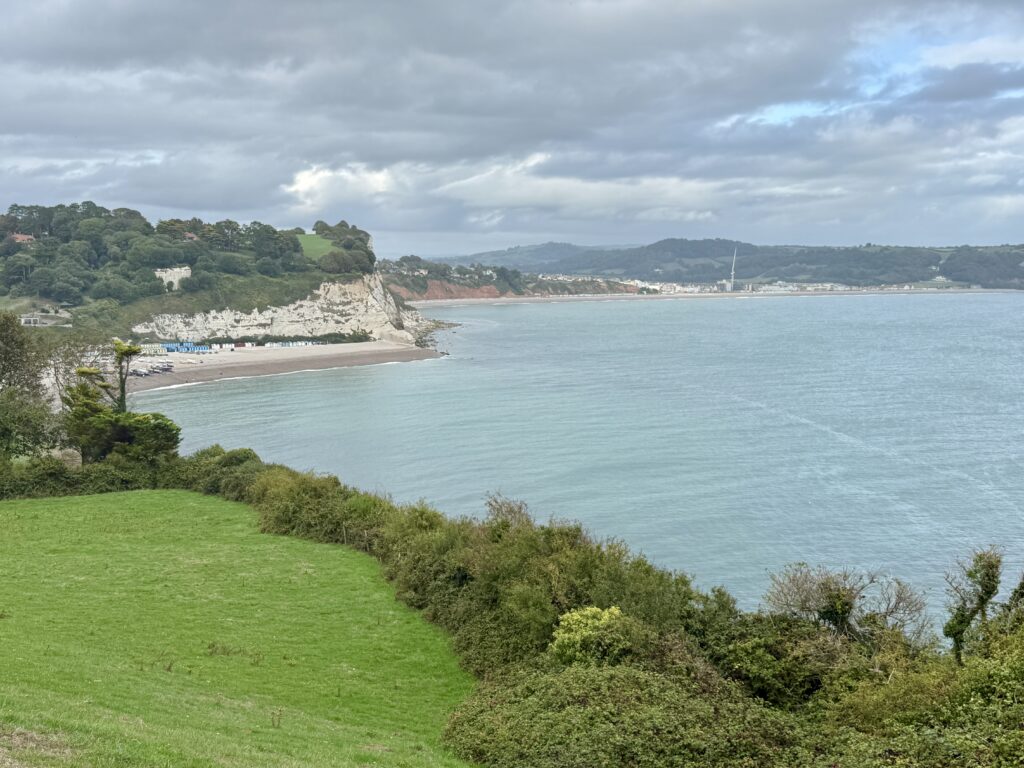
Beer Beach and Seaton. (Credit: ThisIsSouthWest)
Return to the path and continue around the lower edge of Beer Head Holiday Park. Depending on opening times, Beer Head Bistro, with its fabulous views, may offer a chance to stop for refreshments.
The path continues gently uphill towards Beer Head. Compared with Common Hill, this section feels a little easier.
Before reaching the headland, you will pass a bench with an excellent view back across Beer Beach and along the coast towards Seaton. It is perfectly placed for a rest after the climb and is one of our favourite viewpoints on this side of Beer Head.
The white cliffs enclosing Beer Beach show why the village is so sheltered. Fishing boats are drawn up on the shingle below, while Seaton Bay opens out beyond the headland.
Beer Head
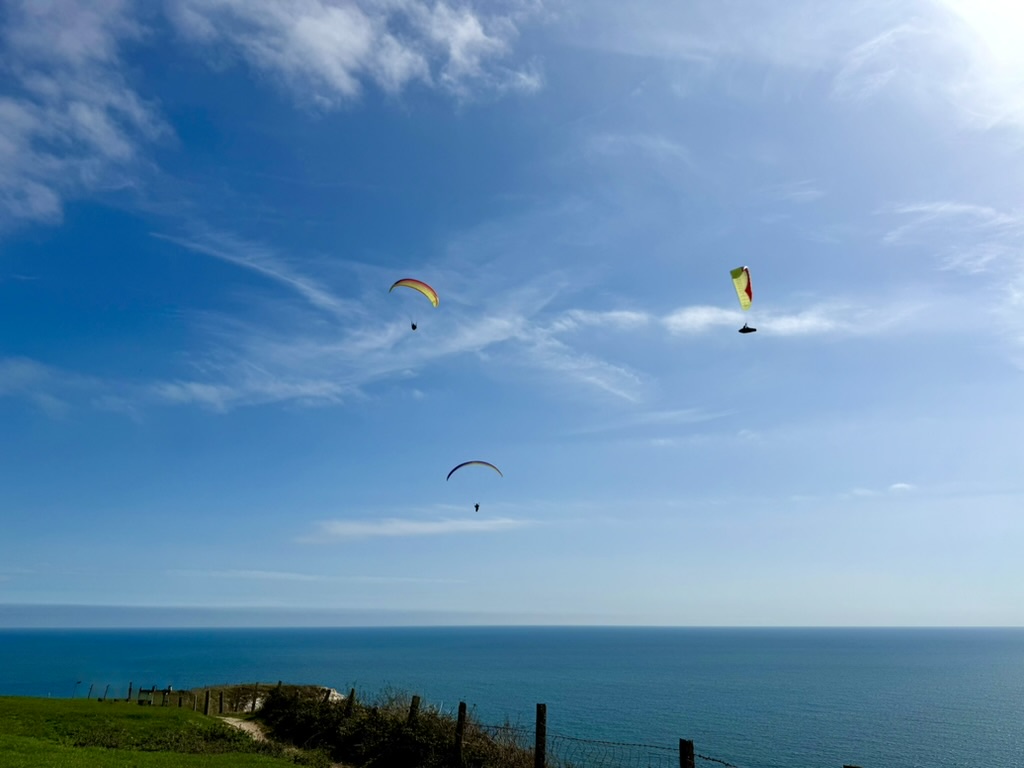
Paragliders above Beer Head on a clear day. (Credit: ThisIsSouthWest)
Beer Head is a broad, open headland rising above the white chalk cliffs of the Jurassic Coast.
The views are the main reason to make the climb. On a clear day, you can look east along the coast towards Portland and west across Lyme Bay towards Torbay and Berry Head. Closer at hand, there are wonderful views over Beer, Seaton Bay and the changing colours of the East Devon coastline.
Paragliders are sometimes seen above the headland when the weather and wind direction are suitable.
The path is generally wide, with much of the cliff edge fenced because of grazing livestock. Those who are nervous around heights can easily remain well back from the edge.
Beer Head is exposed, however, with little shelter in poor weather. The cliffs are also unstable, so walkers should stay on the established paths and keep children and dogs under close supervision.
Farming and Wildlife on Beer Head
Open clifftop fields between Beer Head and Branscombe. (Credit: ThisIsSouthWest)
Beer Head remains a working farm, and its agricultural story stretches back more than 4,500 years.
Information boards explain how people have grown crops and kept animals here since at least the Neolithic period. The most visible field boundaries date from later centuries, but the wider landscape contains traces of far older activity.
The chalk grassland around the cliffs is particularly valuable. Thin soils and wind exposure create conditions in which specialist wildflowers can survive. The information boards identify rare plants found in the area, including Nottingham catchfly and purple broomrape.
Sheep and cattle often graze the fields beside the route. Dogs are welcomed, but should be kept on leads where livestock are present.
Ancient Archaeology and the Lost Gun Battery
Coastal views towards Seaton from Beer Head. (Credit: ThisIsSouthWest)
Subtle marks in the fields around Beer Head reveal a long history of occupation. The local map identifies areas of ancient and Roman archaeology, while worked flint found on the headland provides evidence of much earlier activity.
A ten-gun coastal battery once stood close to Beer Head.
The battery was installed during a period of concern about attacks and invasion during the Napoleonic era. It appears to have been a fairly simple position, with guns placed on the cliff and a hut to shelter the men rather than a substantial stone fort.
The guns were regularly exercised but apparently never fired in action. Local accounts say that a section of the cliff collapsed during the night, taking the guns and their shelter into the sea. The Beer Head map marks the former position, but walkers see little or nothing recognisable today.
The map also marks the site of a steam-powered winding wheel from the 1920s which we think was associated with stone working and features connected with later coastguard and wartime activity.
The Junction for Hooken Beach
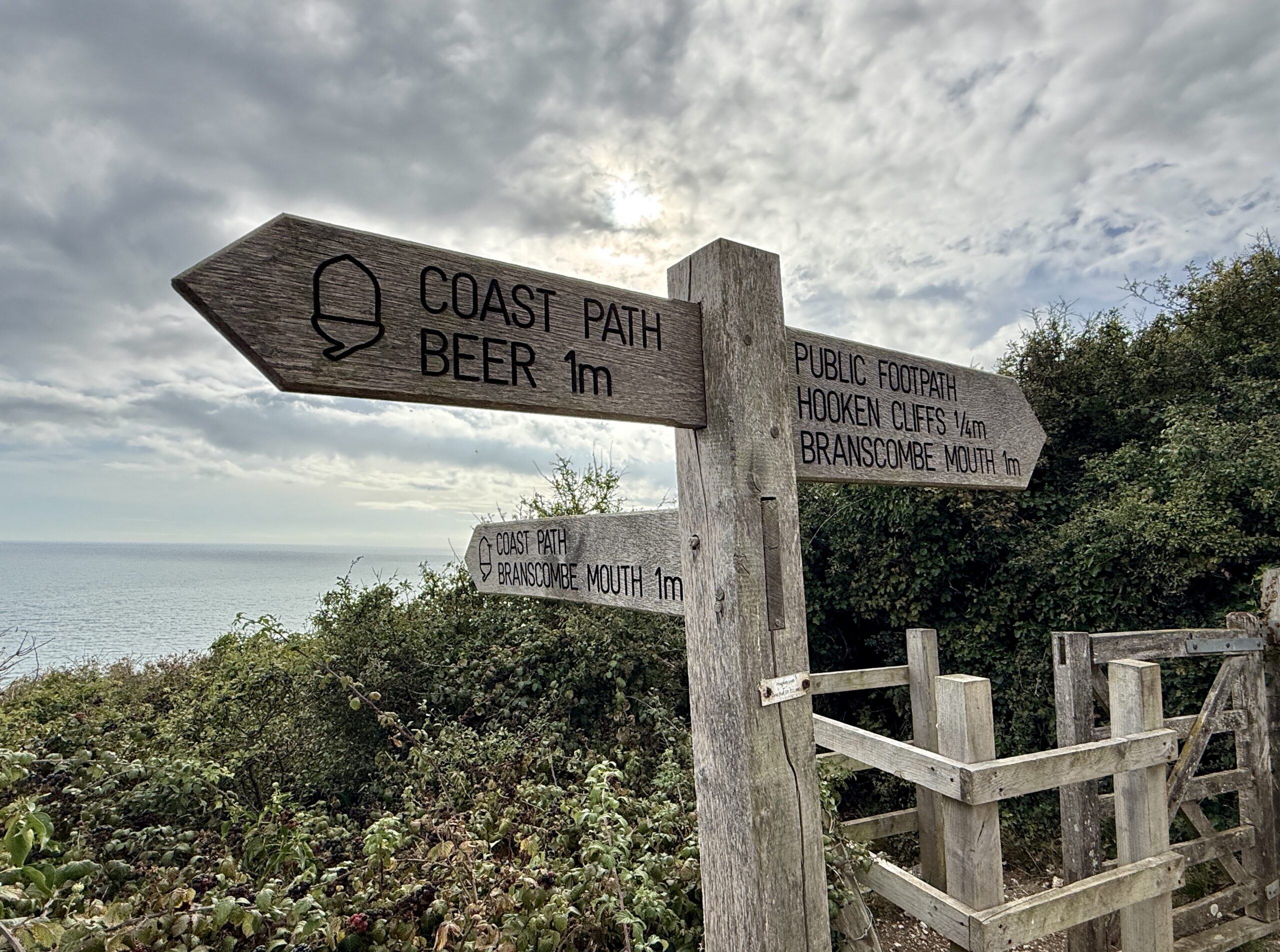
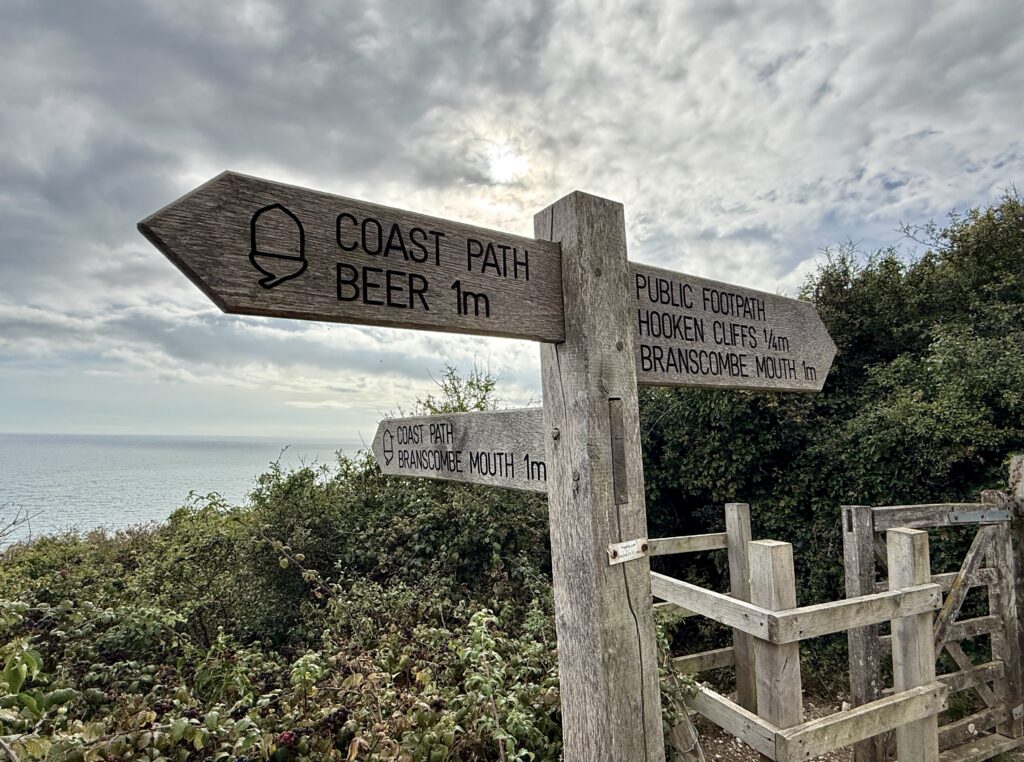
Coast path choices between Beer, Branscombe and Hooken Cliffs. (Credit: ThisIsSouthWest)
Continuing west, you reach the walk’s most important junction.
The path to the left descends towards Hooken Undercliff and Hooken Beach. Continuing straight ahead (signposted Hooken Cliffs and Branscombe Mouth) keeps you on the upper clifftop route towards the lookout and Branscombe.
At the time of our latest visit, the South West Coast Path through the lower undercliff towards Branscombe was closed following landslips and subsidence during the winter of 2025/26. The upper route provides a clear and straightforward alternative for the main Beer to Branscombe walk.
However, Hooken Undercliff and Hooken Beach remain well worth exploring as a separate detour.
Hooken Undercliff
The steep path through Hooken Undercliff to Hooken Beach. (Credit: ThisIsSouthWest)
Hooken Undercliff is one of the most remarkable parts of the East Devon coast.
A huge cliff collapse in 1790 created the landscape, when about ten acres of chalk slipped towards the sea. Great blocks and pinnacles of chalk were left standing while the fallen ground between them gradually became covered with trees, shrubs and coastal plants.
The result is quite unlike the open fields above. The path descends into a sheltered and almost hidden landscape, with pale cliffs and chalk pinnacles rising through the vegetation.
It is beautiful, slightly mysterious and much more dramatic than the word “landslip” might suggest. The sheltered conditions also provide valuable wildlife habitat, helping explain its designation as a Site of Special Scientific Interest.
One of the most striking formations is the Pinnacle, a tower-like section of chalk left standing when the surrounding cliff moved.
The path down is steep, stepped and uneven. It is considerably harder on the way back up, but we think the landscape is worth the extra effort if time and conditions allow.
Hooken Beach
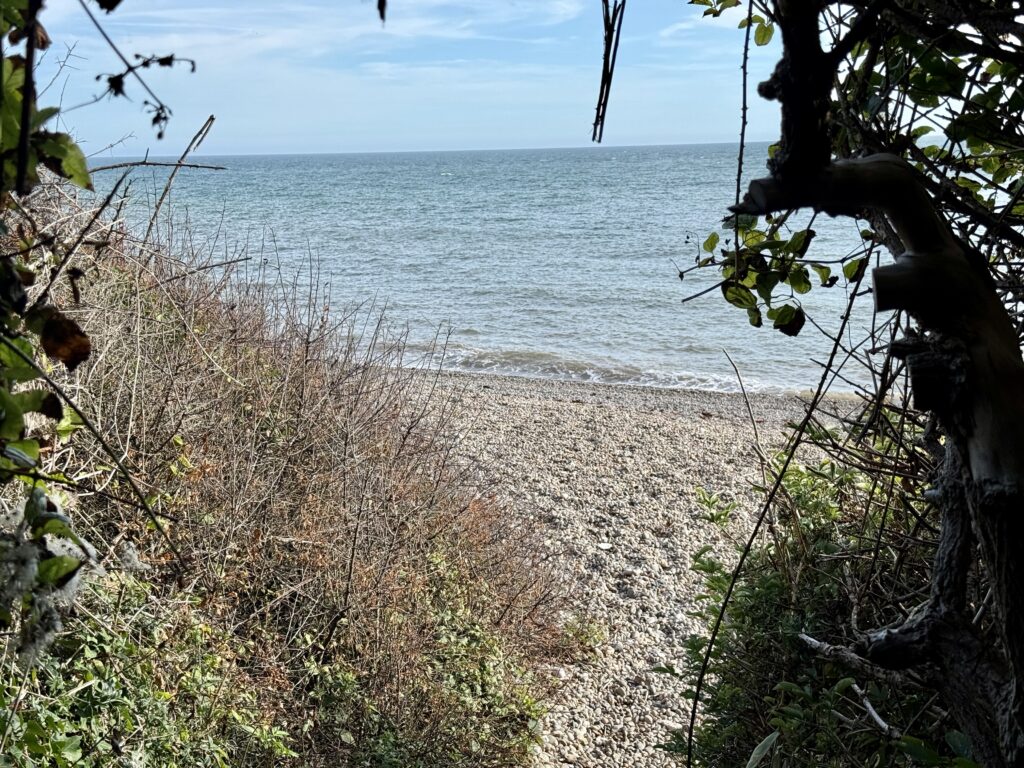
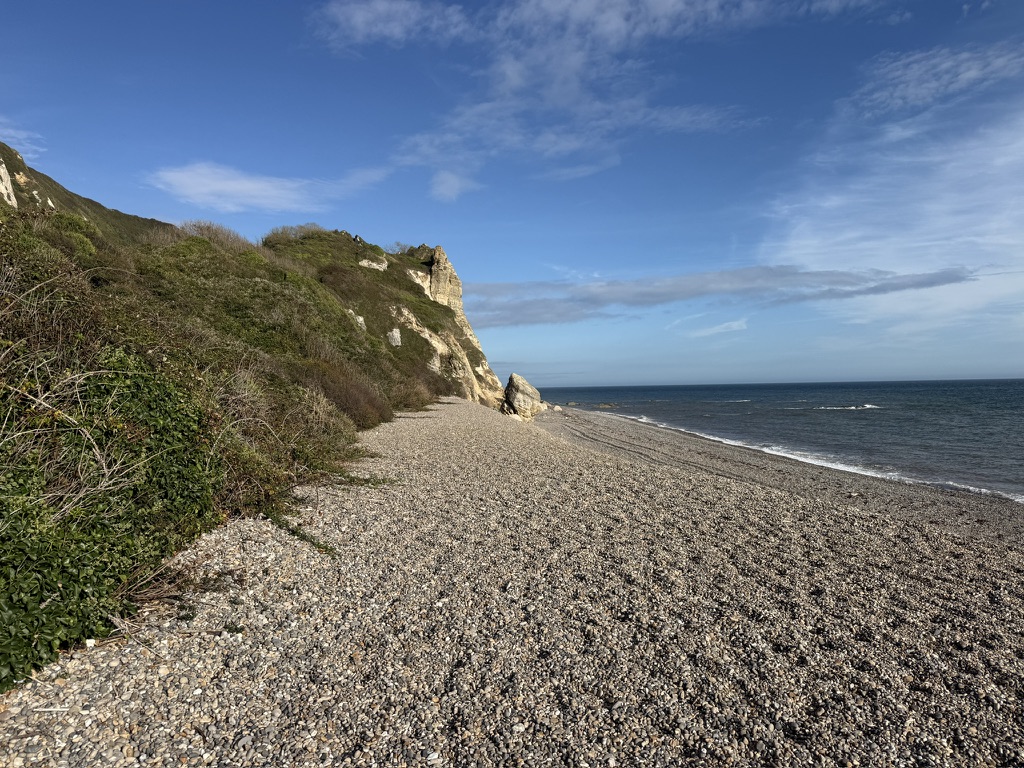
A secluded glimpse of Hooken Beach. (Credit: ThisIsSouthWest)
At the bottom lies Hooken Beach, a wonderfully quiet stretch of shingle beneath the white cliffs.
It feels far removed from the busier beaches at Beer and Branscombe. There are no cafés, toilets or other facilities, and it is quite possible to have much of the beach to yourself.
Access to Hooken Beach remains possible, but visitors should watch the tide and allow enough time for the steep climb back to the clifftop.
People do walk west along the shingle towards Branscombe, and we have done so ourselves in the past. However, warning signs now highlight the danger of rockfalls and further landslips, even when walking closer to the sea at low tide.
For that reason, we don’t recommend using the beach as the route to Branscombe. Conditions can change, the cliffs remain unstable, and the rising tide can reduce the available space. The safer choice is to enjoy Hooken Beach, then return up the same path and continue along the upper clifftop route.
The Lookout Tower and Signal House
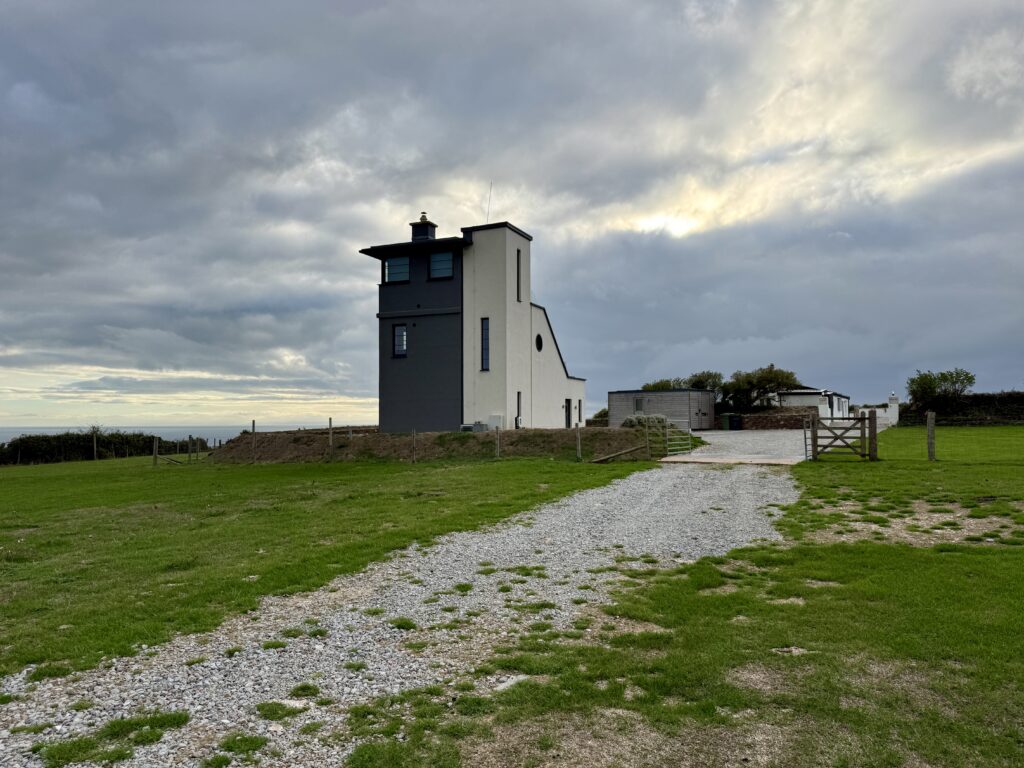
The Lookout Tower occupies a secluded position on Beer Head. (Credit: ThisIsSouthWest)
Back at the junction, continue straight ahead across the clifftop. The route climbs gently before levelling out near the lookout.
The Lookout Tower has a fascinating history. It developed from an 18th-century Napoleonic signal station and later became a 19th-century observation post used in attempts to control smuggling. It subsequently served as a coastguard lookout before being converted into private self-catering accommodation.
Nearby, the Signal House has also had several lives. It appears to have been used for livestock before becoming a coastguard and signal building and later a Customs and Excise house.
Its exact age remains uncertain. During renovation, musket balls, coastguard buttons and large blocks of local Beer stone were discovered. Stories that it dates from around 1600 or stands upon much earlier foundations remain intriguing but unproven.
Both buildings now offer private, self-catering accommodation, so walkers should stay on the public path and respect guests’ privacy.
The Lookout Tower and its near neighbour, the Signal House, may appeal to anyone searching for an unusual place to stay on Beer Head, with panoramic views across the surrounding coast and countryside.
Across the Clifftops Towards Branscombe
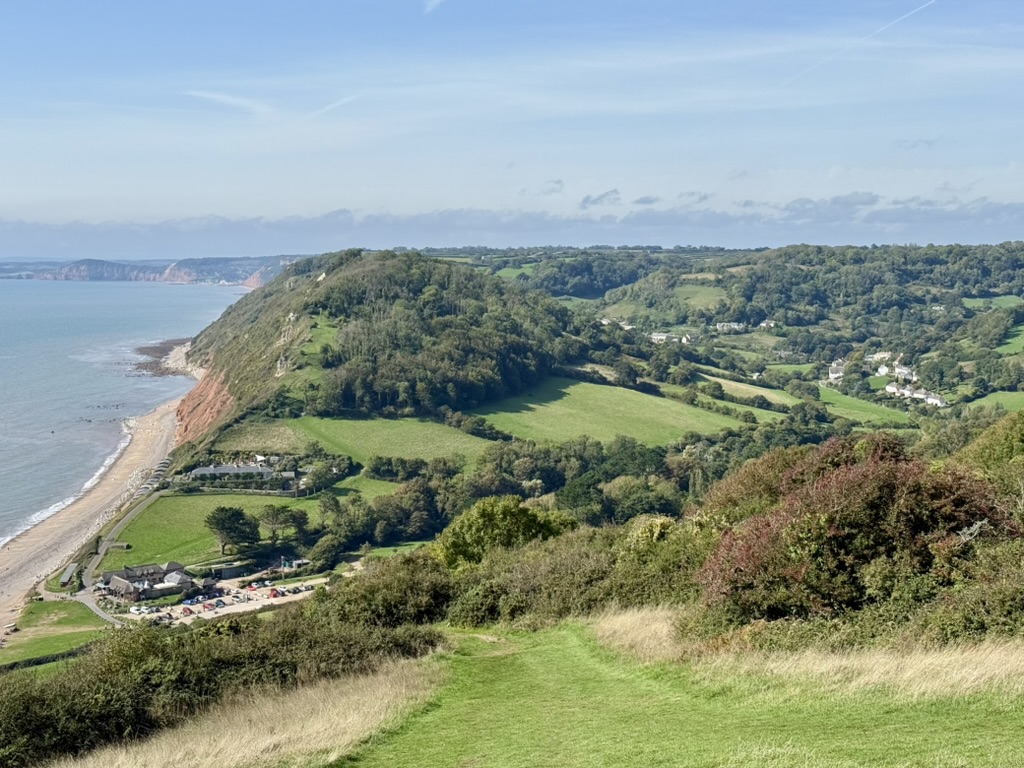
Branscombe Beach and village from the path down East Cliff. (Credit: ThisIsSouthWest)
Beyond the lookout, the path continues west across open fields. After the earlier climbs, this section feels wonderfully easy.
The route is largely level, the path is clear, and the sense of space is enormous. Sheep or cattle may be grazing in the adjoining fields, so keep dogs on leads.
Pass through the gate and continue towards East Cliff. Branscombe Beach gradually appears below, with the village stretching inland along its green valley.
Benches near the top provide a fine place to stop. The view looks across Branscombe Beach and west towards Sidmouth, with even more of the coastline visible in exceptionally clear weather.
Anyone who wants a shorter walk can turn around here. You will avoid the steep descent into Branscombe while still enjoying Beer Head and most of the clifftop views.
We think Branscombe is worth the additional effort, but there is no shame in saving your legs for another day.
Descending East Cliff
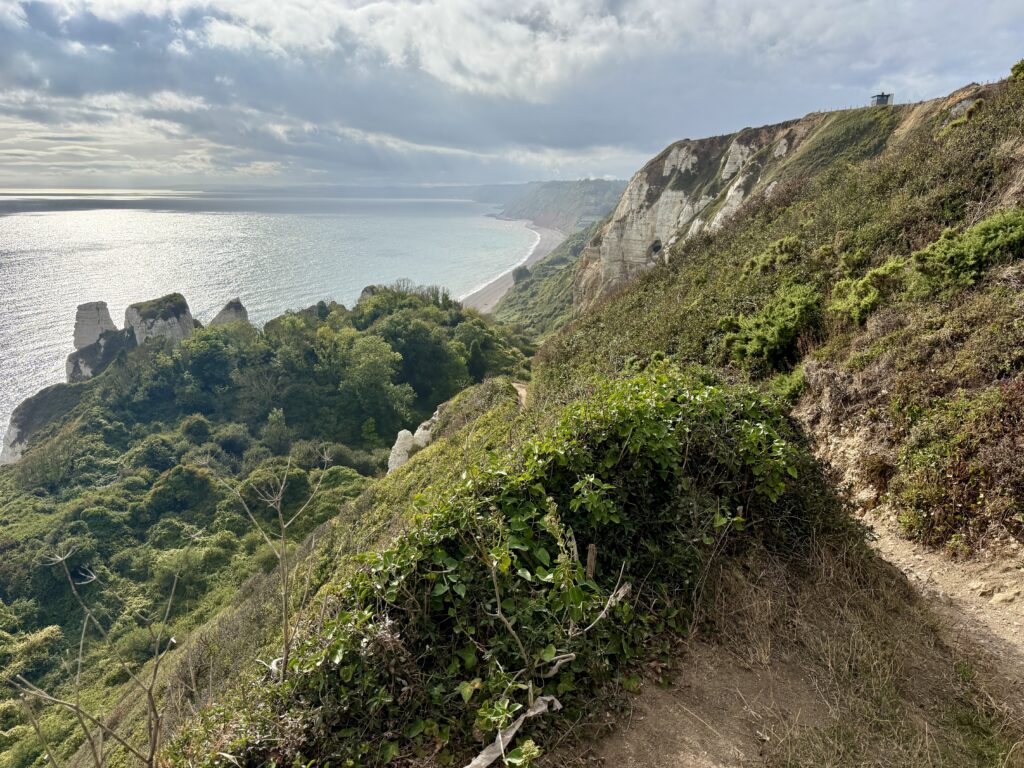
Descending East Cliff on the Beer to Branscombe walk. (Credit: ThisIsSouthWest)
The path now drops steeply down East Cliff towards Branscombe Beach.
This is the steepest section of the Beer to Branscombe walk, with a sharply descending path and several flights of steps. The route is easy to follow, but the ground can become muddy and slippery during winter, so take particular care when it is wet.
A few more benches line the descent, offering places to rest and enjoy the view.
If you return to Beer on foot, remember you will need to regain this height. The climb back up East Cliff is short but sharp, and children may find it challenging.
At the bottom, the path reaches Branscombe Beach close to the Sea Shanty Beach Café.
Branscombe Beach and the Napoli Anchor
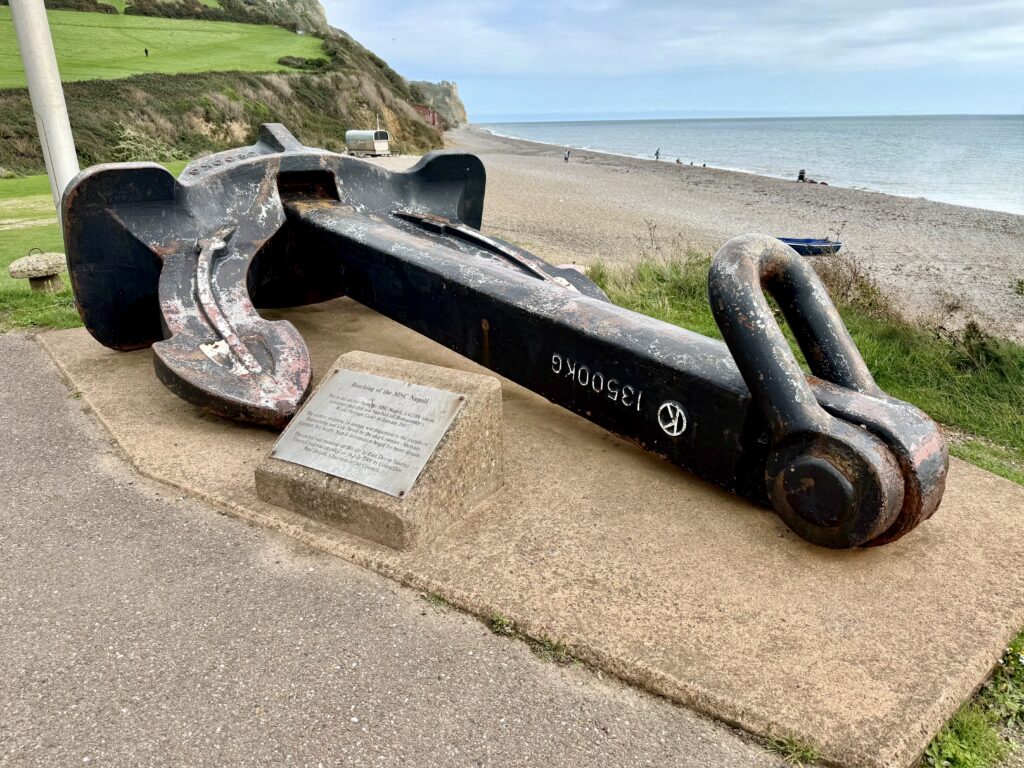
The MSC Napoli anchor overlooking Branscombe Beach. (Credit: ThisIsSouthWest)
Branscombe Beach is a long shingle beach backed by low cliffs and the entrance to the village valley.
Near the Sea Shanty stands an anchor associated with the MSC Napoli. The cargo ship got into difficulty during severe weather in January 2007 and was deliberately grounded off Branscombe to prevent it from sinking in deeper water.
More than 100 containers were lost, and items ranging from car parts and motorcycles to everyday household goods washed ashore. The incident briefly turned this quiet Devon beach into the focus of national attention.
Today the anchor provides a reminder of one of the most extraordinary episodes in Branscombe’s recent history.
Exploring Branscombe
The Masons Arms, Branscombe (Credit: ThisIsSouthWest)
It would be a shame to reach Branscombe and immediately turn around.
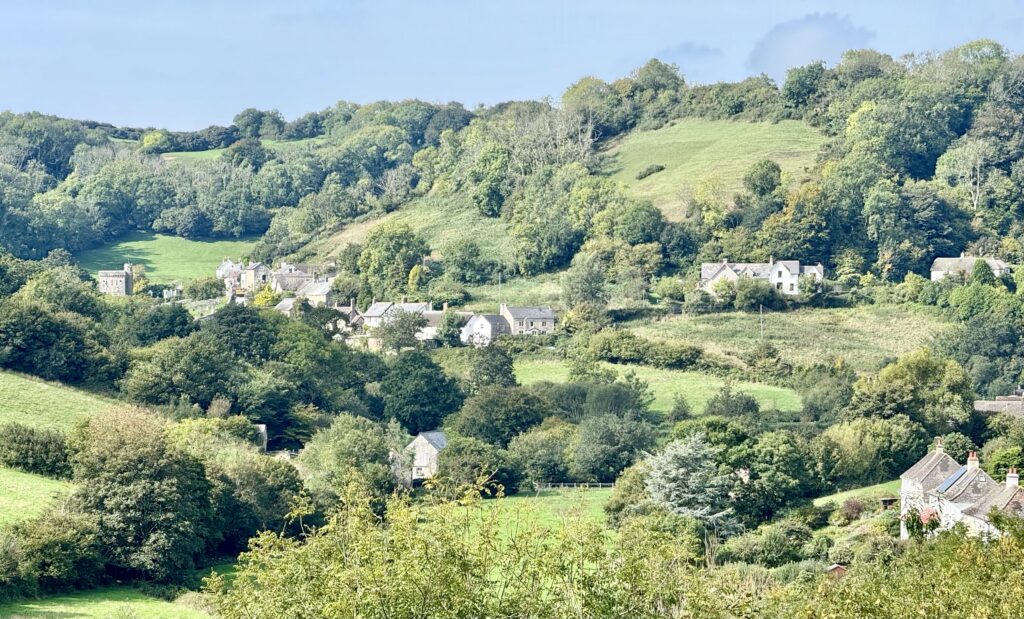
The village has a peaceful, timeless quality quite different from Beer. The National Trust cares for much of the surrounding land, and historic buildings are scattered along the valley rather than concentrated around a single centre.
From the beach, a gentle footpath follows the valley inland. Along the way you can visit Manor Mill, the Old Bakery and Branscombe Forge.
Manor Mill is the only surviving working mill of the three that once served the village. The Old Bakery was Devon’s last traditional working bakery, closing in 1987, and some of its historic baking equipment has been preserved.
Branscombe Forge is believed to be England’s only working thatched forge. When open, visitors can see the blacksmith at work and browse locally made ironwork.
For refreshments, the Sea Shanty is the most convenient choice beside the beach. The Masons Arms is the nearest village pub, while the Fountain Head lies farther up the valley.
Opening arrangements can be seasonal, so check before planning the day around a particular café or attraction.
Branscombe’s scattered cottages and church sit within its deep green valley. (Credit: ThisIsSouthWest)
There are several ways to return to Beer.
Walk Back Over Beer Head
The most scenic option is to climb East Cliff and retrace the outward route across Beer Head.
The Branscombe to Beer coastal walk follows the same spectacular clifftop route in the opposite direction.
We particularly recommend this route for anyone starting in Branscombe. Descending towards Beer provides a memorable view over the village and its sheltered beach.
Return via the Lookout Bridleway
On our walk, we climbed East Cliff and retraced the clifftop route to The Lookout.
Here, we turned left onto a bridleway and access track leading inland to the small informal car park at the very top of Common Hill. From the car park, follow Common Hill downhill, past Beer Head Holiday Park, and return to the centre of Beer.
This version of the walk measuredjust over 4 miles and included approximately 800 feet of ascent. Without stops, you could do it in just over 2 hours, about an hour each way.
Allow at least three hours at a comfortable pace. If you explore Branscombe, stop for lunch or spend time on the beaches, this can easily become a full day out.
Return by Bus
The Axe Valley 899 bus links Beer and Branscombe as part of its route between Seaton and Sidmouth.
In Beer, the bus stops near the village shop. In Branscombe, it stops beside the village hall and car park. We have used the service ourselves and find it a useful option for turning the walk into a one-way journey.
The service is limited, and timetables can change, so check return times before you start.
Make It a Circular Walk
A longer inland return is possible using paths around Stockham’s Hill and Mare Lane.
This creates a fuller circular walk, although it misses the pleasure of crossing Beer Head again.
Walking from Branscombe to Beer
Hooken Undercliff and the coast towards Branscombe. (Credit: ThisIsSouthWest)
The Branscombe to Beer walk is equally enjoyable.
We normally park behind Branscombe Village Hall, EX12 3DB, where parking is by donation. From here, it is roughly half a mile down the valley to Branscombe Beach. The pleasant route passes close to the Old Bakery and Manor Mill, with the Masons Arms also nearby.
The walk can include the Old Bakery, Manor Mill and, with a short variation, the Masons Arms. It is a lovely introduction to the village before tackling the coast path.
A paid ANPR-controlled car park is also available beside Branscombe Beach. The lane leading to it is narrow and can feel tortuous when traffic is busy, particularly during summer. For this reason, we generally prefer the village hall car park.
From Branscombe Beach, the path up East Cliff is obvious. The climb is a short, sharp shock, but once you reach the top, the route becomes considerably easier.
Starting in Beer means a longer but generally gentler climb. Starting in Branscombe gets you over the steepest ascent quickly. We find it difficult to recommend one direction over the other because the views and sense of space are wonderful either way.
How Difficult Is the Beer to Branscombe Walk?
We consider this a moderate walk.
Common Hill is the hardest sustained climb, while East Cliff is the steepest individual section. Most of the clifftop route is comparatively easy and should be manageable for reasonably active walkers.
The main path is well signed and difficult to lose. Look out for the left turn from Common Hill into Little Lane and, farther along, the junction for Hooken Beach.
With the lower through-route closed, walkers continuing to Branscombe should remain on the upper clifftop path.
Walking With Children
The route should suit active children who are comfortable walking uphill.
The return climb up East Cliff may be tiring, so allow extra time and breaks. The main clifftop path is wide and much of it is fenced, but children should still be supervised around cliff edges.
The full route is unsuitable for pushchairs because of steep slopes, steps, gates and uneven ground.
Walking With Dogs
This is an enjoyable dog-friendly walk.
Keep dogs on leads around sheep and cattle, and under close control near cliffs. Carry water in warm weather, and remember the Hooken Beach detour includes steep steps in both directions.
Footwear and What to Bring
We have walked between Beer and Branscombe in both winter and summer. Our most recent visit was in September, with sunny spells, comfortable temperatures and dry ground.
In settled summer weather, supportive everyday shoes may be sufficient. In winter, we recommend proper walking boots because the paths can become muddy and slippery.
Beer Head and the clifftops are exposed, with very little shelter from wind or rain. Bring clothing appropriate to the forecast and consider carrying an extra layer even when conditions seem pleasant in the villages.
Apart from water, you need little specialist equipment. If making a day of it, take whatever you need at the other end, perhaps beachwear, a picnic or warmer clothing. Food and drink are available in both villages, but some businesses open seasonally.
Mobile reception can be poor beneath the cliffs and around Branscombe Valley.
Weather and Tide Times in Beer, Devon
Beer has a mild coastal climate, although the exposed cliffs around Beer Head can be much windier than the sheltered village. Check the latest Beer Beach forecast from the Met Office or BBC Weather before travelling, particularly when planning a coastal walk.
Tide Times for Beer Beach
Tide predictions for Beer Beach are based on Lyme Regis, the nearest reporting station, approximately seven miles away. Actual times, heights and conditions at Beer may vary slightly.
Check the tide for swimming, rockpooling and fishing, but never rely on it to make the shoreline route towards Branscombe safe. The cliffs beyond Hooken Beach are unstable, so walkers should use the open route over Beer Head.
Is the Beer to Branscombe Walk Worth Doing?
Quiet and unspoilt Hooken Beach below the undercliff. (Credit: ThisIsSouthWest)
Absolutely.
The walk combines two contrasting villages with some of the finest coastal scenery in East Devon. It offers open clifftops, white chalk cliffs, quiet beaches, ancient archaeology, military history, and the remarkable landscape of Hooken Undercliff.
Beer is the busier village, with shops, fishing boats, and plenty of places to eat. Branscombe is quieter, greener and wonderfully timeless.
If you do nothing else, walk from either village to Beer Head. On a clear day, the views are stunning, and we promise they make the climb worthwhile.
Those who want an easier outing can turn around on the clifftop and retrace their steps. Ideally, though, allow enough time to visit both Beer and Branscombe. The walk is best when treated as a full day out rather than simply a route between two points.
Beer to Branscombe Walk FAQs
Practical answers about the Beer to Branscombe coastal walk, including its distance, difficulty, parking, bus service and the current route around Hooken Undercliff.
How far is the Beer to Branscombe walk?
The direct coastal route between Beer and Branscombe is approximately two miles each way. Our return route, using the bridleway near the Lookout Tower and Common Hill on the final section, measured just over four miles.
How long does it take to walk from Beer to Branscombe?
Allow about one hour of continuous walking in each direction. Our complete return walk took just over two hours without stops. We recommend allowing at least three hours, or longer if you want to explore Branscombe, visit Hooken Beach or stop for refreshments.
Can you walk from Beer to Branscombe?
Yes. A clearly signed upper clifftop route connects Beer and Branscombe via Beer Head and East Cliff. Coastal landslips can affect the lower path through Hooken Undercliff, so follow current signs and local diversions.
Is the Beer to Branscombe walk difficult?
We rate the walk as moderate. Common Hill provides the longest climb, while East Cliff above Branscombe is much steeper but relatively short. Most of the clifftop section is comparatively level and easy to follow.
Which direction is easier?
Walking from Beer involves a longer but generally gentler climb. The Branscombe to Beer walk begins with a short, steep climb up East Cliff, after which the route becomes much easier. The views are rewarding in both directions.
Is Hooken Undercliff open?
Hooken Undercliff and Hooken Beach remain accessible as a there-and-back detour from the clifftop. However, the onward lower coast path towards Branscombe was closed because of subsidence during our latest visit. Walkers continuing to Branscombe should follow the signed upper route and check current conditions.
Can you walk along Hooken Beach to Branscombe?
People do walk west along the shingle towards Branscombe, and we have done so in the past. However, warning signs highlight the risk of rockfalls, unstable cliffs and changing tides. We therefore recommend returning to the clifftop and using the signed upper path.
Is Hooken Beach worth visiting?
Yes. Hooken Beach is a beautiful and usually quiet stretch of shingle beneath the white cliffs. The steep path also passes through the remarkable Hooken Undercliff, formed by a major landslip in 1790. There are no facilities at the beach.
Is the Beer to Branscombe walk dog friendly?
Yes. Dogs are welcome, but they should be kept on leads around sheep and cattle and under close control near cliff edges. Carry water for your dog during warm weather.
Is the walk suitable for children?
The route should suit active children who are comfortable walking uphill. The climb back up East Cliff can be tiring, so allow extra time and supervise children carefully around the cliffs.
Where can I park for the Beer to Branscombe walk?
In Beer, we usually use Clapps Lane car park, EX12 3EN. Cliff Top Long Stay Car Park, also known as Beer Head Car Park, EX12 3AQ, provides a shorter starting option that avoids the steep climb up Common Hill. In Branscombe, donation parking is available behind Branscombe Village Hall, EX12 3DB.
Is there a bus between Beer and Branscombe?
Yes. The Axe Valley 899 bus connects the villages, stopping near the village shop in Beer and beside Branscombe Village Hall. Services are limited, so check the current timetable before starting a one-way walk.
Over to you … have you recently travelled to South West England? What worked for you? What advice would you give to others? Please leave your comments below or join in the discussion in our Facebook Group.
New to South West England or returning after a while? Start with our ‘Travel Basics’ – quick guides packed with tips to help you plan your trip.
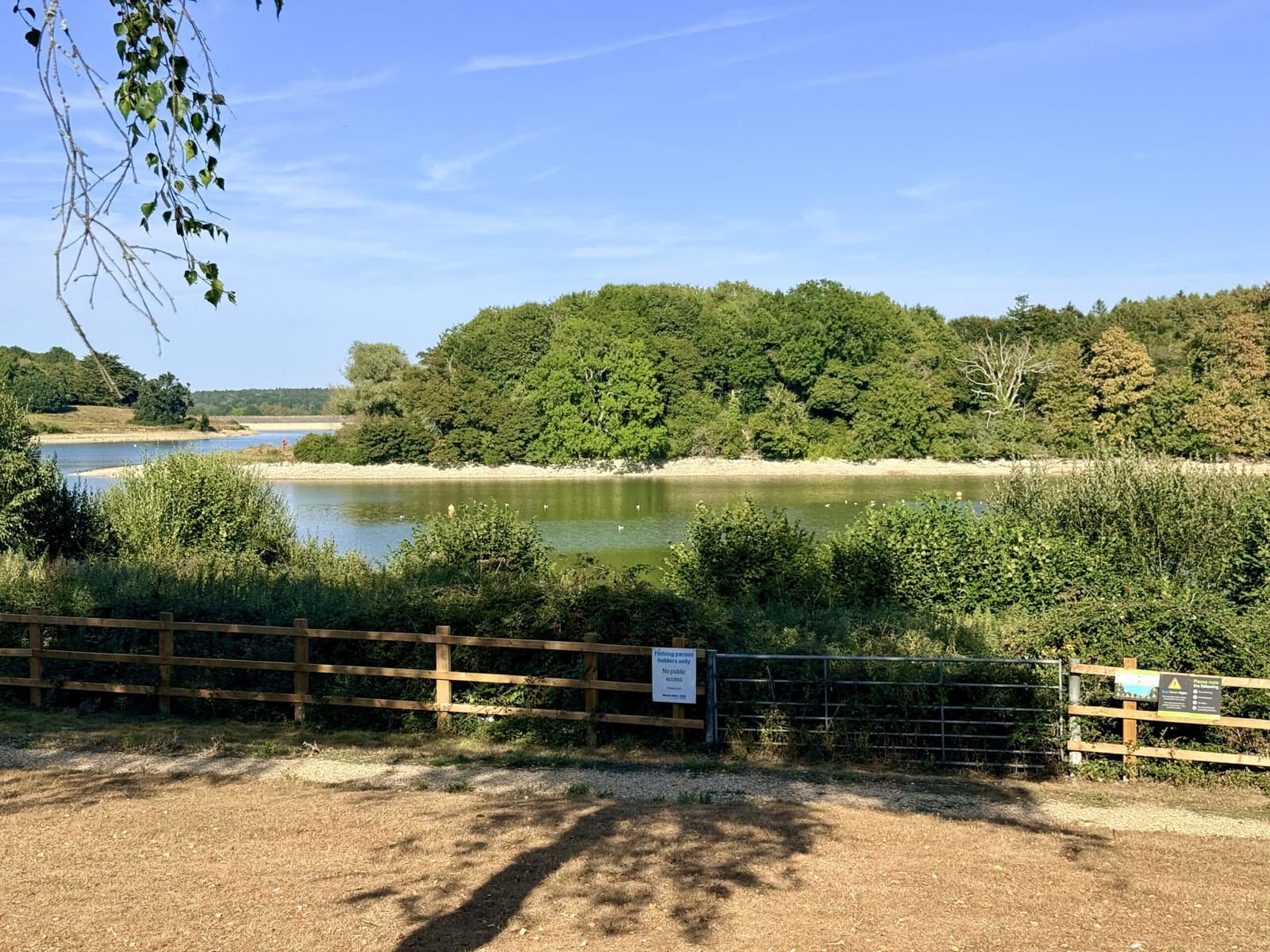
Sutton Bingham Reservoir near Yeovil. (Credit: ThisIsSouthWest)
Sutton Bingham Reservoir is a peaceful place to walk, picnic and enjoy the countryside just a few miles south of Yeovil in Somerset. There is free parking, a children’s play area, toilets, picnic tables and a short Meadow Trail beside the water, while fishing, sailing and paddlesports also take place on the reservoir.
We first noticed Sutton Bingham Reservoir on a map and, despite living relatively nearby, had never visited. So, on a hot weekday afternoon in August, we went to explore.
What we found was a surprisingly attractive and well-maintained place that was remarkably quiet. We walked the Meadow Trail, spent some time beside the water and discovered somewhere we would happily return to simply for a picnic, to read, or even to sit at one of the shaded tables and get some work done.
Sutton Bingham Reservoir at a Glance
Important sat nav information
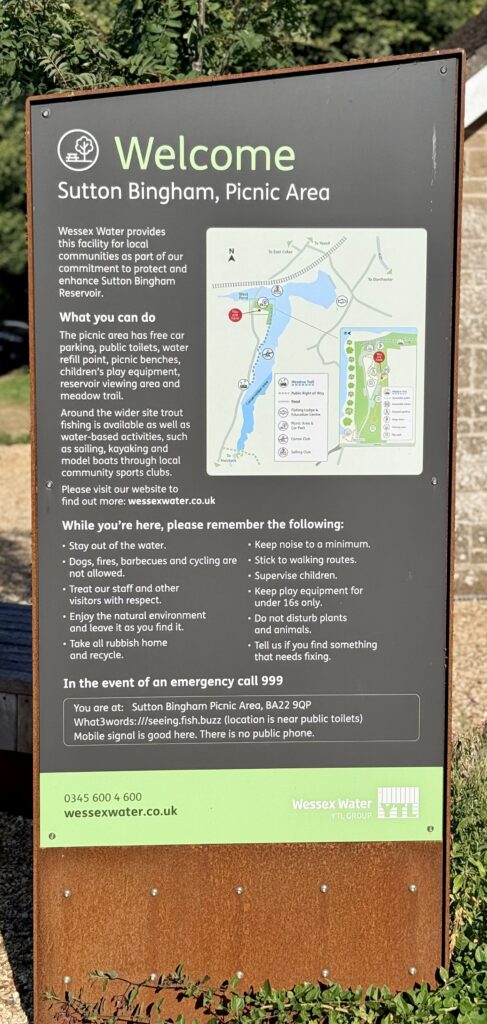
For general visits, enter Sutton Bingham Picnic Area, BA22 9QP. Do not simply search for “Sutton Bingham Reservoir”, as your sat nav may direct you to the separate Fishing Lodge on the opposite side of the water, which is not open to general visitors.
Location: Around 15 minutes south of Yeovil, near the Somerset and Dorset border.
Best for: Picnics, reservoir views, a short countryside walk and quiet time beside the water.
Parking: Free parking at Sutton Bingham Picnic Area.
Walking: The signed Meadow Trail is approximately 2 km return. Allow at least one hour.
Accessibility: The picnic area and separate Meadow Viewing Area have accessible paths. The full Meadow Trail crosses uneven grass and is not suitable for most wheelchairs or pushchairs.
Facilities: Public toilets, picnic tables, benches, children’s play area, water refill point, bike racks and an accessible viewing area.
Food and drink: There is nowhere to buy refreshments, so bring drinks and preferably a picnic.
Dogs: Dogs are not permitted.
Water access: Swimming and unauthorised launching of boats, kayaks or paddleboards are prohibited.
Good to know: The reservoir has separate areas for fishing, sailing and paddlesports. Some paths and sections of shoreline are restricted to permit holders or club members.
Disclosure:Some of the outbound links on this page are affiliate links to sites that we use and would genuinely recommend. Using them doesn’t cost you extra, but it does help support this free guide. We also provide links to other sites that we believe may be helpful to you.
This is one part of the visit where our experience may save you some frustration.
Our sat nav initially took us to the wrong part of the reservoir, near the fishing lodge and education facilities rather than the main picnic area.
A very friendly Wessex Water warden pointed us in the right direction.
If approaching from the A30, we found it better to use the A37 Dorchester Road first, then turnonto Darvole Road for the picnic area.
Alternative sat nav routes can take you along some very picturesque Somerset lanes, but they can also be extremely narrow.
Parking when you arrive is both plentiful and free of charge.
For the picnic area, the visitor information displayed during our visit gave:
Sutton Bingham Picnic Area BA22 9QP
The general reservoir has other entrances and facilities, so using the correct destination rather than simply entering “Sutton Bingham Reservoir” into your sat nav is worthwhile.
Sutton Bingham Picnic Area
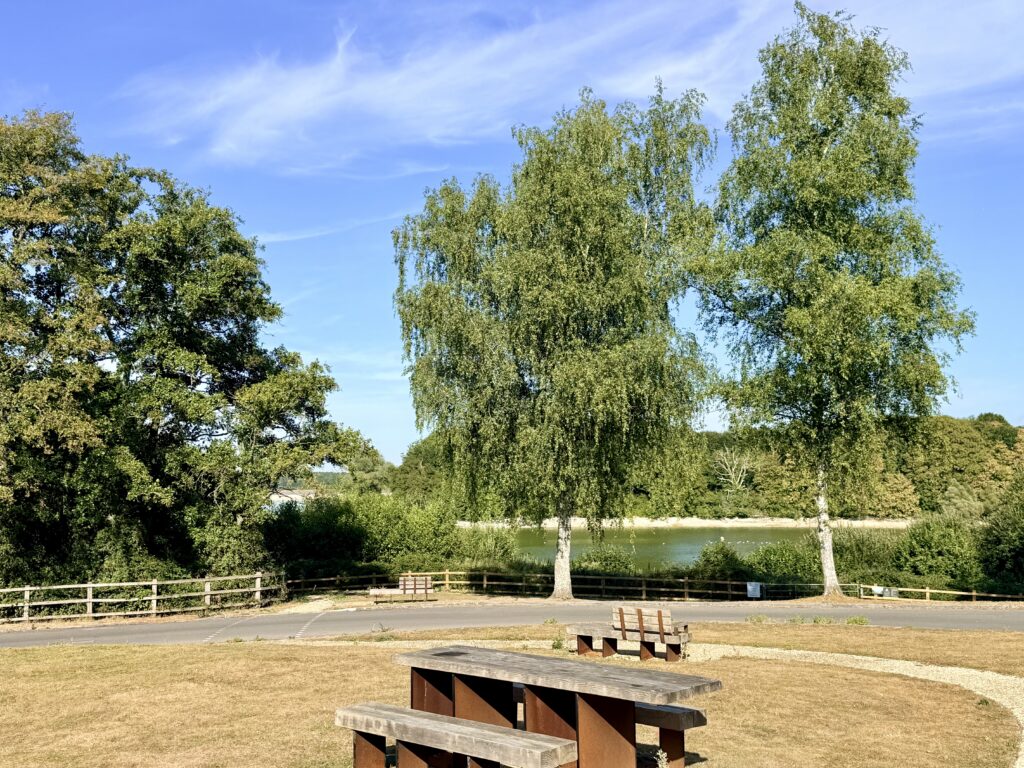
Picnic tables overlooking Sutton Bingham Reservoir through mature trees on a sunny day.
The picnic area was one of the nicest surprises of our visit.
There is plenty of space, with picnic tables and benches overlooking the reservoir and attractive countryside. On the hot afternoon when we visited, there were only a handful of cars in the car park and the whole place felt remarkably peaceful.
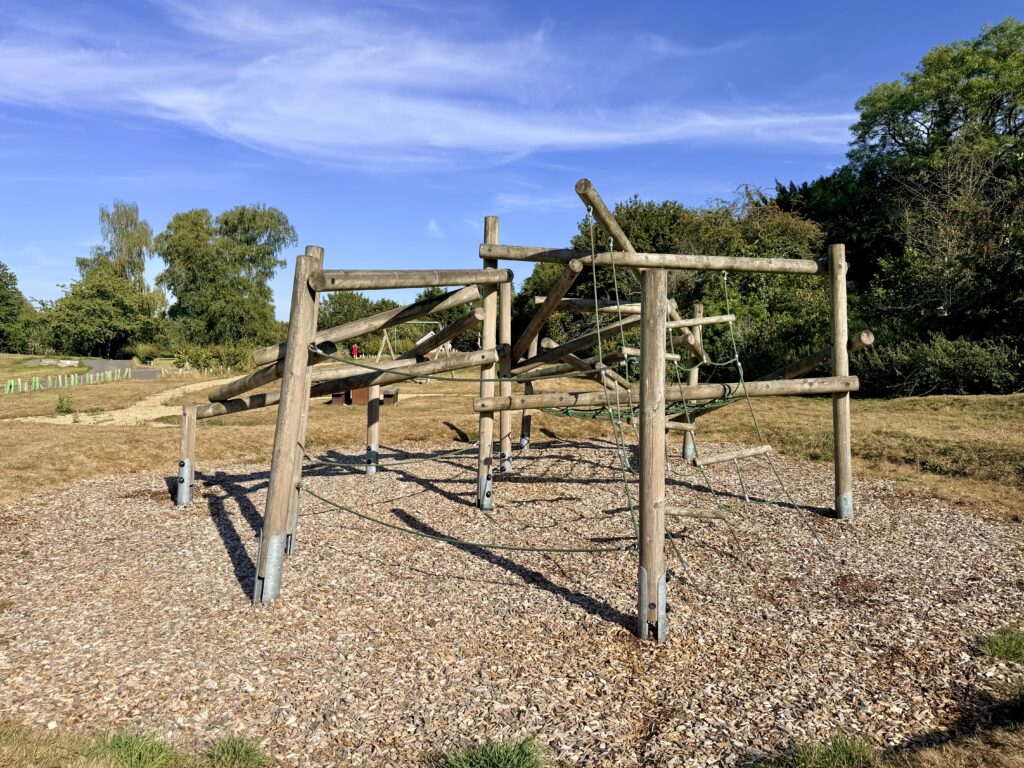
There is a good children’s play area rather than simply a token piece of play equipment. It includes wooden climbing and balancing structures, ropes and a large basket swing, spread across a grassy area.
The public toilets were clean when we visited, and perhaps unsurprisingly, given that this is a Wessex Water Reservoir, there is a handy water refill point, which we used.
There is nowhere at the picnic area to buy food or drinks, so we would recommend bringing at least something to drink and, better still, a picnic. This is somewhere that lends itself to lingering rather than rushing through.
There was a little distant road noise during our visit, but otherwise it felt rural and secluded, with birdsong providing much of the background noise.
Even if you don’t intend to walk, we think the picnic area is worth visiting simply to sit and enjoy the surroundings.
Walking at Sutton Bingham Reservoir
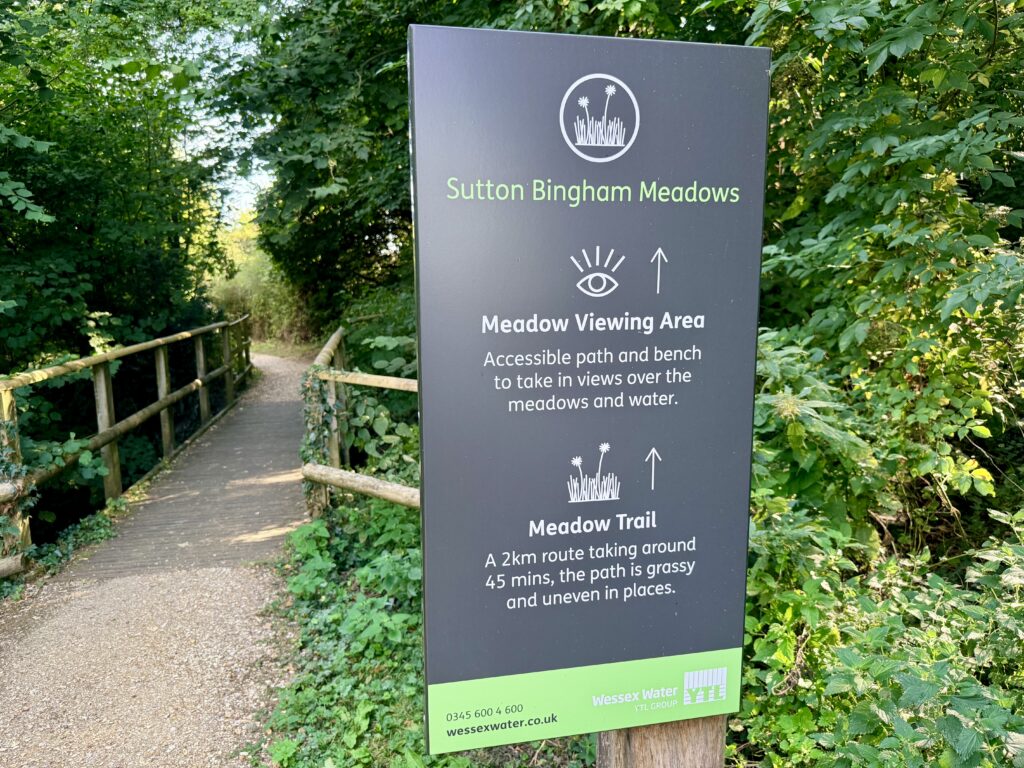
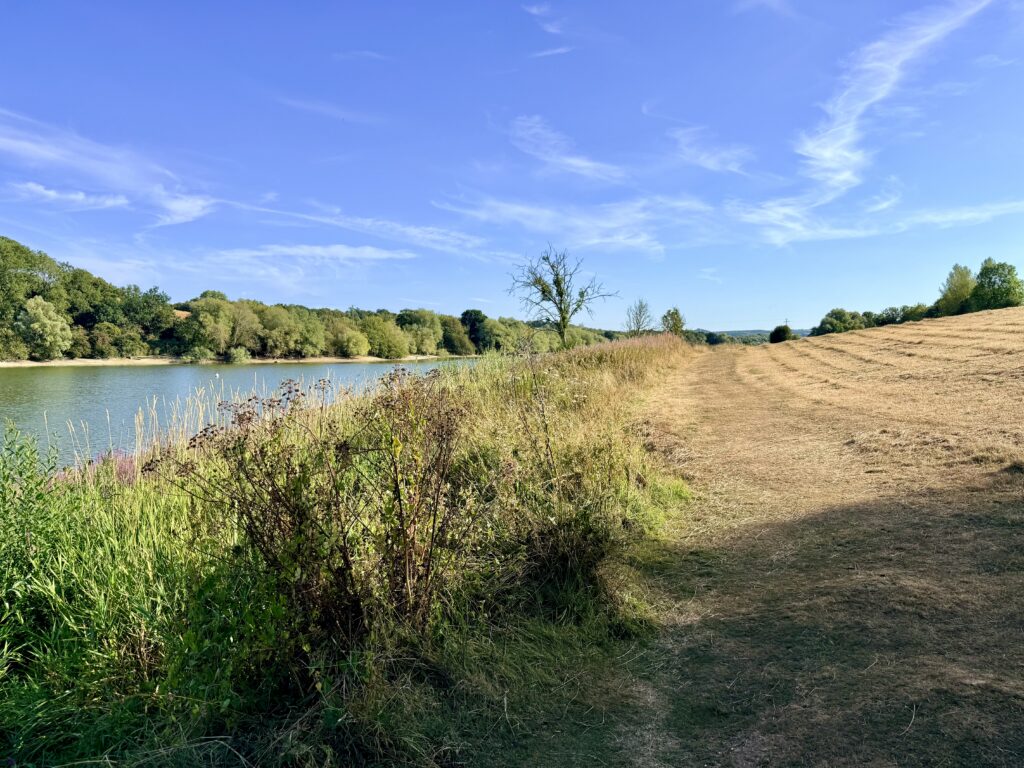
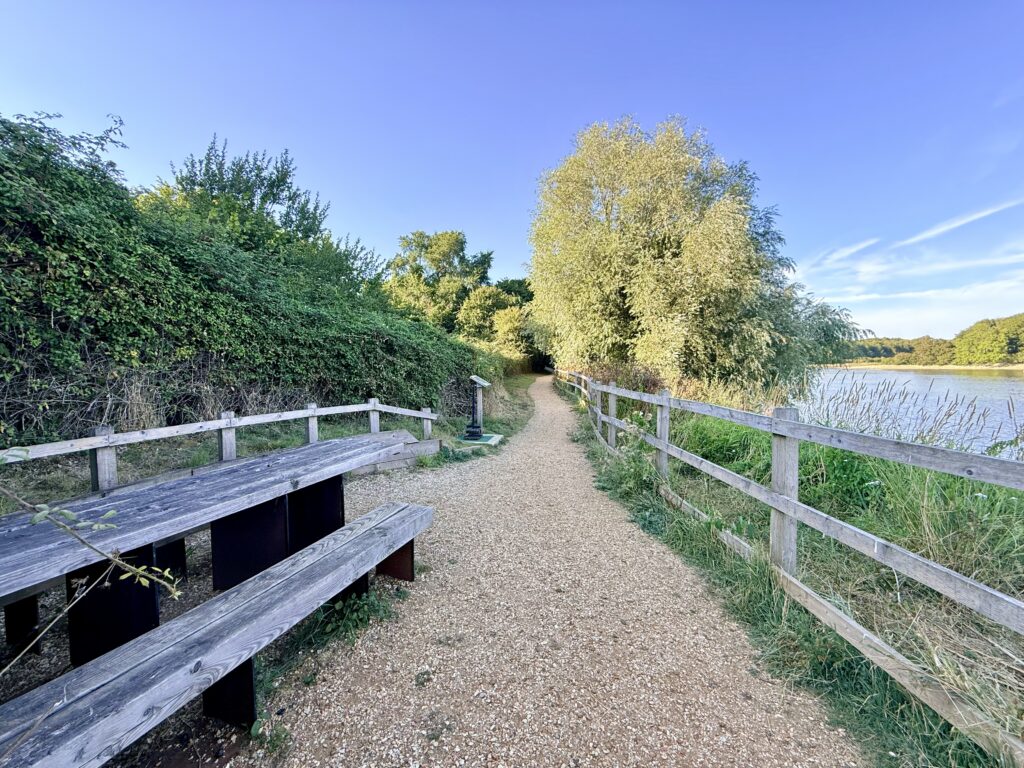
The accessible path and Meadow Trail at Sutton Bingham Meadows. (Credit: ThisIsSouthWest)
The main public walk from the picnic area is the Sutton Bingham Meadow Trail.
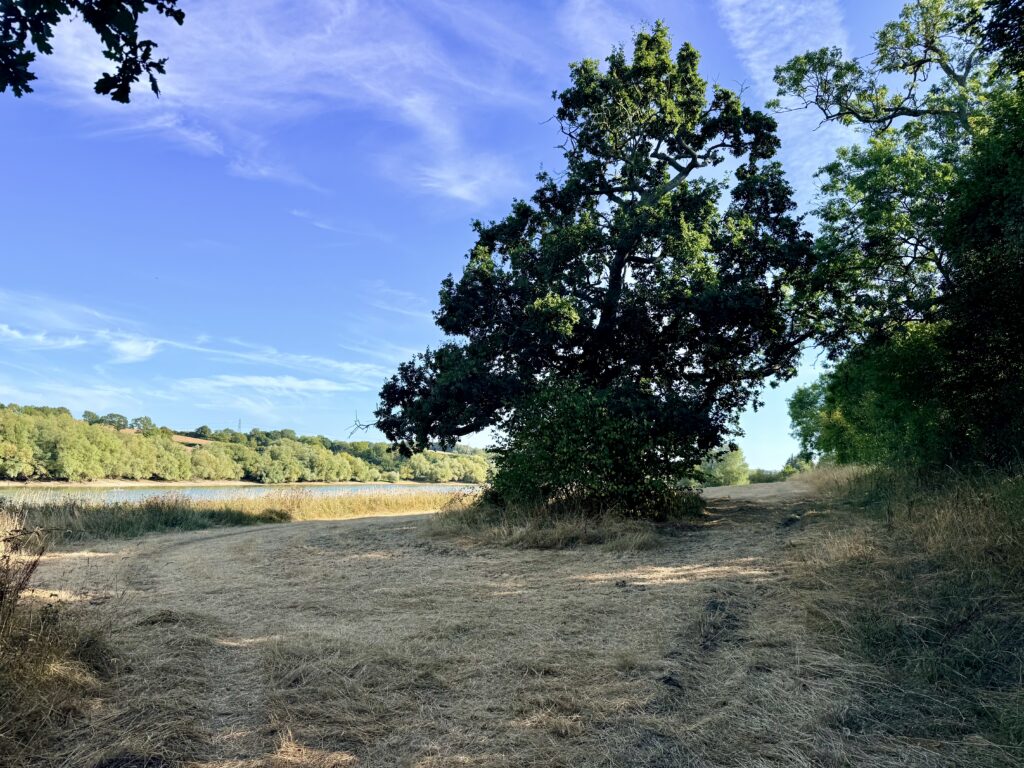
This follows the western side of the reservoir through a mixture of open meadow, grassy paths, gravel and small shaded sections.
One of the best things about the walk is how close you remain to the water for much of the route. There are frequent reservoir views rather than the frustrating experience of walking around a lake while barely being able to see it.
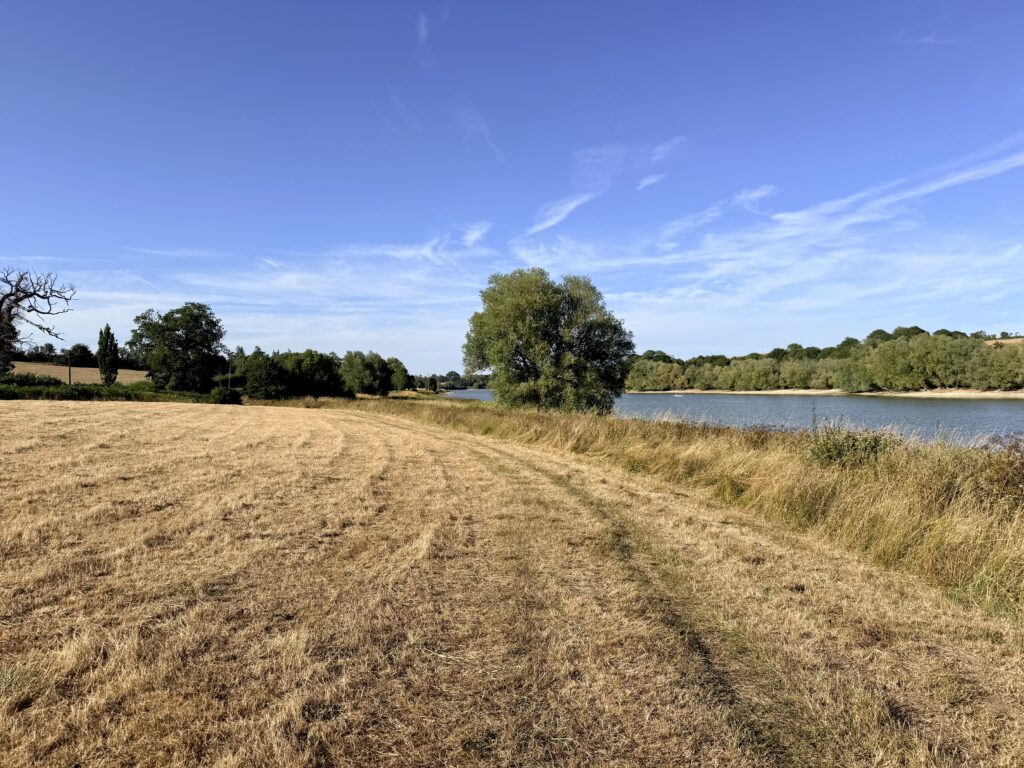
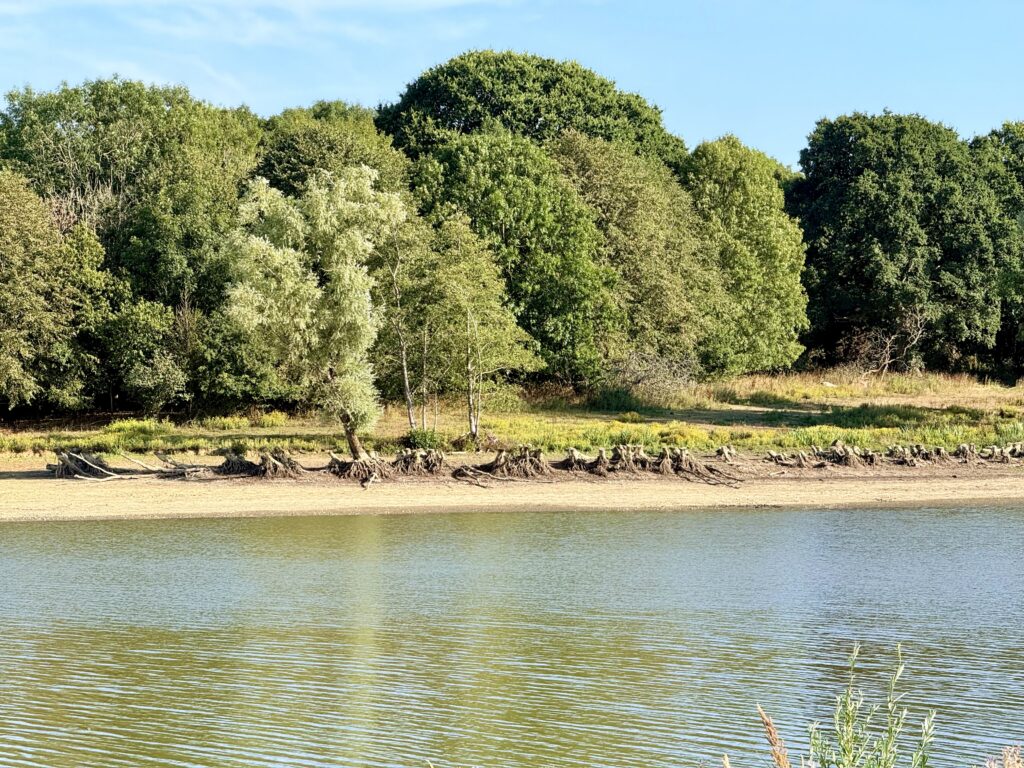
On our visit in August 2026, following a prolonged spell of hot, dry weather, the reservoir was noticeably low. This exposed substantial stretches of shoreline that resembled small beaches in places.
They looked tempting on a hot afternoon, but visitors should stay out of the water. Swimming is prohibited, and access to the reservoir is controlled.
We actually found the unusually low water level fascinating rather than disappointing. It gave us a different view of the reservoir and certainly didn’t detract from our visit.
The signed Meadow Trail is approximately 2 km for the return walk, with the outward section ending after around 1 km at the road.
Wessex Water suggests allowing around 45 minutes. We would allow at least an hour so that you have time to stop and enjoy the views.
The route is extremely easy to follow, and we didn’t encounter any significant hills or difficult sections.
However, don’t confuse an easy walk with an entirely accessible one. Parts cross grass and meadow, and the ground is uneven in places. It was completely dry during our summer visit, but we would expect some sections to become muddy during wet winter weather.
For that reason, we wouldn’t recommend the full Meadow Trail for wheelchairs or most pushchairs.
There is, however, a separate signed Meadow Viewing Area, reached by an accessible path, with a bench and views across the meadows and reservoir.
No. There isn’t a straightforward public circular walk around Sutton Bingham Reservoir.
This is important because looking at the reservoir on a map might give the impression that you could simply walk around its shoreline.
The public Meadow Trail naturally ends at a gate beside the road after approximately 1 km. A Wessex Water sign warns that the road beyond has no pavement and recommends returning to the picnic area.
We followed that advice and retraced our route, making the walk approximately 2 km in total.
It is possible to continue by road towards the Dorset village of Halstock, where there is a small village shop. However, local people also cautioned us against walking this way because the lane has no pavement and carries a 40 mph speed limit.
We therefore wouldn’t recommend incorporating Halstock into a walk from the reservoir.
Elsewhere around Sutton Bingham, sections of shoreline are private or restricted to anglers and other authorised users. This is a working reservoir rather than a country park with unrestricted access.
Wildlife at Sutton Bingham Reservoir
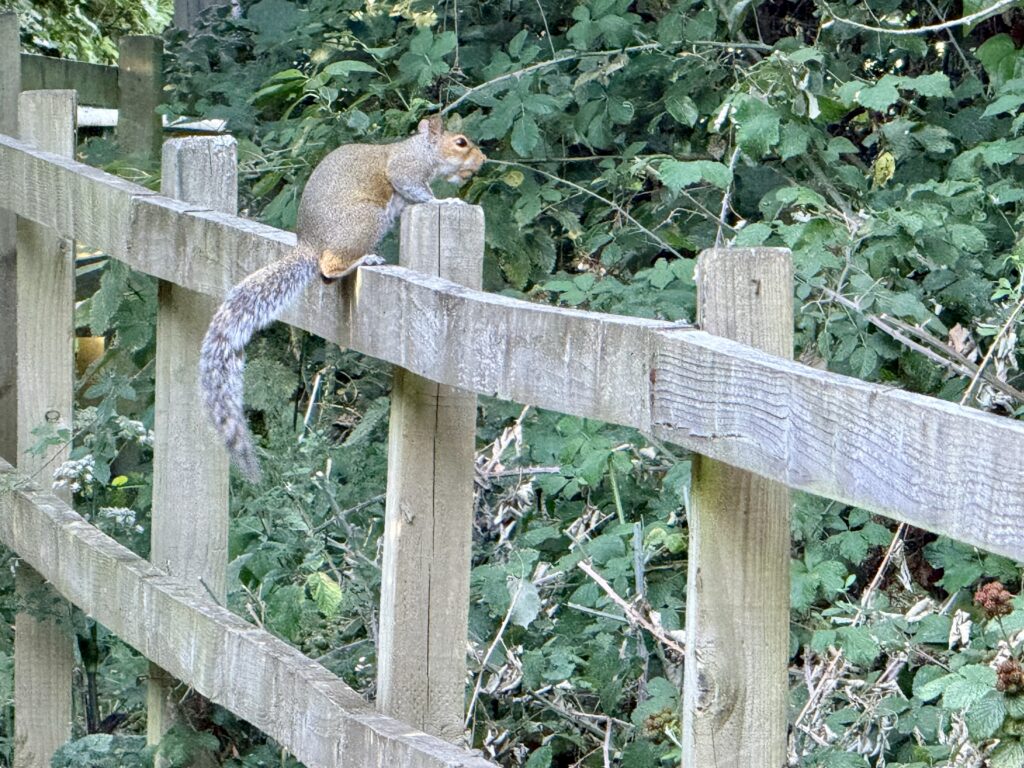
Squirrel on the Meadow Trail. (Credit: ThisIsSouthWest)
The reservoir and surrounding meadows are valuable wildlife habitats.
Wessex Water says the site supports more than 200 species of wildflowers and grasses, around 1,000 species of invertebrates and at least 88 species of birds.
Interpretation boards beside the trail explain how some of the grassland is managed as traditional hay meadow. Wildflowers support butterflies, bees and other insects, while the reservoir attracts resident and visiting waterbirds.
Sutton Bingham is also known for overwintering wildfowl and migrant birds, including occasional ospreys.
We’re certainly not expert birdwatchers, so we’ll leave identifying Sutton Bingham’s more interesting birds to those who are. During our own walk, we saw rabbits and squirrels and heard plenty of birdsong.
The relative tranquillity of the site is part of its appeal if you simply want to slow down and enjoy the countryside.
Visitors are also asked to help prevent the spread of invasive non-native species by cleaning footwear and equipment. Information boards around the reservoir highlight species including New Zealand pygmyweed, Himalayan balsam, giant hogweed and Japanese knotweed.
Fishing is an important recreational use of Sutton Bingham. Wessex Water manages both bank and boat fishing, with trout and coarse fishing available at different times of year. In 2026, the trout season ended in June, after which the reservoir reopened to coarse fishing for the remainder of the year.
The Fishing Lodge and some areas of shoreline are reserved for anglers and are not accessible to general visitors. We encountered signs stating “Fishing permit holders only. No public access.” A visible path or stretch of shoreline should not therefore be assumed to form part of the public walking route.
Check current seasons, permits, access arrangements and conditions with Wessex Water before travelling.
Kayaking, Canoeing and Paddleboarding
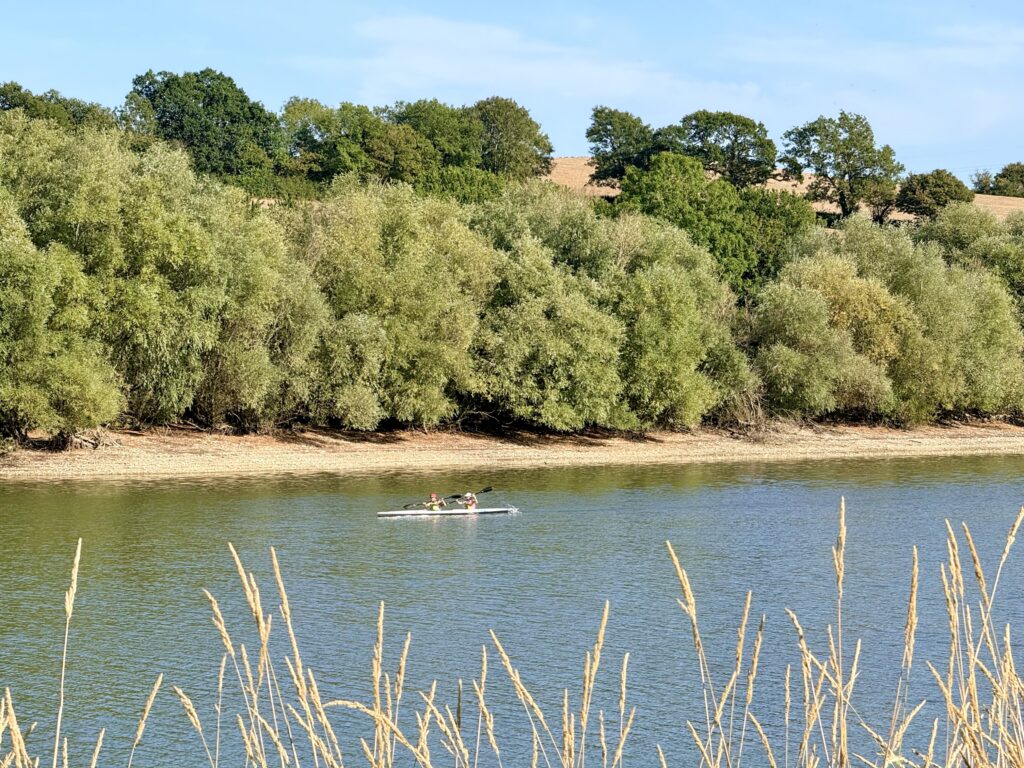
Kayaking at Sutton Bingham Reservoir. (Credit: ThisIsSouthWest)
You can kayak, canoe and paddleboard at Sutton Bingham Reservoir, but you cannot simply arrive with your own craft and launch independently.
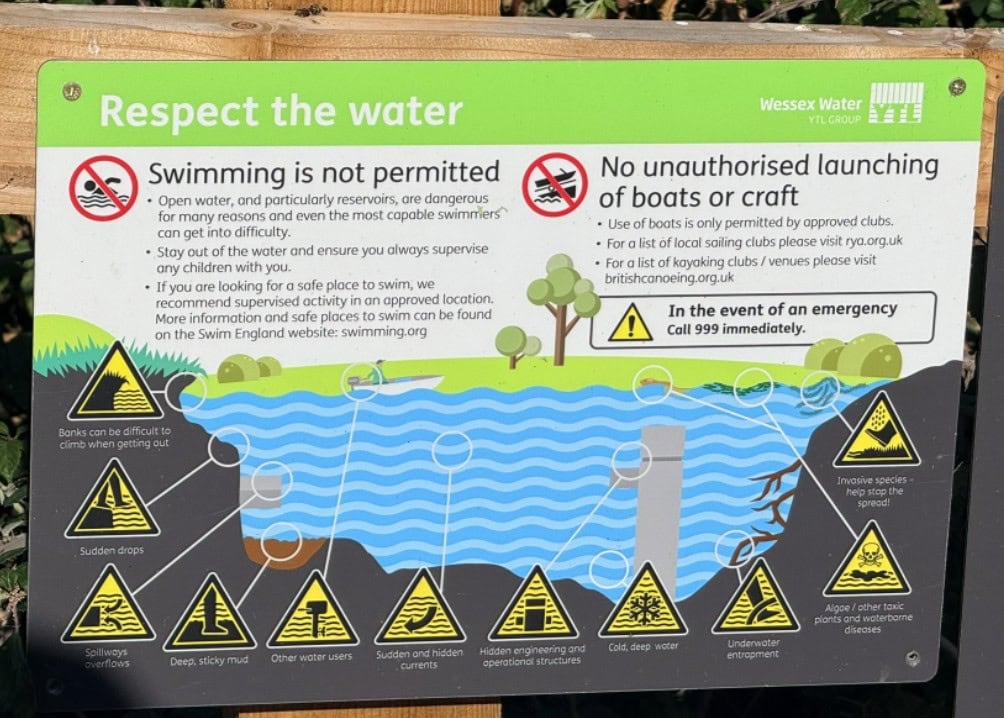
Signs around the reservoir state that unauthorised launching of boats or other craft is prohibited and that boats may only be used through approved clubs.
Sutton Bingham Paddlesports Club operates at the reservoir and offers kayaking, canoeing and stand-up paddleboarding. The club was founded in 2001 as Sutton Bingham Canoe Club and welcomes both beginners and more experienced paddlers. It is affiliated with Paddle UK.
When we visited, the club was closed, but the information board showed a range of kayaks, open canoes, and paddleboards available, along with equipment such as paddles and buoyancy aids.
Current membership, sessions and equipment arrangements are available from Sutton Bingham Paddlesports Club. In 2026, adult membership was £35 and junior membership £12, although these prices can change.
Sailing at Sutton Bingham Reservoir
Sailing is another well-established activity at Sutton Bingham. Sutton Bingham Sailing Club was founded in the early 1970s and has operated from the reservoir for more than fifty years.
The club is an accredited RYA Training Centre and supports recreational sailing, organised racing, youth activities and recognised sailing courses. Its programme caters for different levels of experience, including people learning to sail and established members looking to develop their skills or take part in club racing.
Races are normally held on Sundays, with additional Thursday evening sailing during the summer months. Activities and access are organised through the club rather than forming part of the reservoir’s general visitor facilities.
No. Swimming is not permitted at Sutton Bingham Reservoir.
Wessex Water signs around the site warn of the hazards associated with reservoirs, including deep, cold water, sudden drops, mud, currents, and underwater structures.
During our visit in August 2026, there was also a blue-green algae warning, advising people and animals to stay out of the water.
Are Dogs Allowed at Sutton Bingham Reservoir?
Dogs are not permitted. (Credit: ThisIsSouthWest)
No. Dogs are not permitted at Sutton Bingham Reservoir.
We saw very few walkers during our weekday visit, despite the excellent weather. The restriction on dogs may be one reason the Meadow Trail is quieter than many comparable countryside walks, although that is only our impression.
The no dogs rule is one of several restrictions visitors should know about.
Wessex Water signage also states that there should be no swimming, fires, barbecues, cycling or unauthorised launching of boats.
There are quite a few rules and signs around Sutton Bingham, so you’re never likely to forget that this is a working reservoir rather than a conventional country park.
We didn’t find that detracted from the experience. Its primary purpose is water supply, and restrictions around the water and wildlife are understandable.
A Little Sutton Bingham History
Low water at Sutton Bingham Reservoir. (Credit: ThisIsSouthWest)
Sutton Bingham Reservoir was completed in 1955 to provide a water supply for Yeovil and South Somerset. The reservoir covers around 142 acres and holds approximately 2,600 million litres when full.
Its creation changed the landscape considerably. The valley was flooded, and the remains of Sutton Mill now lie beneath the reservoir.
One much older landmark survived.
Close to the reservoir stands All Saints Church, Sutton Bingham, which dates from the medieval period and contains important historic wall paintings.
We didn’t visit the church on this occasion, largely because we hadn’t appreciated its significance until researching Sutton Bingham afterwards. In hindsight, we wish we had.
If you are visiting the reservoir and have time, it is therefore worth investigating the church as an addition to your visit.
We found plenty of spaces on our weekday afternoon visit, and parking was straightforward. Wessex Water also lists parking at its fishing lodge, but this serves a different part of the site.
From the picnic area car park, it is only a short distance to the toilets, play area, picnic tables, reservoir viewing area, and the start of the Meadow Trail.
The main picnic area appeared reasonably accessible during our visit, with surfaced areas connecting the principal facilities.
There is also a specifically designated accessible path leading to the Meadow Viewing Area, with a bench overlooking the meadows and water.
Wessex Water also lists accessible fishing facilities, including a wheelchair-accessible lodge, toilets and boats. These are associated with fishing access and are separate from the facilities available to general visitors at the picnic area.
The full Meadow Trail is different. Because it crosses grass and uneven terrain, we wouldn’t consider the entire 2 km walk suitable for wheelchairs, and some pushchairs may also struggle.
Visitors with specific accessibility requirements should check the latest information with Wessex Water before travelling.
How Long Should You Spend at Sutton Bingham Reservoir?
Sutton Bingham play area. (Credit: ThisIsSouthWest)
Allow at least an hour if you want to walk the Meadow Trail and enjoy the reservoir views without rushing.
But we’d recommend staying longer.
Bring a picnic, and Sutton Bingham could easily fill a relaxed couple of hours. Families can combine the walk with a visit to the playground, while couples might simply enjoy a picnic and a stroll beside the water.
It is also somewhere we would happily visit alone. There are shaded tables, peaceful surroundings and attractive views. We’d quite happily bring a laptop or notebook and spend an afternoon writing here.
There is no café, so bring your own food and drinks. The water refill point is useful, particularly during warmer weather.
Is Sutton Bingham Reservoir Worth Visiting?
Meadow Trail beside the reservoir. (Credit: ThisIsSouthWest)
Yes, particularly if you’re looking for a peaceful, free place near Yeovil for a picnic and a short walk.
Sutton Bingham isn’t a major visitor attraction, and we don’t think it needs to be presented as one. Its appeal is simpler than that.
There is attractive countryside, plenty of water to look at, a pleasant and easy-to-follow Meadow Trail, good picnic facilities, a surprisingly substantial children’s play area and enough wildlife to make you slow down and look around.
The reservoir was very quiet during our late afternoon weekday visit. There were only a few cars and very few other walkers, despite visiting on a beautiful summer day.
We initially went because we’d spotted Sutton Bingham on a map and wondered what was there. We left thinking it was somewhere we’d happily return to, perhaps with a picnic and a book, or simply to sit beside the water for a couple of hours.
For somewhere only around a 15-minute drive from Yeovil, we think Sutton Bingham is easily overlooked.
Sutton Bingham Reservoir FAQs
What is the postcode for Sutton Bingham Reservoir?
For a general visit, use Sutton Bingham Picnic Area, BA22 9QP. Do not simply enter “Sutton Bingham Reservoir”, as your sat nav may direct you to the separate Fishing Lodge, which is not open to general visitors.
Is parking free at Sutton Bingham Reservoir?
Yes. Parking is free at Sutton Bingham Picnic Area. The Fishing Lodge has separate parking for anglers and should not be used as the destination for a general visit.
What are Sutton Bingham Reservoir’s opening times?
The picnic area opens at 8am throughout the year. Closing times range from 3.30pm in December to 8pm in June and July, with intermediate seasonal closing times during other months. Check the
latest Wessex Water information
before travelling.
Can you walk around Sutton Bingham Reservoir?
No. There is no public circular walk around the reservoir. The signed Meadow Trail is approximately 2 km return and follows the western shoreline before visitors retrace their route to the picnic area.
Can you swim in Sutton Bingham Reservoir?
No. Swimming is prohibited because of hazards including deep, cold water, sudden drops, mud, currents and submerged structures.
Can you paddleboard or kayak at Sutton Bingham Reservoir?
Kayaking, canoeing and paddleboarding are available through Sutton Bingham Paddlesports Club. Visitors cannot independently launch their own craft without authorisation.
How much does fishing at Sutton Bingham Reservoir cost?
Permit prices depend on the season, type of fishing and ticket selected. Check current prices, permitted methods and access arrangements directly with
Wessex Water.
Are dogs allowed at Sutton Bingham Reservoir?
No. Dogs are not permitted at Sutton Bingham Reservoir, including on the Meadow Trail.
Over to you … have you recently travelled to South West England? What worked for you? What advice would you give to others? Please leave your comments below or join in the discussion in our Facebook Group.
New to South West England or returning after a while? Start with our ‘Travel Basics’ – quick guides packed with tips to help you plan your trip.
The Byes Sidmouth walk follows the River Sid from Sidford into the heart of Sidmouth, passing old meadows, woodland, parkland and some remarkable trees before reaching the sea at the Ham. It is an almost entirely level walk of around 4 miles when walked there and back, with surfaced paths for much of the route and several bridges that let you explore both banks of the river.
I walked from Sidford to Sidmouth, for the most part on the western side of the River Sid, continuing as far as the seafront beside the Ham. On the return, I took the eastern path from the Toll House, then crossed back to the western side for the walk to Sidford.
It was an absolute delight. Having lived in or near East Devon for most of my life, I was surprised that I had never properly explored the Byes before. Sidmouth is familiar to many people for its beach, red cliffs, Regency architecture and annual carnival, regatta and folk festival. Yet, this green corridor behind the town seems to be one of its best-kept secrets.
The route is not dramatic or demanding. Its attraction comes from the river, mature trees, open grassland and the gradual transition from village to countryside, park and coast. It is a walk I would happily repeat in every season.
The Byes Sidmouth walk at a glance
Start and finish: Church Street long-stay car park, Sidford
Distance: Around 4 miles (6.5 km) return
Time: Allow 1.5 to 2.5 hours
Difficulty: Gentle, with no significant climbs
Turnaround: The Ham and Sidmouth seafront
Terrain: Tarmac and surfaced shared paths, with optional grass and meadow paths and occasional uneven ground
Maps: OS Explorer 115, Exmouth & Sidmouth, or OS Landranger 192, Exeter & Sidmouth
Parking: Church Street long-stay car park in Sidford
Public transport: Regular buses connect Sidford with Sidmouth, Exeter, Honiton and Seaton
Facilities: Shops and places to eat in Sidford, with toilets, cafés and a wider choice in Sidmouth
Accessibility: The level, metalled main path is suitable for wheelchairs, mobility scooters, pushchairs and bicycles. Optional meadow paths may be less suitable after rain
Dogs: Welcome under control in most areas. The Golden Copse and Community Orchard are dog-free
Shared path: The route is used by cyclists, runners, families and dog walkers. Keep left where practical and listen for bicycles approaching from behind.
Disclosure:Some of the outbound links on this page are affiliate links to sites that we use and would genuinely recommend. Using them doesn’t cost you extra, but it does help support this free guide. We also provide links to other sites that we believe may be helpful to you. As an Amazon Associate, I earn from qualifying purchases.
The Byes are a broad ribbon of fields, meadows, woodland and parkland surrounding the River Sid between Sidford and Sidmouth. The main green corridor is about 2 km long, although the riverside route continues into Sidmouth and reaches the sea beside the Ham.
The character changes as you walk downstream. The northern section feels more rural, with rough grassland and wooded riverbanks. Closer to Sidmouth, it becomes more formal parkland, with lawns, specimen trees, allotments and well-used paths.
Part of the middle section is maintained as a nature reserve by the Sid Vale Association. The association owns four parcels of land here, including Margaret’s Meadow, Gilchrist Field, Livonia Road Field and the Govier Orchard. Its volunteers manage the land for wildlife while keeping it open for the community.
This combination of public park, nature reserve and riverside path helps explain why the Byes never feels like a conventional town park. In places, Sidmouth seems much farther away than it really is.
Although a map is not essential for this route, I find that having one adds a useful sense of perspective and often reveals nearby places and points of interest that I might otherwise miss. I use the OS Maps app on my phone to plan and follow my walks. If you prefer a paper map, the route is covered by OS Explorer 115: Exmouth & Sidmouth and OS Landranger 192: Exeter & Sidmouth.
Stage 1: Church Street car park to Byes Lane
Church Street long-stay car park – July 2026. (Credit: ThisIsSouthWest)
I started at the Church Street long-stay car park in Sidford. It is quieter than central Sidmouth and, even on a hot July day, spaces were readily available.
You will find signs for the Byes near the south-eastern corner of the car park. Follow the road south through the housing estate, then turn left into Drakes Avenue.
At the end of Drakes Avenue, you reach Byes Lane. The playing fields are ahead, and a small children’s play area is on the left.
Turn right onto the metalled path shared by walkers and cyclists. This route is suitable for pushchairs, wheelchairs, mobility scooters, and bicycles.
The Sidmouth Rugby Football Club training grounds are on the left. At first, the path is some distance from the River Sid, so do not worry if the walk does not immediately feel like a riverside route.
Stage 2: Gilchrist Field and Margaret’s Meadow
The shared path passes Gilchrist Field Nature Reserve before the footpath turns left into Margaret’s Meadow. Both form part of the land cared for by the Sid Vale Association.
Gilchrist Field covers more than seven acres and is managed as rough meadow and woodland. An old Victorian pond nearby has been adapted as a protected wildlife area, where moorhens, newts, toads and dragonflies have been recorded.
Margaret’s Meadow was stunning in the afternoon heat. Within the meadow, the Golden Copse is one of the few dog-free parts of the Byes. Its benches make it a restful place to pause, while the trees were selected for their golden foliage to mark Queen Elizabeth II’s Golden Jubilee.
Crossing the Woolbrook to the River Sid
The route crosses the Woolbrook close to its confluence with the River Sid. (Credit: ThisIsSouthWest)
The meadow path eventually rejoins the shared cycle path. Shortly afterwards, one of the first footbridges crosses the water near the confluence of the Woolbrook and the River Sid, beginning a beautiful stretch along the river, past allotments on the right and through open parkland.
The River Sid and its wildlife
The Sid may be short, but it supports an impressive range of wildlife. Atlantic salmon, sea trout, brown trout, European eels, lamprey and bullhead have all been recorded in the river.
These fish help support other species associated with the valley, including otters, dippers and kingfishers. Seeing any of them requires patience and luck, but the wooded banks, gravel riverbed and quiet pools make the river feel alive even when nothing obvious appears.
There are environmental pressures. Himalayan balsam and Japanese knotweed have both been found in the catchment, and volunteers continue working to limit their spread.
The Roncombe Stream joins the River Sid in Sidbury, the Snod Brook in Sidford and the Woolbrook in Sidmouth. It reaches Lyme Bay beside the Ham, although its route into the sea is not always immediately visible.
Waves and longshore drift move pebbles along Sidmouth beach, periodically creating a shingle ridge across the river mouth. During periods of low flow, the river can filter through the stones rather than forming an open channel. Higher river levels following heavy rain may break through the ridge before the sea gradually rebuilds it.
Stage 3: Byes Cycle Bridge, Salters Meadow and the Lawn
The next major crossing is the Byes Cycle Bridge. On the outward walk, I remained on the western side of the River Sid and continued through Salters Meadow.
There are benches and picnic spots throughout the Byes, but some of the most memorable here are formed from old tree trunks. Children in particular may enjoy discovering these natural seats.
Heart’s Delight Bridge leads across the River Sid into the Lawn. (Credit: ThisIsSouthWest)
The path eventually crosses the River Sid at the bridge known as Heart’s Delight. A short walk through the Lawn then leads to Salcombe Road and the old Toll House.
The Lawn is the most formal part of the Byes, with broad grass, mature trees and paths connecting the surrounding residential streets. At its southern end, Waterloo Bridge and Salcombe Road provided improved eastern access to Sidmouth from around 1817.
The nearby Toll House was built at about the same time in the fashionable Greek Revival style. The Turnpike Trust collected tolls to help maintain the road, although the scheme made little profit and ended during the 1870s.
The Byes Tree Trail
Mature trees provide welcome shade across the Lawn. (Credit: ThisIsSouthWest)
This is also the setting for the Sidmouth Byes Tree Trail. The accessible loop is around a mile long and includes more than 200 trees representing over 50 species.
I know little about identifying trees, but their scale and variety are impossible to miss. The trail leaflet points out common limes, a Huntingdon elm, sweet chestnut, tulip tree, black poplars, willows, alders and an enormous horse chestnut.
Some beech trees are estimated to be around 120 years old. They date from about the time local philanthropist and suffragist Annie Leigh Browne purchased land for public recreation.
Even without knowing every species, the trees define this part of the walk. They create shade, frame the river and give the Byes a deep sense of age.
A few trees to look for
The Sidmouth Arboretum leaflet provides a much better guide than I could, but several trees have stories that make them worth finding.
Near the Toll House entrance, two common limes dominate the approach to the Lawn. Their summer flowers are rich in nectar and strongly scented.
A Huntingdon elm nearby is particularly interesting because it has some resistance to Dutch elm disease, which destroyed many of the large elms that once dominated the valley.
Beside one of the weirs is a fast-growing black poplar hybrid, while riverside alders and willows are found closer to the water. There are also trees from much farther afield, including a tulip tree from the magnolia family, a North American robinia and a young giant redwood.
On the opposite side of the river, Lovers’ Walk passes beneath Norway maple, sycamore and silver birch. Several trees in the Byes have been planted in memory of local people, adding another layer to the landscape.
Stage 4: The Toll House to Sidmouth Ford
Vehicles can cross the River Sid at Sidmouth Ford, while walkers use the nearby footbridge. (Credit: ThisIsSouthWest)
Cross Salcombe Road and continue south along Milford Road. This road is fairly quiet, but there is no pavement, so listen for approaching vehicles and take care.
At Sidmouth Ford, cars can cross the shallow River Sid while walkers have a separate footpath.
Riverside Road, the Ham and Alma Bridge
Lynette and Peter’s Garden Sensory Garden adds another peaceful planted space beside the River Sid. (Credit: ThisIsSouthWest)
Continue south along Mill Road, then turn left into Riverside Road to regain the river on your left.
This is another slightly undiscovered part of Sidmouth. It leads past the Sensory Garden in the Old Boat Park, a community project created by Sidmouth in Bloom and opened in 2018.
Its raised beds are planted to engage sight, smell, taste, touch and sound. The garden reflects years of work by Sidmouth in Bloom volunteers, including Lynette Talbot and Peter Endersby, whose contribution to the town’s floral displays has received a South West in Bloom Lifetime Achievement Award.
Next is the well-equipped Ham Play Park. Its sea-themed equipment includes a zip wire, climbing wall, slides, swings, trampoline, boat activity centres and a sandpit with hidden fossils.
The Ham itself is the open recreation ground behind the eastern end of Sidmouth seafront. As well as providing space for play and community events, it forms the final green link between the Byes and the coast.
Reaching the sea at Alma Bridge
Alma Bridge crosses the River Sid shortly before it reaches Lyme Bay. (Credit: ThisIsSouthWest)
The walk reaches the sea beside Alma Bridge. The first bridge here was built in 1855 and named after the Battle of Alma during the Crimean War, with timber taken from a wreck on Sidmouth beach.
The historic replacement was damaged by flooding, and the present 19-metre pedestrian bridge opened in 2020, about 40 metres inland from the earlier structure. Reclaimed bricks and other architectural pieces preserve a physical link to its predecessor.
Arriving here gives the walk a proper destination as the river corridor opens onto Lyme Bay. Salcombe Hill rises beyond the river mouth, while Sidmouth’s beach extends west beneath the red cliffs.
Allow time to explore Sidmouth
Sidmouth’s long esplanade stretches towards Salcombe Hill. (Credit: ThisIsSouthWest)
The walk is short enough to leave plenty of time for Sidmouth before heading back. We love the town’s gentle refinement, its long esplanade and the sense that the seafront has changed more slowly than many other resorts.
The centre has a good selection of independent and more unusual shops. These include Fields of Sidmouth, a traditional department store that has traded in the town for more than 200 years.
Sidmouth is also home to some of East Devon’s most elegant hotels. Connaught Gardens and the famous Jacob’s Ladder are further west along the seafront, while the climb to Salcombe Hill brings wide views across the town and Lyme Bay.
There are plenty of places to eat. Rockfish has recently opened in the restored Drill Hall near Alma Bridge and the Ham, while the Salcombe Tap House serves breakfast, coffee, beer, cocktails and pizzas from its seafront terrace.
For more ideas, including beaches, gardens, walks, shops and places to eat, read our full guide to the best things to do in Sidmouth.
Returning to Sidford by bus
If you would prefer not to walk back, regular Stagecoach 9 and 9A buses run from the Triangle to Sidford, stopping near Drake’s Avenue and the SPAR. The journey takes only a few minutes, although it is sensible to check the current timetable before setting out.
The Triangle is at the western end of the esplanade, close to the town centre. This option allows more time for Sidmouth while turning the route into a one-way walk.
Returning along the eastern side of the River Sid
The Byes Cycle Bridge links the riverside paths on the eastern and western banks. (Credit: ThisIsSouthWest)
I chose to walk back, initially retracing my steps from Alma Bridge to the old Toll House. From there, I followed the eastern side of the River Sid through the Lawn, which made the return feel different from the outward walk.
The path passes the Community Orchard, the delightfully named Roly Poly Field and Sid Meadow. The opposite bank gives different views of the river, trees and parkland.
The Community Orchard incorporates the Community Food Forest, planted as a layered, food-producing space for people and wildlife. It is a dog-free area with paths and seating where adults can pause, and children can explore the planting without picking anything unless signs indicate it is ready.
After Sid Meadow, I crossed the river at the Byes Cycle Bridge and returned to the western bank. From here, it was simply a matter of following my earlier route towards Sidford.
Rather than turn back through Drakes Avenue, I continued along Byes Lane until it met Church Street. I turned left, resisted the smell drifting from the busy Bloaters Fish and Chip Shop, and followed Church Street back to the car park.
The history behind the landscape
The return route follows quiet paths through the greener eastern side of the Byes. (Credit: ThisIsSouthWest)
Before Sidmouth expanded, the land behind the town consisted largely of water meadows beside the River Sid. These supported dairy herds, with local dairies producing clotted cream for sale as far away as London.
During the nineteenth century, Sidmouth developed into a fashionable seaside resort, but the river valley retained much of its open character. Land was gradually protected and made available for recreation.
The Sid Vale Association grew from the Sidmouth Improvement Committee, first convened in 1846. It describes itself as Britain’s oldest civic society and was created to protect the landscape and amenities of Sidmouth and the Sid Valley.
That history of local conservation is still visible in the Byes. The open meadows, mature trees and public access are not simply accidental gaps between housing. They reflect generations of land purchases, donations, planting, and volunteer work.
The result is a green route running almost uninterrupted into the centre of Sidmouth.
Is the Byes walk accessible?
The main shared path through the Byes is largely level and surfaced. It is used by people with wheelchairs and mobility aids, as well as families with pushchairs.
The most accessible section is around the Lawn and the Tree Trail, where approximately one mile follows mainly tarmac paths on level ground.
Some optional paths beside the river and through the meadows are narrower, uneven or muddy after rain. Anyone requiring a firm surface can remain on the principal path without missing the main character of the Byes.
There are benches throughout the route, including shaded seating in Margaret’s Meadow and tree-trunk benches in Salters Meadow. Milford Road has no pavement, and road crossings require care.
Walking the Byes with dogs
Dogs are welcome across most of the Byes, but they should be kept under control around wildlife, livestock and other path users. The Golden Copse within Margaret’s Meadow and the Community Orchard are dog-free.
The river can be tempting, particularly in warm weather, but currents and water quality can vary after rain. Owners should also avoid allowing dogs to disturb wildlife along the wooded banks.
Because parts of the walk are shared with cyclists and runners, a short lead may be sensible in the busier sections.
Parking and public transport
Church Street long-stay car park in Sidford is a convenient starting point. I found it much quieter than parking in central Sidmouth, with spaces still readily available on a hot summer’s day in July.
Charges apply, so check the tariff board or parking app when you arrive. From the south-eastern corner of the car park, signs lead through the housing estate towards Drakes Avenue and Byes Lane.
Sidford can also be reached by bus from Sidmouth, Exeter, Honiton and Seaton. Starting here and walking towards the sea gives the route a satisfying destination.
Stagecoach services 9 and 9A connect the Triangle in Sidmouth with Sidford. This makes a one-way walk possible for anyone who would rather spend longer in town than retrace the route.
Check current bus times and parking restrictions before travelling, as services and arrangements can change.
Places to eat and drink
Rockfish and the Salcombe Tap House overlook the point where the River Sid meets the sea. (Credit: ThisIsSouthWest)
Sidford has a SPAR, Bloaters Fish and Chip Shop and the Rising Sun pub. The Blue Ball Inn and the Salty Monk Restaurant and B&B are also nearby.
Sidmouth has a much wider choice, with the Ham only a short walk from the esplanade, Old Fore Street and the town centre. Rockfish beside the Ham and the Salcombe Tap House on the seafront are two of the newest additions.
This makes the walk particularly convenient for lunch or coffee. Bringing water is still sensible in summer, as the open meadows can feel warm even when the wooded sections remain shaded.
Things to do near the Byes
The walk can be combined with several places in and around Sidmouth:
The riverside route from Sidford to the Ham is around 2 miles each way. Allow approximately 1.5 to 2.5 hours for the 4-mile return walk, with extra time for stops or exploring Sidmouth.
Where does the Byes walk start?
This route starts at Church Street long-stay car park in Sidford. Follow the signs from the south-eastern corner, continue through the housing estate and turn left into Drakes Avenue, then right onto the shared path at Byes Lane.
Is the Byes walk circular?
The route is broadly linear, but bridges allow you to walk along both sides of the River Sid. Following one bank towards Sidmouth and the other for part of the return creates a partial circular route.
Is the Byes walk flat?
Yes. The main route is almost entirely level, with no significant climbs between Sidford and Sidmouth.
Is the Byes suitable for wheelchairs and pushchairs?
Much of the principal route is metalled, level and suitable for wheelchairs, mobility scooters and pushchairs. Some optional meadow paths may become muddy, while Milford Road has no pavement.
Can dogs walk through the Byes?
Dogs are welcome under control across most of the Byes. They are not permitted in the Golden Copse within Margaret’s Meadow or the Community Orchard.
Can you cycle through the Byes?
Yes. Much of the principal route is shared by walkers and cyclists. Cyclists should slow down around families, dogs and narrower sections.
Can I walk one way and return by bus?
Yes. Stagecoach services 9 and 9A run from the Triangle in Sidmouth to Sidford. Check the current timetable before travelling.
Does the River Sid reach the sea?
Yes. The River Sid runs for around 6 miles through Sidbury, Sidford and Sidmouth before reaching Lyme Bay beside the Ham. At times, a shingle ridge forms across its mouth and the water filters through the pebbles.
Are there toilets on the Byes walk?
Facilities are available in Sidmouth close to the Ham and seafront. There are also cafés, pubs and shops in the town centre.
What trees can you see in the Byes?
The parkland contains more than 200 trees from over 50 species. These include common lime, Huntingdon elm, sweet chestnut, black poplar, alder, willow, horse chestnut, tulip tree and giant redwood.
Is the Byes Sidmouth walk worth doing?
Yes. The Byes provides a peaceful and largely traffic-free route from Sidford to the sea, passing meadows, woodland, nature reserves, mature parkland and the River Sid.
Helpful Links
These trusted resources can help you plan and book your trip, from transport and accommodation to weather and local information.
Booking.com – for most accommodation needs. Look out for options that include free cancellation.
Easy Tide – Free UK tidal prediction service, providing tidal data and tide times for the current day and 6 days into the future.
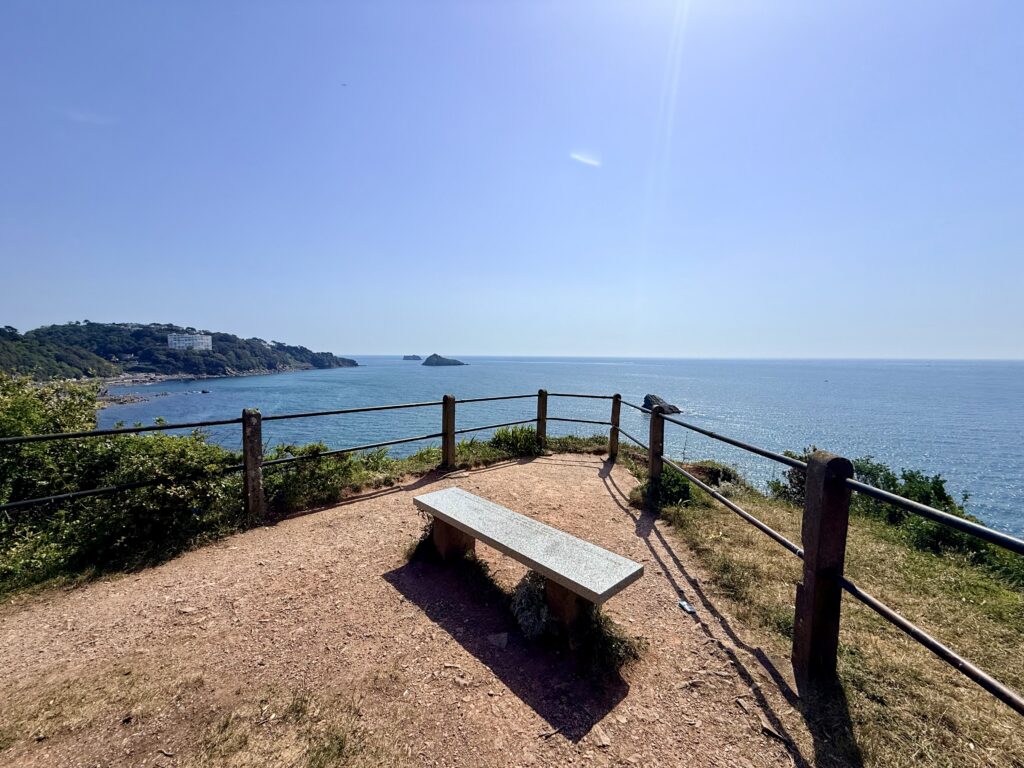
Viewing point above Meadfoot Beach with Thatcher Rock beyond. (Credit: ThisIsSouthWest)
I set out on foot from Meadfoot Beach in Torquay to discover the best beaches in Torbay and followed the South West Coast Path around Torbay to Brixham, exploring every major beach and several quieter coves along the way. Rather than simply compiling a list, this guide invites you to come with me as I discover the coastline one beach at a time, sharing the places that impressed me, the hidden corners I almost missed and the practical details that will help you plan your own visit.
From sheltered family beaches and traditional seaside resorts to secluded coves backed by red sandstone and limestone cliffs, Torbay beaches offer one of the most varied stretches of coastline in South West England. Along the way, I visited many of the best Torquay and Paignton beaches, as well as the quieter coves towards Brixham, combining first-hand observations with practical visitor information to help you discover the best beaches in Torbay, whether you are looking for swimming, walking, watersports, or simply somewhere to relax by the sea.
Can you walk from Torquay to Brixham?
Yes. Following the South West Coast Path from Torquay to Brixham via Paignton covers around 10 miles (16 km) and passes more than twenty of Torbay’s beaches and coves. Much of the route between Torquay Harbour and Goodrington Sands is relatively level, although the total ascent and descent is around 650 ft (200 m). The walk is best described as moderate due to its length rather than its difficulty. Allow a full day to complete the route, with the Brixham-to-Torquay ferry providing a memorable, scenic return journey across Tor Bay.
Torbay Beaches at a Glance
Torbay beaches range from busy family resorts to secluded coves reached only on foot. This guide follows the South West Coast Path from Meadfoot Beach in Torquay to Brixham, passing the main Torquay beaches, Paignton beaches and quieter beaches around Beacon Cove, Broadsands, Elberry Cove and Churston Cove.
Best for families: Goodrington Sands, Paignton Beach, Preston Sands and Broadsands Beach.
Best for dogs: Elberry Cove, Churston Cove, Fairy Cove, Beacon Cove and Peaked Tor Cove are dog friendly all year.
Best hidden beaches: Elberry Cove, Fairy Cove, Churston Cove, Peaked Tor Cove and Hollicombe Beach.
Best for swimming: Goodrington Sands, Broadsands Beach and Elberry Cove, depending on conditions.
Best for rock pooling: Hollicombe Beach, Fairy Cove and Saltern Cove at low tide.
Best for walking: The South West Coast Path between Broadsands Beach, Elberry Cove and Churston Cove.
Best for steam train views: Goodrington Sands, the South West Coast Path above the railway and Broadsands Beach.
Best for couples: Beacon Cove, Corbyn Head and Elberry Cove.
Best for views: Churston Point, Corbyn Head, Beacon Cove and Broadsands Beach.
Good to know: Many of the larger resort beaches have summer dog restrictions, while several smaller coves have no facilities and are best visited on foot. Always check tides, water quality and local safety information before swimming.
Disclosure:Some of the outbound links on this page are affiliate links to sites that we use and would genuinely recommend. Using them doesn’t cost you extra, but it does help support this free guide. We also provide links to other sites that we believe may be helpful to you.
Our walk around Torbay’s beaches began at Meadfoot Beach on a blisteringly hot day in early June, with temperatures climbing into the high twenties. It made for a long but memorable day exploring the English Riviera on foot. Although I travelled by car from our base on the Devon-Somerset border, the train is often our preferred option, with reasonably priced off-peak fares to Torquay via Axminster.
Parking was straightforward, with free spaces available on Ilsham Road near Ilsham Green, additional roadside parking near Meadfoot Beach if you arrive early enough, and a pay-and-display car park at Kilmorie Beach.
Meadfoot Beach itself is one of Torquay’s most attractive and varied beaches, combining sand, shingle and pebbles. The western end is backed by colourful beach huts and the popular café, while the quieter eastern section is rockier and known for fishing, diving and rock pooling. At high tide, much of the beach disappears beneath the sea, making low tide the best time to visit.
Leaving the beach, the South West Coast Path climbs steadily towards Daddyhole Plain, passing the Osborne Hotel and Headland Hotel, both enjoying superb views across Tor Bay. Looking back, Meadfoot Beach stretches below while the National Coastwatch Institution lookout stands prominently above the cliffs, complete with a welcome water bowl for passing dogs when volunteers are on duty.
The path then descends gently towards Peaked Tor Cove, passing the London Bridge viewing point (London Bridge is a sea stack with an archway), offering impressive views across the coastline. I did not make the steep descent to the cove itself, but the secluded beach is reached via a challenging path with around 150 steps and is known as a peaceful spot popular with walkers and dog owners year-round. There are no facilities at the cove itself, with the nearest parking around Beacon Quay and limited public transport serving nearby Torquay.
Meadfoot Beach, Torquay (Credit: ThisIsSouthWest)
Meadfoot Beach Information
Access: The beach can be reached from Kilmorie Car Park via a walk of around 250 metres, or by steep steps from Meadfoot long stay car park. There are 18 steps from the promenade to the beach, while level access to the promenade is available from the road via a slope.
Facilities: Year round toilets, including accessible facilities, a café, beach showers, annual and visitor chalet hire, deckchair hire and a boat launching area for small craft are available.
Parking: The nearest parking is at Meadfoot Beach, Meadfoot Road and Kilmorie car parks, together with limited roadside parking nearby.
Dogs: Dogs are permitted all year on the rocky eastern half of the beach but are prohibited on the main sandy western section between 1 May and 30 September.
Peaked Tor Cove Information
Access: The cove is reached via a steep path with around 115 steps from the South West Coast Path. The route is approximately 150 metres from the coast path and is not suitable for wheelchairs.
Facilities: There are no toilets, cafés or other visitor facilities at Peaked Tor Cove.
Parking: There is no dedicated parking nearby. The cove is best accessed on foot from the South West Coast Path or via Daddyhole Road in Torquay.
Dogs: Dogs are permitted all year round.
Peaked Tor Cove to Beacon Cove
From Peaked Tor Cove, the South West Coast Path continues north past the rather grand-looking Imperial Hotel before descending towards Beacon Cove and Torquay Harbour. The walk is relatively short but packed with history, with superb views across the bay before the path reaches the small cove tucked beneath Beacon Hill.
Unlike Peaked Tor Cove, I made the short walk down to Beacon Cove itself. Access is through a seasonal gate from the Beacon Quay car park, followed by a winding path down to the shoreline. The final approach involves large stone revetments rather than a ramp, so care is needed.
Beacon Cove is far more than just another beach. Once known as the Ladies Bathing Cove, it was a favourite place of Agatha Christie, who almost drowned here as a child while trying to rescue her nephew. Information boards around the cove tell its fascinating story, from Victorian bathing machines and the former lifeboat station to the Marine Spa, Coral Island leisure attraction and, more recently, Living Coasts, all remembered fondly by generations of visitors.
The cove also lies within the English Riviera UNESCO Global Geopark, with interpretation boards explaining the ancient geology beneath your feet and the rich marine life in the seagrass meadows of Tor Bay, which are home to seahorses, cuttlefish, and many other species.
Just beyond the beach, Beacon Quay provides another unexpected piece of history. Memorials mark the D-Day embarkation ramps used by American forces in June 1944 as thousands of troops and vehicles departed Torquay for Normandy. It is an easy place to pause and reflect before continuing into the bustling harbour and seafront.
Beacon Cove, Torquay (Credit: ThisIsSouthWest)
Beacon Cove Beach Information
Access: Reached via a seasonal gate from Beacon Quay Car Park followed by a winding path of around 100 metres. The final approach to the beach is via stone steps forming part of the sea defences rather than a ramp. The promenade above is suitable for wheelchair users but there is no step free access onto the beach.
Facilities: The nearest public toilets are at Beacon Quay. There are no facilities on the beach itself.
Parking: The closest parking is the Beacon Quay pay and display car park a short walk from the beach entrance.
Dogs: Dogs are permitted all year round.
Beacon Cove to Torre Abbey Sands
Leaving Beacon Cove, the walk follows the waterfront through Torquay Harbour, one of the liveliest parts of Torbay. Ferries depart regularly for Paignton and Brixham, while sightseeing boats and wildlife cruises head out across Tor Bay and along the South Devon coast towards Dartmouth.
There is no shortage of things to do along the harbour front. Gift shops, independent businesses, cafés, restaurants and ice cream kiosks line the promenade, creating a lively holiday atmosphere on a warm summer’s day. Torquay’s town centre has sometimes been criticised for looking tired, but during our visit, it was bustling and bright with visitors enjoying the sunshine.
Along the way, look out for the elegant Torquay Marina lifting bridge, the historic Princess Gardens, the English Riviera Wheel and the Princess Theatre overlooking the bay. Nearby, the Grade II-listed Pavilion, opened in 1912 as a concert hall and entertainment venue, remains one of the town’s best-known landmarks; it is currently closed while plans for its future continue.
The Rock Walk is another highlight, particularly after dark when colourful lighting transforms the cliffside gardens and seafront into an attractive evening promenade.
Continuing east, the recognisable Black Ball pedestrian bridge spans the busy road and marks the start of Torre Abbey Sands. It also provides the easiest route to nearby Torre Abbey and its historic gardens, one of Torquay’s best-known landmarks.
Torre Abbey Sands, Torquay’s main sandy beach. (Credit: ThisIsSouthWest)
Torre Abbey Sands Beach Information
Access: Straightforward via steps ramps and oversized revetments from Torbay Road with level access along the promenade making it suitable for wheelchair users.
Facilities: Year round toilets including accessible facilities cafés restaurants deckchair hire and a designated windsurfing area are available nearby.
Parking: Pay and display parking is available along Torbay Road and at the Abbey Park and Shedden Hill car parks.
Dogs: Dogs are banned from the main beach between 1 May and 30 September although a dedicated dog exercise area is provided on Torre Abbey Meadows.
Torre Abbey Sands to Corbyn Beach
From Torre Abbey Sands, the walk continues along Torquay seafront and promenade, with Torre Abbey Gardens to the right and the sea to the left. This is one of the easiest sections of the route, following the curve of the bay towards Corbyn Beach.
The path passes Torquay railway station, the most convenient station for Torquay town centre and seafront, before continuing past the Grand Hotel, another prominent seafront hotel with superb views across Tor Bay.
Corbyn Beach is smaller and often quieter than Torre Abbey Sands, which is generally regarded as Torquay’s main beach. Tucked beneath Corbyn Head, it still has useful facilities, including a café, and makes a calmer stopping point along the seafront walk.
Just beyond the beach, Corbyn Head provides excellent views across Tor Bay, with seats, public toilets and a poignant war memorial commemorating local Home Guard service members who died here during a Second World War training accident. Agatha Christie fans may also recognise the headland, said to be the inspiration for Baldy’s Head in Postern of Fate.
Corbyn Beach with Corbyn Head beyond. (Credit: ThisIsSouthWest)
Corbyn Beach Information
Access: Good access from the road to the promenade with a slipway providing wheelchair access to the beach. There are also eight steps from the promenade onto the sand. Please note that access to the public toilets is via a fairly steep slope.
Facilities: Seasonal toilets including accessible facilities are available from April to October. The beach also has a café beach hut hire deckchair hire and beach showers.
Parking: There is no parking immediately beside the beach. The nearest car parks are Abbey Park and Torre Valley while Torquay railway station is just a short walk away.
Dogs: Dogs are prohibited from the beach between 1 May and 30 September.
Corbyn Head to Livermead Sands and Institute Beach
After a brief pause at Corbyn Head to enjoy the views across Tor Bay, I continued east along the South West Coast Path. This section is one of the easiest of the walk, following a wide level pavement alongside Torbay Road with uninterrupted sea views.
The next beach is Livermead Sands, a small sandy beach that has a habit of almost disappearing beneath the sea at high tide. At low water, however, it provides another pleasant place to stop, particularly for families and those looking for a quieter alternative to Torquay’s larger beaches.
Overlooking the beach is the Livermead Cliff Hotel, another of the grand seafront hotels that occupy commanding positions above Tor Bay and enjoy panoramic coastal views.
Just beyond lies Institute Beach, a small and often overlooked cove tucked beneath the red sandstone cliffs below the hotel. On this occasion, I admired it from above rather than making the descent. Still, its sheltered setting and secluded atmosphere make it feel a world away from the busy promenade only a few metres away.
Made up of red sand, shingle and rocky outcrops, Institute Beach is particularly attractive at low tide when rock pools are exposed along the shoreline. Dogs are welcome all year, making it a popular spot for local walkers, while its secluded location rewards those prepared to venture away from Torquay’s better-known beaches.
Livermead Sands with the Livermead Cliff Hotel and Institute Beach below. (Credit: ThisIsSouthWest)
Livermead Sands Beach Information
Access: The beach is reached via 24 steps from Torbay Road and is not suitable for wheelchairs.
Facilities: There are no toilets or cafés on the beach itself. The nearest public toilets are at Corbyn Head. A designated water skiing area operates offshore.
Parking: There is no parking immediately beside the beach. The nearest parking is some distance away although Torquay railway station is within walking distance.
Dogs: Dogs are permitted all year round.
Livermead Sands to Hollicombe Beach
Beyond Livermead Sands and the Livermead Cliff Hotel, the South West Coast Path leaves the seafront and heads inland around the headland, climbing steadily alongside Torbay Road and the railway line that links Torquay with Paignton. This is probably the least inspiring section of the walk, with the road and railway replacing the coastal scenery for a short distance.
After crossing the railway by footbridge, the path descends once more towards the coast, where a pleasant surprise awaits. To the left lies Hollicombe Park, a peaceful green space of mature trees and open lawns that feels far removed from the busy main road.
Passing through a tunnel beneath the railway line brings you to Hollicombe Beach, one of Torbay’s hidden beaches. Sheltered beneath towering red sandstone cliffs, the beach is known for its distinctive red sand and quiet atmosphere, making it feel much more secluded than many of the bay’s larger beaches.
At low tide, extensive rock pools are revealed at either end of the beach, making it an excellent place for rock pooling and crabbing, while the calm waters and sheltered position make it popular with swimmers and families. Backing directly onto the beach, Hollicombe Park provides an ideal spot for a picnic before continuing what is now quite a short walk towards Preston Sands and Paignton.
Hollicombe Beach is one of Torbay’s hidden beaches. (Credit: ThisIsSouthWest)
Hollicombe Beach Information
Access: From Torbay Road and the South West Coast Path walk through Hollicombe Park and under the railway bridge before following a steep path down to the beach. The route from the nearest parking is approximately 170 metres. Wheelchair access is possible via a slipway although the return climb to the road is steep.
Facilities: There are no toilets or other visitor facilities at Hollicombe Beach.
Parking: Limited roadside parking is available nearby or the beach can be reached on foot from the South West Coast Path.
Dogs: Dogs are prohibited from the beach between 1 May and 30 September.
Hollicombe Beach to Preston Sands
Returning to Hollicombe Park, the South West Coast Path continues south west across a larger open area on top of the headland before descending once again to the coast. Within a few minutes, the route reaches Preston Sands, one of Paignton‘s two main beaches and a popular destination for families visiting the English Riviera.
Although often slightly quieter than neighbouring Paignton Beach, Preston Sands can still become extremely busy during the summer holidays. Backing the beach is Preston Green, a large open space that provides plenty of room for picnics, games and relaxation away from the sand. During our visit, much of the green was inaccessible due to coastal defence works, a reminder of the growing need to protect Torbay’s coastline from erosion and rising sea levels.
Preston Sands is a wide, gently sloping beach of distinctive red sand with attractive views across Tor Bay towards Torquay and Brixham. A colourful line of beach huts, cafés and seafront facilities creates a traditional seaside atmosphere, while the calm waters make it a popular spot for swimming and paddleboarding.
At low tide, the beach extends significantly and joins with neighbouring Paignton Sands, creating a vast stretch of sand ideal for walking. Rock pools are also exposed beneath the cliffs at the northern end of the beach, making it a good place for exploring marine life before continuing the walk towards Paignton Harbour.
Preston Sands looking towards Paignton Pier. (Credit: ThisIsSouthWest)
Preston Sands Beach Information
Access: The beach is flat and easily accessible from the promenade making it suitable for wheelchair users and visitors with limited mobility. Accessible parking spaces are available nearby.
Facilities: Year round toilets including accessible facilities are available at Preston North while additional seasonal toilets are available at Preston Redcliffe from April to October. The beach also has cafés and restaurants deckchair hire and beach hut sites.
Parking: The closest parking is at Colin Road Car Park just a short walk from the beach.
Dogs: Dogs are prohibited from the beach between 1 May and 30 September although a designated dog exercise area is available on Preston Green behind the beach.
Preston Sands to Paignton Beach
At low tide, it is possible to walk directly from Preston Sands to Paignton Beach across the sand, although care should be taken to avoid being cut off by the incoming tide. If there is any doubt, the safer option is to follow Marine Drive just inland, where the walk is level and only takes a few minutes. Along the way, I spotted what must surely be one of the closest Travelodge hotels to a beach anywhere in the country.
The route soon reaches Paignton Green, a large open space overlooking the broad sands of Paignton Beach, with Paignton Pier stretching out into Tor Bay ahead. For me, arriving here felt like coming home, having been born in Paignton many years ago. The familiar sights of the promenade, beach and pier brought back countless childhood memories.
Paignton
Paignton remains a traditional seaside resort with plenty to see and do. Although slightly smaller than neighbouring Torquay, it has retained its own distinct character, centred around the beach, harbour and pier. The town is also home to the mainline railway station and the Dartmouth Steam Railway, whose heritage trains I would soon be walking alongside as the route continues towards Goodrington.
Like many British seaside towns, Paignton has changed over the years, and some parts would undoubtedly benefit from investment and restoration. Even so, on a busy summer’s day, it remains full of life, with cafés, bars, amusement arcades and independent shops lining Torbay Road and the seafront.
One of the great advantages of exploring Torbay on foot is the excellent public transport. Frequent buses run throughout the day between Torquay, Paignton and Brixham, making it easy to walk only part of the route if preferred. It is also possible to return to Torquay by train or by ferry across the bay for a more memorable journey home.
For me, the highlights of Paignton include the free-to-enter Paignton Pier, the bustling harbour and nearby Victoria Park. A short bus ride or drive inland brings you to Paignton Zoo, one of Devon’s leading visitor attractions. At roughly the halfway point of today’s walk, Paignton makes an ideal place to stop for lunch, an ice cream or simply a well-earned rest before continuing along the coast towards Goodrington Sands.
For a complete visitor guide to Paignton, including the best attractions, beaches, walks, restaurants and practical travel advice, read our Things to Do in Paignton guide.
Paignton Sands and Paignton Pier on the shores of Torbay. (Credit: ThisIsSouthWest)
Paignton Beach Information
Access: Access is excellent with level promenades stretching along the seafront and harbour. Two ramps located north and south of Paignton Pier provide easier access from the promenade onto the beach for wheelchair users and visitors with limited mobility.
Facilities: Year round toilets including accessible facilities are available at Central and Festival Apollo with additional public toilets at Paignton Harbour. The beach is well served by cafés and restaurants deckchair and pedalo hire a designated windsurfing area Paignton Pier a promenade crazy golf a children’s play park and seasonal donkey rides on Paignton Green.
Parking: Parking is available a short walk from the beach with Victoria Car Park the nearest public car park.
Dogs: Dogs are prohibited from the beach between 1 May and 30 September although a designated dog exercise area is available on Paignton Green behind the beach.
Fairy Cove – Paignton’s Hidden Beach
Before leaving Paignton behind, it is worth making the short walk to Fairy Cove, one of Torbay’s best secret beaches and a place that many visitors never discover.
Tucked beneath the red sandstone cliffs between Paignton Harbour and Goodrington Sands, the tiny cove feels surprisingly secluded despite being only a few minutes from the busy seafront. The easiest route is to follow the harbour wall around the far side of Paignton Harbour, where the beach suddenly appears below the headland. It can also be reached via steep steps from Cliff Road through the small memorial garden above.
The beach is a mixture of red sand, shingle, and rocks, with extensive rock pools exposed at low tide, ideal for exploring with children. Sea glass can often be found among the pebbles, while the sheltered position and views across Tor Bay towards Torquay make it a peaceful place to pause before continuing the walk.
Dogs are welcome year-round, making Fairy Cove popular with local dog walkers outside the busier nearby beaches. There are no facilities on the beach itself, but the cafés, pubs and restaurants around Paignton Harbour are only a short walk away.
Fairy Cove beneath Roundham Head in Paignton. (Credit: ThisIsSouthWest)
Fairy Cove Beach Information
Access: Fairy Cove can be reached from Roundham Car Park by walking through the small public garden and descending around 50 steps to the beach. Alternatively from Paignton Harbour walk towards the sea bear right and descend approximately 19 steps to the cove. The beach is not suitable for wheelchairs.
Facilities: There are no facilities on the beach itself. The nearest public toilets are at Paignton Harbour with cafés pubs and restaurants just a short walk away.
Parking: The nearest parking is at Roundham Pay and Display Car Park.
Dogs: Dogs are permitted all year round.
Paignton Harbour to Goodrington Sands
Shortly after leaving Paignton Harbour, the South West Coast Path turns left onto Roundham Head, following Cliff Road before entering the attractive Roundham Gardens. This is the official route and offers superb views across Tor Bay from the clifftops.
On this occasion, however, the combination of the heat and the growing realisation of just how far I had already walked meant I missed the turning and carried straight on towards Goodrington. It proved no great hardship, as I still passed Roundham Gardens before making the short descent onto the beach.
Few beaches in Torbay are as popular as Goodrington Sands. On a sunny day, it is packed with families enjoying the wide expanse of red sand and the safe, gently shelving waters that make it ideal for swimming and paddling. The beach is divided into North Sands and South Sands, with excellent facilities spread across the seafront.
Among the biggest attractions is Splashdown Quaywest, the UK’s largest outdoor waterpark, while nearby Young’s Park offers boating lakes, crazy golf and family activities. A Premier Inn overlooks part of the beach, and cafés, kiosks and ice cream outlets ensure nobody goes hungry.
For us, however, the real highlight was the Dartmouth Steam Railway, whose heritage trains run immediately behind the beach throughout the season. Watching a steam locomotive emerge alongside the sand before heading towards Kingswear is one of the iconic sights in Torbay and a favourite location for photographers.
One small feature also stood out: the public drinking water refill tap. After many miles in the summer heat, it was a welcome sight and something we wish more beaches, towns and villages would provide, as is common across much of continental Europe.
Goodrington Sands and Young’s Park in Paignton. (Credit: ThisIsSouthWest)
Goodrington Sands Beach Information
Access: Access to both North Sands and South Sands is straightforward from Young’s Park and Quaywest Car Parks with level paths leading to the promenade and ramps or a small number of steps down to the beach. South Sands can also be reached from Cliff Park Road Car Park via the railway bridge and promenade. The beach is generally suitable for wheelchair users with accessible ramps and beach matting provided during the main season weather permitting.
Facilities: Year round public toilets including accessible facilities are available at the central beach with additional seasonal toilets at North Sands and South Sands. The beach also offers cafés and restaurants annual and visitor beach hut hire deckchair hire beach showers pedalo and windsurf hire together with excellent family attractions nearby.
Parking: The nearest parking is at Quaywest Car Park and Young’s Park Car Park both within a short walk of the beach. Cliff Park Road Car Park provides an alternative for South Sands.
Dogs: Dogs are prohibited from South Sands between 1 May and 30 September while North Sands welcomes dogs all year round. Dogs on the promenade must be kept on a lead at all times.
Goodrington Sands to Broadsands Beach
Leaving Goodrington Sands behind also marks the end of the largely flat section of the walk that has followed the Torbay coastline from Torquay Harbour. The South West Coast Path soon crosses the Dartmouth Steam Railway via a footbridge, a favourite spot for photographers hoping to capture one of the heritage trains as it climbs away from Goodrington Station.
Beyond the bridge, the path begins a steady climb inland while still offering glimpses of both the sea and the railway below. After around half a mile, signposts point towards Oyster Cove and Saltern Cove, two secluded beaches tucked away beneath the red sandstone cliffs. By this stage, with time running short and the last ferry from Brixham to Torquay firmly in mind, I reluctantly stayed on the main coast path rather than making the detour.
The Dartmouth Steam Railway between Goodrington Sands and Broadsands. (Credit: ThisIsSouthWest)
Oyster Cove is a quiet sandy and shingle beach known for its rock pools and peaceful atmosphere, while neighbouring Saltern Cove, a Site of Special Scientific Interest and Local Nature Reserve, is renowned for its ancient geology, marine life and crystal clear waters. At low tide, it is a superb place for rock pooling, crabbing and snorkelling, while nearby Armchair Cove offers another, off-the-beaten-path corner of the coastline for those prepared to explore.
Continuing along the South West Coast Path, the climb becomes noticeably steeper before the route suddenly drops towards Broadsands Beach, passing beneath the impressive limestone viaduct carrying the Dartmouth Steam Railway high overhead. It is one of the most dramatic moments of the entire walk and also marks the point where the railway leaves the coastline behind.
From here, the line climbs inland to Churston Ferrers before descending through mature woodland and eventually emerging alongside the River Dart for its spectacular final approach into Kingswear, opposite Dartmouth. It is one of England’s finest heritage railways and, although not inexpensive, forms part of what is surely one of Devon’s best days out when combined with the Round Robin excursion of steam train, ferry, river cruise and bus linking Paignton, Kingswear, Dartmouth and Totnes.
Back at Broadsands Beach, the atmosphere is once again very different. A broad sweep of gently shelving red sand backed by grassy parkland makes it one of Torbay’s most popular family beaches. The calm waters are ideal for swimming, paddleboarding and kayaking, while beach huts, cafés, toilets and deckchair hire provide everything needed for a day by the sea.
For railway enthusiasts and photographers, Broadsands offers some of the best viewpoints anywhere on the English Riviera, with steam trains crossing Brunel’s impressive limestone viaducts just behind the beach.
Broadsands Beach at low tide on the English Riviera. (Credit: ThisIsSouthWest)
Broadsands Beach Information
Access: The beach is located directly in front of Broadsands Car Park and can be reached via either a slipway or steps. The promenade is level and easily accessible although access onto the sand itself is mainly via steps with handrails.
Facilities: Year round toilets including accessible facilities are available. The beach also offers cafés and restaurants annual and visitor beach hut hire deckchair hire boat hire beach showers and a designated windsurfing area.
Parking: Broadsands Car Park is immediately adjacent to the beach providing easy access with only a short walk required.
Dogs: Dogs are prohibited from the beach between 1 May and 30 September. A designated dog exercise area is available on the grass behind the beach where dogs must be kept on leads.
Broadsands Beach to Elberry Cove
The short walk from Broadsands Beach to Elberry Cove is one of my favourite sections of the entire Torbay route. It takes little more than fifteen minutes but quickly leaves behind the crowds and bustle of Broadsands.
The South West Coast Path climbs gently around Churston Point, passing through open grassland with plenty of benches to stop and enjoy the views. Looking back across Tor Bay, you can see Paignton, Torquay and, in the distance, Meadfoot Beach and Thatcher Rock, where today’s walk began. The grassy headland also makes an ideal picnic spot and, if you’re anything like me, is far preferable to trying to keep sand out of your sandwiches.
With the sea breeze, open views and relatively few people, it feels a peaceful corner of the coast path that many visitors never discover.
The path then descends to Elberry Cove, which is perhaps my favourite beach in Torbay. Best reached on foot from Broadsands or Brixham, it remains popular with walkers, and dogs are welcome year-round.
The beach itself is a mixture of shingle and crystal-clear blue-green water, backed by woodland that almost reaches the shoreline. The sheltered waters support eelgrass beds, an important habitat for native seahorses, while rock pools and marine life make it a fascinating place to swim, snorkel and explore.
At the eastern end of the cove stand the remains of Lord Churston’s Bath House, built in the eighteenth century for private sea bathing. The cove also has links to Agatha Christie, who is said to have enjoyed swimming here and is believed to have drawn inspiration for The ABC Murders from it.
For us, Elberry Cove was a place to stop for a while, enjoy the scenery and appreciate just how different this quieter stretch of coastline feels compared with the busy beaches further around the bay.
Elberry Cove is one of Torbay’s most secluded beaches. (Credit: ThisIsSouthWest)
Elberry Cove Beach Information
Access: From Broadsands Car Park bear right past the beach chalets and continue across the large grassy area keeping the sea on your left. Pass through the metal kissing gate and follow the South West Coast Path before descending approximately 30 steps to the cove. The walk from the car park is around 400 metres.
Facilities: There are no toilets or other visitor facilities at Elberry Cove. A designated water skiing lane operates offshore.
Parking: The nearest parking is at Broadsands Car Park followed by a pleasant walk along the South West Coast Path.
Dogs: Dogs are permitted all year round.
Elberry Cove to Churston Cove
Leaving Elberry Cove behind, the South West Coast Path becomes more demanding once again. The route climbs quite steeply through woodland as it begins one of the final stretches of today’s walk towards Churston Cove.
Although the distance is a little more than a mile, it somehow feels much longer. The path winds through mature woodland with Churston Golf Club never far away on the right, while the cliffs to the left rise to around 150 feet above the sea below. There are occasional side paths leading towards viewpoints, but I would always recommend keeping well away from cliff edges, which can be unstable. Children should be kept close, and dogs should be kept on a lead through this section.
For most of the way, the route is easy to follow, although at the far end of the golf course, there is a junction where the path appears to continue straight ahead or left. The left fork is the correct route, leading through more woodland before the trees suddenly open to reveal a steep flight of steps descending into Churston Cove.
The effort is well rewarded. Churston Cove is another of Torbay’s hidden beaches, surrounded by woodland and high cliffs, giving it a wonderfully secluded feel. The beach is a mixture of sand and shingle, while the clear waters make it popular with swimmers, paddleboarders and snorkellers. Seals are occasionally spotted offshore, adding to the sense of this being one of Torbay’s quieter and more natural corners.
There are no cafés or facilities here, only the sound of the sea and the surrounding woodland. We love it. After the busier beaches of Torquay and Paignton, Churston Cove feels wonderfully remote and is one of those places that really does reward the effort needed to reach it.
Churston Cove with Fishcombe Cove beyond. (Credit: ThisIsSouthWest)
Churston Cove Beach Information
Access: From Fishcombe Road Car Park walk downhill past Brixham Battery and Brixham Holiday Park before following the path uphill into the woods to join the South West Coast Path. Continue with the sea on your right before descending to the cove via a very uneven track and approximately 67 steps. The route is steep and unsuitable for wheelchairs or visitors with limited mobility.
Facilities: There are no toilets cafés or other visitor facilities at Churston Cove.
Parking: The nearest parking is at Fishcombe Road Car Park followed by a walk along the South West Coast Path.
Dogs: Dogs are permitted all year round.
Churston Cove to Fishcombe Cove
Mindful of the time and increasingly in need of suitable refreshment and hoping to catch the 5 pm ferry back to Torquay rather than a much longer bus ride around the bay, I reluctantly left Churston Cove behind. I began the final climb through the woods.
The path rises steadily before emerging into open countryside, with Brixham Holiday Park on the right and The Cove luxury apartments on the left. Almost immediately, I found myself distracted by the Brixham Battery Museum. Unfortunately, it had already closed for the day, which was a shame, as it is one of the best-preserved World War II coastal defence sites in Britain. The restored gun emplacements, tunnels and exhibits make it well worth visiting, and with free admission, it has now earned a place on my list for a future trip.
Brixham Battery Museum preserves the history of the town’s former coastal defences. (Credit: ThisIsSouthWest)
The coast path turns left here before making one final steep descent into Fishcombe Cove. Another of Torbay’s hidden beaches, Fishcombe Cove is a peaceful shingle beach tucked beneath wooded red cliffs on the northern edge of Brixham. Sheltered from the open sea, its clear, calm waters make it a popular spot for swimming, paddleboarding and snorkelling, while the surrounding woodland creates a surprisingly secluded atmosphere just a short distance from the town centre.
The cove can be reached via a steep path from Battery Gardens or the nearby Fishcombe Road car park, making it an excellent stop for walkers following the South West Coast Path. During the summer months, a seasonal café and toilets are available, although the toilets were closed during our June visit. Dogs are welcome year-round.
Fishcombe Cove, one of Brixham’s hidden beaches. (Credit: ThisIsSouthWest)
Fishcombe Cove to Brixham
The Western Lady ferry passing Brixham Breakwater. (Credit: ThisIsSouthWest)
The final section of the walk from Fishcombe Cove to Brixham comes as something of a relief after the many climbs and descents along the route. Although there are still a few steps to negotiate, the path soon emerges into the lower part of Battery Gardens, where you’re rewarded with your first views of Brixham, its breakwater and the sweeping panorama across Tor Bay. Benches, picnic spots and welcome shade beneath the trees make it an ideal place to pause on a warm day. From here, the route is straightforward, with a final flight of steps leading down to the level path that passes Freshwater Car Park, Oxen Cove and the Fish Market before arriving at Brixham Harbour.
I have always liked Brixham. It somehow manages to combine a busy working fishing port with a traditional seaside destination and an independent shopping town. Colourful cottages climb the hillsides above the harbour, fishing boats unload their catches, and cafés spill onto the quayside. Although I know the town reasonably well, there simply was not enough time to explore properly, giving me the perfect excuse to return soon to write a dedicated guide to Brixham.
Although Brixham is best known for its harbour and fishing fleet, Breakwater Beach deserves special mention. Just a short walk from the harbour, its remarkably clear water has made it one of the country’s best locations for scuba diving and snorkelling, while its sheltered position, beach café and easy access make it popular with families throughout the summer.
Before long, it was time for one final treat. After admiring the replica of Sir Francis Drake’s Golden Hind and resisting the temptation of fresh seafood being served around the harbour, I bought a cold drink and a ticket for the Brixham to Torquay ferry back to where I started.
I arrived just in time.
Breakwater Beach, Brixham. (Credit: ThisIsSouthWest)
Brixham to Torquay Ferry
By now, the wind had strengthened considerably, and conditions out on Tor Bay were becoming lively. Fortunately, I have always enjoyed ferries and rough crossings, although walking around the boat proved almost impossible as it pitched its way across the bay. The planned refreshments remained firmly behind the counter, but nobody seemed to mind. The views back towards Brixham and Berry Head were magnificent, and, remarkably, I was treated to sightings of both seals and dolphins during the half-hour crossing.
The ferry delivered me back to Torquay Harbour, almost exactly where the walk had begun several hours earlier. Tired but satisfied, I took the direct route back to the car via Parkhill Road and Meadfoot Sea Road, passing the Osborne Hotel where guests were enjoying pre-dinner drinks on the terrace and then Meadfoot Beach itself, now almost completely covered by the incoming tide.
The car was still there.
It had been a long day, covering much of Torbay’s coastline on foot, discovering famous beaches and out-of-the-way coves, busy promenades and quiet woodland paths, steam railways and historic harbours. There are still sections left to explore, notably between Babbacombe and Meadfoot and onwards from Brixham to Berry Head (or maybe even Kingswear), but I came away convinced that there is no better way to experience the English Riviera than on foot. It is a journey that simply cannot be appreciated from a car, a bus or even a bicycle, and one that left me already planning my next visit.
Torquay viewed from the Brixham to Torquay ferry across Torbay. (Credit: ThisIsSouthWest)
Walking the South West Coast Path from Brixham to Torquay
For long-distance walkers following the South West Coast Path from Minehead to Poole, this section is normally walked in the opposite direction to the route described here, travelling from Brixham through Paignton to Torquay.
It can be tempting to save time by taking the ferry across Tor Bay from Brixham to Torquay, but in our view, that would mean missing one of the most rewarding sections of the entire coastline. Yes, parts of the route pass through busy seaside resorts, but they also reveal hidden coves, quiet parks and unexpected places that many visitors never discover.
Eastbound walkers encounter the steepest climbs between Brixham, Churston and Broadsands before the route becomes much easier beyond Goodrington Sands. From there, a largely level promenade continues through Paignton and much of Torquay, offering a welcome break after some of the tougher sections elsewhere in Devon.
Practical facilities are another advantage of staying on the path. There are regular cafés, public toilets, water refill points, beach showers and shops, making it easy to stock up on supplies or freshen up before continuing. For walkers carrying camping gear, these can make a real difference on a warm day.
If time allows, it is also worth making short detours to places such as Fairy Cove, Hollicombe Park, Elberry Cove and Churston Cove. They lie only a few minutes from the South West Coast Path yet offer peaceful surroundings and some of the finest coastal scenery on the English Riviera, proving that even on a popular stretch of coast, there are still plenty of quiet corners waiting to be discovered.
South West Coast Path sign near Churston Cove. (Credit: ThisIsSouthWest)
This guide was researched by walking almost the entire Torbay coastline from Meadfoot Beach in Torquay to Brixham in a single day, visiting the major beaches and many of the quieter coves along the way. It is based on first-hand observations, local knowledge, and official visitor information.
Torbay Beaches FAQs
Does Torquay have nice beaches?
Yes. The main Torquay beaches include Meadfoot Beach, Torre Abbey Sands, Corbyn Beach, Livermead Sands and Beacon Cove. Torre Abbey Sands is best for easy access and facilities, while Meadfoot Beach and Beacon Cove offer more character, coastal scenery and history.
What are the top five beaches in Torbay?
Our top five Torbay beaches are Goodrington Sands for families, Elberry Cove for a hidden beach, Broadsands Beach for space and views, Meadfoot Beach for scenery and swimming, and Fairy Cove for a quiet cove close to Paignton Harbour.
Which is nicer, Paignton or Torquay?
Torquay is better for harbour views, restaurants, the marina, Torre Abbey Sands and Meadfoot Beach. Paignton is better for a traditional family seaside day, with Paignton Beach, Goodrington Sands, the pier, harbour, railway station and Dartmouth Steam Railway nearby.
Is Torquay good for children?
Yes. Torquay is good for children, especially around Torre Abbey Sands, the seafront, harbour, Princess Gardens and nearby attractions. For a more traditional family beach day, Goodrington Sands and Paignton Beach are also excellent choices.
Which Torbay beaches are best for families?
Goodrington Sands, Paignton Beach, Preston Sands and Broadsands Beach are among the best Torbay beaches for families, with good facilities, nearby cafés, toilets and easy access.
Which Torbay beaches are dog friendly?
Several smaller Torbay beaches are dog friendly all year, including Elberry Cove, Churston Cove, Fairy Cove, Beacon Cove and Peaked Tor Cove. Some larger beaches have summer dog restrictions, so always check local signs before visiting.
Which Torquay beaches are dog friendly?
Beacon Cove, Peaked Tor Cove and Livermead Sands are dog friendly all year. Meadfoot Beach allows dogs all year on the rocky eastern section, but dogs are restricted on the main sandy section during summer.
What are the best hidden beaches in Torbay?
Elberry Cove, Fairy Cove, Churston Cove, Peaked Tor Cove and Hollicombe Beach are among the best hidden beaches in Torbay. Most require a short walk and some have steep or stepped access.
Which are the best sandy beaches near Torquay?
Torre Abbey Sands is the main sandy beach in Torquay, while nearby Preston Sands, Paignton Beach, Goodrington Sands and Broadsands Beach offer larger sandy beaches within easy reach around Tor Bay.
Can you walk from Torquay to Brixham?
Yes. Following the South West Coast Path from Torquay to Brixham via Paignton covers around 10 miles (16 km) and passes more than twenty of Torbay’s beaches and coves. Allow a full day if you want time to stop, take photographs and return by ferry.
Are Torbay beaches good for swimming?
Many Torbay beaches are sheltered and suitable for swimming in calm conditions. Goodrington Sands, Broadsands Beach and Elberry Cove are popular choices, but swimmers should always check tides, weather, water quality and local safety information before entering the sea.
Where are the best steam train views near Torbay beaches?
Goodrington Sands and the South West Coast Path above the railway offer some of the best steam train views, especially around the footbridge and the descent towards Broadsands Beach, where the Dartmouth Steam Railway crosses the viaduct.
Plan Your Visit to Torbay Beaches
These trusted resources can help you plan and book your trip, from transport and accommodation to weather and local information.
Booking.com – for most accommodation needs. Look out for options that include free cancellation.
Easy Tide – Free UK tidal prediction service, providing tidal data and tide times for the current day and 6 days into the future.
Traveline SW – Comprehensive public transport information from A to B by bus, coach, train, ferry in South West England and Great Britain.
TripAdvisor – for reviews of… pretty much everything. Our go-to before booking anything.
Vrbo – Great for self-catering and vacation holiday home rentals.
Over to you … have you recently travelled to South West England? What worked for you? What advice would you give to others? Please leave your comments below or join in the discussion in our Facebook Group.
Blue Anchor towards Dunster and Minehead (Credit: ThisIsSouthWest)
The Watchet to Minehead walk follows approximately 8 miles of the West Somerset Coast Path, passing Blue Anchor and Dunster Beach before reaching Minehead seafront. Walkers can continue to Minehead Harbour and the official start of the South West Coast Path.
I completed the walk in about three and a half hours without rushing. The first section climbs out of Watchet and crosses higher ground above the coast before descending into Blue Anchor. From there, the route becomes much flatter, following a mixture of beachside tracks, the Steam Coast Trail and surfaced paths towards Dunster Beach and Minehead.
This is a varied linear walk rather than a simple beachside stroll. The route includes woodland, fields, cliffside paths, shingle and stretches beside the West Somerset Railway. There are wide views across the Bristol Channel, with South Wales visible in clear weather, while Dunster Castle and the hills of Exmoor gradually appear ahead.
I drove to Watchet and parked at the Harbour Road car park, close to the marina, the town centre, and the West Somerset Railway station. After completing the walk, I returned from Minehead on the First Bus number 28, boarding outside the main entrance to Butlin’s.
The combination of parking, buses and West Somerset Railway stations makes this a particularly flexible section of the King Charles III England Coast Path. It can be completed as the full Watchet to Minehead route or divided into shorter walks between Watchet, Blue Anchor, Dunster Beach, and Minehead.
Watchet to Minehead walk at a glance
Start: Watchet Harbour, Somerset
Finish: Minehead seafront and railway station. Continue to Minehead Harbour for the official South West Coast Path marker.
Distance: Approximately 8 miles (13 km) to Minehead seafront, with additional distance if you continue to Minehead Harbour.
Time: Allow 3.5 to 5 hours
Difficulty: Moderate, with a climb after leaving Watchet followed by much flatter walking
Terrain: Roads, woodland and field paths, cliffside sections, shingle, beachside tracks and surfaced shared paths
Route: Watchet Harbour, Daws Castle, Blue Anchor, Steam Coast Trail, Dunster Beach and Minehead
Maps: OS Explorer OL9, Exmoor, or OS Landranger 181, Minehead & Brendon Hills
Parking: Harbour Road long-stay car park in Watchet
Return transport: First Bus services 28 and 28A connect Minehead and Watchet. Seasonal West Somerset Railway services provide another option on operating days
Facilities: Toilets, cafés and shops in Watchet, with additional facilities at Blue Anchor, Dunster Beach and Minehead
Dogs: Dogs are welcome, but leads are advisable near cliff edges, livestock and other path users. Check seasonal beach restrictions
Accessibility: The complete route is not suitable for wheelchairs or pushchairs. Short, surfaced sections at Blue Anchor, Dunster Beach and Minehead may be accessible independently, but they do not form a continuous accessible route.
Important: Check tide times and current path conditions before setting out. A short section immediately west of Blue Anchor may be affected by high tides or bad weather.
Disclosure:Some of the outbound links on this page are affiliate links to sites that we use and would genuinely recommend. Using them doesn’t cost you extra, but it does help support this free guide. We also provide links to other sites that we believe may be helpful to you.
The route map below shows the complete Watchet to Minehead walk via Daws Castle, Blue Anchor, and Dunster Beach.
Although the coast and railway provide useful reference points, I recommend carrying a proper map or using a downloaded digital map. I use the OS Maps app to plan my walks and check nearby paths and points of interest. The route is covered in detail by OS Explorer OL9: Exmoor, while OS Landranger 181: Minehead & Brendon Hills provides a useful wider overview.
Mobile reception can be patchy along parts of the coast, so download any digital mapping before leaving Watchet and carry enough battery power for the day.
What is the West Somerset Coast Path?
The West Somerset Coast Path runs for approximately 25 miles (40 km) between Steart and Minehead. It now forms part of the longer 58-mile King Charles III England Coast Path section between Brean Down and Minehead, where it joins the South West Coast Path.
Between Watchet and Minehead, the route passes through Blue Anchor and Dunster before reaching the broad sweep of Minehead Bay. It shadows the West Somerset Railway for much of the second half of the walk, creating several possible starting points and return options.
This guide follows the route from east to west, beginning beside Watchet Harbour and finishing in Minehead.
Stage 1: Watchet Harbour and the start of the walk
Watchet Harbour towards Minehead (Credit: ThisIsSouthWest)
The walk begins at Watchet, a historic harbour town on the Bristol Channel with long links to maritime trade, iron ore exports and the West Somerset Railway. The marina, harbour walls and surrounding streets provide an easy starting point, with cafés, independent shops, a bus stop and a railway station all within a short distance. For a complete guide to the town, see our page, “Things to do in Watchet, Somerset: A Complete Visitor Guide.”
A short walk around Watchet Harbour gives a clear sense of the town’s connection to the sea. Fishing boats and yachts sit within the marina, while the harbour walls look out across the Bristol Channel towards South Wales. Around the quayside are reminders of the town’s maritime and literary past, including the statue of the Ancient Mariner and the memorial to Yankee Jack, a local sailor and sea shanty singer.
East Quay
Next to the marina, East Quay adds a more contemporary element to the waterfront. Its galleries, studios and café overlook the basin and have become a focal point for visitors, sitting comfortably alongside what is now largely a leisure marina rather than a working port.
West Somerset Railway
Watchet Station is also a popular stop on the West Somerset Railway, which operates for around 20 miles through the Somerset countryside and coast. The line reached the town in the nineteenth century and later extended to Minehead, opening up the coast to trade and tourism. Steam trains still arrive beside the harbour during the season, adding to the atmosphere around the station.
Beyond the harbour, the coastline is known for its geology and fossils. The cliffs contain layers from the Triassic and Jurassic periods, and ammonites and other finds are regularly uncovered after rough weather. This stretch of coast provides an early glimpse of the landscapes that continue west towards Blue Anchor and Dunster Beach, setting the scene for the walk ahead.
Stage 2: Watchet to Blue Anchor
View from Daws Castle back towards Watchet (Credit: ThisIsSouthWest)
Leaving Watchet, keep the harbour to your right and climb steadily up Cleeve Hill along the B3191, which is closed to through motor traffic at Cleeve Hill because of continuing cliff instability. Pedestrian arrangements and coast-path conditions can change, so follow current signs and diversions. The climb towards Daws Castle is moderate, and the lack of traffic makes this an unexpectedly peaceful section. Daws Castle itself is the earthwork remains of an Iron Age hillfort, later reused in the Saxon period as a defensive site guarding the Bristol Channel.
At Daws Castle, the King Charles III England Coast Path leaves the road to the right, crossing open ground before entering woodland. From here to Blue Anchor, the route weaves in and out of trees, with a mix of shaded paths and more open stretches. A short descent leads into a small valley, with a track to the left leading to Warren Bay Holiday Village, while a track to the right drops down to the rocky beach typical of this part of the coast.
Another steady climb takes you to the highest point of the route, around 270ft (83 m), before the path begins to descend through woodland and then fields. It is on this descent that the views really begin to open up, with your first sight of Dunster Castle, Dunster Beach and, in the distance, Minehead, your destination for the day. A short stretch along the road then leads down to the beach at Blue Anchor.
The coast path between Watchet and Blue Anchor is narrow in places and unsuitable for pushchairs. It also passes close to unstable cliff edges, so children should be carefully supervised, and dogs, even the best-behaved, should be kept on leads. After wet weather, the path can be muddy, so decent footwear is recommended.
Blue Anchor, Somerset: Coastal Walk and Fossil Hunting
Blue Anchor promenade and beach (Credit: ThisIsSouthWest)
Blue Anchor is one of the key geological locations along this stretch of coast. The cliffs here clearly reveal distinct layers formed over millions of years, with red Triassic rocks showing beneath darker Jurassic deposits. These exposed strata provide a visible record of changing environments, from arid desert conditions in the Triassic period to the warmer, shallow seas of the Jurassic.
The shoreline around Blue Anchor and towards Watchet is particularly well known for fossil hunting. After storms or high tides, it is not uncommon to find fragments of ammonites, bivalves and other marine fossils washed out from the cliffs and scattered across the foreshore.
Blue Anchor is not a traditional sandy seaside beach. The beaches along this stretch of the Somerset coast are a mix of shingle, rock, mud, and intertidal sand, so the experience is very different from that of a classic sandy beach.
The Bristol Channel has one of the highest tidal ranges in the world, and at low tide the sea can retreat a considerable distance, exposing wide areas of mudflats. As a result, conditions may be unsuitable for paddling or swimming, particularly at low tide or after heavy rain. Water quality can also vary, particularly after periods of heavy rain, so it is worth checking current conditions before planning a swim.
That said, Blue Anchor does offer a range of useful facilities. There is free parking near the beach, public toilets, a pub, the Smugglers Inn, and a café, Driftwood Café, which is a popular stop for walkers. Blue Anchor is also home to several holiday parks, including Hoburne Blue Anchor and Beeches Holiday Park, which provide accommodation and on-site amenities.
Transport links are also good for walkers. Blue Anchor railway station is on the West Somerset Railway line, while a short walk inland to Carhampton gives access to the First Bus 28 service between Watchet and Minehead.
In all but the best weather, Blue Anchor can feel exposed. However, for those staying locally, the surrounding area has plenty to offer. The nearby countryside offers excellent walking and wildlife watching, with Exmoor just a short drive away, along with a wider choice of activities in Watchet, Dunster, Minehead and the surrounding villages.
Fossil rich shores along the West Somerset coast
While the official UNESCO Jurassic Coast lies further south, the Somerset coastline around Blue Anchor, Kilve and Lilstock shares similar geology and contains some of the most important fossil beds on the West Somerset coast.
At Blue Anchor, the cliffs expose layers rich in evidence of ancient marine life. Fossils found here include ammonites, fish remains, shark material and fragments from the late Triassic Bone Bed. Early Jurassic ammonites such as Psiloceras are particularly significant.
Further west, near Kilve and Lilstock, broad intertidal rock platforms are revealed at low tide. These expose layered mudstone and limestone, where fossils continue to appear through natural erosion.
Storms and tides regularly uncover new material while gradually wearing back the cliffs, so conditions and visible features can change from one visit to the next, making this a particularly interesting stretch of the West Somerset Coast Path to explore.
Stage 3: Blue Anchor to Dunster Beach
Steam Coast Trail near Blue Anchor towards Dunster Beach (Credit: ThisIsSouthWest)
At the western end of the sea wall at Blue Anchor, you need to descend the steps onto the beach, as the King Charles III England Coast Path follows the shoreline for a short distance, passing close to private land. At high tide, and particularly in poor weather, this section can become difficult or even impassable, so it is important to check tide times before setting out. We recommend using a reliable tide table service such as EasyTide, provided by the UK Hydrographic Office.
If conditions allow, it is possible to continue along the beach towards Dunster Beach. However, the mix of rocks and shingle can make this slow and hard going. A better option for most walkers is to follow the path at the top of the beach, which begins as loose shingle, becomes a firmer track and then joins a paved multi-use route, part of the Steam Coast Trail.
This is a pleasant and straightforward stretch of around 2 to 2.5 miles (3 to 4 km), with the West Somerset Railway running alongside for much of the way. Views of Dunster Castle, with Exmoor behind, add interest as you approach your destination.
What is the Steam Coast Trail?
The Steam Coast Trail is a developing walking and cycling route along the West Somerset coast, designed to link coastal communities between Minehead and Williton. On this walk, the most useful section is between Blue Anchor and Dunster Beach, where it provides an easier alternative to the rougher shoreline.
This stretch runs close to both the coast and the West Somerset Railway, which is where the trail gets its name. In places, you can walk with the beach on one side and the heritage railway line nearby, making it one of the most distinctive parts of the Watchet to Minehead route.
Between Blue Anchor and Dunster Beach, the path begins as a rougher beachside track before becoming firmer and, in places, surfaced. It is generally easier underfoot than walking directly along the shingle, although conditions can still vary after bad weather.
Dunster Beach, Somerset: Coastal Walk and Beach guide
Dunster Beach and Dunster Beach Holiday Chalets (Credit: ThisIsSouthWest)
Dunster Beach opens out into a wide, exposed stretch of the Somerset coast, with views over the channel towards Wales.
Here, the shoreline is a mix of shingle, mud and intertidal sand rather than a continuous sandy beach. The very large tidal range in the Bristol Channel means the sea retreats a long way at low tide, exposing wide expanses of shoreline that are very different from a typical seaside beach. That said, it remains a good place to pause, walk and take in the scenery, with a quieter, more open feel than many nearby coastal spots.
The shoreline is backed by a large shingle ridge, with dunes and wetland areas forming in the more sheltered ground behind. The pebbles are mainly derived from Devonian sandstone eroded from the Exmoor coast, many marked with distinctive white quartz veins. Over thousands of years, these have been carried eastwards by longshore drift and tidal movement following the end of the last Ice Age. The ridge continues to shift under the influence of tides and storms, with wooden groynes helping to trap pebbles and slow erosion, while marram grass stabilises the dunes.
Compared with the cliffs further east, the landscape here is lower and more open, with wide areas of sand visible at low tide and a constantly changing shoreline of shingle, sand and mud. Behind the beach, dunes, rough grassland and wetland areas support a wide range of plant and animal life. In summer, wildflowers such as Viper’s Bugloss, Carline Thistle and Evening Primrose bring colour to the dunes, while the shoreline and wetter ground attract birds including curlew, oystercatchers, turnstones and little egrets.
Set just behind the beach is Dunster Beach Holidays, a long-established collection of chalets and open green spaces that gives this area a more settled, low-key feel. Some of the chalets are modern, while others are more traditional, but overall, it remains a relaxed place to stop. For walkers, it provides a useful break point, with the Kingfisher Café, benches, open greens and direct access to the coast all close to the path.
There is also beachside pay-and-display parking here, making it a practical access point for exploring this section of the coast.
Optional Detour – Walk to Dunster Village
Riverside Jubilee Walk map linking Dunster Beach to Dunster village (Credit: ThisIsSouthWest)
From Dunster Beach, you can turn inland along Sea Lane, which links the beach to the A39. On the right is Dunster railway station on the West Somerset Railway. Continuing along Sea Lane, look for signs for the Riverside Jubilee Walk, which leads inland to Dunster village.
The Riverside Jubilee Walk follows the banks of the River Avill, offering a quieter, more scenic route into the village. It is hard to imagine now, but medieval Dunster once had its own port here before the river silted up in the 17th century, leaving Minehead as the nearest harbour.
Dunster itself is one of Somerset’s best-preserved medieval villages, known for Dunster Castle, the Yarn Market, its historic high street and a good range of independent shops and cafés. The detour is approximately 1.5 miles each way, adding about 3 miles to the complete walk.
Stage 4: Dunster Beach to Minehead
Approaching Minehead past the golf course and dunes (Credit: ThisIsSouthWest)
From Dunster Beach to Minehead, the route follows the shoreline, with several Second World War pillboxes visible along the way. At the far end of Dunster Beach, the path bears slightly right, running between Minehead Golf Course on the left and the beach on the right.
Station Road leads inland towards Dunster railway station and Dunster village. This is an optional detour rather than part of the direct coastal route to Minehead. This can be useful in poor weather or during very high tides, as the coastal path here runs close to the beach.
The path passes between Minehead Golf Course and the beach. Follow the waymarkers, remain on the designated path and stay alert when crossing or walking near areas of play.
The route continues along the back of the beach, crossing low dunes, which makes this section unsuitable for pushchairs or cycles. It then drops down onto Warren Road, where the walk becomes easier along the seafront. Passing Butlin’s Minehead on your left, you continue into Minehead, finishing at Minehead Railway Station and the town centre, a natural endpoint for the walk.
Minehead: End of the Watchet to Minehead Walk
The beach in Minehead and North Hill (Credit: ThisIsSouthWest)
Minehead makes a natural endpoint for the walk and, in good weather, is an enjoyable place to spend some time. The town’s main draw is Butlin’s, which dominates this part of the seafront and remains one of the area’s biggest attractions, particularly for families.
Alongside it is Minehead Beach, a long stretch of sand and shingle. There is plenty of space for a walk, with broad sandy areas suitable for traditional seaside activities such as sandcastles and beach games, although some sections are pebbly; tides here are significant, with the sea retreating a long way at low tide, so the best time for swimming is usually around high tide.
It is well worth continuing your walk a little further to Minehead Harbour, where you will find the statue marking the official start of the South West Coast Path, a popular photo spot and a fitting place to pause at the end of the route. The harbour itself has a more traditional feel, with fishing boats and cafés back along the coastline you have just walked.
The town centre is centred on The Avenue, a broad, tree-lined street with a mix of independent shops, cafés, and places to eat. It is at its best in the sunshine, with a relaxed, seaside feel. Just a short walk away, Blenheim Gardens offers a quieter space to sit, with well-kept lawns, seasonal planting, and a café that makes a good stop before heading back.
Another highlight is the West Somerset Railway, which terminates in Minehead. The West Somerset Railway operates for around 20 miles between Minehead and Bishops Lydeard, making it a major attraction in its own right. If you time it right, you may see steam trains arriving and departing, and the turntable used to reverse engines for the return journey is particularly interesting to watch.
For the return journey, First Bus Somerset service 28 runs regularly. It can be caught outside Butlin’s main entrance or near Minehead Railway Station, making it straightforward to get back to your starting point without retracing your steps.
Minehead Railway Station and steam train (Credit: ThisIsSouthWest)
Parking for the Watchet to Minehead walk
I parked at Harbour Road car park in Watchet, which is a convenient starting point for the walk. It is close to the harbour, marina, town centre, public toilets and West Somerset Railway station.
Payment by contactless card was simple. There were plenty of spaces when I visited, though it was a weekday very early in the season, so it may be busier on summer weekends and school holidays.
Harbour Road is a long-stay pay-and-display car park with 24-hour access and no height restriction. Payment is available by card, cash or the PayByPhone app. Charges and arrangements can change, so check the tariff board when you arrive or consult the Somerset Council Harbour Road car park page.
The public toilets were clean and tidy during my visit. From the car park, it is only a short walk to the harbour and the beginning of the route.
Returning from Minehead to Watchet by bus
After reaching Minehead, I returned to Watchet on the First Bus number 28. I boarded outside the main entrance to Butlin’s, which is conveniently placed near the eastern end of Minehead seafront.
The journey twists and turns through West Somerset, and I always marvel at how comfortably the drivers negotiate some of the narrower stretches. The bus itself was comfortable, and the USB charging port was particularly welcome because my phone battery was running low after using it during the walk.
Services 28 and 28A connect Minehead with Watchet, Williton, Bishops Lydeard and Taunton. Timetables can change, so check the current service before starting the walk. It is sensible to identify your intended return bus in advance rather than waiting until you reach Minehead.
Can you return from Minehead to Watchet by train?
The West Somerset Railway links Minehead, Dunster, Blue Anchor and Watchet. Travelling back by heritage train can turn the walk into a particularly memorable day out.
However, this is a heritage railway rather than an everyday public transport service. Trains operate on selected dates, and the timetable varies through the season. Check the current West Somerset Railway timetable before relying on it for your return journey.
The number 28 bus is generally the more flexible option because it operates more frequently and does not depend on the heritage railway’s running calendar.
Tide conditions west of Blue Anchor
I followed the marked route rather than walking along the shoreline, apart from the brief stretch immediately after leaving Blue Anchor. The tide was a long way out on my walk, but warning signs made it clear that this section could be difficult or inaccessible at high tide or in bad weather.
Check tide times before leaving home. I use EasyTide, the free tidal prediction service provided by the UK Hydrographic Office. Do this before the walk because mobile reception can be unreliable along parts of the coast.
Even when the tide is out, shingle and loose stones can make shoreline walking slower and more tiring than expected. Follow local signs, avoid unstable cliffs and never attempt to continue if waves are reaching the available route.
Helpful Links for the West Somerset Coast Path
Booking.com – for most accommodation needs. Look out for options that include free cancellation.
Easy Tide – Free UK tidal prediction service, providing tidal data and tide times for the current day and 6 days into the future.
Traveline SW – Comprehensive public transport information from A to B by bus, coach, train, ferry in South West England and Great Britain.
TripAdvisor – for reviews of… pretty much everything. Our go-to before booking anything.
Vrbo – Great for self-catering and vacation holiday home rentals.
Watchet to Minehead walk FAQs
How long is the Watchet to Minehead walk?
The walk is approximately 8 miles (13 km) to Minehead seafront and the railway station. I completed it in about three and a half hours without rushing, but allowing up to five hours provides time for photographs, refreshments and stops at Blue Anchor or Dunster Beach. Continuing to Minehead Harbour and the South West Coast Path marker adds further distance.
What is the Watchet to Minehead walk route?
The route begins at Watchet Harbour and climbs past Daws Castle before crossing woodland and fields to Blue Anchor. It then follows a short beachside section and the Steam Coast Trail towards Dunster Beach before continuing along the coast to Minehead.
Is there a map of the Watchet to Minehead walk?
Yes. The interactive route map above shows the complete walk from Watchet to Minehead via Blue Anchor and Dunster Beach. The route is also covered by OS Explorer OL9, Exmoor, and OS Landranger 181, Minehead & Brendon Hills.
Where can I park for the Watchet to Minehead walk?
Harbour Road long-stay car park is close to Watchet Harbour and the start of the route. It has public toilets and accepts contactless cards, coins and PayByPhone. Check the current charges before travelling.
How difficult is the Watchet to Minehead walk?
The walk is moderately challenging. The principal climbs come between Watchet and Blue Anchor, where there are also some narrow, muddy or uneven paths. The route becomes considerably flatter between Blue Anchor and Minehead.
Can I walk from Watchet to Blue Anchor?
Yes. The Watchet to Blue Anchor walk follows the coast path past Daws Castle and across higher ground before descending to Blue Anchor. This is the hillier part of the complete route and includes narrow paths close to the cliffs.
Can I walk from Blue Anchor to Minehead?
Yes. Blue Anchor to Minehead is the flatter part of the route, passing Dunster Beach before reaching Minehead. It is a useful alternative for anyone who does not want to complete the hillier section from Watchet, although parts of the path remain rough or covered with shingle.
Can I return from Minehead to Watchet by bus?
Yes. First Bus services 28 and 28A connect Minehead and Watchet. I boarded the number 28 outside the main entrance to Butlin’s. Check the current timetable and identify a suitable return service before starting the walk.
Can I travel between Watchet and Minehead by train?
The West Somerset Railway operates heritage trains between Watchet, Blue Anchor, Dunster and Minehead on selected dates. It can provide an enjoyable return journey, but services are seasonal and do not operate like a regular National Rail service. Check the railway’s operating calendar before relying on it.
Does the route pass through Dunster village?
The main coastal route passes Dunster Beach rather than Dunster village. An optional inland detour connects the beach with the village, approximately 1.5 miles away. This adds around 3 miles to the walk. I did not include the detour during my Watchet to Minehead walk, although I have since walked between Dunster village and the beach.
Do I need to check the tide?
Yes. A short stretch immediately west of Blue Anchor can be affected by high tides and poor weather. Check EasyTide before beginning the walk and follow warning signs along the route.
Is the Watchet to Minehead walk suitable for dogs?
Dogs can accompany walkers, but they should be kept under close control around livestock, other path users and cliff edges. Seasonal restrictions may apply on some beaches.
Is the walk suitable for wheelchairs or pushchairs?
The complete Watchet to Minehead route is not suitable for wheelchairs or pushchairs because of its climbs, narrow paths, uneven ground, shingle and cliffside sections. Short, surfaced sections at Blue Anchor, Dunster Beach and Minehead may be accessible independently, but they do not form a continuous accessible route.
Is the Watchet to Minehead walk worth doing?
Yes. Despite the slightly grey day apparent in the photographs, I found the Watchet to Minehead walk varied, manageable and rewarding. This stretch of coast is particularly beautiful when the sun is out, but even on a cloudy day, its appeal lies in the changing landscape, from Watchet Harbour and the wooded paths above the cliffs to Blue Anchor, Dunster Beach and Minehead seafront.
The route links Watchet, Blue Anchor, Dunster Beach and Minehead, combining coastal paths, shingle beaches, open shoreline and historic settlements. You can complete the full walk in a day, shorten it using the bus or West Somerset Railway, or explore individual sections at your own pace.
The variety is its greatest strength. Along the way, you pass fossil-rich cliffs, woodland, fields, dunes, harbour scenery and long stretches of open coast, with occasional views towards South Wales in clear weather. The West Somerset Railway follows parts of the route, adding interest and providing another option for planning a one-way walk.
Over to you … have you recently travelled to South West England? What worked for you? What advice would you give to others? Please leave your comments below or join in the discussion in our Facebook Group.
New to South West England or returning after a while? Start with our ‘Travel Basics’ – quick guides packed with tips to help you plan your trip.
The Exe Estuary Trail links Exeter, Exmouth and Dawlish Warren along a wide tidal estuary, following a largely flat, traffic-free route that is easy to explore on foot or by bike.
Running along both sides of the River Exe, the route connects historic towns, nature reserves, coastal viewpoints and railway links. You can follow it in sections or complete a full circular route using the ferry between Exmouth and Starcross.
Disclosure:Some of the outbound links on this page are affiliate links to sites that we use and would genuinely recommend. Using them doesn’t cost you extra, but it does help support this free guide. We also provide links to other sites that we believe may be helpful to you.
Map of the Exe Estuary Trail
The Exe Estuary Trail forms a scenic loop around the River Exe Estuary, with two distinct sides linked by the seasonal Starcross Ferry, which usually operates between Exmouth and Starcross from April to 31 October, subject to weather conditions.
The eastern side of the estuary follows the route from Exeter to Exmouth via Topsham, Exton and Lympstone, combining riverside paths, marshes, railway viewpoints and estuary villages. The western side runs from Dawlish Warren to Exeter via Starcross and Exminster, passing nature reserves, sea walls and wide estuary views.
One of the great advantages of the Exe Estuary Trail is its flexibility. It is entirely possible to walk or cycle south from Exeter to Exmouth, cross the estuary by ferry to Starcross, then return northwards on the opposite side of the estuary back towards Exeter. However, with a little imagination, almost any section can become a day out to suit you.
Excellent rail links make it easy to tailor the route to suit different distances and abilities. Railway stations at Exeter, Topsham, Exton, Lympstone, Exmouth, Starcross, Dawlish Warren and Dawlish allow walkers and cyclists to join or leave the Exe Trail at multiple points, making shorter linear walks and rail-assisted circular routes straightforward to plan.
This guide focuses on walking from Exeter to Exmouth before crossing to Starcross and returning along the western side of the estuary from Dawlish Warren. Many people choose to complete individual sections, shorter day walks or relaxed estuary outings using the area’s excellent public transport connections.
Exe Estuary Trail Distance, Route and Full Loop
The Exe Estuary Trail runs on both sides of the estuary and can be walked or cycled in sections or as a full loop.
Exeter to Exmouth (east side) – around 11 miles (18 km)
Exeter Quay → Topsham → Exton → Lympstone → Exmouth
Walking: 4 to 5 hours | Cycling: 45 to 90 minutes
Dawlish Warren to Exeter (west side) – around 10 to 11 miles (16 to 18 km)
Dawlish Warren → Starcross → Powderham → Exminster → Exeter
Walking: 3.5 to 5 hours | Cycling: 1 to 2 hours
Full loop – around 22 to 26 miles
Includes ferry between Exmouth and Starcross
Both sides are largely flat and traffic free. You can also combine walking or cycling with train travel for an easier one way route.
Exe Estuary Trail, Exeter to Exmouth Route Guide: Eastern Side of the Exe Estuary
Exe Estuary Trail Exeter to Topsham
Exeter is a historic cathedral city and a natural starting point for the Exe Estuary Trail, combining easy access to the river with a wide range of things to see and do. Around Exeter Quay, you will find a mix of historic buildings, waterside paths, cafés and open spaces, making it a good place to begin your walk or cycle along the estuary.
If you have time to explore before or after your route, the city centre offers a wider mix of attractions, including Exeter Cathedral, independent shops, museums and green spaces. For more detailed ideas and planning information, see our full visitor guide to Exeter.
Exeter Quay: Starting Point for the Exe Estuary Trail
Exeter Quay is the most popular starting point for the Exe Estuary Trail, with direct access to the riverside path and clear routes heading south towards Topsham, Exmouth and Dawlish Warren. Built along the River Exe and historic Exeter Ship Canal, the quay combines working waterways with restored warehouses, waterside cafés, pubs and open spaces, creating a lively but relaxed setting to begin or end a walk or cycle.
The Exeter Ship Canal dates back to the sixteenth century, originally constructed to allow vessels to bypass the weirs on the River Exe and reach Exeter more easily. It was later extended and improved to accommodate larger ships as trade developed. One of the main obstacles it avoided was Countess Weir, which had effectively blocked navigation upstream and helped establish Topsham as an important trading port for Exeter.
Today, the canal runs parallel to the river and forms part of the trail, offering a flat, well-surfaced route with calm water, moored boats and long views towards the estuary.
Exe Estuary Trail Parking and Access at Exeter Quay
Exeter Quay is one of the easiest places to start the Exe Estuary Trail, with several car parks close to the riverside path and straightforward access to the route.
The most practical option is Haven Banks Car Park (EX2 8DP), a large long-stay pay-and-display car park just off Haven Road. It is around a 5-minute walk from the quay and provides direct access to the Exe Trail, making it a convenient choice for longer walks and cycle rides.
If this is full, the Cathedral and Quay Car Park (EX1 1DX) is another option, although it is usually more expensive. It is also within a short walk of the river and quay.
Parking around Exeter Quay can become busy, particularly in summer and at weekends, so arriving earlier in the day is often worthwhile. On-street parking is limited, and most car parks use pay-and-display or app-based payment systems.
Exeter Quay is also well served if arriving by public transport. Exeter St Thomas station is about a 10-minute walk away, while Exeter Central and Exeter St Davids are slightly further but still within walking distance.
All three stations connect to the Avocet Line, which runs along the eastern side of the estuary to Topsham, Lympstone and Exmouth. The Riviera Line follows the western side of the estuary connecting the Exeter train stations to Starcross, Dawlish Warren and Dawlish. This makes it incredibly easy to walk or cycle one way and return by train.
Local bus services also stop in Exeter city centre, within walking distance of the quay.
Facilities at Exeter Quay
The Quay in Exeter (Credit: ThisIsSouthWest)
Exeter Quay is a well-equipped starting point for the Exe Estuary Trail, with a good range of facilities close to the riverside.
There are public toilets near the quay and along Haven Road, making it easy to prepare before setting off. The area is also well served by a convenience store, cafés, pubs and waterside restaurants, so you can pick up coffee, food or supplies before starting the route.
Bike hire is available from Saddles & Paddles, with options for standard bikes and e-bikes, allowing you to start the Exe Estuary Trail without bringing your own equipment. It is also possible to hire paddleboards.
Exeter Quay is a visitor attraction in its own right, with antique shops, a visitor centre, and regular live music at weekends, alongside a varied programme of events throughout the season. You will also find benches, open spaces and places to sit along the quay, making it a comfortable spot to pause before starting your walk or cycle.
Overall, Exeter Quay offers everything you need for a straightforward start, whether you are heading out for a short section or planning to follow the trail further along the estuary.
Exeter to Topsham Route Overview
The section from Exeter to Topsham is the first part of the Exe Estuary Trail on the eastern side of the estuary, covering around 4 miles. It is flat, well-surfaced and easy to follow, making it one of the easiest stretches of the route.
Starting from Exeter Quay, cross the Exe either by the historic Butts Ferry or the footbridge to the canal basin. Keeping the river on your left and the canal on your right, follow the Exe Trail south through Exeter Riverside Valley Park. This is a wide, shared multi-use path used by walkers and cyclists, and is suitable for wheelchairs, prams and pushchairs. The route is clear from the outset and remains easy to follow as you head south.
The first popular stopping point along this section is the Double Locks pub, set beside the canal and a good place to pause before continuing towards Topsham. As you leave the city, the surroundings become quieter and more open, with views across the estuary and areas of marshland that are particularly good for birdlife.
For variation, it is also possible to walk on the eastern side of the River Exe. Following either the river or the canal will take you to Countess Weir, where the route is signposted onwards to Topsham.
The section for walkers between Countess Weir and Topsham is tidal, so at certain times it may be less accessible. If necessary, walkers can continue into Topsham along the cycle route on Topsham Road.
Topsham marks a natural break in the route, with its historic quay, independent shops and places to eat and drink. It is also a convenient turning point or rest stop, with Topsham railway station nearby for return journeys.
Topsham: Historic Quay and Estuary Stop
Topsham is a key stop along the Exe Estuary Trail, with a historic quay, independent shops and links to the area’s trading past. Once an important port for Exeter, it developed as an outport handling goods that could not travel further upriver, and this history is still visible in the Dutch-style merchant houses and waterfront buildings along the estuary.
Today, Topsham is one of the most attractive places on the route to pause or explore, with a mix of cafés, pubs and small independent shops set around the quay and high street. It makes for a destination in its own right, a lunch stop or a place to break the journey, with easy rail connections to return to Exeter or continue towards Exmouth. For more details, see our full guide to things to do in Topsham.
Exe Estuary Trail Parking and Access at Topsham
River Exe, Topsham (Credit: ThisIsSouthWest)
Topsham is a well-placed access point for the Exe Estuary Trail, with direct links to both the Exeter and Exmouth sections of the route. However, our experience is that parking here can be very limited, particularly at busy times.
The main option is Holman Way Car Park (EX3 0EN), a pay-and-display car park within easy walking distance of the quay and the riverside path. While this is the most practical place to park, it often fills up, especially at weekends and during warmer months. On-street parking is also quite limited and can be difficult to find.
For this reason, public transport is often the better option if you are planning to start or finish your walk in Topsham. Topsham railway station is a short walk from the quay and is on the Exeter to Exmouth line, with regular services throughout the day. This makes it easy to plan one-way walks or cycle routes along the estuary.
Bus services also run between Exeter and Exmouth via Topsham, stopping close to the town centre. Overall, Topsham is probably best as a stop along the route or as part of a one-way journey using train or bus connections, rather than relying on parking at the quay.
Facilities in Topsham
Topsham offers a good range of facilities for those following the Exe Estuary Trail. There are public toilets close to the quay and town centre, along with a variety of cafés, pubs and small restaurants where you can stop for food or drink. The high street has independent shops, bakeries and a convenience store, making it easy to pick up supplies.
Bike hire is available in Topsham from Route 2 Bikes, with options for standard bikes and e-bikes, allowing you to join or continue along the Exe Trail without bringing your own equipment. There are also two seasonal ferries.
The Topsham Ferry operates across the River Exe, linking Topsham with the canal side, offering additional options for varying your route. The Topsham to Turf Lock Ferry serves a similar purpose, taking slightly longer and linking to the hugely popular Turf Lock pub, The Turf.
Topsham to Exton and Lympstone Route Overview
There are several ways to leave Topsham on the Exe Estuary Trail, depending on whether you are walking or cycling. The most attractive route follows the river, starting from the quay and continuing south along The Strand.
The path then leads onto the Goat Walk, a narrow riverside section along the edge of the estuary. The name is said to come from a remark that the path was barely wide enough for a goat, reflecting its tight, constrained route beside the water. Today, it remains one of the most attractive parts of the trail, but cyclists must dismount here due to the narrow width.
Beyond the Goat Walk, the route passes the RSPB reserve at Bowling Green Marsh, one of the best places along the estuary for birdlife. The path then continues under the railway bridge before joining the main trail towards Exton, where the route widens and becomes easier for both walkers and cyclists.
A short detour from the Exe Estuary Trail near Topsham and Exton leads toDarts Farm, which has grown into one of Devon’s best-known family-run farm shops, food and lifestyle destinations. Combining a working farm with award-winning food halls, restaurants, artisan producers and seasonal events, it makes for an interesting stop for walkers and cyclists looking to break up the route. Alongside the café and restaurant, visitors will find a fish shed, vineyard, wellness spa, animals, a Cotswold Outdoor shop, and extensive local produce, all centred on Devon food, farming, and sustainability.
Exton: Village Stop on the Exe Estuary Trail
Exton is a small estuary village and a quiet stopping point along the Exe Estuary Trail, with its own railway station providing a convenient option for joining or leaving the route. The Puffing Billy pub is on the trail and a popular place to stop for food or a drink. Facilities are otherwise limited here, with no general shop in the village, so it is best to plan if you need supplies.
Shortly after leaving Exton, the route passes the Royal Marines Commando Training Centre at Lympstone, one of the main training bases for the Royal Marines. From the trail, you can see the outdoor assault course, known for its demanding obstacles designed to test endurance, strength and teamwork. This is where recruits complete elements of the famously tough 32-week commando training programme, including endurance runs, water crossings and timed challenges across rough terrain. While access to the base (and its railway station) is restricted, glimpses from the path add a distinctive, slightly unexpected contrast to the otherwise calm, scenic surroundings.
As you approach Lympstone, just after crossing the railway footbridge, there is a small park straight ahead. This is a good place to pause, with open views across the River Exe towards Powderham Castle and Haldon Hill.
Lympstone is a small, picturesque estuary village on the eastern bank of the River Exe, between Exeter and Exmouth. It has a long history as a riverside settlement, with a small harbour where Wotton Brook meets the estuary and a cluster of houses backing directly onto the shore. The village has a strong connection to the water, with narrow lanes, historic buildings and open views across the estuary giving it a quieter, more traditional feel than nearby towns.
Today, Lympstone is known for its relaxed pace and distinctive character, with features such as the Italianate Peter’s Tower by the riverside and the well-known tradition of washing being hung out to dry along the foreshore.
For visitors following the Exe Estuary Trail, Lympstone is a scenic stopping point, with estuary views, a small harbour and a setting influenced by its position on the River Exe.
Exe Estuary Trail Parking and Access in Lympstone
Lympstone is one of the quieter access points on the Exe Trail, although parking can be limited, particularly in summer and at weekends. A small public car park (EX8 5HH) in the village serves the quay and trail, but spaces fill quickly, while on-street parking is also limited close to the village centre and waterfront.
Access roads into Lympstone are narrow in places and can be awkward for larger vehicles during busy periods. For many visitors, public transport is the easier option. Lympstone Village railway station is close to the trail and provides regular services between Exeter and Exmouth, making it useful for one-way walks and cycle rides along the estuary. Nearby, Lympstone Commando railway station serves the Royal Marines training centre only and is not open to the public.
Facilities in Lympstone
Lympstone is a small village, but it offers enough facilities for a comfortable stop along the Exe Estuary Trail, particularly around the quay and village centre.
There are public toilets in the village car park, which are useful for those walking or cycling the route. There are also a handful of well-known pubs and restaurants. The Swan Inn and Saddlers Arms are the two main pubs. The Swan is at the centre of the village, close to the railway station and quay, while The Saddlers Arms, although well known for its carvery, is actually on the main Exeter to Exmouth road about a mile from the centre.
For everyday supplies, there is a small convenience store on The Strand, useful for picking up drinks, snacks or basic provisions before continuing your walk or cycle. In the centre of the village, you will also find the High Tide café, a welcome place to pause for coffee, light lunches and homemade cakes.
Set above the Exe Estuary near Lympstone, Lympstone Manor Hotel, Restaurant and Vineyard is one of Devon’s best-known luxury hotels and restaurants, combining estuary views, vineyards and Michelin-starred dining in a restored Georgian manor house. Created by chef Michael Caines, the hotel makes an impressive stop for lunch, afternoon tea or a longer stay, with landscaped grounds, a vineyard estate and views stretching across the River Exe towards Powderham and Starcross.
Lympstone to Exmouth Route Overview
Exmouth Marina (Credit: ThisIsSouthWest)
The section from Lympstone to Exmouth is the final part of the Exe Estuary Trail on the eastern side, covering around 2-3 miles. It is flat, well-surfaced and easy to follow, making it suitable for walkers, cyclists, pushchairs and wheelchairs.
From Lympstone onwards, the route broadly follows the line of both the River Exe and the railway, running alongside the Avocet Line as it continues towards Exmouth.
Leaving Lympstone, the path stays close to the edge of the estuary, with views across the water towards Powderham Castle, Starcross and Dawlish Warren. Just before leaving the village, a short detour takes you to The Rag, a well-known viewpoint with particularly fine views across the Exe Estuary. It is worth pausing here, both for the outlook and for the interpretation boards explaining the area’s birdlife and fishing history.
The route passes through quieter sections before gradually leading into the outskirts of Exmouth, where the path becomes busier again. As you approach the town, you pass through a small housing estate and then follow alongside the A376 Exeter to Exmouth road for a short stretch before reaching Exmouth railway station.
From here, it is a short, signposted walk to Exmouth Marina, formerly Exmouth Docks, which forms a natural start or finishing point for this section of the Exe Estuary Trail. As you arrive, the estuary opens out fully and meets the sea, with views across the marina, beach and sandbanks. If you are completing a circular route and returning to Exeter via the western side of the River Exe, this is where you can catch the Starcross Ferry.
Exmouth: Seaside Town at the Mouth of the River Exe
Exmouth is a classic seaside town at the mouth of the River Exe, where the estuary meets the sea. It has one of the longest sandy beaches in Devon, a wide seafront, a marina, and strong connections to both the Exe Estuary and the start of the Jurassic Coast at Orcombe Point. Historically, it developed as one of Devon’s early seaside resorts, and today it combines that traditional character with a busy, active and attractive waterfront.
For visitors following the Exe Trail, Exmouth offers plenty to see and do, from walking the seafront and exploring the marina to taking boat trips, watersports or onward coastal walks on the South West Coast Path towards Budleigh Salterton. It also has a good range of cafés, pubs and shops, making it a practical and enjoyable place to stop, start or finish your route.
Exmouth also makes an excellent base for exploring the wider area, with easy rail connections back to Exeter and along the estuary, as well as links to the South West Coast Path. For more details, see our full guide to things to do in Exmouth.
Exe Estuary Trail Parking and Access in Exmouth
Exmouth is one of the easiest places to access the Exe Estuary Trail, with direct links from the town centre, seafront and railway station.
For car visits, we recommend the Estuary long-stay car park near Exmouth railway station. It is usually cheaper than the main seafront car parks and provides particularly convenient access to the Exe Estuary Trail and rail services along the estuary.
Nearby, the Imperial Recreation Ground car park provides access to the River Exe and is popular with walkers, paddleboarders, kayakers, and other water sports users. It also has wide views across the estuary towards Dawlish Warren and Starcross.
Seafront parking is available at places such as Foxholes and Queens Drive, although these car parks are generally more expensive and can become very busy during summer, school holidays and warm weekends.
Exmouth railway station is especially useful for walkers and cyclists because it sits on the Avocet Line between Exeter and Exmouth. Direct trains connect Exmouth with Lympstone, Topsham, Exeter, Starcross, Dawlish Warren and Dawlish, making one-way walks and cycle rides easy to plan.
Local buses also serve the town centre and the seafront, both within a short walk of the trail. During busy summer periods, roads and car parks can become busy, so arriving earlier in the day is often worthwhile.
Facilities in Exmouth
Exmouth is a well-equipped starting point for the Exe Estuary Trail, with a wide range of facilities close to both the railway station and seafront.
There are public toilets near Exmouth railway station, along the seafront and around Queens Drive, making it easy to prepare before setting off. The town centre is only a short walk away. It has supermarkets, convenience stores, cafés, bakeries, pubs, restaurants and takeaway options for picking up food or supplies before starting the route.
Exmouth is geared up for cyclists, with easy access onto the Exe Estuary Trail directly from the station area and seafront. Cycle hire in Exmouth is available locally, with several options including Exmouth Cycle Hire, The Cycle Hive and Exmouth Cycles.
The town is also popular for watersports, with opportunities for paddleboarding, kayaking and sailing on the River Exe.
Overall, Exmouth offers one of the most convenient and enjoyable starting points for the Exe Estuary Trail, combining practical facilities with beaches, estuary scenery and good transport connections. Along with Exeter and Dawlish Warren, it is also one of the easiest places to begin the trail if arriving by car, thanks to the number of long-stay and seafront car parks close to the route.
Exmouth: Quick Guide
Exmouth is one of East Devon’s best known seaside towns, set where the River Exe meets the sea on the edge of the Jurassic Coast. It combines a long sandy beach, a busy seafront and marina, and easy access to the Exe Estuary Trail.
It works well for beach days, short breaks and outdoor activities, with watersports, coastal walks, boat trips and family friendly attractions all close at hand. The town centre has shops, cafés, pubs and markets, while the estuary and seafront give it a lively but relaxed holiday feel.
Best for: beach days, watersports, walking and family seaside breaks
Highlights: Exmouth Beach, marina, seafront, estuary views and the Exe Estuary Trail
Good to know: easy rail access, busy in summer, popular year round
Exmouth also makes a practical base for exploring East Devon, with good transport links and easy access to places such as Topsham, Budleigh Salterton and the wider Jurassic Coast.
Starcross Ferry: Exmouth to Starcross
The Starcross Ferry provides a simple and scenic way to cross the River Exe between Exmouth and Starcross, and is an important link if you are completing a circular walk or cycle of the Exe Estuary Trail.
The ferry runs from Exmouth Marina (ferry steps) on the eastern side to Starcross Pier, next to the railway station on the western side. It typically operates daily from April to October, with services starting around 10:30 am from Exmouth and running roughly hourly until late afternoon, with additional later sailings in peak summer.
Crossings take around 15 to 30 minutes and are subject to tides, weather, and operational conditions, so that times can vary or change at short notice. It is advisable to arrive at least 10 minutes before departure and to check the latest timetable.
Fares are modest, with single adult fares starting at £6 and children’s fares starting from £4, with small additional charges for bikes and dogs. Payment is cash only.
No booking is usually required. For up-to-date information, timetable changes and weather-related updates, visit the Starcross Ferry website or follow their Facebook page.
For those walking or cycling the Exe Estuary Trail (or the South West Coast Path), the ferry is the key link between the eastern and western sides of the estuary, connecting directly with the railway at Starcross and routes towards Dawlish Warren and Exeter.
Exe Estuary Trail, Dawlish Warren to Exeter Route Guide: Western Side of the Exe Estuary
Dawlish Warren is the starting point for the western side of the Exe Estuary Trail, located at the mouth of the estuary where the River Exe meets the sea. Known for its long sandy beach, dunes and nature reserve, it offers a very different feel to the eastern side, with open coastal views and wide skies from the outset.
The route from Dawlish Warren to Exeter follows the western edge of the estuary for around 10 to 11 miles. It is largely flat and well-surfaced, again making it suitable for walking and cycling.
Dawlish Warren: Starting Point for the Exe Estuary Trail
The trail begins near the nature reserve and seafront at Dawlish Warren, where there is clear signage for the Exe Estuary Trail. From here, the route heads under the railway bridge, turning inland along the edge of the estuary, leaving the beach behind and following the river north towards Starcross.
This section runs close to the railway line, part of Brunel’s historic coastal route, with trains regularly passing between Exeter, Plymouth and Penzance and the south coast.
Exe Estuary Trail Parking and Access at Dawlish Warren
Dawlish Warren is one of the easiest places to access the Exe Estuary Trail on the western side, with a large car park close to the beach and the start of the route.
The main option is Dawlish Warren Car Park (EX7 0NF), a large pay-and-display car park within a short walk of the seafront and trail access points. Charges vary by season, with higher rates in summer, and it can get busy during peak holiday periods.
There are additional car parks and some limited on-street parking in the area, but most visitors use the main beach car park for convenience.
Dawlish Warren also has its own railway station, just a short walk from the beach, with regular services to Exeter, Starcross and along the coast. This makes it easy to plan one-way routes along the estuary.
Facilities at Dawlish Warren
The Beach at Dawlish Warren, Devon (Credit: ThisIsSouthWest)
The trail begins near the nature reserve and seafront at Dawlish Warren, where there is clear signage for the Exe Estuary Trail. This is one of the best-equipped starting points along the route, particularly for those arriving by car or train, with everything close to hand before setting out.
Close to the start point, Exe Trail Cycle Hireprovides bike hire and basic repairs, making it an easy place to pick up a cycle without bringing your own. Within a short walk, there are plenty of places to eat and drink, including cafés, pubs, bars and takeaway options, along with beach shops and seasonal kiosks. There is also a convenience store, making it easy to pick up drinks, snacks or supplies before heading out along the trail. Public toilets are available near the main beach entrance and car park.
Dawlish Warren to Starcross Route Overview
Leaving Dawlish Warren, the trail passes under the railway line and, after leaving the holiday parks of Dawlish Warren behind, follows the estuary inland towards Starcross, staying close to both the water and the railway. This section is flat and easy to follow, with views across the estuary towards Exmouth and the eastern side of the trail.
There is a mix of surfaces along this stretch, including sections beside the road on generally wide pavements, as well as prepared footpaths closer to the water. Care is needed at Cockwood, where there is a short section across a narrow bridge that shares the road.
As you pass through Cockwood, you may wish to pause at the Anchor Inn, set in a particularly picturesque position overlooking the harbour and estuary. With views across the water towards Exmouth and the eastern side of the trail, it is a popular stop for walkers and cyclists, offering a relaxed place for a drink or meal right beside the route.
As you head north, the route runs closely alongside the railway, with the Exe Estuary and the East Devon coastline visible beyond. Depending on the state of the tide, you may see wide expanses of mudflats, which attract a range of wildlife and wading birds.
Starcross: Ferry, Railway and Estuary Views
The Starcross to Exmouth Ferry Pier (Credit: ThisIsSouthWest)
Starcross marks the first main stopping point, with its small harbour, railway station and views back across the estuary. It is also where Brunel’s atmospheric railway was once tested, adding some historical interest, and where walkers and cyclists arriving via the Starcross Ferry from Exmouth join the trail.
The path itself takes a slightly convoluted route through the village, likely to keep cyclists away from the busier main road. For walkers, and with care, it is often more straightforward to follow the pavement through Starcross, keeping the railway on your right before rejoining the signed route beyond the village.
Exe Estuary Trail Parking and Access in Starcross
Starcross is a convenient access point on the western side of the Exe Estuary Trail, particularly for walkers and cyclists using the ferry connection to Exmouth. A public car park (pay and display) is at the start of the village if you are driving from Exeter. On-street parking is limited, and spaces can be difficult to find during busy periods and in summer.
For many visitors, the train is still the easiest option. Starcross railway station is right beside the estuary and the trail, with regular services between Exeter, Dawlish, Teignmouth and Exmouth connections via the ferry. The seasonal Starcross Ferry also links the village with Exmouth Marina, making it easy to create circular walks and cycle routes around the estuary.
Facilities in Starcross
Starcross offers a small but useful range of facilities for those following the Exe Estuary Trail. Around the harbour and station area, you will find a village shop, the Atmospheric Railway pub and Teign Bean Starcross, a popular takeaway coffee and drinks stand beside the public car park and directly on the trail. Note that there is parking opposite the pub, reserved for pub customers only.
Public seating along the estuary provides wide views across the water towards Exmouth and the eastern side of the trail. At the same time, the ferry landing stage makes Starcross a natural stopping point for walkers and cyclists crossing the River Exe. The railway, with frequently passing trains adds further interest.
Starcross to Turf Locks Route Overview
From Starcross, the trail continues north towards Exeter, initially on a paved footpath to the outskirts of Starcross, where you will join a minor road that provides access only to Powderham Church and a yacht club. To the right runs the mainline railway, with the Exe Estuary beyond, while to the left lie the grounds of the Powderham Castle Estate and its deer park.
An interesting diversion just before the path joins the road leads left towards Powderham Farm Shop, which also serves as a Post Office and community store. There is an excellent café and garden shop here, and visitors can also continue to Powderham Castle, the historic home of the Earl of Devon. Cyclists will need to retrace their steps, but walkers can use a public footpath that runs back down to Powderham Church and the Exe Estuary Trail.
Beyond Powderham and just past the yacht club, the route leaves the road. It becomes fully off-road again, eventually crossing the railway line and running alongside the River Exe with splendid views across to Lympstone and Topsham. The next stop is the Turf pub at Turf Locks, marking the entrance to the Exeter Ship Canal.
One of the best-known stopping points on the Exe Estuary Trail is The Turf, a historic waterside pub beside Turf Lock at the end of the Exeter Ship Canal. Reached mainly on foot, by bike, boat or by ferry from Topsham, it has become a popular stopping place for walkers and cyclists exploring the estuary, with wide views across the Exe, passing boats and nearby marshes rich in birdlife.
Originally linked to the construction of the canal and lock system in the early nineteenth century, The Turf combines estuary history, wildlife, and a distinctly off-the-beaten-track atmosphere, making it one of the most memorable stops along the Exe Trail.
Turf Locks to Double Locks
On leaving Turf Locks, walkers have a choice to walk either to the left or to the right of the canal. The easiest is to the left, and this is shared with cyclists. This is a more remote section. To the left, you will have Exminster Marshes Nature Reserve, and to the right, the canal and beyond it the Exe.
Just less than a mile north of the Turf, there is a small car park that can be accessed via a narrow lane from the Swan Inn roundabout at Exton. It is not easy to get to, and unless arriving early (or late), it is invariably full, and for that reason, we would not recommend it as a starting point for a walk. A larger (public) car park is to be found near the Swan Inn and railway bridge at Exminster.
Continuing on foot or by bike, you will reach a bridge across the canal leading to the seasonal Topsham Ferry across the River Exe, one of several ways to adapt the route depending on the places you want to visit and the distance you plan to walk or cycle.
As you approach Exeter, the route passes beneath the M5 motorway, carried high overhead on a viaduct, before reaching the A379 and the canal swing bridge. After carefully crossing the pedestrian crossing, the trail turns right and continues through Riverside Valley Park towards Double Locks.
Double Locks, Exeter
Exeter Ship Canal and Double Locks, Exeter (Credit: ThisIsSouthWest)
Double Locks is a historic canalside pub beside the famous locks on the Exeter Ship Canal. Originally built as a lock-keeper’s cottage in 1701, it later became an inn serving canal workers, boat crews and travellers along the towpath. Today it is well known for its large waterside garden, relaxed atmosphere and excellent position on the Exe Estuary Trail, making it a popular stopping point for walkers, cyclists and families exploring the canal between Exeter Quay and Turf Lock.
Walk from Double Locks to Exeter
Exeter Canal Basin (Credit: ThisIsSouthWest)
For those following the trail out from Exeter Quay, this section usually involves retracing your steps, although there are several possible variations depending on whether you are walking or cycling. Around three-quarters of a mile north of Double Locks, you will reach a road bridge crossing the canal, where there is also a small parking area.
Turning left at the road bridge brings you within a few minutes of the relatively new Marsh Barton railway station, with trains running towards Exmouth, Dawlish and Dawlish Warren. Although located on an industrial estate, it is often possible to find free parking nearby, making it a useful alternative starting point for the Exe Estuary Trail with the option of a rail return journey.
Turning right is another option and takes you across the River Exe via Salmonpool Bridges, where there is also a picturesque weir. From here, it is possible to walk back to Exeter Quay by following the river on the opposite bank rather than returning along the canal.
Towns and Villages Along the Exe Estuary Trail
We have also created separate guides to many of the principal towns, villages and places along the Exe Estuary Trail. These provide more detailed information on things to do, places to eat and drink, local history, attractions and nearby walks. Follow the links below to explore the key places along the route in more detail.
Each offers a slightly different view of the estuary, from historic quays to open coastal stretches.
Ferries, Boat Trips and Cruises on the Exe Estuary
Cruise Boat on the River Exe at Exmouth with Dawlish Warren in the background. (Credit: ThisIsSouthWest)
One of the best ways to experience the Exe Estuary is from the water itself, with a mix of ferries, sightseeing cruises and seasonal boat trips operating between Exeter, Topsham, Exmouth, Starcross and Dawlish Warren. These services not only provide scenic views across the estuary, but also make it easier to create circular walks, shorter trail sections and relaxed day trips without retracing your steps.
Starcross to Exmouth Ferry
The best-known crossing is the seasonal Starcross to Exmouth Ferry, which links the eastern and western sides of the Exe Estuary Trail between April and October, subject to weather and tides. The crossing usually takes around 15 to 20 minutes and is popular with walkers, cyclists and day trippers exploring the estuary loop.
Topsham to Turf Ferry
Further upriver, the Topsham to Turf Ferry provides a smaller seasonal passenger ferry between Topsham Quay and Turf Lock beside the Exeter Ship Canal. This is particularly useful for walkers and cyclists wanting to link the eastern and western canal paths without returning through Exeter.
Topsham Ferry
A separate foot ferry also operates at Topsham, run by Exeter Port Authority Ferry Service, providing a short crossing between Topsham Quay and the canal side near Countess Wear. This small ferry has long formed part of local river life and offers another useful shortcut for adapting Exe Estuary walks and cycle rides.
River Exe Cruises and Boat Trips
For longer trips, Stuart Line Cruises operates a wide range of cruises from Exmouth, including River Exe cruises, Topsham round-robin sail-and-rail trips, Jurassic Coast cruises, and wildlife-focused excursions. Their river cruises travel past Powderham Castle, Starcross and the estuary marshes, combining scenery, wildlife and live commentary.
Smaller independent operators also run seasonal trips and estuary cruises. Exeter Cruises offers canal and river cruises from Exeter Quay. At the same time, Dawlish Boat Trips runs trips exploring the estuary and nearby coastline from Dawlish Warren and the western side of the Exe.
Together, these ferry and cruise services offer another way to explore the Exe Estuary, making it possible to combine walking, cycling, train travel and time on the water into a much more flexible and scenic day out.
The towns and villages around the Exe Estuary host events throughout the year, ranging from local markets and food festivals to regattas, outdoor concerts, sporting events and seasonal celebrations.
Popular annual highlights include the River Exe Regatta, centred on Topsham and the wider estuary; the Exmouth Festival; the Exeter Quayside Shanty Festival; and major outdoor events at Powderham Castle, such as concerts, comedy festivals, classic vehicle shows, and dog-friendly festivals. Along the estuary, you will also find beach sports events, food festivals, sailing events, open-air cinema nights and community celebrations linked to the river and coastline.
Well-known venues and locations along the Exe Estuary events circuit include Exeter Quay, Powderham Castle, Topsham, Darts Farm, Exmouth seafront, Lympstone Manor and Sideshore in Exmouth, all of which host regular seasonal programmes throughout the year.
For current dates, confirmed listings and seasonal highlights, see our regularly updated guide to What’s On in South West England.
Exe Estuary Trail Bike Hire and Cycle Route
Exe Trail Cycle Hire at Dawlish Warren on the Exe Estuary Trail. (Credit: ThisIsSouthWest)
The Exe Estuary Trail is one of the best cycling routes in Devon, combining largely flat, traffic-free paths with estuary views, cafés, ferry links and easy railway connections. It is suitable for families, leisure cyclists, and longer day rides, with most sections well-surfaced and straightforward to follow.
One of the advantages of cycling the Exe Estuary Trail is the flexibility to ride shorter sections or complete much longer circular routes using the Starcross Ferry and local railway stations. Many cyclists choose to combine cycling with train travel, allowing one-way rides between Exeter, Topsham, Exmouth, Starcross and Dawlish Warren.
Bike hire is available at several points around the estuary. At Exeter Quay, Saddles & Paddles hires standard bikes, e-bikes and family cycles close to the start of the trail. In Topsham, Route 2 Bikes provides cycle hire near the estuary and railway station, while Exmouth has several options, including Exmouth Cycle Hire, the Cycle Hive and Exmouth Cycles.
On the western side of the estuary, Exe Trail Cycle Hire at Dawlish Warren offers bikes close to the start of the trail. At the same time, Cofton Holidays near Dawlish provides e-bike hire for exploring the estuary and the surrounding countryside.
Most providers offer standard bikes, e-bikes and family-friendly options, making it easy to explore the Exe Estuary Trail without bringing your own cycle.
How to Get to the Exe Estuary Trail
Steam excursion train beside the Exe Estuary Trail near Dawlish Warren. (Credit: ThisIsSouthWest)
Starting Points
Popular starting points for the Exe Estuary Trail include Exeter Quay, Exmouth, Dawlish Warren, and Starcross, all of which offer easy access to the route, along with nearby pay-and-display car parks.
Free Parking for the Exe Estuary Trail
Free parking can sometimes be found in quieter locations, including around Cockwood village between Dawlish Warren and Starcross, near the Swan Inn at Exton, close to Countess Wear beside the canal, and in parts of Marsh Barton Industrial Estate near Marsh Barton railway station. Availability varies, and some areas can become busy in summer or at weekends. If you do find on-street parking in towns or villages along the route, please park considerately.
Trains
The train network is one of the easiest ways to access and use the Exe Estuary Trail. The Avocet Line runs between Exeter and Exmouth along the eastern side of the estuary, stopping at Topsham, Exton and Lympstone, while the main line on the western side serves Starcross, Dawlish Warren and Dawlish.
Cyclists can also make good use of the rail network. However, cycle spaces on trains are limited, and it is usually advisable to reserve a bike space in advance, particularly during busy periods and on longer-distance services.
Where to Eat and Drink Along the Exe Estuary Trail
The Lighter Inn, Topsham (Credit: ThisIsSouthWest)
At Exeter Quay, there is a wide choice of waterside cafés, pubs and restaurants. One of our favourites is On The Waterfront, well known for its pizzas and busy quayside setting overlooking the water.
Topsham has several excellent stopping points, particularly around the quay and Strand. The Lighter Inn is a popular choice for its riverside position, outdoor seating and views across the estuary.
Further south, the Puffing Billy at Exton is a long-established favourite with walkers and cyclists, while in Lympstone, The Swan Innmakes a good place to rest and refresh close to the waterfront and trail.
In Exmouth, there is no shortage of choice around the marina, seafront and town centre. Rockfish is especially popular for its seafood and estuary views near the marina.
For something completely different along the estuary, River Exe Cafe offers one of the most unusual dining experiences in Devon. Floating on a custom-built barge in the middle of the Exe Estuary near Exmouth, the restaurant is reached either by water taxi from Exmouth Marina or by private boat, adding to the sense of occasion before you even arrive!
On the western side of the estuary, the Farm Shop Bistro at Powderham makes a worthwhile stop near Powderham Castle. At the same time, The Turf Hotel and Double Locks are both almost essential Exe Estuary Trail experiences, combining waterside settings, outdoor seating and strong links to the history of the canal and estuary.
Cyclists and walkers using the western side of the trail should also look out for Ian’s Café at Exe Trail Cycle Hire near Dawlish Warren, a friendly stop for coffee, delicious homemade cake and refreshments.
Overall, you will not be short of choice, whether you are looking for a quick coffee stop, a waterside pub lunch or a longer break beside the estuary.
Where to Stay Near the Exe Estuary Trail
There is a wide range of accommodation around the Exe Estuary, including waterside hotels, holiday parks, self-catering cottages, boutique stays, campsites and apartments.
Exeter is one of the most convenient bases, with excellent transport links, a wide choice of restaurants and easy access to Exeter Quay and the start of the Exe Estuary Trail. Nearby Topsham offers a quieter atmosphere, with estuary views, independent places to stay, good pubs and attractive waterfront sunsets, although parking can sometimes be limited.
Lympstone is one of the prettiest villages along the estuary and would be good for a quieter stay, with self-catering accommodation and easy rail access to Exeter, Exmouth and Topsham.
Exmouth has the widest choice of accommodation on the eastern side of the estuary, ranging from holiday parks and family resorts to seafront hotels, apartments and budget options close to the beach and marina.
On the western side, Dawlish and Dawlish Warren combine coastal scenery with good rail connections and a strong holiday atmosphere. Accommodation ranges from campsites and caravan parks to hotels and self-catering stays.
One unusual option is the restored railway carriage accommodation at Brunel Boutique Holiday Park in Dawlish Warren, where converted carriages sit beside Brunel’s famous railway line.
Wherever you stay, accommodation with views across the Exe Estuary can make exploring this part of Devon especially memorable.
Other Walking Routes Around the Exe Estuary
While the Exe Estuary Trail is the best-known route in the area, it connects to a wider network of long-distance paths, many of which share sections with the trail.
The Exe Valley Way links directly with the estuary at Exmouth and follows the River Exe inland through Exeter and beyond towards Exmoor. It shares sections around the lower river and offers a natural extension of the estuary route, gradually changing from open water views to wooded valleys and quieter countryside as you head upstream.
The South West Coast Path meets the estuary at both Exmouth and Dawlish Warren, making it easy to combine coastal walking with sections of the Exe Estuary Trail. From Exmouth it heads east along the Jurassic Coast towards Budleigh Salterton and Sidmouth, while from Dawlish Warren it continues west towards Dawlish and Teignmouth.
The East Devon Way also starts at Exmouth, running inland across the East Devon landscape towards Lyme Regis. Although it quickly leaves the estuary behind, it is a possible continuation route for those wanting to move from coast to countryside in a single walk.
The Two Counties Way provides another interesting and lesser-known link, running from Starcross through Exeter and Tiverton to Taunton in Somerset. It shares the Exe Estuary Trail and Exe Valley Way as far as Tiverton, offering another longer inland route connecting the Exe Estuary with mid-Devon and the Somerset Levels.
Together, these routes make the Exe Estuary a natural hub for walking in Devon, whether you are exploring short sections around the water or linking into longer distance paths across the wider region.
Weather and Best Time to Visit the Exe Estuary Trail
The Exe Estuary Trail can be enjoyed throughout the year, with each season bringing a slightly different character to the estuary. Spring and summer are particularly popular for walking and cycling, with longer days, calmer weather and busy waterside cafés and ferry services. Autumn brings quieter trails, colourful marshes and excellent birdlife, while winter can offer dramatic skies, peaceful estuary views and good wildlife watching, especially around the nature reserves.
The route is generally mild by UK standards, thanks to the sheltered estuary setting and Devon’s south-coast climate. However, exposed sections around Dawlish Warren, Starcross and Exmouth can become windy, particularly in winter or during unsettled weather.
Before setting out, it is always worth checking local weather forecasts and ferry updates, especially if planning longer circular walks using the Starcross Ferry. Tide levels, strong winds and heavy rain can occasionally affect exposed sections and ferry crossings.
Helpful Links for the Exe Valley Trail
Booking.com – for most accommodation needs. Look out for options that include free cancellation.
Easy Tide – Free UK tidal prediction service, providing tidal data and tide times for the current day and 6 days into the future.
Traveline SW – Comprehensive public transport information from A to B by bus, coach, train, ferry in South West England and Great Britain.
TripAdvisor – for reviews of… pretty much everything. Our go-to before booking anything.
Vrbo – Great for self-catering and vacation holiday home rentals.
Exe Estuary Trail FAQs
How long is the Exe Estuary Trail?
The full Exe Estuary Trail loop is usually around 22 to 26 miles, depending on your exact start and finish points. The eastern side from Exeter to Exmouth is around 11 miles, while the western side from Dawlish Warren to Exeter is around 10 to 11 miles.
Can you walk the Exe Estuary Trail?
Yes. The Exe Estuary Trail can be walked in sections or as a longer circular route. Popular walking sections include Exeter Quay to Topsham, Topsham to Lympstone, Lympstone to Exmouth, and Dawlish Warren to Starcross.
Can you cycle the Exe Estuary Trail?
Yes. The Exe Estuary Trail is one of Devon’s best cycling routes, with largely flat, well-surfaced and traffic-free paths. It is suitable for families, leisure cyclists and longer day rides, with bike hire available at several points around the estuary.
Do you need to use the ferry on the Exe Estuary Trail?
You only need to use the ferry if you want to complete the full circular route around the estuary. The seasonal Starcross Ferry links Exmouth and Starcross, connecting the eastern and western sides of the trail.
Where does the Exe Estuary Trail start?
There is no single fixed starting point. Popular places to start include Exeter Quay, Topsham, Exmouth, Starcross and Dawlish Warren. Railway stations around the estuary make it easy to start and finish at different points.
Is the Exe Estuary Trail flat?
Yes. The Exe Estuary Trail is largely flat and well-surfaced, making it accessible for most walkers and cyclists. Some sections are shared use, and there are a few places where extra care is needed, especially through villages or near roads.
Can you do the Exe Estuary Trail by train?
Yes. The Avocet Line links Exeter with Topsham, Exton, Lympstone and Exmouth, while the railway on the western side serves Starcross, Dawlish Warren and Dawlish. This makes it easy to plan one way walks or cycle rides with a train return.
What are the best stops on the Exe Estuary Trail?
Popular stops include Exeter Quay, Topsham, Darts Farm, Exton, Lympstone, Exmouth, Starcross, Powderham, Turf Locks, Double Locks and Dawlish Warren. Each offers a different mix of estuary views, cafés, pubs, history and access points.
Is the Exe Estuary Trail suitable for families?
Yes. Many sections of the Exe Estuary Trail are suitable for families, especially the flatter traffic- free stretches around Exeter Quay, Topsham, Exmouth and Dawlish Warren. Families cycling with younger children should take care on shared paths, village sections and road crossings.
When is the best time to visit the Exe Estuary Trail?
Spring and summer are the most popular times for walking and cycling the Exe Estuary Trail, with longer days, ferry services and busy waterside cafés. Autumn and winter are quieter and can be excellent for birdwatching, especially around the estuary nature reserves.
Is the Exe Estuary Trail worth Doing?
Yes. The Exe Estuary Trail is one of Devon’s best walking and cycling routes, offering an easy, flexible way to explore the River Exe and its surrounding towns, villages and coastline.
The route links Exeter, Exmouth, Dawlish Warren and the wider Exe Estuary through riverside paths, open estuary views, historic villages, nature reserves and coastal sections. You can follow a short stretch, complete the full loop, or combine walking and cycling with ferries and train travel.
Its biggest strength is variety. Along the way, you can enjoy beaches, wildlife, watersports, boat trips, historic sites, cafés, pubs, family attractions and free views across the estuary.
Whether you visit for a day, a short break or a longer stay, the Exe Estuary Trail is one of the best ways to experience this part of Devon.
Over to you … have you recently travelled to South West England? What worked for you? What advice would you give to others? Please leave your comments below or join in the discussion in our Facebook Group.
New to South West England or returning after a while? Start with our ‘Travel Basics’ – quick guides packed with tips to help you plan your trip.
Winsham village centre, Somerset (Credit: ThisIsSouthWest)
Somerset Walks – Hike to Wayford Woods
If you are looking for a quieter walk in South Somerset, this circular route from Winsham to Wayford Woods offers a varied and rewarding loop through gently rolling countryside, woodland and quiet lanes, with views stretching into Dorset and a number of interesting features along the way.
Winsham, Somerset
Starting in the pretty village of Winsham, with its traditional pub, The Bell Inn and community-run shop, the route heads out along the Chalkway, skirting the edge of the Cricket St Thomas Estate, best known as the filming location for the classic BBC comedy To the Manor Born. From here, it climbs steadily towards higher ground near Windwhistle, where the landscape opens up with wide views across the Somerset countryside and south into Dorset.
The return leg brings a clear change in character, descending towards the attractive village of Wayford, home to the church of St Michael and All Angels and the nearby Wayford Manor, a striking Tudor manor house dating from the 16th century, before joining a section of the Liberty Trail. A highlight of the walk is the stretch past Wayford Woods, which, in spring, is particularly appealing with bluebells and wildflowers and offers a peaceful spot for a picnic. From here, a quieter, largely level section leads back towards Winsham.
This is a quiet walk that never feels busy, yet offers plenty of interest throughout. There is a good mix of terrain, from open tracks and farmland to woodland and quiet country lanes, making it ideal for a relaxed half-day walk. It is also suitable for dogs, though care is needed around livestock, and while it may be a longer route for younger children, the variety of scenery helps keep it interesting.
Facilities are limited along the route, with the pub and shop in Winsham providing the main stopping point. However, there are opportunities to adapt the walk, including optional diversions to Cricket St Thomas Hotel or the Windwhistle Inn. As with many walks in this area, studying an Ordnance Survey map reveals several possible variations, allowing you to tailor the route to suit your time and energy.
Small bridge and stream in Wayford Woods (Credit: ThisIsSouthWest)
Practicalities
Start: Winsham village centre (near the pub and village shop)
Difficulty: Moderate – a varied walk with a steady climb towards Windwhistle and a similar descent towards Wayford
Length: approx. 11–13 km (7–8 miles), 3 to 4 hours depending on pace and any diversions
Parking: Limited on-street parking in Winsham. Please park considerately. Alternative informal parking near Wayford Woods is possible, but access is via an uneven track
Public Transport: Winsham is served by South West Coaches bus 96 which links Winsham with Chard and Crewkerne. Nearest rail stations include Crewkerne and Axminster, both a short drive away
Nearest Towns: Chard, Crewkerne (also close to Axminster in Devon)
Facilities: Village shop and pub in Winsham. Additional options if you divert to Cricket St Thomas Hotel, Forde Abbey or Windwhistle Inn
Dog Friendly Walk: Yes, suitable for dogs throughout, but they should be kept on a lead around livestock
Maps: Ordnance Survey Explorer 129 (Yeovil & Sherborne) or Landranger 193 is recommended for this walk. The OS App is useful for following the network of paths and potential variations
Best for: varied countryside, quiet lanes, woodland, spring flowers, views towards Dorset, dog walking
Disclosure:Some of the outbound links on this page are affiliate links to sites that we use and would genuinely recommend. Using them doesn’t cost you extra, but it does help support this free guide. We also provide links to other sites where we believe their inclusion may be helpful to you.
Map: Winsham to Wayford Woods Circular Walk
Winsham Circular Walk Route Description
St Stephen’s Church, Winsham (Credit: ThisIsSouthWest)
The starting point is Winsham, a small, picturesque village of around 750 residents, surrounded by gently rolling farmland and the wider Axe Valley landscape.
At the centre of the village stands the parish church of St Stephen, parts of which date from the 13th and 14th centuries. Around it, a mix of stone cottages, farmhouses and quiet lanes gives Winsham a settled, traditional feel. The village is also on the Liberty Trail, which passes directly through Winsham, and this walk follows a short section of it.
Winsham is also within easy walking reach of Forde Abbey, a former Cistercian monastery with well-known gardens just a short distance away. Despite its rural setting, it remains a very much lived-in place, with a community-run shop and a welcoming pub, making it a practical and appealing starting point for walks exploring the quieter countryside around Cricket St Thomas and Wayford.
What is the Liberty Trail? Route, History and Maps
The Liberty Trail is a 28 mile (45 km) long-distance walking route linking Lyme Regis in Dorset to Ham Hill in Somerset. The route passes through a number of villages and historic landscapes, as well as nearby attractions including Forde Abbey and hillforts such as Lambert’s Castle and Coney’s Castle.
The trail is closely associated with the events of 1685, when the Duke of Monmouth, reputed illegitimate son of King Charles II, landed at Lyme Regis after a period in exile and attempted to overthrow his uncle, King James II.
Today, the Liberty Trail offers a very different experience. It provides a way of exploring quiet countryside, historic villages, churches and lanes that still retain a strong sense of the past. In places such as Winsham, it adds an extra historical thread to an already interesting walk.
The route can be completed as a longer walk over a few days or broken into shorter sections for day walks. It is covered by Ordnance Survey Explorer maps 116 (Lyme Regis & Bridport), 128 (Taunton & Blackdown Hills) and 129 (Yeovil & Sherborne), and GPX routes are widely available for those using GPS devices.
For walkers today, the Liberty Trail is both a practical waymarked route and a reminder that many of these peaceful paths once formed part of a much more dramatic chapter in West Country history.
1. Start from the centre of Winsham near the Bell Inn or Winsham Village Shop
With the church on your left and the Bell Inn on your right, head north through the village, passing Fore Street before turning right into Back Lane, then almost immediately left into Colham Lane. The route climbs gently with great views across the countryside before descending into a wooded valley, where a right turn across a cattle grid brings you onto the Chalkway.
2. Walk along the Chalkway (0.75 miles)
The Chalkway leads across open farmland for around half a mile, where you will often find livestock grazing, so dogs should be kept on a lead. This stretch forms part of the Cricket St Thomas Estate, well known as the setting for the BBC comedy To the Manor Born.
If you are interested, you can continue up Colham Lane instead of turning right onto the Chalkway, you will reach the estate lodge, recognisable to fans of the series as the home of Mrs Forbes Hamilton and her long suffering butler, Ned. This also offers a variation to the walk, taking you through the estate towards Cricket St Thomas Hotel.
Otherwise, continue along the Chalkway until you reach a left turn into Limekiln Lane.
3. Limekiln Lane to Purtington (3 miles)
You now face a short but fairly steep climb, the most noticeable ascent of the walk, as you gain the higher ground near Windwhistle. This is a quiet lane, used mainly by local farm traffic.
Partway up, you will pass a lane on your left which leads into the estate and towards the hotel. For now, continue straight on along Limekiln Lane. As you climb, the views begin to open out, with glimpses into the Cricket St Thomas Estate and across to Windwhistle on your left and across open farmland to the right.
The route then approaches Purtington, more a small hamlet than a village, comprising a handful of farms, homes and cottages set in a shallow valley. Like much of this area, it has long agricultural roots and a quiet, settled feel.
At Purtington, turn right onto Purtington Road, continuing towards a crossroads at Crewkerne Hill.
4. Crewkerne Hill to Wayford (5 miles)
St Michael and All Angels Church, Wayford, Somerset (Credit: ThisIsSouthWest)
From the crossroads at Crewkerne Hill, turn right. This section of road runs from the A30 towards Winsham and, while still quiet, is likely to be the busiest stretch of the walk, so take care.
To your left, the views open out across Somerset towards Crewkerne. In this wider landscape, you may also catch glimpses towards Coombe Farm, part of a long-established organic farming enterprise in the area. The farm supplies products, including yoghurt, to supermarkets.
Continue broadly south along Crewkerne Hill for around half a mile before taking a left turn onto Chard Road.
Take care to follow the route here as described, as continuing straight on will bring you back towards Winsham sooner than intended.
Chard Road then descends moderately towards a crossroads, with the village of Wayford off to your right. There is a bench here, well placed for a pause, with views down towards the railway line below and across the countryside towards Dorset in the distance.
A short detour to the left will take you to Wayford Cemetery, with its small chapel.
Wayford Village and Wayford Woods
The Lake at Wayford Woods, Somerset (Credit: ThisIsSouthWest)
For now, turn right into the village of Wayford, passing first the parish church of St Michael and All Angels and then Wayford Manor. The church, which dates largely from the 13th century, reflects the long history of this quiet hillside village overlooking the Axe Valley, with features such as lancet windows and a 14th century font. Look out for small details, including marks by the doorway traditionally said to have been made by returning Crusaders, and a historic scratch dial in the porch, once used to indicate service times before clocks were common.
Just beyond, Wayford Manor is a striking Tudor house dating from the 16th century, built in local hamstone and later extended. The manor has long associations with prominent West Country families and forms an important part of the village’s historic setting. The house is private, but its gardens open to visitors through the National Garden Scheme, with opening dates in 2026 on Sunday, 31st May. These openings provide a rare opportunity to explore the formal terraced gardens, redesigned by Harold Peto in the early 20th century, with features including yew hedges, topiary, spring-fed ponds and a wide range of seasonal planting.
There is a pleasant bench within the village where you can pause for a moment before continuing. The route then follows what becomes an unmetalled track, heading broadly west towards Wayford Woods.
You will first pass a small volunteer’s hut on your right before reaching a short flight of steps leading up towards a small ornamental lake. Beyond this, an informal car park marks the main entrance to the woods.
Wayford Woods
Wayford Woods is one of the highlights of this walk and well worth lingering in, or visiting in its own right. Managed by local volunteers, it is a community woodland where paths are maintained, habitats cared for and the area preserved as a quiet space for both wildlife and visitors.
The woods themselves make for a worthwhile diversion, with well-kept paths leading through a sheltered valley, across a small bridge and back again through a mix of woodland and open meadow. There is a small lake, a good chance of spotting wildlife, and several benches placed thoughtfully throughout, making it an ideal place for a short pause or picnic.
It remains a quiet corner, known mainly to locals, but popular with families, dog walkers and those who value peace, quiet and a close connection with nature. There are no formal facilities. Entry is free, but donations are encouraged to support the work of the volunteers.
If you do visit by car, please be respectful of residents in Wayford. It is a small village with one road in and out, and beyond the village the track is unmetalled and rough in places, so care is needed. A very slow approach is sensible, with an absolute maximum of 10 mph.
Although included here as part of a longer circular walk, Wayford Woods can also be reached more simply by following the Liberty Trail from Winsham and returning the same way. This makes a pleasant alternative of around 4 miles there and back, with the added benefit of easier parking in Winsham, along with the village pub and community-run shop.
6. From Wayford Woods to Winsham (7 miles)
Liberty Trail near Wayford, Somerset (Credit: ThisIsSouthWest)
From Wayford Woods, continue along the track heading west towards Winsham and your starting point. This is a private farm track serving nearby properties, with barriers in place to prevent unauthorised vehicles.
Following part of the Liberty Trail, the route passes through attractive countryside and farmland, where you are likely to see horses, ponies, livestock and a variety of wildlife and birdlife. Just to the south runs the Waterloo to Exeter railway line, and the occasional passing train adds a small point of interest to an otherwise quiet stretch.
The return to Winsham is generally straightforward to follow. The only point to note is near Broadenham Farm, where the track turns right into Ebben Lane. While this will take you back to Winsham, the Liberty Trail and the route described here continue straight ahead through a series of field gates before re-entering the village.
This final section may be less suitable for pushchairs, particularly after wet weather. In that case, the return via Ebben Lane provides a more straightforward alternative.
Practical Information
• Parking in Winsham is limited but usually manageable with on-street options – please park considerately • Some lanes are narrow with occasional traffic, particularly around Crewkerne Hill • Facilities available in Winsham (pub and community shop), otherwise none along the route • Dogs welcome but must be kept on a lead around livestock • Footpaths and tracks can be muddy or slippery after rain • Parts of the route use working farm tracks and quiet lanes • Mobile signal can be variable in places
Why Walk Here?
This is a varied and rewarding Somerset countryside walk, combining quiet lanes, open farmland and woodland with far-reaching views towards Dorset. The route links together a number of highlights, including the edge of the Cricket St Thomas Estate, the historic village of Wayford and a section of the Liberty Trail.
It never feels busy, yet offers plenty of interest, from open stretches along the Chalkway to the more sheltered and peaceful setting of Wayford Woods. Along the way, there are opportunities to pause, take in the views, or extend the walk with optional diversions.
Whether you are looking for a relaxed half-day walk, a dog-friendly route, or a way to explore a quieter corner of South Somerset, this walk provides a well-balanced mix of scenery, history and accessibility.
Other Helpful Links
Booking.com – for most accommodation needs. Look out for options that include free cancellation.
Easy Tide – Free UK tidal prediction service, providing tidal data and tide times for the current day and 6 days into the future.
Traveline SW – Comprehensive public transport information from A to B by bus, coach, train, ferry in South West England and Great Britain.
TripAdvisor – for reviews of… pretty much everything. Our go-to before booking anything.
Vrbo – Great for self-catering and vacation holiday home rentals.
Over to you … have you recently travelled to South West England? What worked for you? What advice would you give to others? Please leave your comments below or join in the discussion in our Facebook Group.
New to South West England or returning after a while? Start with our ‘Travel Basics’ – quick guides packed with tips to help you plan your trip.
Brean Sands with the Somerset Levels and Brent Knoll rising in the distance. (Credit: ThisIsSouthWest)
Brean Sands is one of Somerset’s most distinctive stretches of coast. Wide, open and exposed, it runs three miles south towards Burnham on Sea, with Brean Down jutting into the Bristol Channel at the northern end. For walkers, that limestone headland is the real highlight.
Brean is firmly associated with caravan parks and traditional seaside holidays, and rightly so. Static caravans, arcades, bingo halls and fish and chip shops line the narrow strip behind the beach. In summer, it is busy with returning families and has an unpretentious, no frills feel.
If you are looking for boutiques or a varied high street, you will not find them here. Outside peak season the village can feel limited and slightly cut off, reached by a single road across the Levels. With marshland to one side and the Bristol Channel to the other, poor weather can make it feel bleak at any time of year.
At low tide, the beach is vast, with firm sand ideal for long walks and wide views towards Wales. It is less suited to paddling. The tidal range is huge, and the water, when in, is often brown from strong currents and estuary mud.
During the peak summer season, parts of Brean Beach are lifeguarded by the RNLI. If you plan to swim, do so between the red and yellow flags. No flags means no lifeguards on duty.
Brean is one of several very different beaches around Weston Bay. See our guide to the best beaches near Weston-super-Mare for comparisons with Weston Beach, Uphill, Sand Bay and Berrow.
Those same open conditions also make it popular among kitesurfers and other wind-powered sports enthusiasts. On breezy days, it is common to see kites above the shoreline and boards moving quickly across the shallows. The combination of wide-open sand, strong tidal flow, and reliable wind suits experienced riders, though it is not a calm, sheltered swimming beach in the traditional sense.
Brean Down changes the mood entirely. Within minutes of climbing from the National Trust car park, the holiday parks fall away. You are on open grassland with sea on both sides and views from the Somerset Levels to Steep Holm, Flat Holm and the Welsh coast.
The contrast is sharp: a family resort below, a narrow limestone ridge shaped by geology and history above. With its fort, trig point and sweeping views, Brean Down is the real reason to visit.
This guide focuses on walking from the National Trust car park at Brean Down, following a gentle anticlockwise route that takes in the old military road, the summit, and the long stair descent. We have also written a wider article describing the Brean Down Way, the 8-mile walk and cycle path that runs from Weston-super-Mare to Brean Down.
Disclosure:Some of the outbound links on this page are affiliate links to sites that we use and would genuinely recommend. Using them doesn’t cost you extra, but it does help support this free guide. We also provide links to other sites that we believe may be helpful to you.
Where is Brean Sands?
Getting to Brean Down from the M5
Brean is straightforward to reach by car.
Leave the M5 at Junction 22, signposted for Burnham-on-Sea. Follow the A38 briefly, then pick up signs for Burnham and Brean. After passing through Burnham-on-Sea, follow the coast road north towards Brean. It is also possible to cut across from the A370 near Eastertown (if approaching from Weston-Super-Mare or the B3140 from Brent Knoll), but both roads are windy and in places single-track.
Brown tourist signs direct you to Brean Down and the National Trust car park at the base of the headland. In summer, the roads through Brean village can be busy, so allow extra time and arrive early if possible.
The National Trust car park is directly at the foot of the Down, making it the most convenient place to start the walk. As of February 2026, parking costs £6 per day for non-members. In summer and on sunny weekends, it often fills by late morning. Arriving early is sensible in peak season.
Facilities are basic, National Trust Cafe, kiosk and toilets (seasonal), with information boards explaining the history and layout of the Down. Further on, you will also find the independently owned Brean Down Cafe (seasonal).
Just beyond the National Trust car park, on the right-hand side, there is a slightly cheaper alternative car park which operates year-round. This can be useful if the main car park is full or if you prefer not to pay the National Trust all-day rate.
Public transport options are limited compared to those in larger resorts, so most visitors arrive by car. There are seasonal bus services linking Brean with Weston-super-Mare and Burnham-on-Sea, with Weston offering the nearest railway station on the main line between Bristol and the South West. Services are generally more frequent in summer and much reduced in winter, so it is worth checking current timetables in advance.
It is possible to walk from Weston-super-Mare along the coast path and Brean Cross sluice to Brean Down. This forms part of the Brean Down Way, which you can read about in more detail here: https://thisissouthwest.com/brean-down-way-walk/
Although this makes for a fairly long outing. As our article explains, it can be made more manageable by combining the walk with a bus journey back, or by cycling the route, both of which make for a great day out.
A brief history of Brean Down
Brean Down Fort on the headland above the Bristol Channel, with Steep Holm beyond. (Credit: ThisIsSouthWest)
Brean Down has been important for thousands of years. Archaeological evidence shows that it was occupied in the Iron Age, when communities built defensive earthworks across the narrowest part of the ridge. The shape of the headland made it an obvious stronghold. It is long, narrow and elevated, with steep slopes dropping to the sea and wide views in every direction. Anyone based here could see movement along the coast and across the Bristol Channel.
Traces of banks and ditches from the Iron Age are still visible in places, particularly along the spine of the Down. Finds over the years have included pottery and evidence of settlement. Its position would have offered both security and status, set apart from the flat lands of the Somerset Levels behind.
There is also evidence of Roman activity. Brean Down appears to have been used as a religious site during the Romano British period. Excavations in the twentieth century uncovered the remains of what is thought to have been a small temple or shrine. The location, prominent and surrounded by sea, would have carried symbolic as well as strategic value. Although little survives above ground today, the idea that this headland once held a place of worship adds another layer to its story.
The old military road to Brean Down Fort (Credit: ThisIsSouthWest)
The most visible remains, however, date from the nineteenth century. In the 1860s, Britain feared invasion from Napoleon III’s France. As part of a national defence programme, a series of coastal forts were constructed to guard vulnerable ports and estuaries. Brean Down Fort was built to help defend the approaches to the River Severn and the major ports of Bristol and Cardiff. Together with forts on Steep Holm and Flat Holm, it formed a defensive triangle across the channel.
The fort was substantial for its time. Thick stone walls enclosed gun emplacements designed to house heavy artillery capable of firing across the water. Underground magazines and stores were built into the rock. From here, the guns could command shipping moving up and down the estuary.
In reality, the feared invasion never came, and the fort did not see action in the nineteenth century. It was eventually disarmed, but it was used again during both world wars. In the First World War, it served as a coastal defence site once more. In the Second World War, it was adapted again, this time for more modern military needs. The site was used for experimental weapons testing, including rocket trials, due to its exposed position and clear firing range across the channel.
After 1945, the fort was finally decommissioned. Like many coastal defences, it became redundant as military technology changed. For a period, it fell into disrepair before being taken into care.
Today, the fort buildings remain at the seaward end of the Down. The concrete gun emplacements, vaulted rooms and thick defensive walls are open to explore. Standing in the empty chambers, it is easy to imagine the wind outside and the tension that once accompanied their use. The views that made the site strategically important are the same views visitors enjoy now.
The headland itself was acquired by the National Trust in the twentieth century and has since been protected from development. That protection has ensured that Brean Down retains its open character. Grazing animals help maintain the grassland habitat, keeping scrub at bay and preserving the clear lines of the ridge.
What makes Brean Down distinctive is its natural landscape, expansive views, and history. An Iron Age stronghold, a possible Roman religious site, a Victorian fort and a twentieth-century military outpost all occupy the same narrow strip of limestone. Walk along the ridge today, and you are moving through thousands of years of coastal defence, belief and strategy, set against the constant presence of the Bristol Channel below.
Walking Brean Down from the National Trust car park
The walk described here is a gentle anticlockwise circuit starting from the National Trust car park. It combines the old military road, the highest point of the Down and a return via the long staircase.
Stage 1: The gentle climb along the old military road
Weston-super-Mare is seen across the Bristol Channel from the old military road on Brean Down. (Credit: ThisIsSouthWest)
From the car park, instead of heading straight up the steps, bear right, then left off the farm track, and follow the broad track that curves around the south-eastern side of the headland. This is the old military road, built to allow access to the fort at the end.
The gradient here is steady and relatively gentle, and the old military road to the fort may be suitable for some pushchairs. It is a good option if you prefer a gradual climb rather than a short, steep ascent.
As you gain height, look back over Brean Sands. The scale of the beach becomes clearer. On a clear day, you can see Burnham-on-Sea to the south.
Ahead, the path continues to rise gradually along the flank of the Down. The grassland is open, often grazed by sheep or cattle. The sea begins to appear on your right as the path curves around towards the western side.
The views open up quickly. To the west, across the Bristol Channel, the outline of the Welsh coast becomes visible on a clear day. To the north, you can see Weston-super-Mare stretching along the bay, with its seafront and the distinctive outline of its pier reaching out into the water.
Stage 2: Towards the fort and the end of the Down
Brean Down Fort overlooking the Bristol Channel, with Steep Holm, Flat Holm and the South Wales coast visible on a clear day. (Credit: ThisIsSouthWest)
Continuing along the military road, you approach the narrower spine of the headland. The path is clear and well used. Wind can be strong here, even on days that are calm inland.
Eventually, you reach the fort complex at the far end of the headland. Take time to explore. Information boards explain the site’s history and its role in coastal defence. The gun emplacements face out across the Channel, and it is easy to see why this was considered a strategic location. The estuary narrows further north, and vessels heading towards Bristol would once have passed within range.
From this point, you also have good views of the islands in the channel. To the north west lies Steep Holm. Further east, closer to the Somerset coast, is Flat Holm.
Steep Holm is rugged and rises sharply from the water, as its name suggests. It has its own Victorian fortifications and a small resident warden presence in season.
Flat Holm is lower and flatter, and also has historic military structures. Both islands add interest to the horizon and help you judge visibility on the day.
Beyond and between these islands, the outline of the Welsh coast becomes visible in good conditions. You are looking towards South Wales, with the hills forming a dark band on the horizon across the Bristol Channel. On very clear days, the coastline is distinct rather than a faint shape, giving a strong sense of how relatively narrow this stretch of water is despite its powerful tides.
Stage 3: The highest point and trig point
The OS trig point at the highest point of Brean Down, looking east towards the Somerset Levels. (Credit: ThisIsSouthWest)
After exploring the fort, begin your return along the top of the ridge rather than retracing the military road exactly. The path along the crest leads you towards the highest point of Brean Down.
This section crosses open ground rather than a formed track. The surface is uneven in places, with short grass, exposed stone and occasional dips. It is straightforward to walk in dry conditions, but not suitable for pushchairs, wheelchairs, or anyone needing a smooth, level path. In wet weather, it can be slippery underfoot, and there is little shelter from the wind along the ridge.
The highest point is around 97 metres (318 feet) above sea level. Nearby stands a trig pillar, marking the summit. From here, the views are at their widest.
To the north, you look towards Weston-super-Mare and the start of the Mendip Hills. To the east, the flat farmland with the Somerset levels beyond, to the south, you see the full sweep of Brean Sands. To the west, the Bristol Channel dominates, with Steep Holm and Flat Holm clearly visible in good weather.
This is a good place to pause. On clear days, you can also make out more distant features along the Welsh coast.
Visiting Steep Holm and Flat Holm
Both islands can be visited on organised boat trips (usually seasonal and tide dependent). For the most up to date sailing dates and booking, see the operators below:
Bay Island Voyages (Steep Holm trips from Weston-super-Mare and Cardiff, plus some Flat Holm sailings)
Cardiff Cruises (Flat Holm trips from the Cardiff Bay area on selected dates)
Stage 4: The stair descent
The stepped path down from Brean Down to the National Trust car park. (Credit: ThisIsSouthWest)
To complete the anticlockwise circuit, continue along the ridge path until you reach the staircase that drops steeply back towards the car park. Alternatively, you can continue on, eventually returning via the old military road, the same way in which you came up.
The steps make for the most direct descent. It is noticeably steeper than the military road ascent. We counted over 200 steps on this section.
Take care here, especially in wet conditions. The steps can be uneven and slippery. The handrail helps, but sensible footwear makes a difference.
As you descend, the beach comes back into view and the holiday parks reappear beyond the dunes. The contrast between the exposed ridge and the busy strip below is clear.
At the bottom of the stairs, you rejoin the lower path and return easily to the National Trust car park.
How long does the walk take?
At a relaxed pace, allowing time to explore the fort and stop at the trig point, allow around 1.5 to 3 hours for the full anticlockwise circuit.
The total distance is roughly 3 miles, depending on the exact line you take along the ridge. The highest point is around 97 metres (314 feet) above sea level, so there is a steady climb on the way out and a matching descent on the return. The ascent via the old military road is gradual and manageable for most walkers, while the return via the staircase is steeper, with more than 200 steps down to the base.
The distance is not great, but wind and exposure can slow progress. In strong winds, it can feel more demanding than the map suggests, particularly along the open crest where there is little shelter.
When is the best time to walk Brean Down?
Brean Down is open all year. In summer, it can be busy, particularly at weekends and during school holidays. Early morning or late afternoon are usually quieter.
Autumn and winter can offer excellent views. The air is often sharper, and the beach below is much less crowded. Just be prepared for the wind and bring an extra layer. These quieter months are also the most rewarding for bird watching. The upper Bristol Channel and Severn Estuary support internationally important numbers of Redshank, Whimbrel, Shelduck, Dunlin and Teal, either on passage or over winter. They join many other waterbirds that live here year-round or visit seasonally, feeding along the mudflats and tide line.
Spring brings wildflowers to the grassland and grazing to the fields inland. The ridge itself can also reward patient watchers, with gulls riding the wind and the occasional bird of prey using the updraft along the cliffs.
Final thoughts
Brean Sands has a mixed reputation because of its holiday park setting. But the setting itself is striking. The combination of a vast tidal beach and a narrow limestone ridge makes it different from many other parts of the Somerset coast. Add in the scale of the Bristol Channel and the backdrop of the Levels, and it has a sense of space that is hard to ignore.
Brean Down is also one of those landmarks many people recognise without ever properly exploring. The headland is clearly visible from the M5 near Bristol as you descend towards the Somerset Levels, a long ridge rising from otherwise flat land. It is just as distinctive from Weston-super-Mare, where it forms the southern edge of the bay. Thousands of people see it in passing each year, but far fewer take the time to walk it.
For keen walkers, it can make a full day out from Weston-super-Mare along the Brean Down Way or Burnham-on-Sea along the King Charles III England Coast Path. It links well with other local landmarks, too. We combined it with a walk on Brent Knoll, the distinctive hill near the M5 between Weston and Burnham-on-Sea, which offers a different perspective over the Levels.
It is a relatively short walk, but it feels more substantial because of the sea, the history and the scale of the tides. Bring binoculars, and you may also spot waders along the mudflats or birds of prey riding the wind along the ridge. For anyone interested in coastal walking in Somerset, Brean Down should be on the list.
Other Helpful Links
Booking.com – for most accommodation needs. Look out for options that include free cancellation.
Easy Tide – Free UK tidal prediction service, providing tidal data and tide times for the current day and 6 days into the future.
Traveline SW – Comprehensive public transport information from A to B by bus, coach, train, ferry in South West England and Great Britain.
TripAdvisor – for reviews of… pretty much everything. Our go-to before booking anything.
Vrbo – Great for self-catering and vacation holiday home rentals.
Over to you … have you recently travelled to South West England? What worked for you? What advice would you give to others? Please leave your comments below or join in the discussion in our Facebook Group.
New to South West England or returning after a while? Start with our ‘Travel Basics’ – quick guides packed with tips to help you plan your trip.
Hartridge & the Blackdown Hills (Credit: ThisIsSouthWest)
East Devon Walks – Hartridge Common
Hartridge Hill is one of the quiet giants of the Otter Valley, an elongated, peat-topped ridge that rises to around 261 metres and forms part of the upland spine between Luppitt, Beacon and Dumpdon Hill. Mostly given over to fields and grazing, it feels wilder than the map suggests, with huge skies, far-reaching views and a strong sense of being on the roof of East Devon. At its southern tip the Ordnance Survey marks a tumulus, a prehistoric burial mound that hints at how long people have used this ridge as a lookout over the surrounding countryside. It is a rewarding choice for anyone seeking peaceful East Devon walks, offering a quieter alternative to more familiar routes closer to the coast.
Unlike coastal paths or waymarked honeypot routes, Hartridge Hill and the neighbouring Hartridge Common remain relatively little visited. Lanes are narrow, waymarks are sparse and much of the land is privately owned farmland, but a network of public rights of way and permissive paths skirts the ridge and links into the quiet hamlet of Beacon below the southern end. From the higher stretches, you can pick out Dumpdon Hill across the valley, the patchwork of fields and hedgerows around Honiton and, on a clear day, the further ridges of the Blackdown Hills National Landscape.
This circular walk makes the most of those rights of way, tracing lanes and tracks around Hartridge Hill and Hartridge Common and passing close to Beacon on the way. It offers a mix of open ridge views, traditional Devon farmland and peaceful, hedged lanes with very little traffic. The route suits walkers who enjoy quieter, more rural paths; families with older children and confident dog walkers will also enjoy it, provided dogs stay on a lead near livestock and during the nesting season. Taken at a steady pace, it makes an unhurried half-day outing and works well with a visit to nearby Honiton, and by way of a short and quiet lane between the two could be combined with our separate walk on Dumpdon Hill.
Hartridge Common, East Devon (Credit: ThisIsSouthWest)
More about the Luppitt Commons
The Luppitt Commons form one of the most distinctive landscapes in East Devon, combining upland grazing, heathland, wet moor and long views across the Otter Valley. If you would like to explore their history, wildlife and management in more detail, the Luppitt Landscape website provides an excellent overview.
Hartridge Hill, permissive footpath (Credit: ThisIsSouthWest)
Practicalities
Start: From position A on the map below. To get there, first find the hamlet of Beacon (EX14 4TT), follow the minor road that runs North-West, immediately beneath Hartridge Hill & Common, which rises behind the hamlet. Follow this, keeping the hill on your right, taking the first fork to the right, where, after a short while, you will find a small parking place – Grid Reference ST180067 – What3Words blemishes.others.overused
Difficulty: Easy – level, elevated walk crossing fields in places so unsuitable for pushchairs in parts
Disclosure:Some of the outbound links on this page are affiliate links to sites that we use and would genuinely recommend. Using them doesn’t cost you extra, but it does help support this free guide. We also provide links to other sites where we believe their inclusion may be helpful to you.
Map
Route Description
Close to the start of the walk (Credit: ThisIsSouthWest)
From the small car park at position A, walk through the gate onto a permissive path, often through an open field with sheep, and walk along the obvious farm track and lane. Eventually, you will have a hedge and trees to your left with glimpses across the Otter Valley and the open fields of Hartridge Hill to your right.
Continue South for just less than a mile, where you will find yourself above the hamlet of Beacon with views across to Dumpdon Hill. The track ahead goes downhill to the village, and from here you could walk the short distance along a quiet lane to combine the walk with Dumpdon Hill Fort.
Dumpdon Hill Fort from just above the hamlet of Beacon near Honiton (Credit ThisIsSouthWest)
Otherwise, keep the high ground and bear right to a gate into a field, which the permissive path crosses. Follow this footpath East and then North, where you will find, on a clear day, views South West towards Honiton and West across the Blackdown Hills, and the village of Luppit.
The footpath is slightly rougher now and eventually crosses an open common before returning to the start point A where you will find two or three benches with superb views – ideal for a picnic or flask of coffee.
Luppit – A small village in the Blackdown Hills near Honiton, Devon (Credit: ThisIsSouthWest)
Practical Information
• Parking is limited – avoid blocking gates • Lanes are narrow with few passing places • No facilities on site • Dogs welcome but must be kept on a lead around livestock • Footpaths can be slippery after rain • Mobile signal varies
Why Walk Here?
Although this is a short, family-friendly walk, you may find it takes longer than expected simply because the views are so good. On a clear day, the landscape opens out in every direction, offering a peaceful and unspoiled backdrop that feels surprisingly remote for somewhere only 20 minutes from Honiton. Like its near neighbour, Dumpdon Hill, Hartridge Hill is very much an off-the-beaten-track place to visit, whether you are exploring the Honiton area, planning a longer day out, or simply looking for a quiet hour or two in the great outdoors.
Over to you … have you recently travelled to South West England? What worked for you? What advice would you give to others? Please leave your comments below or join in the discussion in our Facebook Group.
New to South West England or returning after a while? Start with our ‘Travel Basics’ – quick guides packed with tips to help you plan your trip.
Views across the Otter Valley and A30 from Dumpdon Hill Fort (Credit: ThisIsSouthWest)
East Devon Walks – Dumpdon Hill
Dumpdon Hill is one of the most rewarding East Devon walks near Honiton, a steep-sided, unmistakably shaped landmark that rises above the Otter Valley and can be clearly seen from Honiton and the A30 and A35. Located within the Blackdown Hills National Landscape, it feels surprisingly remote despite only being a 15-minute drive from the main road.
Managed by the National Trust, the hill climbs to around 265 metres and offers stunning views over the Blackdown Hills and East Devon, a peaceful beech woodland at the summit and the impressive earthworks of a large Iron Age hill-fort.
Quieter than many of East Devon’s walks and better-known high points, Dumpdon has a calm, atmospheric feel that makes it an excellent addition to any visit to Honiton or the wider East Devon countryside.
It is a welcoming spot for families, with a straightforward climb and plenty of space to explore, and dogs are very much at home here too, provided they remain on a lead around livestock and during the nesting season. Alongside the straightforward ascent to the trig point, the hill links easily into a longer figure-of-8 route through the nearby and aptly named village of Beacon (Hartidge Common and Beacon Walk, East Devon), turning a short outing into a relaxed half-day adventure.
This circular walk explores the ramparts of Dumpdon Fort, first climbing to the trig point at the centre of the hill-fort. The route shown on the map below begins and ends on Dumpdon Lane, where there is a small National Trust car park.
Practicalities
Start: Dumpdon Lane, near Honiton
Difficulty: Easy/Moderate – short but with a steep ascent
Length: 2.4–3.2 km (1.5–2 miles), 45–75 minutes
Parking: Small (free) National Trust Car Park on Dumpdon Lane (limited spaces) OS Grid Reference: ST 176 203, further parking along the lane, first left
Public Transport: Honiton is the nearest town with rail and bus links; no direct service to Dumpdon Hill
Nearest Town: Honiton, Devon
Facilities: None on site – cafés, shops and toilets available in Honiton
Dog Friendly Walk: Yes, but dogs must be on a lead around livestock and during the nesting season
Maps: Ordnance Survey Explorer 115 or Landranger 192. The OS App is also useful for following paths and contours
Best for: views, history lovers, dog walkers (livestock likely – keep dogs on leads), quiet nature
Disclosure:Some of the outbound links on this page are affiliate links to sites that we use and would genuinely recommend. Using them doesn’t cost you extra, but it does help support this free guide. We also provide links to other sites where we believe their inclusion may be helpful to you.
Map
Views of Honiton and in the distance East Hill (Credit: ThisIsSouthWest)
Route Description
1.Start on Dumpdon Lane (Point A on the map)
Begin at the small parking area on Dumpdon Lane, an informal car park with space for a few vehicles and an information board outlining the site. From here, go through the gate, follow the path a short distance to the right, then turn left and begin the brief but steep climb uphill.
You will soon see the outer earthworks of Dumpdon Hill Fort, an Iron Age fortification that once defended this high ground.
2. Climb towards the ramparts and inner enclosure
Continue uphill to meet the ramparts. The inner and outer banks are visible here, especially on the northern side, where the fort builders constructed double ramparts and ditches to defend the most straightforward approach. You will most likely walk through a gap in the ditches, once the heavily defended entrance to the fort.
From here, you will see the Ordnance Survey trig point and can explore the small beech copse nearby, a favourite spot where children often build their own makeshift forts. Enjoy the views!
3. Loop around the Hill
From the summit, you will see several paths radiating away, and by this point, you will have a good sense of the hill’s layout. We suggest returning partway down towards your starting point before joining the clear, clockwise (and mostly level) loop that circles the hill-fort. This path leads through woodland and open pasture, offers plenty of viewpoints, and brings you back to the start after roughly a mile.
The small beech copse is a favourite spot where children often build their own makeshift forts. (Credit: ThisIsSouthWest)
History and layout of Dumpdon Hill Fort
Dumpdon Camp crowns the summit of Dumpdon Hill and is a classic Iron Age hill-fort, probably dating from the first millennium BC. The fort encloses a large, roughly triangular area whose narrow tip points south, with the broad top of the enclosure running north east to south west. Its builders chose the hill for its steep natural slopes and then strengthened the weaker approaches with substantial earthworks.
The most impressive defences sit on the northern side, where access to the hill is easiest. Here a double bank and double ditch run across the hillside, with the inner rampart standing around two metres above the interior and dropping sharply to an outer ditch and bank. On the naturally precipitous eastern and western slopes the fort is reinforced by further banks and a single ditch, creating a continuous defensive circuit that still reads clearly on the ground once you know what to look for.
The main entrance lies on the north eastern side. At this point the inner and outer ramparts bend inward to form a narrow passage that would have forced attackers to move between high banks, exposed to defenders on either side. Below the entrance, terraced earthworks add another layer of control, restricting direct access up the slope. Inside the fort, a beech plantation now covers the southern third of the interior, while other parts show traces of historic ploughing and later disturbance.
Archaeological surveys suggest that Dumpdon may never have been fully completed or permanently occupied, and some specialists believe it could predate and have been superseded by larger regional forts such as Hembury. Even so, the scale of the earthworks, the strategic position above the Otter Valley and the atmospheric summit make Dumpdon one of the most striking hill-forts in East Devon.
Dumpdon Hill Fort from the North (Credit: ThisIsSouthWest)
Practical Information
• Parking is very limited – arrive early at weekends • Lanes are narrow with few passing places • No facilities on site • Dogs welcome but must be kept on a lead around livestock • Footpaths can be slippery after rain • Mobile signal varies
Why Walk Here?
Dumpdon Hill offers one of East Devon’s best short walks. It feels remote yet is just minutes from Honiton. The combination of Iron Age archaeology, huge views and peaceful summit makes it a great (off the beaten track) place to visit, whether you are exploring nearby Honiton, planning a longer day out or simply looking for a quiet hour or two in the great outdoors.
Over to you … have you recently travelled to South West England? What worked for you? What advice would you give to others? Please leave your comments below or join in the discussion in our Facebook Group.
New to South West England or returning after a while? Start with our ‘Travel Basics’ – quick guides packed with tips to help you plan your trip.