

Dartmouth is one of our favourite destinations in Devon. We have travelled there by car, bus, train and even in our own boat, and we also have family connections in the immediate area. However you arrive, Dartmouth makes an immediate impression.
The first thing you notice is the River Dart. It is wide, deep and full of movement, with ferries, boats and yachts crossing between Dartmouth and Kingswear. The surrounding green hills of Devon give the town a sheltered, almost timeless feel, while Dartmouth, Kingswear and the nearby Dart villages all have a quiet calm that helps you slow down.
We last visited Dartmouth in June 2026, travelling by train to Paignton and then onwards by bus to Kingswear. From there, it is a short ferry ride of around five minutes across the River Dart into Dartmouth town centre.
Dartmouth is one of South Devon’s most recognisable harbour towns, set on the western bank of the River Dart opposite Kingswear. With its waterfront, ferries, castle, historic streets, boat trips, and nearby beaches, it is a great choice for a day trip, weekend break, or a longer South Devon stay.
This guide covers the best things to do in Dartmouth, Devon, including Dartmouth Castle, Dartmouth Harbour, the town centre, river trips, walks, nearby National Trust places, beaches and practical travel advice.
Dartmouth suits several types of visits. You can keep things simple with a harbour walk, coffee and a ferry crossing, or build a full day around castles, coast paths, boat trips and nearby places to visit. If you are wondering what to do in Dartmouth, whether Dartmouth is worth visiting, or how to plan a day in and around the town, this guide will help you make the most of your visit.
Dartmouth at a Glance
Best for: harbour views, River Dart ferries, boat trips, history, walking, food, independent shops and watersports.
Top things to do: explore Dartmouth Harbour, visit Dartmouth Castle, cross to Kingswear, take a River Dart boat trip and walk back via Warfleet and Bayard’s Cove.
Best car-free route: travel by train to Paignton, then take the bus or Dartmouth Steam Railway to Kingswear before crossing by passenger ferry.
Best nearby trips: Greenway, Coleton Fishacre, Blackpool Sands, Dittisham, Totnes and the wider South Hams.
Parking tip: Dartmouth town centre parking is limited and fills quickly in season. The Dartmouth Park and Ride is often the easier option if you arrive by car.
Best time to visit: May, June and September are good choices if you want longer days without the busiest school holiday crowds.
Disclosure: Some of the outbound links on this page are affiliate links to sites that we use and would genuinely recommend. Using them doesn’t cost you extra, but it does help support this free guide. We also provide links to other sites that we believe may be helpful to you.
- Dartmouth at a Glance
- Map of Dartmouth, Devon Town Centre
- A Brief History of Dartmouth
- Things to Do in Dartmouth, Devon
- What's On in Dartmouth, Devon: Festivals and Seasonal Highlights
- How to Get to Dartmouth and Travel Around
- Where to Eat and Drink in Dartmouth
- Where to Stay in Dartmouth, Devon
- Weather in Dartmouth, Devon: When to Visit
- Practical Information for Visiting Dartmouth, Devon
- Dartmouth FAQs
- Is Dartmouth Worth Visiting?
Map of Dartmouth, Devon Town Centre
Use the map below to get your bearings and zoom in before exploring Dartmouth town centre. Many of the main things to do in Dartmouth are close to the waterfront, Royal Avenue Gardens, the Boat Float, Duke Street, Foss Street and Bayard’s Cove.
Dartmouth is compact and best explored on foot, but driving through the town can be slow. The roads are often narrow, sometimes steep, and parking in the centre is limited, especially during busy periods.
For visits, it is easier to park once, use the Dartmouth Park and Ride, arrive by ferry from Kingswear, or use public transport where practical. From the harbour, you can walk to ferry crossings, boat trips, independent shops, cafés, historic streets and riverside viewpoints within a short distance.
A Brief History of Dartmouth

Dartmouth’s history is closely tied to the River Dart and the sea. The town developed as a port, trading centre and defensive harbour, with its deep-water setting giving it strategic importance for centuries.
The town’s maritime past can still be seen around the waterfront, Bayard’s Cove, Dartmouth Castle and the narrow streets behind the harbour. The Butterwalk, built around 1640, is one of Dartmouth’s most notable historic buildings and now houses Dartmouth Museum.
Dartmouth Castle has guarded the entrance to the Dart Estuary for more than 600 years. English Heritage describes it as one of England’s most beautifully situated fortresses, with installations that explain its story through to the Second World War.
Dartmouth also has a strong naval connection through Britannia Royal Naval College, which stands above the town. Its presence reinforces Dartmouth’s long association with ships, training, defence and the wider maritime world.
Things to Do in Dartmouth, Devon
For most people, the best things to do in Dartmouth begin by the water. The harbour and embankment will be the focus of most visits, with boats, ferries, river views, and a vibrant waterfront atmosphere that in summer features live music.
Explore Dartmouth Harbour
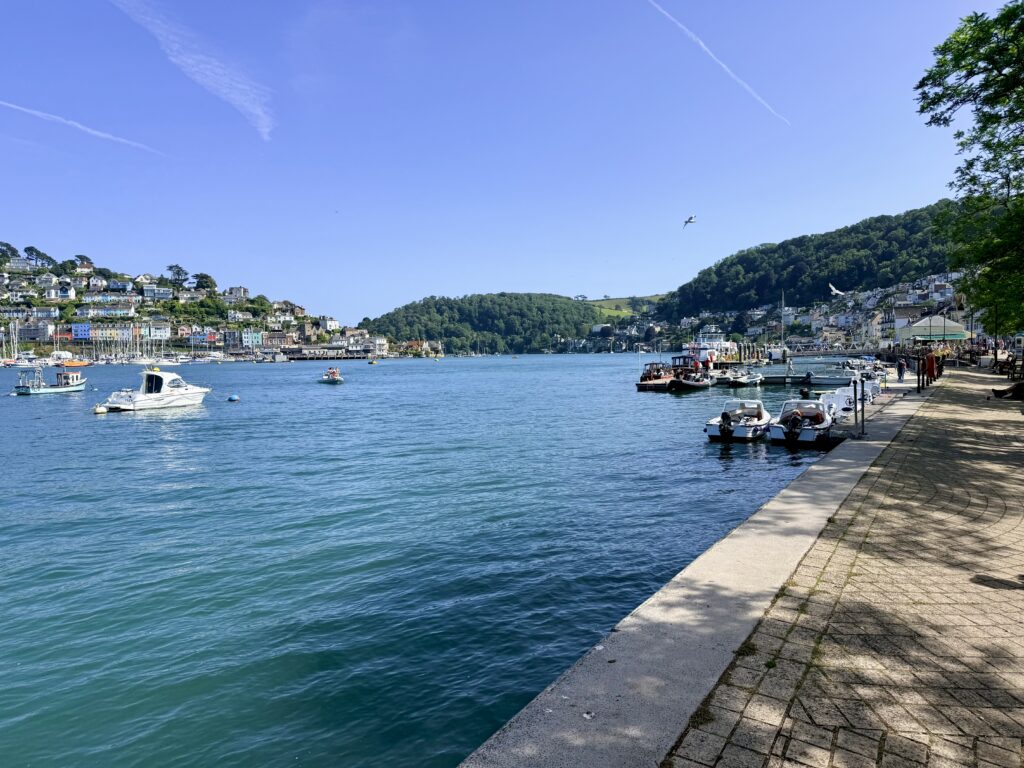
Dartmouth Harbour is the heart of the town. The River Dart widens here before reaching the sea, with Kingswear rising on the opposite bank and boats moving between the moorings, ferry landings and river piers.
A simple waterfront walk is one of the best free things to do in Dartmouth. Start near Royal Avenue Gardens, look across to Kingswear, then continue towards Bayard’s Cove for older streets and harbour views.
This is also the best place to get your bearings. Boat trips, ferries, cafés, pubs, shops and many Dartmouth attractions are all within a short walk.
Explore Dartmouth Town Centre

Dartmouth town centre is one of the main reasons we enjoy visiting. It has a proper harbour-town feel, with independent shops, cafés, galleries, old streets, food shops, outdoor stores, chandlery shops, and river views all close together.
Start around Royal Avenue Gardens and the Boat Float, then explore Duke Street, Foss Street, Fairfax Place, Higher Street, Lower Street and the lanes behind the waterfront. Foss Street is especially good for art galleries, boutiques and smaller independent shops, while Duke Street has The Butterwalk and Dartmouth Museum.
We enjoy Dartmouth because the shops feel different from a standard high street. You will find coastal clothing, art, gifts, homewares, books, local food, sailing kit and outdoor gear, rather than rows of the same national chains.
The Old Market Square is worth a look, with specialist shops and regular market days. Dartmouth Artisan Market is usually held on the second Saturday of the month.
For practical shopping, Dartmouth has town centre convenience stores and food shops, plus larger supermarkets further up the hill. The town centre is also a natural place to stop between ferry crossings, boat trips and walks.
Visit Dartmouth Castle

Dartmouth Castle is one of the main historic places to visit in Dartmouth, standing at the entrance to the Dart Estuary, with views towards Kingswear Castle and the coast. It has guarded the river for more than 600 years, with its gun tower, harbour chain, passageways and displays telling the story of Dartmouth’s maritime defence.
On our last visit, we took the Dartmouth Castle Ferry from Dartmouth and walked back into town. The ferry trip takes around 10 minutes and gives some of the best views of Dartmouth, Kingswear and both castles from the River Dart.
In 2026, ferry fares were £3.50 per adult and £2.50 for under-14s, with dogs travelling free. English Heritage currently says dogs are welcome at Dartmouth Castle on leads, and assistance dogs are welcome too.
Other dog-friendly things to do in Dartmouth include harbour walks, ferry crossings and boat trips, coast path routes, pub stops and Dartmouth Castle, where dogs are welcome on leads.
Dartmouth Castle Tea Rooms are right by the castle and are handy before or after a visit. St Petrox Church is next door and is worth a brief look for its beautiful estuary setting.
For sat nav, use TQ6 0JN. There is a small public car park close by (charges apply), including disabled spaces. When full, there may be free roadside parking on Castle Road, although spaces are limited and the road is narrow.
Always check the current ferry, castle and tea room times before travelling.
Walk to Bayard’s Cove Fort

The walk back from Dartmouth Castle to Dartmouth town centre is just over a mile and takes around 30 minutes. It follows the South West Coast Path, which crosses the River Dart by ferry between Dartmouth and Kingswear.
From the castle, the route passes through Warfleet, a small waterside area tucked between Dartmouth and the estuary entrance. Warfleet Creek was busy with kayakers and stand-up paddleboarders when we visited, and it is one of the prettiest parts of the walk.
For much of the route, you get views across the Dart, with several benches where you can stop and watch the boats. You also pass some of the impressive houses that line this sought-after stretch of the estuary.
Shortly before reaching Dartmouth, the coast path turns right and drops down steps towards Bayard’s Cove. This brings you through Bayard’s Cove Fort, a small 16th-century artillery fort built to help defend Dartmouth’s harbour.
It is much smaller than Dartmouth Castle, but it adds context to the town’s defences. The surrounding streets are among Dartmouth’s most atmospheric, with old buildings, slipways, stone walls and glimpses of the river as you return to the waterfront.
Visit Britannia Royal Naval College

Britannia Royal Naval College is one of Dartmouth’s most recognisable landmarks, standing high above the River Dart. Its large Edwardian buildings can be seen from the waterfront, Kingswear and many river ferries.
The college has trained Royal Navy officers for more than a century and gives Dartmouth a close naval connection alongside its harbour, castle and ferry history. Even if you do not tour inside, it is a major part of the town’s skyline.
Guided public tours are available on selected dates throughout the year. They usually start from the Bandstand in Royal Avenue Gardens, with transport by small coach to the college, followed by a walking tour lasting around 2¼ hours.
Britannia Royal Naval College is a working military establishment, so photo ID is required for visitors aged 16 or over. Tours should be booked in advance, and availability can change, so check the Britannia Association website before planning your visit.
For many people, the best views of the college are from the River Dart, Kingswear, the passenger ferry or a river cruise.
Take a River Dart Boat Trip
A River Dart boat trip is one of the best things to do in Dartmouth, but it does not have to mean a full cruise. Even the short ferry to Kingswear gives you a quick, inexpensive view of Dartmouth from the river.
For the full experience, read our first-hand guide to the River Dart cruise from Dartmouth to Totnes, including what you see along the way, boarding information, tides, seating and practical tips.
Dartmouth to Kingswear Passenger Ferry
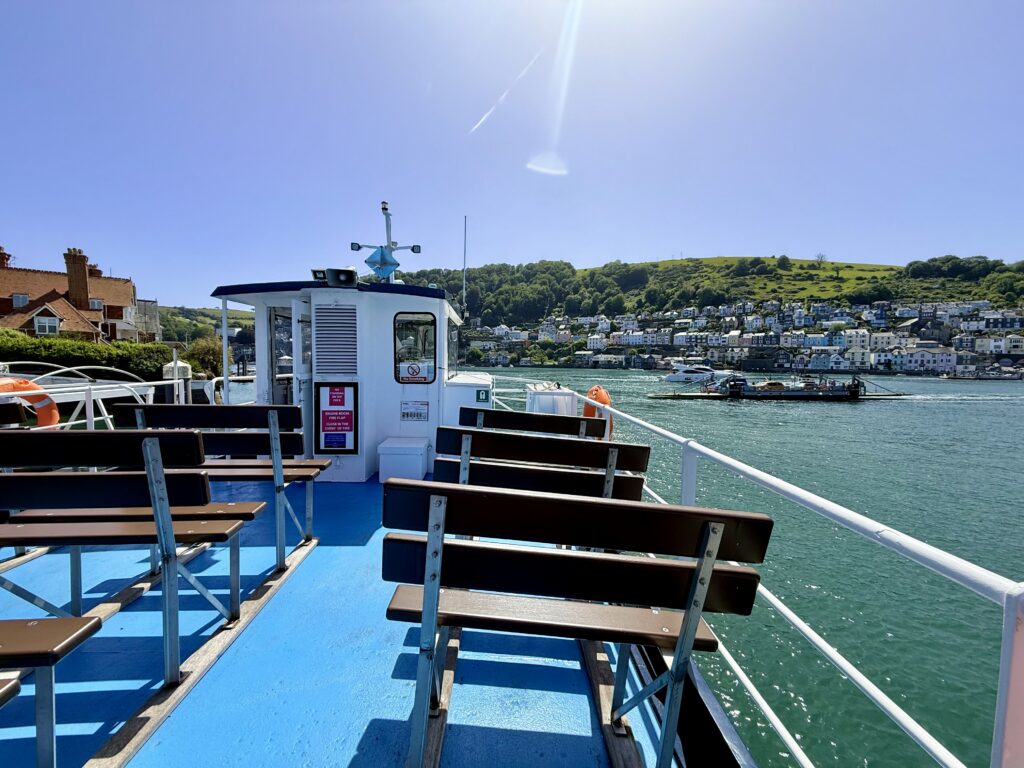
The Dartmouth to Kingswear Passenger Ferry runs between Dartmouth Town Jetty and Kingswear, close to the steam railway station. It takes around five minutes, runs as a frequent shuttle, and adult fares were around £2.50, according to the 2026 Dart Harbour guide.
It is a simple way to enjoy the water, especially if you arrive by steam train or bus via Kingswear.
Dartmouth Round Robin Trip
For a fuller day out, we think the Round Robin is the classic River Dart experience and one of the best things to do in Devon. It combines a steam train, river boat and bus, linking Paignton, Dartmouth and Totnes.
We have also travelled the Dartmouth to Totnes section by river boat, which takes around 90 minutes and passes Greenway, Dittisham, Galmpton Creek, Stoke Gabriel and the upper reaches of the Dart.
It is a great way to visit Dartmouth without a car.
River Dart Cruise
A shorter option is a one-hour River Dart cruise from Dartmouth. Greenway Ferry runs cruises from Dartmouth Town Pontoon, Dittisham or Greenway Quay.
Routes can include views of Britannia Royal Naval College, Sir Walter Raleigh’s Boathouse, Greenway Estate and Dittisham village. In 2026, these cruises were listed at £10 per person.
Dartmouth to Dittisham Ferry

For a proper river village trip, we recommend Dittisham. It is a quintessential River Dart village, with steep lanes, waterside views, the Ferry Boat Inn and a real sense of estuary life.
Dittisham Ferries runs Dartmouth-to-Dittisham services from Dartmouth Town Pontoon, usually between March and November, with regular sailings in season.
Dartmouth to Greenway Ferry
Greenway is another excellent choice from Dartmouth. The former holiday home of Agatha Christie is reached by Greenway Ferry to Greenway Quay, with seasonal services from Dartmouth Town Pontoon.
National Trust entry is separate, so check both ferry times and Greenway opening details before travelling.
Dittisham to Greenway Ferry
There is also a small ferry from Dittisham to Greenway that takes about five minutes to cross the river. It is summoned by ringing the bell at Dittisham Pontoon or Greenway Quay.
This is a handy way to combine Dittisham, Greenway and river walking in one trip.
Dartmouth Higher and Lower Ferry

For crossing the Dart rather than cruising, Dartmouth also has the Lower Ferry and Higher Ferry. The Lower Ferry runs between central Dartmouth and Kingswear, carrying vehicles, cyclists and foot passengers.
The Higher Ferry runs further upriver, links into the A379, operates all year, and saves a long road detour between Dartmouth and Kingswear.
Both vehicle ferries are practical crossings, but they are also part of the Dartmouth experience. In season, queues for the Higher Ferry and Lower Ferry can be considerable, so allow extra time if you are driving.
Even so, the short crossing is memorable, with close-up views of the river, boats and steep banks on either side.
Watersports, Boat Hire and Getting on the River Dart

Dartmouth is a brilliant base for getting on the water, whether by ferry, river cruise, kayak, paddleboard, sailing trip or boat hire. The River Dart is wide around the town, with ferries, moorings, sheltered sections and quieter creeks further upstream.
On our June 2026 visit, Warfleet Creek was busy with kayakers and stand-up paddleboarders. Blackpool Sands also offers kayak and paddleboard hire in season, including guided coastal trips.
For paddleboarding in Dartmouth, The Paddle Shack runs SUP lessons and tours on the River Dart. Sea Kayak Devon is another key local operator, with guided trips, sea kayak courses, paddleboard sessions and longer coastal adventures.
There are also options for casual kayak and paddleboard hire around Dittisham, plus motorboat and RIB hire from Dartmouth. Check requirements carefully, as some self-drive boats need no licence, while faster RIB hire may require experience or a skipper.
Tides, wind and river traffic matter here. The Dart is beautiful, but it is also a working river with ferries, trip boats and changing conditions. The Dart Harbour Guide contains detailed information for water users and is worth reading before setting out. Beginners should use recognised hire companies or guided sessions, and always check local safety advice.
Visit Kingswear
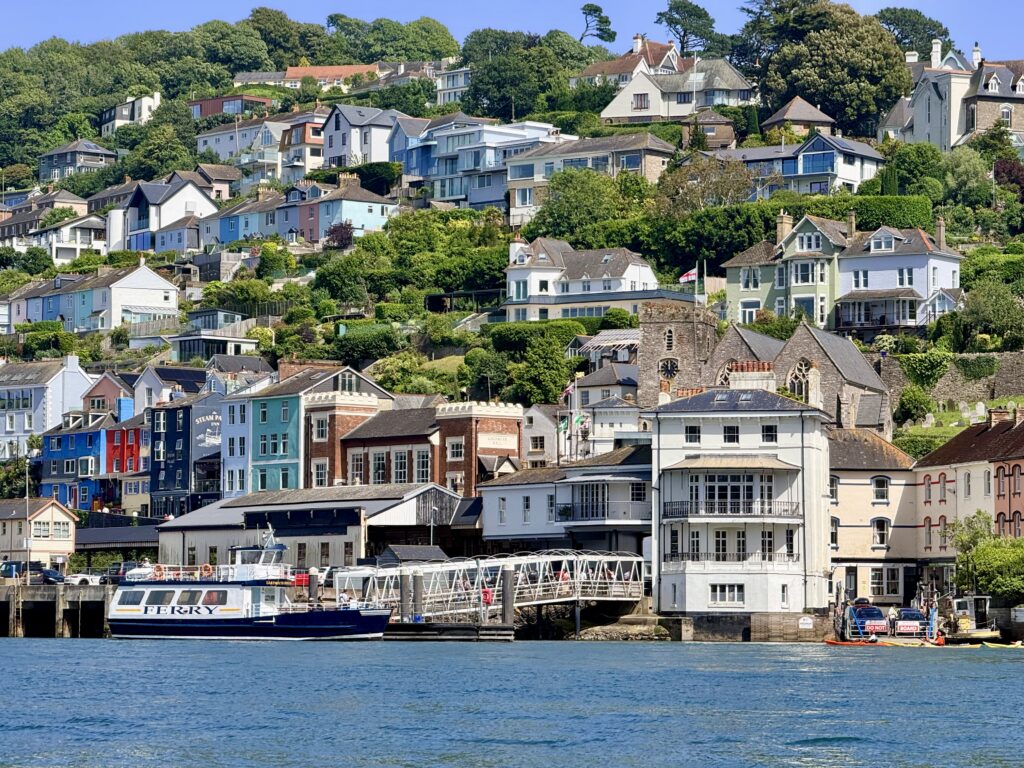
For us, Kingswear and Dartmouth are closely linked, and no visit to one feels complete without crossing the river. If you approach from Paignton, Kingswear is often your first proper glimpse of the River Dart. In all but the worst weather, the view across to Dartmouth, the ferries, and the wooded hills is hard to beat.
Kingswear is directly opposite Dartmouth, with colourful houses rising above the waterfront. It is also the arrival point for the Dartmouth Steam Railway from Paignton.
The village has long been connected with ferries, river traffic, trade and coastal defence. Kingswear Castle, a 15th-century artillery tower, still stands opposite Dartmouth Castle and helps show the historic importance of the Dart Estuary.
Kingswear is also good for walking. The path towards the Higher Ferry gives excellent river views, while longer routes connect with the Dart Valley Trail, Greenway, Coleton Fishacre and Brownstone Battery.
For a simple visit, take the passenger ferry from Dartmouth to Kingswear, walk along the waterfront, watch the steam trains, and enjoy the view back across the Dart.
Ride the Dartmouth Steam Railway to or from Kingswear
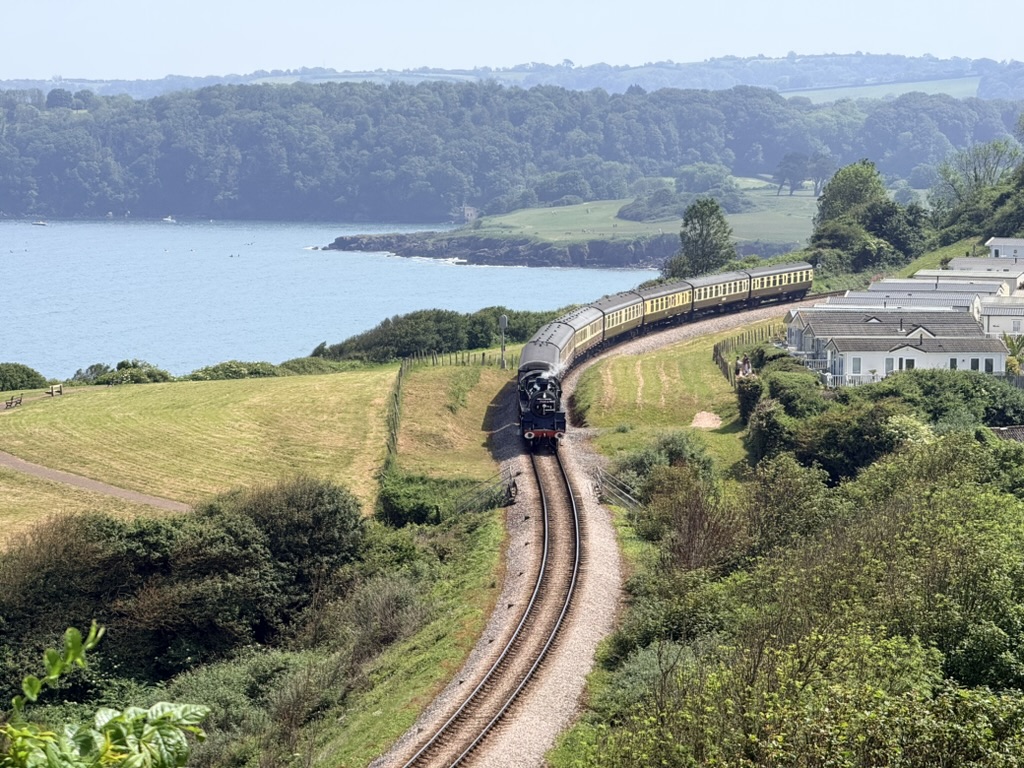
Dartmouth does not have its own railway station. Instead, trains arrive at Kingswear, across the River Dart, where the Dartmouth Steam Railway connects with Paignton.
The line opened to Kingswear in the 1860s as part of South Devon’s railway expansion. Today, it is one of the most memorable car-free ways to visit Dartmouth, combining steam-train travel, coastal views, and the short ferry crossing into town.
This is a good option if you are visiting Dartmouth from Paignton, Brixham or Torquay. You can travel one way by bus and the other by steam railway, or include it as part of the Round Robin route linking train, river boat and bus.
For us, the Round Robin is one of the best days out in Devon. We have done it several times, and it brings together coast, countryside, river scenery, steam railway travel and Dartmouth in one trip.
Good places to watch the trains include Kingswear waterfront, the path towards the Higher Ferry, Goodrington Beach in Paignton, and parts of the coastal footpath between Goodrington and Broadsands.
Visit Dartmouth Museum
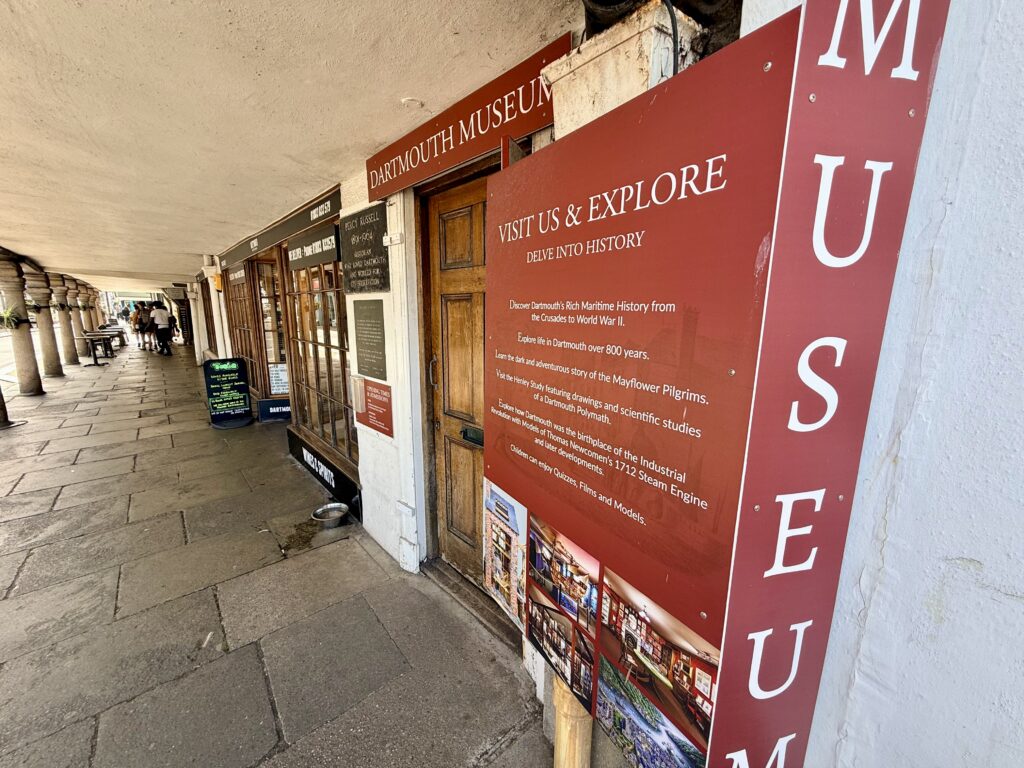
Dartmouth Museum is housed in The Butterwalk on Duke Street, one of the town’s most distinctive historic buildings. The terrace dates from around 1640 and is known for its leaning structure, uneven floors and old merchant-house character.
The museum covers Dartmouth’s maritime, trading and social history, with displays on ships, local families, Dartmouth pottery, Thomas Newcomen, the Mayflower story and the town’s wider links with the sea. The King’s Room is one of the highlights, associated with King Charles II’s stay in Dartmouth during a storm in 1671.
Unfortunately, Dartmouth Museum was closed when we last visited, as was the Dartmouth Tourist Information Centre, but that gives us a good excuse to return. The Tourist Information Centre is by the Mayor’s Avenue car park, close to the Newcomen Engine House, which contains the preserved Newcomen Memorial Engine. It is widely described as the world’s oldest surviving steam engine and commemorates Thomas Newcomen, who was born in Dartmouth.
Dartmouth Museum is one of the most interesting indoor activities in Dartmouth, especially on a wet day. For rainy days in Dartmouth, also look at The Flavel Arts Centre, cafés, pubs, galleries, independent shops, covered ferry crossings and boat trips.
Dartmouth Museum is at The Butterwalk, Duke Street, Dartmouth, TQ6 9PZ.
Visit Greenway
Greenway is one of the best places to visit near Dartmouth, especially if you are interested in Agatha Christie, River Dart scenery or National Trust houses. Set above the river near Galmpton, close to Brixham, it was Agatha Christie’s much-loved holiday home, and she famously called it “the loveliest place in the world”.
The Georgian house is presented with 1950s interiors and family collections, including books, first editions and objects gathered by Christie and her family. Outside, the estate has walled gardens, woodland paths, riverside views, a boathouse linked to Dead Man’s Folly, and a 1790s gun battery built as a Napoleonic defence.
Greenway is a good half-day trip from Dartmouth, and arriving is the best way to visit. Seasonal ferries run from Dartmouth to Greenway Quay, and there is also a small Dittisham to Greenway ferry, which can be called by ringing the bell at either side.
You can also visit by car via Greenway Road, Galmpton, near Brixham, TQ5 0ES. Parking must usually be booked in advance through the National Trust, and availability is not guaranteed without a reservation. Larger vehicles are restricted, and there is no parking on Greenway Road or in Galmpton village.
For walkers, Greenway can be reached from Kingswear via the Dart Valley Trail, or from Dartmouth by combining ferry crossings and riverside paths. It can also be linked with Churston, Broadsands or the Dartmouth Steam Railway for a longer day out.
There is a café, a shop, and a second-hand bookshop on site, making it a possible option in mixed weather. Check current National Trust opening times, admission details, parking requirements and ferry services before travelling, as access varies by season.
Things to Do Near Dartmouth

Dartmouth is a good base for exploring the River Dart, the South Hams and the English Riviera. Once you have seen the harbour, castle, ferries and town centre, there are several easy trips nearby.
Coleton Fishacre
Coleton Fishacre, near Kingswear, is another excellent National Trust option. It combines a 1920s country house, Art Deco interiors, coastal gardens and access towards the South West Coast Path.
Blackpool Sands
Blackpool Sands is one of the best-known beaches near Dartmouth. It is a privately owned shingle beach near Stoke Fleming, with food, parking, watersports, toilets, showers and seasonal facilities.
Woodlands Family Theme Park
Families may want to look at Woodlands Family Theme Park, about five miles from Dartmouth on the A3122. It has rides, indoor play, animals and all-weather activities.
Slapton Ley and Slapton Sands
For wildlife, walking and coastal scenery, Slapton Ley is a good South Hams day out. The freshwater lake is separated from the sea by the long shingle beach at Slapton Sands.
Totnes
Totnes is another excellent place to visit near Dartmouth. It offers a very different side of the River Dart, with historic streets, a castle, independent shops and markets. Seasonal cruises connect the two towns, and our Dartmouth to Totnes River Dart cruise guide follows the complete journey, including the villages, creeks, historic sites and wildlife you may see along the way.
Dartington
A visit to Dartington can be combined with a visit to Totnes or the wider River Dart. Dartington Hall has gardens, arts, events, places to eat and riverside walks nearby, while the estate gives a quieter contrast to Dartmouth’s harbour and ferry traffic.
It works especially well for couples, garden lovers, walkers and anyone planning a slower South Devon break. If you are staying near Totnes, Dartington is one of the easiest places to add to a Dartmouth trip.
South Devon Railway
The South Devon Railway is another good day out near Dartmouth, especially for steam railway fans. It runs between Buckfastleigh and Totnes Riverside, following the River Dart through attractive countryside.
Brixham, Paignton and Torquay
Torbay is within reach. Brixham is best for harbour life, seafood, Berry Head and the breakwater, while Paignton links well with the Dartmouth Steam Railway. Torquay offers beaches, marina walks, and wider English Riviera facilities.
Walks Near Dartmouth
For quieter walks, look at Little Dartmouth, Gallants Bower, Brownstone Battery, the Dart Valley Trail and the coast path towards Stoke Fleming, Strete and Start Point. These are better saved for a dedicated Dartmouth walks or South Hams coast guide.
What’s On in Dartmouth, Devon: Festivals and Seasonal Highlights

Dartmouth has a lively events calendar, with the waterfront giving many festivals a natural setting. If you are looking for what’s on in Dartmouth, expect maritime events, food festivals, music, theatre, markets and seasonal celebrations.
The biggest annual event is the Port of Dartmouth Royal Regatta, usually held in late August. It brings rowing, sailing, music, fireworks, markets and shoreside activity to both Dartmouth and Kingswear.
Other regular highlights include Dart Music Festival in May, Dartmouth Shakespeare Week in summer and Dartmouth Food Festival in October. The Flavel Arts Centre also adds cinema, theatre, talks, live music and community events throughout the year.
Dartmouth Old Market Square is worth checking during your visit. Main market days are usually held on Tuesdays and Fridays, with extra Thursday markets in the summer high season. Saturday markets often vary by week, including tabletop, farmers’, emporium and artisan markets.
Dartmouth is a good town to plan a short break around an event, but accommodation can book quickly during regatta week and festival weekends. For more ideas across the region, see our guide to what’s on in South West England. Always check current dates, market days and event details before travelling, as programmes can change.
How to Get to Dartmouth and Travel Around
![keyword suggestions for things to do in dartmouth a complete visitors guide
Ubersuggest
For your article, I’d use this as the core SEO structure.
Primary keyphrase
things to do in Dartmouth
This is the clear main target. Ubersuggest shows around 1,900 UK searches/month, with relatively manageable SEO difficulty compared with bigger destination terms.
Best SEO title options
Things to Do in Dartmouth, Devon: A Complete Visitor Guide
or slightly more engaging:
Things to Do in Dartmouth, Devon: Harbour, Castle, Walks & Day Trips
or for stronger CTR:
Best Things to Do in Dartmouth, Devon: A Complete Visitor Guide
My preferred version:
Things to Do in Dartmouth, Devon: A Complete Visitor Guide
It is clean, direct, and matches search intent.
Suggested slug
things-to-do-in-dartmouth
Meta description
Discover the best things to do in Dartmouth, Devon, including the harbour, castle, river trips, coastal walks, beaches, nearby villages and places to eat.
Approx 153 characters.
Secondary keywords to use naturally
Use these across headings, intro, FAQs and image alt text:
things to do in Dartmouth Devon
best things to do in Dartmouth
things to do in and around Dartmouth
what to do in Dartmouth
what is there to do in Dartmouth
places to visit in Dartmouth
places to visit near Dartmouth
things to see in Dartmouth Devon
Dartmouth attractions
Dartmouth harbour
Dartmouth Castle
Dartmouth town centre
Dartmouth Devon visitor guide
visit Dartmouth Devon
Useful long-tail keywords
These are good for subheadings and FAQs:
is Dartmouth worth visiting
unusual things to do in Dartmouth
things to do in Dartmouth in the rain
things to do in Dartmouth for adults
things to do in Dartmouth with kids
dog friendly things to do in Dartmouth
free things to do in Dartmouth
things to do in Dartmouth today
things to do in Dartmouth this weekend
things to do near Dartmouth in the rain
romantic things to do in Dartmouth
things to do in Dartmouth harbour
things to do in Dartmouth at night
what to do in Dartmouth for a day
Location and attraction keywords
These should help the page rank beyond the generic "things to do" phrase:
Dartmouth Castle
Bayard’s Cove Fort
Royal Avenue Gardens Dartmouth
Dartmouth Museum
Dartmouth Harbour
River Dart boat trips
Dartmouth Steam Railway and River Boat Company
Dartmouth to Kingswear ferry
Kingswear Dartmouth
Greenway House near Dartmouth
Coleton Fishacre near Dartmouth
Blackpool Sands near Dartmouth
Sugary Cove Dartmouth
Dartmouth waterfront
South West Coast Path Dartmouth
Dart Valley Trail
Dartmouth Regatta
Suggested H1
Things to Do in Dartmouth, Devon: A Complete Visitor Guide
Suggested article structure
Introduction
Naturally include "things to do in Dartmouth", "Dartmouth Devon" and "visit Dartmouth".
At a Glance: Dartmouth, Devon
Good for UX and AI summaries.
A Short History of Dartmouth
Keep this fairly concise. Dartmouth has rich maritime history, but the search intent is mainly practical.
Best Things to Do in Dartmouth
Main H2 using the primary phrase.
Possible H3s:
Explore Dartmouth Harbour
Visit Dartmouth Castle
Walk to Bayard’s Cove Fort
Take a River Dart Boat Trip
Ride the Dartmouth Steam Railway from Kingswear
Explore Dartmouth Town Centre
Visit Dartmouth Museum
Relax in Royal Avenue Gardens
Walk Part of the South West Coast Path
Visit Blackpool Sands
Take the Ferry to Kingswear
Visit Greenway House
Explore Coleton Fishacre
Plan Around Dartmouth Regatta
FAQ keywords to target
I’d add a compact FAQ near the end using these:
Is Dartmouth worth visiting?
What is Dartmouth best known for?
What are the best free things to do in Dartmouth?
What can you do in Dartmouth in the rain?
Is Dartmouth good for a day trip?
Can you visit Dartmouth without a car?
Where is the best place to park in Dartmouth?
What are the best things to do near Dartmouth?
Is Dartmouth dog friendly?
How do you get from Dartmouth to Kingswear?
Internal link opportunities
Link naturally to:
Things to do in Devon
Towns in Devon
Things to do in Paignton
Things to do in Brixham
Best Torbay beaches
South West Coast Path guides
What’s on in South West England
You could also create future supporting posts for:
Dartmouth Castle guide
Best walks near Dartmouth
Dartmouth to Kingswear ferry guide
Best beaches near Dartmouth
Things to do near Dartmouth without a car
Best overall target set:
Primary: things to do in Dartmouth
Secondary: things to do in Dartmouth Devon
Support: things to do in and around Dartmouth
Intent booster: is Dartmouth worth visiting
Local detail: Dartmouth harbour, Dartmouth Castle, Dartmouth town centre, Kingswear ferry, Blackpool Sands.
OK with this in mind help me draft an article for dartmouth with the following equivalent sections - Introduction, Map of Exmouth Town Centre
A Brief History of Exmouth
Things to Do in Exmouth, Devon
Explore Exmouth Town Centre
What's On in Exmouth, Devon: Festivals and Seasonal Highlights
How to Get to Exmouth and Travel Around
Where to Eat and Drink in Exmouth
Where to Stay in Exmouth, Devon
Weather in Exmouth, Devon: When to Visit
Is Exmouth Worth Visiting?
Worked for 40s
Below is a full draft in the same structure as your Exmouth guide, adjusted for Dartmouth search intent.
Things to Do in Dartmouth, Devon: A Complete Visitor Guide
Dartmouth is one of South Devon’s most distinctive harbour towns, set on the western bank of the River Dart opposite Kingswear. With its waterfront, ferries, castle, historic streets, boat trips and nearby beaches, it is a strong choice for a day trip, weekend break or longer South Devon stay.
This guide covers the best things to do in Dartmouth, Devon, including Dartmouth Castle, the harbour, the town centre, river trips, walks, nearby National Trust places, beaches and practical travel advice.
Dartmouth suits several types of trip. You can keep things simple with a harbour walk, coffee and a ferry crossing, or build a full day around castles, coast paths, boat trips and nearby places to visit.
Map of Dartmouth Town Centre
Dartmouth town centre is compact, but its layout is shaped by the River Dart, steep streets and ferry links. Most first-time visits centre on the waterfront, Royal Avenue Gardens, the Boat Float, Duke Street, Foss Street, Bayard’s Cove and the streets leading uphill from the harbour.
The main visitor area is easy to explore on foot. The waterfront gives you access to boat trips, ferries to Kingswear, harbour views and level walking beside the river.
Dartmouth Castle sits outside the main town centre on Castle Road. You can walk there from the waterfront, take a seasonal passenger boat when operating, or drive if you are happy with narrow roads and limited parking. English Heritage lists Dartmouth Castle at Castle Road, Dartmouth, TQ6 0JN.
For a useful embedded map, add a Google Map centred on Dartmouth Boat Float or Royal Avenue Gardens. This gives readers a practical town centre reference point before they reach the detailed things to do section.
A Brief History of Dartmouth
Dartmouth’s history is closely tied to the River Dart and the sea. The town developed as a port, trading centre and defensive harbour, with its deep-water setting giving it strategic importance for centuries.
The town’s maritime past can still be seen around the waterfront, Bayard’s Cove, Dartmouth Castle and the narrow streets behind the harbour. The Butterwalk, built around 1640, is one of Dartmouth’s most notable historic buildings and now houses Dartmouth Museum.
Dartmouth Castle has guarded the entrance to the Dart Estuary for more than 600 years. English Heritage describes it as one of England’s most beautifully located fortresses, with installations explaining its story through to the Second World War.
Dartmouth also has a strong naval connection through Britannia Royal Naval College, which stands above the town. Its presence adds another layer to Dartmouth’s long association with ships, training, defence and the wider maritime world.
Things to Do in Dartmouth, Devon
For most people, the best things to do in Dartmouth begin by the water. The harbour is the natural focus of the town, with boats, ferries, river views and a constant sense of movement.
Explore Dartmouth Harbour
Dartmouth Harbour is the heart of the town. The River Dart widens here before reaching the sea, with Kingswear rising on the opposite bank and boats moving between the moorings, ferry landings and river piers.
A simple waterfront walk is one of the best free things to do in Dartmouth. Start near Royal Avenue Gardens, look across to Kingswear, then continue towards Bayard’s Cove for older streets and harbour views.
This is also a good place to get your bearings. Boat trips, ferries, cafés, pubs, shops and many Dartmouth attractions are within a short walk.
Visit Dartmouth Castle
Dartmouth Castle is one of the town’s headline historic attractions. It stands at the entrance to the Dart Estuary, with views across the water towards Kingswear Castle and out towards the coast.
The castle has guarded the river entrance for more than six centuries. Inside, English Heritage highlights the gun tower, harbour chain, passageways, sound and light displays and family-friendly interpretation.
You can reach the castle by walking from the town centre, although the route includes some gradients. In season, the boat from Dartmouth makes the journey feel more memorable and gives some of the best views of the castle from the water.
Walk to Bayard’s Cove Fort
Bayard’s Cove Fort is a small but atmospheric historic site close to the lower end of Dartmouth’s waterfront. It is much smaller than Dartmouth Castle, but it adds useful context to the town’s defences.
The walk from the town centre to Bayard’s Cove is short and rewarding. The surrounding streets have some of Dartmouth’s most characterful views, with old buildings, slipways, stone walls and glimpses of the river.
This is a good section for readers searching for unusual things to do in Dartmouth, as it is easy to miss if you stay only around the main quay.
Take a River Dart Boat Trip
A boat trip is one of the best ways to understand Dartmouth. From the water, you see the town, Kingswear, wooded riverbanks and the scale of the Dart Estuary far better than you can from the street.
River trips often run between Dartmouth, Totnes, Greenway and other points along the Dart, depending on season and operator. Timetables vary, so readers should check before travelling.
This is one of the strongest things to do in and around Dartmouth for couples, families and anyone visiting without a car. It also works well as a relaxed alternative to driving narrow South Hams lanes.
Ride the Dartmouth Steam Railway from Kingswear
Dartmouth does not have its own railway station. Instead, trains arrive at Kingswear, across the River Dart, where the Dartmouth Steam Railway connects with Paignton.
The heritage railway runs along the coast and River Dart side between Paignton and Kingswear. From Kingswear, passengers cross to Dartmouth by ferry. The railway and ferry combination is one of the classic ways to visit Dartmouth from Torbay.
This is particularly useful for readers planning things to do near Dartmouth or looking for a car-free day out from Paignton, Brixham or Torquay.
Visit Dartmouth Museum
Dartmouth Museum is based in the historic Butterwalk and gives useful background to the town’s maritime, social and local history. The museum describes its collections as including artefacts, models, paintings and photographs relating to Dartmouth and the surrounding district.
It is a good option on wet days, especially if you want more than a surface-level look at the town. Displays include Dartmouth’s maritime story, ship models, local figures and the town’s part in wider events.
For a visitor guide, this section is also useful for search intent around things to do in Dartmouth in the rain.
Visit Greenway
Greenway, the former holiday home of Agatha Christie and her family, is one of the best places to visit near Dartmouth. The National Trust describes it as a Georgian house with 1950s interiors, riverside gardens, woodland and River Dart views.
The setting is a major part of the appeal. There are gardens, a boathouse, river views and walks around the estate, making it more than a house visit.
Greenway works particularly well as part of a river trip from Dartmouth, although access and transport options vary by season. Check the National Trust and ferry details before planning your day.
Visit Coleton Fishacre
Coleton Fishacre is another excellent National Trust place near Dartmouth, located close to Kingswear. It is a 1920s country retreat with Arts and Crafts architecture, Art Deco interiors and a coastal valley garden.
The garden is one of its biggest draws, with exotic planting, sea views and access towards the South West Coast Path. It feels quite different from Greenway, so both can justify separate visits.
This is a strong choice for readers looking for places to visit near Dartmouth, especially if they enjoy gardens, design, coast path walks or quieter countryside settings.
Visit Blackpool Sands
Blackpool Sands is one of the best-known beaches near Dartmouth. It is a sheltered shingle beach south-west of the town, backed by trees and hills.
It is not in Dartmouth itself, but it is close enough to include in a Dartmouth visitor guide. It is a good option for a beach stop, especially in warmer months or as part of a wider drive towards Stoke Fleming and Slapton.
As with many South Devon beaches, parking and facilities can change seasonally. Readers should check ahead in summer, particularly during school holidays.
Walk Part of the South West Coast Path
Dartmouth is a good base for coast and estuary walking. The South West Coast Path crosses the Dart by ferry, linking Dartmouth and Kingswear before continuing along the coast.
Shorter walks around Dartmouth Castle, Gallants Bower, Warfleet Creek and the coast path above the estuary can give excellent views without needing a full-day route.
For experienced walkers, Dartmouth also connects into longer South Devon routes towards Stoke Fleming, Blackpool Sands, Strete and beyond. The terrain can be steep, so proper footwear is sensible.
Explore Dartmouth Town Centre
Dartmouth town centre is one of the main reasons to visit. It combines a working harbour feel with independent shops, cafés, galleries, old streets and river views.
Start around Royal Avenue Gardens and the Boat Float, then explore Duke Street, Foss Street and the lanes behind the waterfront. The Butterwalk is one of the key historic features, while Bayard’s Cove gives the lower end of town a more old-port feel.
Dartmouth is a good town for slow browsing. You will find galleries, food shops, clothing stores, gifts, bookshops and cafés rather than a standard high street.
The town centre is also where many visitors naturally pause between ferry crossings, boat trips and walks. Even without paying for an attraction, Dartmouth has enough interest for a few hours of exploring.
What’s On in Dartmouth, Devon: Festivals and Seasonal Highlights
Dartmouth has a busy events calendar, with the waterfront giving many local festivals a strong sense of place. The biggest annual event is the Port of Dartmouth Royal Regatta, which takes place in late August and brings rowing, sailing, markets, music and shoreside activity to the town.
For 2026, Discover Dartmouth lists the Port of Dartmouth Royal Regatta for 26 to 29 August 2026. It also lists Dartmouth Food Festival for 23 to 25 October 2026.
The regatta is the major summer highlight, but Dartmouth also has music, food, arts, community and seasonal events across the year. The Flavel arts centre adds theatre, film, talks and live performances to the town’s cultural calendar.
For your internal linking, this section should point to your South West England events calendar. It is also a good place to include "what’s on in Dartmouth" and "things to do in Dartmouth this weekend" naturally.
How to Get to Dartmouth and Travel Around
Dartmouth is slightly unusual because the nearest railway access is across the river at Kingswear or via Totnes and onward bus links. This makes travel planning more important than in some Devon towns.
By car, Dartmouth is reached by road through the South Hams, with routes from Totnes, Kingsbridge and Torbay. Roads close to Dartmouth can be narrow and busy in summer, so allow extra time in peak season.
By public transport, many visitors travel by train to Totnes or Paignton, then continue by bus, ferry or heritage railway. Kingswear is linked to Dartmouth by ferry, and there are three ferry options between Dartmouth and Kingswear: the Higher Ferry, Lower Ferry and Passenger Ferry.
Once in Dartmouth, the town centre is best explored on foot. Ferries, boat trips and buses are useful for reaching Kingswear, Greenway, Totnes, nearby villages and wider South Devon.
Where to Eat and Drink in Dartmouth
Dartmouth is one of South Devon’s stronger food towns, helped by its harbour setting and steady year-round appeal. Seafood is a natural focus, but the town also has pubs, cafés, bakeries, bistros and relaxed places for coffee or lunch.
The waterfront is the obvious place to start, especially if you want river views. Around the town centre, smaller streets offer more independent cafés, restaurants and pubs.
For a simple visit, Dartmouth works well for coffee and cake, fish and chips by the water, a pub lunch or a more planned evening meal. In summer, booking ahead is sensible for the better-known restaurants.
This section could also support affiliate and internal links later. A future article on "best places to eat in Dartmouth" would be a useful supporting post.
Where to Stay in Dartmouth, Devon
Dartmouth has a good range of places to stay, including hotels, guest houses, B&Bs, self-catering cottages and apartments. Many are in or close to the town centre, which is useful if you want to park once and explore on foot.
Staying in the centre suits first-time visitors who want harbour views, restaurants and ferries nearby. Accommodation around Kingswear can also work well, especially if you like river views and easy access to the steam railway.
For quieter stays, look at the countryside around Stoke Fleming, Dittisham, Blackawton, Strete and the River Dart. These areas suit walkers, couples and longer South Devon breaks.
Dartmouth is not always the cheapest place to stay in peak summer. For better value, compare dates carefully and consider shoulder-season trips in spring, early summer or autumn.
Weather in Dartmouth, Devon: When to Visit
Dartmouth has a mild South Devon coastal climate, with the best visitor weather usually from late spring to early autumn. May, June, July and September are often good choices if you want longer days without the busiest school holiday crowds.
Summer is best for boat trips, beaches, alfresco eating and longer evenings around the harbour. It is also the busiest and most expensive period, especially during regatta week and school holidays.
Spring suits walking, gardens and quieter town exploring. Autumn can be excellent for food events, river views and coastal walks, although daylight is shorter and weather becomes less predictable.
Winter is quieter, with a more local feel. Some seasonal attractions, boat services and cafés may reduce hours, so check before travelling.
Is Dartmouth Worth Visiting?
Yes, Dartmouth is worth visiting, especially if you like harbour towns, river scenery, history, boat trips and independent places to eat and shop. It has more depth than a simple seaside stop, with Dartmouth Castle, Bayard’s Cove, the River Dart, Kingswear ferries, Greenway and Coleton Fishacre all adding variety.
It is particularly good for couples, walkers, history fans, food-focused breaks and car-free days out from Torbay using the steam railway and ferry. Families can also enjoy the castle, river trips, crabbing, nearby beaches and short walks.
The main drawbacks are summer crowds, parking pressure and the steep streets behind the waterfront. Even so, Dartmouth remains one of the most rewarding places to visit in South Devon.
For a first visit, allow at least a full day. For a more relaxed trip, stay one or two nights and combine the town with the River Dart, Kingswear, Blackpool Sands, Greenway or Coleton Fishacre.
We would echo that. Dartmouth Castle has guarded the entrance to the Dart Estuary for more than 600 years, and its position above the water is one of the most memorable in South Devon.
English Heritage describes it as one of England’s most beautifully located fortresses. The castle helps explain Dartmouth’s long maritime story, from river defence and coastal trade through to its role during the Second World War.
A few good alternatives to "adds another layer":
Option 1
Dartmouth also has a strong naval connection through Britannia Royal Naval College, which stands above the town. Its presence reinforces Dartmouth’s long association with ships, training, defence and the wider maritime world.
Option 2
Dartmouth also has a strong naval connection through Britannia Royal Naval College, which stands above the town. It remains a visible reminder of the town’s long association with ships, training, defence and the wider maritime world.
Option 3
Dartmouth also has a strong naval connection through Britannia Royal Naval College, which stands above the town. Together with the harbour and castle, it helps tell the story of a town closely linked to ships, training, defence and the wider maritime world.
My preferred version:
Dartmouth also has a strong naval connection through Britannia Royal Naval College, which stands above the town. It remains a visible reminder of the town’s long association with ships, training, defence and the wider maritime world.
Take the Ferry to Dartmouth Castle
On our last visit, we took the ferry from Dartmouth to Dartmouth Castle and walked back into town afterwards. It is an inexpensive and memorable way to see Dartmouth from the River Dart, especially if you want views of Dartmouth, Kingswear, Kingswear Castle and Dartmouth Castle from the water.
The journey takes around 10 minutes and gives a very different view of the estuary. In 2026, fares were £3.50 per adult, £2.50 for under 14s, with dogs travelling free.
Dogs are also welcome on leads inside Dartmouth Castle, and there is good dog walking around the Castle Estate. This makes the ferry and castle a useful option if you are looking for dog friendly things to do in Dartmouth.
During our visit, the ferry started from Dartmouth at 10:00 am. The last ferry from Dartmouth was 4:45 pm, with the final return from the castle at 5:00 pm. Always check current operating times before travelling, as seasonal services can change.
Visit Dartmouth Castle
Dartmouth Castle is one of the main historic things to do in Dartmouth, standing at the entrance to the Dart Estuary with views towards Kingswear Castle and the coast. It has guarded the river entrance for more than 600 years, with its gun tower, harbour chain, passageways and displays helping to tell the story of Dartmouth’s maritime defence.
On our last visit, we took the ferry from Dartmouth to Dartmouth Castle and walked back into town afterwards. The short journey takes around 10 minutes and is one of the best ways to see Dartmouth, Kingswear and both castles from the River Dart.
In 2026, fares were £3.50 per adult and £2.50 for under 14s, with dogs travelling free. Dogs are also welcome on leads inside Dartmouth Castle, and there is good walking around the Castle Estate.
During our visit, the ferry started from Dartmouth at 10:00 am. The last ferry from Dartmouth was 4:45 pm, with the final return from the castle at 5:00 pm. Always check current times before travelling, as seasonal services can change.
fact check - dogs are allowed on the ferry but not sure about the castle Visit Dartmouth Castle
Dartmouth Castle is one of the main historic things to do in Dartmouth, standing at the entrance to the Dart Estuary with views towards Kingswear Castle and the coast. It has guarded the river entrance for more than 600 years, with its gun tower, harbour chain, passageways and displays helping to tell the story of Dartmouth’s maritime defence.
On our last visit, we took the ferry from Dartmouth to Dartmouth Castle and walked back into town afterwards. The short journey takes around 10 minutes and is one of the best ways to see Dartmouth, Kingswear and both castles from the River Dart.
In 2026, fares were £3.50 per adult and £2.50 for under 14s, with dogs travelling free. Dogs are also welcome on leads inside Dartmouth Castle, and there is good walking around the Castle Estate.
During our visit, the ferry started from Dartmouth at 10:00 am. The last ferry from Dartmouth was 4:45 pm, with the final return from the castle at 5:00 pm. Always check current times before travelling, as seasonal services can change.
Worked for 17s
You were right to check. Dogs are allowed at Dartmouth Castle on leads, according to the current English Heritage facilities page. It says: "Dogs welcome on leads. Assistance dogs welcome."
Here is the tidied version with the dog wording kept, but made a little safer and more precise:
Visit Dartmouth Castle
Dartmouth Castle is one of the main historic things to do in Dartmouth, standing at the entrance to the Dart Estuary with views towards Kingswear Castle and the coast. It has guarded the river entrance for more than 600 years, with its gun tower, harbour chain, passageways and displays helping to tell the story of Dartmouth’s maritime defence.
On our last visit, we took the ferry from Dartmouth to Dartmouth Castle and walked back into town afterwards. The short journey takes around 10 minutes and is one of the best ways to see Dartmouth, Kingswear and both castles from the River Dart.
In 2026, fares were £3.50 per adult and £2.50 for under 14s, with dogs travelling free. English Heritage currently says dogs are welcome at Dartmouth Castle on leads, and assistance dogs are welcome too. There is also good walking nearby, including coast and woodland paths around the castle area.
During our visit, the ferry started from Dartmouth at 10:00 am. The last ferry from Dartmouth was 4:45 pm, with the final return from the castle at 5:00 pm. Always check current ferry and castle times before travelling, as seasonal services can change.
mention also, dartmouth castle tea rooms Dartmouth Castle is one of the main historic things to do in Dartmouth, standing at the entrance to the Dart Estuary with views towards Kingswear Castle and the coast. It has guarded the river entrance for more than 600 years, with its gun tower, harbour chain, passageways and displays helping to tell the story of Dartmouth’s maritime defence.
On our last visit, we took the ferry from Dartmouth to Dartmouth Castle and walked back into town afterwards. The short journey takes around 10 minutes and is one of the best ways to see Dartmouth, Kingswear and both castles from the River Dart. Dartmouth Castle
Tea Rooms
HOME
GALLERY
FIND US
SUMMER
HOURS
Open
Monday-Sunday
9am -5pm
Serving Takeaway Breakfast Rolls, Delicious Cakes, Savoury Snacks, Light Lunches, Sweet Treats,
Woodroast Coffee and Hot & Cold Drinks
We occasionally close or close early if the weather is particularly bad
FOLLOW US
In 2026, fares were £3.50 per adult and £2.50 for under 14s, with dogs travelling free. English Heritage currently says dogs are welcome at Dartmouth Castle on leads, and assistance dogs are welcome too. There is also good walking nearby, including coast and woodland paths around the castle area.
During our visit, the ferry started from Dartmouth at 10:00 am. The last ferry from Dartmouth was 4:45 pm, with the final return from the castle at 5:00 pm. Always check current ferry and castle times before travelling, as seasonal services can change. Dartmouth Castle Tea Rooms
Getting there
The tea rooms is situated next to the English Heritage heirloom Dartmouth Castle. The unique location of the tea rooms on the entrance to the Dart Estuary means that you can visit us by boat! In the summer months, take the wonderful family run passenger ferry from Dartmouth Harbour and enjoy a spot of seal spotting as you sail along the coast - the best views of the castle and tea rooms are from the water! Have a look at the Ferry team's website for updates:
Adjacent to the tea rooms is a small public car park which includes disabled spots. When that is full, there is normally always space to park for free on Castle Road too!
For those that prefer a leg stretch, we are just a short 20 minute meander from Dartmouth town centre. If you're up for a real adventure, there are many stunning coastal path walks to explore nearby. Start your walk with a freshly ground coffee and finish with a well deserved slice of cake. In the winter we'll have the fire going so come and warm up after your coastal path hike!
Visit Dartmouth Castle
Dartmouth Castle is one of the main historic things to do in Dartmouth, standing at the entrance to the Dart Estuary with views towards Kingswear Castle and the coast. It has guarded the river entrance for more than 600 years, with its gun tower, harbour chain, passageways and displays helping to tell the story of Dartmouth’s maritime defence.
On our last visit, we took the ferry from Dartmouth to Dartmouth Castle and walked back into town afterwards. The short journey takes around 10 minutes and is one of the best ways to see Dartmouth, Kingswear, Kingswear Castle and Dartmouth Castle from the River Dart.
In 2026, ferry fares were £3.50 per adult and £2.50 for under 14s, with dogs travelling free. English Heritage currently says dogs are welcome at Dartmouth Castle on leads, and assistance dogs are welcome too. There is also good walking nearby, including coast and woodland paths around the castle area.
Dartmouth Castle Tea Rooms sit beside the castle, making this a good place to pause before or after a visit. In summer, they open daily from 9:00 am to 5:00 pm, serving takeaway breakfast rolls, cakes, savoury snacks, light lunches, sweet treats, coffee and hot and cold drinks. They may close early in poor weather, so check before relying on them.
During our visit, the ferry started from Dartmouth at 10:00 am. The last ferry from Dartmouth was 4:45 pm, with the final return from the castle at 5:00 pm. Always check current ferry, castle and tea room times before travelling, as seasonal services can change.
not sure we need full directions but postcode for sat nav and parking info may help Dartmouth Castle Tea Rooms
Getting there
The tea rooms is situated next to the English Heritage heirloom Dartmouth Castle. The unique location of the tea rooms on the entrance to the Dart Estuary means that you can visit us by boat! In the summer months, take the wonderful family run passenger ferry from Dartmouth Harbour and enjoy a spot of seal spotting as you sail along the coast - the best views of the castle and tea rooms are from the water! Have a look at the Ferry team's website for updates:
Adjacent to the tea rooms is a small public car park which includes disabled spots. When that is full, there is normally always space to park for free on Castle Road too!
For those that prefer a leg stretch, we are just a short 20 minute meander from Dartmouth town centre. If you're up for a real adventure, there are many stunning coastal path walks to explore nearby. Start your walk with a freshly ground coffee and finish with a well deserved slice of cake. In the winter we'll have the fire going so come and warm up after your coastal path hike! ### Visit Dartmouth Castle
Dartmouth Castle is one of the main historic things to do in Dartmouth, standing at the entrance to the Dart Estuary with views towards Kingswear Castle and the coast. It has guarded the river entrance for more than 600 years, with its gun tower, harbour chain, passageways and displays helping to tell the story of Dartmouth’s maritime defence.
On our last visit, we took the ferry from Dartmouth to Dartmouth Castle and walked back into town afterwards. The short journey takes around 10 minutes and is one of the best ways to see Dartmouth, Kingswear, Kingswear Castle and Dartmouth Castle from the River Dart.
In 2026, ferry fares were £3.50 per adult and £2.50 for under 14s, with dogs travelling free. English Heritage currently says dogs are welcome at Dartmouth Castle on leads, and assistance dogs are welcome too. There is also good walking nearby, including coast and woodland paths around the castle area.
Dartmouth Castle Tea Rooms sit beside the castle, making this a good place to pause before or after a visit. In summer, they open daily from 9:00 am to 5:00 pm, serving takeaway breakfast rolls, cakes, savoury snacks, light lunches, sweet treats, coffee and hot and cold drinks. They may close early in poor weather, so check before relying on them.
During our visit, the ferry started from Dartmouth at 10:00 am. The last ferry from Dartmouth was 4:45 pm, with the final return from the castle at 5:00 pm. Always check current ferry, castle and tea room times before travelling, as seasonal services can change.
Yes, I’d keep it practical rather than adding full directions. This version includes postcode, parking and access without overloading the section.
Visit Dartmouth Castle
Dartmouth Castle is one of the main historic things to do in Dartmouth, standing at the entrance to the Dart Estuary with views towards Kingswear Castle and the coast. It has guarded the river entrance for more than 600 years, with its gun tower, harbour chain, passageways and displays helping to tell the story of Dartmouth’s maritime defence.
On our last visit, we took the ferry from Dartmouth to Dartmouth Castle and walked back into town afterwards. The short journey takes around 10 minutes and is one of the best ways to see Dartmouth, Kingswear, Kingswear Castle and Dartmouth Castle from the River Dart.
In 2026, ferry fares were £3.50 per adult and £2.50 for under 14s, with dogs travelling free. English Heritage currently says dogs are welcome at Dartmouth Castle on leads, and assistance dogs are welcome too. There is also good walking nearby, including coast and woodland paths around the castle area.
Dartmouth Castle Tea Rooms sit beside the castle, making this a good place to pause before or after a visit. In summer, they open daily from 9:00 am to 5:00 pm, serving breakfast rolls, cakes, savoury snacks, light lunches, coffee and hot and cold drinks. They may close early in poor weather, so check before relying on them.
For sat nav, use TQ6 0JN for Dartmouth Castle. There is a small public car park close to the castle and tea rooms, including disabled spaces. When this is full, there may be free roadside parking on Castle Road, although spaces are limited and the road is narrow.
During our visit, the ferry started from Dartmouth at 10:00 am. The last ferry from Dartmouth was 4:45 pm, with the final return from the castle at 5:00 pm. Always check current ferry, castle and tea room times before travelling, as seasonal services can change.
brief mention of st petrox church which is next door? Yes, I’d keep it practical rather than adding full directions. This version includes postcode, parking and access without overloading the section.
### Visit Dartmouth Castle
Dartmouth Castle is one of the main historic things to do in Dartmouth, standing at the entrance to the Dart Estuary with views towards Kingswear Castle and the coast. It has guarded the river entrance for more than 600 years, with its gun tower, harbour chain, passageways and displays helping to tell the story of Dartmouth’s maritime defence.
On our last visit, we took the ferry from Dartmouth to Dartmouth Castle and walked back into town afterwards. The short journey takes around 10 minutes and is one of the best ways to see Dartmouth, Kingswear, Kingswear Castle and Dartmouth Castle from the River Dart.
In 2026, ferry fares were £3.50 per adult and £2.50 for under 14s, with dogs travelling free. English Heritage currently says dogs are welcome at Dartmouth Castle on leads, and assistance dogs are welcome too. There is also good walking nearby, including coast and woodland paths around the castle area.
Dartmouth Castle Tea Rooms sit beside the castle, making this a good place to pause before or after a visit. In summer, they open daily from 9:00 am to 5:00 pm, serving breakfast rolls, cakes, savoury snacks, light lunches, coffee and hot and cold drinks. They may close early in poor weather, so check before relying on them.
For sat nav, use **TQ6 0JN** for Dartmouth Castle. There is a small public car park close to the castle and tea rooms, including disabled spaces. When this is full, there may be free roadside parking on Castle Road, although spaces are limited and the road is narrow.
During our visit, the ferry started from Dartmouth at 10:00 am. The last ferry from Dartmouth was 4:45 pm, with the final return from the castle at 5:00 pm. Always check current ferry, castle and tea room times before travelling, as seasonal services can change.
Yes, a brief mention is worthwhile. I’d add it after the tea rooms paragraph or before the practical parking details.
Visit Dartmouth Castle
Dartmouth Castle is one of the main historic things to do in Dartmouth, standing at the entrance to the Dart Estuary with views towards Kingswear Castle and the coast. It has guarded the river entrance for more than 600 years, with its gun tower, harbour chain, passageways and displays helping to tell the story of Dartmouth’s maritime defence.
On our last visit, we took the ferry from Dartmouth to Dartmouth Castle and walked back into town afterwards. The short journey takes around 10 minutes and is one of the best ways to see Dartmouth, Kingswear, Kingswear Castle and Dartmouth Castle from the River Dart.
In 2026, ferry fares were £3.50 per adult and £2.50 for under 14s, with dogs travelling free. English Heritage currently says dogs are welcome at Dartmouth Castle on leads, and assistance dogs are welcome too. There is also good walking nearby, including coast and woodland paths around the castle area.
Dartmouth Castle Tea Rooms sit beside the castle, making this a good place to pause before or after a visit. In summer, they open daily from 9:00 am to 5:00 pm, serving breakfast rolls, cakes, savoury snacks, light lunches, coffee and hot and cold drinks. They may close early in poor weather, so check before relying on them.
St Petrox Church stands next to Dartmouth Castle and adds to the atmosphere of this headland site. It is worth a brief look while you are there, especially if you enjoy old churches, estuary views and quiet corners away from the busier waterfront.
For sat nav, use TQ6 0JN for Dartmouth Castle. There is a small public car park close to the castle and tea rooms, including disabled spaces. When this is full, there may be free roadside parking on Castle Road, although spaces are limited and the road is narrow.
During our visit, the ferry started from Dartmouth at 10:00 am. The last ferry from Dartmouth was 4:45 pm, with the final return from the castle at 5:00 pm. Always check current ferry, castle and tea room times before travelling, as seasonal services can change.
reduce by 25% if possible without losing detail Dartmouth Castle is one of the main historic things to do in Dartmouth, standing at the entrance to the Dart Estuary with views towards Kingswear Castle and the coast. It has guarded the river entrance for more than 600 years, with its gun tower, harbour chain, passageways and displays helping to tell the story of Dartmouth’s maritime defence.
On our last visit, we took the ferry from Dartmouth to Dartmouth Castle and walked back into town afterwards. The short journey takes around 10 minutes and is one of the best ways to see Dartmouth, Kingswear, Kingswear Castle and Dartmouth Castle from the River Dart.
In 2026, ferry fares were £3.50 per adult and £2.50 for under 14s, with dogs travelling free. English Heritage currently says dogs are welcome at Dartmouth Castle on leads, and assistance dogs are welcome too. There is also good walking nearby, including coast and woodland paths around the castle area.
Dartmouth Castle Tea Rooms sit beside the castle, making this a good place to pause before or after a visit. In summer, they open daily from 9:00 am to 5:00 pm, serving breakfast rolls, cakes, savoury snacks, light lunches, coffee and hot and cold drinks. They may close early in poor weather, so check before relying on them.
St Petrox Church stands next to Dartmouth Castle and adds to the atmosphere of this headland site. It is worth a brief look while you are there, especially if you enjoy old churches, estuary views and quiet corners away from the busier waterfront.
For sat nav, use TQ6 0JN for Dartmouth Castle. There is a small public car park close to the castle and tea rooms, including disabled spaces. When this is full, there may be free roadside parking on Castle Road, although spaces are limited and the road is narrow.
During our visit, the ferry started from Dartmouth at 10:00 am. The last ferry from Dartmouth was 4:45 pm, with the final return from the castle at 5:00 pm. Always check current ferry, castle and tea room times before travelling, as seasonal services can change.
Walk Back to Dartmouth via Warfleet and Bayard’s Cove
The walk back from Dartmouth Castle to Dartmouth town centre is just over a mile and takes around 30 minutes. It follows the South West Coast Path, which crosses the River Dart by ferry between Dartmouth and Kingswear.
From the castle, the route passes through Warfleet, a small waterside area tucked between Dartmouth and the estuary entrance. Warfleet Creek was busy with kayakers and stand up paddleboarders when we visited, and it is one of the prettiest parts of the walk.
For much of the route, you get views across the Dart, with several benches where you can stop and watch the boats. You also pass some of the impressive houses that line this sought-after stretch of the estuary.
Shortly before reaching Dartmouth, the coast path turns right and drops down steps towards Bayard’s Cove. This brings you through Bayard’s Cove Fort, a small 16th-century artillery fort built to help defend Dartmouth’s harbour.
It is much smaller than Dartmouth Castle, but it adds useful context to the town’s defences. The surrounding streets are among Dartmouth’s most atmospheric, with old buildings, slipways, stone walls and glimpses of the river as you return to the waterfront.
cchek this guide for a section and create a section take a river dart boat trip - add some real detail to make it useful for our guide use our writing rules https://content.yudu.com/web/1vkfm/0A1vl9e/DartHarbourGuide2026/html/index.html#noRedirect
Worked for 30s
I could not reliably extract the Yudu version, but I checked the official Dartmouth Steam Railway and River Boat Company pages and built this from their 2026 river cruise details.
Take a River Dart Boat Trip
A River Dart boat trip is one of the most useful things to do in Dartmouth, especially if you want to understand the town from the water. From the harbour, cruises give views of Bayard’s Cove, Kingswear, Dartmouth Castle, Kingswear Castle and Britannia Royal Naval College, as well as the wooded reaches of the Dart towards Greenway and Dittisham.
The simplest option is the Dartmouth River Cruise, a circular trip from Dartmouth on the lower River Dart. In 2026, it runs for about an hour, with listed departures at 11:15 am, 12:30 pm, 1:45 pm and 3:30 pm. Adult tickets are listed at £13, children at £11 and family tickets at £42.
The lower Dart cruise is a good choice if you only have part of a day in Dartmouth. It includes commentary and passes several key sights, including Bayard’s Cove, the castles, Dittisham, Greenway Quay and the former Agatha Christie estate at Greenway.
For a longer trip, the Dartmouth to Totnes River Cruise travels along much of the navigable River Dart. In 2026, it is listed as a 90-minute journey each way, passing places such as Dittisham, Stoke Gabriel, Greenway and the Sharpham Estate.
You can also build the river into a wider South Devon day out. The Round Robin combines steam train, river boat and bus, linking Paignton, Dartmouth and Totnes. It is a strong option if you are visiting Dartmouth without a car, or travelling from Torbay.
The paddle steamer Kingswear Castle may operate on some lower Dart cruises, usually from mid June to September, but it is not guaranteed on every sailing. Always check the current timetable, vessel and prices before travelling.
https://www.southhams.gov.uk/ferry-and-harbour/dartmouth-lower-ferry https://dkfb.co.uk/ https://dkfb.co.uk/ dartmouthcastleferry.co.uk https://www.dartmouthrailriver.co.uk/ https://www.greenwayferry.co.uk/dartmouth-to-greenway-house/ https://www.greenwayferry.co.uk/dittisham-to-greenway-ferry/ https://www.greenwayferry.co.uk/1-hour-river-cruises/ https://www.greenwayferry.co.uk/dartmouth-to-dittisham-ferry/ expand, add detail and links - whilst we think the round robin is the ultimate river dart day out, something as simple as the dartmouth kingswear foot ferry offers the opportunity to see dartmouth from the river for about £2.50 per adult The Dartmouth-Kingswear Passenger Ferry (also known as the Foot Ferry) provides a direct, undercover pedestrian link across the River Dart in South Devon. It connects Dartmouth Town Jetty/Pontoon with The Quay at Kingswear, positioned next to the terminus of the Dartmouth Steam Railway.Timetable & FrequencyThe ferry runs as a continuous shuttle, crossing the river roughly every 15 minutes with a journey time of about 5 minutes.Monday to Saturday: 07:30 to 18:55First departures: 07:30 (Dartmouth) | 07:40 (Kingswear)Last departures: 18:50 (Dartmouth) | 18:55 (Kingswear)Sunday: 09:00 to 18:55First departures: 09:00 (Dartmouth) | 09:10 (Kingswear)Last departures: 18:50 (Dartmouth) | 18:55 (Kingswear)Daily Staff Break: The ferry stops service for a short window from 13:00 to 13:40.Ticket Prices & FaresFares are purchased on board. Multi-trip ticket books provide a significant discount for frequent users:Adult Single: £2.50Child Single: £1.50Adult Book (20 Tickets): £23.00 (£1.15 per ride)Child Book (20 Tickets): £17.00 (85p per ride)Alternative River CrossingsIf you miss the final passenger ferry departure or are travelling with a vehicle, two other nearby options operate much later into the night:Dartmouth Lower Ferry: Located directly adjacent to the passenger ferry. It is a vehicle and foot passenger tug-and-pontoon ferry operated by the local council. It runs daily until 22:55.Dartmouth Higher Ferry: Located about half a mile upriver near the Dart Marina. This is a larger cable vehicle ferry that connects the A379. It runs daily until 22:50. The Dartmouth Lower Ferry is a historic vehicular and passenger ferry crossing the River Dart in Devon, England. Operated by the South Hams District Council, it links the town centres of Dartmouth and Kingswear using an unpowered floating pontoon pushed by a tugboat.Navigation & Slipway LocationsUnlike the Higher Ferry located further north, the Lower Ferry operates directly from the heart of both communities.Dartmouth Slipway: Locate this using Sat Nav postcode TQ6 9AP.Kingswear Slipway: Locate this using Sat Nav postcode TQ6 0AA.Operating TimetableThe ferry operates daily all year round (except Christmas Day). Crossings run roughly every 15 minutes and the journey takes about 5 minutes.Monday to Saturday:First ferry leaves Kingswear at 07:00 (leaves Dartmouth at 07:10).Last ferry leaves Dartmouth at 22:55.Sundays:First ferry leaves Kingswear at 08:00 (leaves Dartmouth at 08:10).Last ferry leaves Dartmouth at 22:55.Ticket Prices & FaresPayment can be made via credit and debit cards onboard (American Express is not accepted).Ticket TypeSingle FareReturn FareCar / Small Van£6.00£10.00Motorbike£3.00—Adult Foot Passenger / Cyclist£1.50—Child Foot Passenger (5–16 years)£1.00—Children under 5Free—Note: Multi-journey tickets and discounts are available online through the official Dartmouth Lower Ferry Travel Pass Top-up System.Map data ©2026 GoogleTerms50 m The Dartmouth Higher Ferry is a vital vehicle and passenger shuttle ferry operating across the River Dart in South Devon. It connects Dartmouth (at the northern end of the embankment next to the Dart Marina Hotel) with Kingswear (at the Hoodown Ferry Terminal).As a key part of the A379 road, this 3-minute crossing bypasses narrow town centres and saves motorists a 25-mile (50-minute) round trip.🕒 Operating HoursThe ferry operates 7 days a week, 365 days a year, running as a continuous shuttle service:Monday to Saturday: 06:30 – 22:50Sundays & Bank Holidays: 08:00 – 22:50Special timetables apply for holidays like Christmas Day (09:00 – 14:50) and during the Dartmouth Regatta.💳 Onboard Pricing & PaymentPayment onboard is strictly by credit or debit card only (cash is not accepted).Ticket CategoryStandard Onboard SingleFoot Passenger / Cyclist£1.00Motorcycle£4.00Car (up to 8 seats)£8.90Light Goods Vehicle (up to 3.5 tonnes)£8.90Mini Bus (9–20 seats) / Goods Vehicle (3.5–7.5 tonnes)£11.50Coach (21+ seats, max 2 axles)£36.00Note: Frequent users can save over 60% by purchasing and pre-loading a Frequent User Concession Card via the official Dartmouth Higher Ferry Website.ℹ️ Key Travel InformationWeight Limit: The ferry has a maximum weight limit of 18 tonnes. Tri-axle coaches are strictly prohibited.Steam Railway Crossing: The Kingswear slipway sits right next to the Britannia level crossing for the Paignton and Dartmouth Steam Railway. Watch for train signals when queuing.Live Service Updates: For real-time delays, maintenance disruptions, or weather closures, you can check their official social media page via @darthigherferry on X (Twitter).Map data ©2026 Terms50 m provide links to the ferry operators and sufficient detail to guide but not overwhelm the reader - we also recommend dittisham, a quiintesential river dart village and greenway, home to agatha christie
Take a River Dart Boat Trip
A River Dart boat trip is one of the best things to do in Dartmouth, but it does not have to mean a full cruise. Even the short Dartmouth to Kingswear foot ferry gives you a quick, inexpensive view of Dartmouth from the river.
The Dartmouth to Kingswear Passenger Ferry runs between Dartmouth Town Jetty and Kingswear, close to the steam railway station. It takes around five minutes, runs as a frequent shuttle, and adult fares were around £2.50 in the 2026 Dart Harbour guide. It is a simple way to enjoy the water, especially if you are arriving by steam train or bus via Kingswear.
For a fuller day out, we think the Round Robin is the classic River Dart experience. It combines steam train, river boat and bus, linking Paignton, Dartmouth and Totnes, and is especially useful if you are visiting Dartmouth without a car. Dartmouth Steam Railway and River Boat Company describes it as one of its most popular tickets, combining train, river and bus travel around South Devon.
A shorter option is a one-hour River Dart cruise from Dartmouth. Greenway Ferry runs one-hour cruises from Dartmouth Town Pontoon, Dittisham or Greenway Quay, with views of Britannia Royal Naval College, Sir Walter Raleigh’s Boathouse, Greenway Estate and Dittisham village. In 2026, these cruises were listed at £10 per person.
For a proper river village trip, we recommend Dittisham. It is a quintessential River Dart village, with steep lanes, waterside views, the Ferry Boat Inn and a strong sense of estuary life. Greenway Ferry lists Dartmouth to Dittisham services from Dartmouth Town Pontoon between March and November, with several daily sailings in season.
Greenway is another excellent choice from Dartmouth. The former holiday home of Agatha Christie is reached by ferry to Greenway Quay, with services running from Dartmouth Town Pontoon in season. Greenway Ferry’s Dartmouth to Greenway service runs hourly on its published timetable, with dogs and under 4s travelling free, though National Trust entry is separate.
There is also a small Dittisham to Greenway Ferry, which takes about five minutes across the river. It is summoned by ringing the bell at Dittisham Pontoon or Greenway Quay, and is useful if you want to combine Dittisham, Greenway and river walking in one trip.
For crossing the Dart rather than cruising, Dartmouth also has the Lower Ferry and Higher Ferry. The Lower Ferry runs between central Dartmouth and Kingswear and carries vehicles, cyclists and foot passengers. The Higher Ferry runs further upriver, links into the A379, operates all year, and saves a long road detour between Dartmouth and Kingswear.
Useful operator links: Dartmouth Steam Railway and River Boat Company, Greenway Ferry, Dartmouth Lower Ferry, Dartmouth Higher Ferry and Dartmouth Castle Ferry. Always check current times, fares and weather updates before travelling, as River Dart ferry and cruise services can change by season, tide and conditions.
in the season, queues for the higher and lower ferries can be considerable as they are an attraction in their own right Take a River Dart Boat Trip
A River Dart boat trip is one of the best things to do in Dartmouth, but it does not have to mean a full cruise. Even the short Dartmouth to Kingswear foot ferry gives you a quick, inexpensive view of Dartmouth from the river.
The Dartmouth to Kingswear Passenger Ferry runs between Dartmouth Town Jetty and Kingswear, close to the steam railway station. It takes around five minutes, runs as a frequent shuttle, and adult fares were around £2.50 in the 2026 Dart Harbour guide. It is a simple way to enjoy the water, especially if you are arriving by steam train or bus via Kingswear.
For a fuller day out, we think the Round Robin is the classic River Dart experience. It combines steam train, river boat and bus, linking Paignton, Dartmouth and Totnes, and is especially useful if you are visiting Dartmouth without a car. Dartmouth Steam Railway and River Boat Company describes it as one of its most popular tickets, combining train, river and bus travel around South Devon.
A shorter option is a one-hour River Dart cruise from Dartmouth. Greenway Ferry runs one-hour cruises from Dartmouth Town Pontoon, Dittisham or Greenway Quay, with views of Britannia Royal Naval College, Sir Walter Raleigh’s Boathouse, Greenway Estate and Dittisham village. In 2026, these cruises were listed at £10 per person.
For a proper river village trip, we recommend Dittisham. It is a quintessential River Dart village, with steep lanes, waterside views, the Ferry Boat Inn and a strong sense of estuary life. Greenway Ferry lists Dartmouth to Dittisham services from Dartmouth Town Pontoon between March and November, with several daily sailings in season.
Greenway is another excellent choice from Dartmouth. The former holiday home of Agatha Christie is reached by ferry to Greenway Quay, with services running from Dartmouth Town Pontoon in season. Greenway Ferry’s Dartmouth to Greenway service runs hourly on its published timetable, with dogs and under 4s travelling free, though National Trust entry is separate.
There is also a small Dittisham to Greenway Ferry, which takes about five minutes across the river. It is summoned by ringing the bell at Dittisham Pontoon or Greenway Quay, and is useful if you want to combine Dittisham, Greenway and river walking in one trip.
For crossing the Dart rather than cruising, Dartmouth also has the Lower Ferry and Higher Ferry. The Lower Ferry runs between central Dartmouth and Kingswear and carries vehicles, cyclists and foot passengers. The Higher Ferry runs further upriver, links into the A379, operates all year, and saves a long road detour between Dartmouth and Kingswear.
Useful operator links: Dartmouth Steam Railway and River Boat Company, Greenway Ferry, Dartmouth Lower Ferry, Dartmouth Higher Ferry and Dartmouth Castle Ferry. Always check current times, fares and weather updates before travelling, as River Dart ferry and cruise services can change by season, tide and conditions.
Take a River Dart Boat Trip
A River Dart boat trip is one of the best things to do in Dartmouth, but it does not have to mean a full cruise. Even the short Dartmouth to Kingswear foot ferry gives you a quick, inexpensive view of Dartmouth from the river.
The Dartmouth to Kingswear Passenger Ferry runs between Dartmouth Town Jetty and Kingswear, close to the steam railway station. It takes around five minutes, runs as a frequent shuttle, and adult fares were around £2.50 in the 2026 Dart Harbour guide. It is a simple way to enjoy the water, especially if you arrive by steam train or bus via Kingswear.
For a fuller day out, we think the Round Robin is the classic River Dart experience. It combines steam train, river boat and bus, linking Paignton, Dartmouth and Totnes. It is especially useful if you are visiting Dartmouth without a car.
A shorter option is a one-hour River Dart cruise from Dartmouth. Greenway Ferry runs cruises from Dartmouth Town Pontoon, Dittisham or Greenway Quay, with views of Britannia Royal Naval College, Sir Walter Raleigh’s Boathouse, Greenway Estate and Dittisham village. In 2026, these cruises were listed at £10 per person.
For a proper river village trip, we recommend Dittisham. It is a quintessential River Dart village, with steep lanes, waterside views, the Ferry Boat Inn and a strong sense of estuary life. Greenway Ferry lists Dartmouth to Dittisham services from Dartmouth Town Pontoon between March and November, with several daily sailings in season.
Greenway is another excellent choice from Dartmouth. The former holiday home of Agatha Christie is reached by ferry to Greenway Quay, with seasonal services from Dartmouth Town Pontoon. National Trust entry is separate, so check both ferry times and Greenway opening details before travelling.
There is also a small Dittisham to Greenway Ferry, which takes about five minutes across the river. It is summoned by ringing the bell at Dittisham Pontoon or Greenway Quay, and is useful if you want to combine Dittisham, Greenway and river walking in one trip.
For crossing the Dart rather than cruising, Dartmouth also has the Lower Ferry and Higher Ferry. The Lower Ferry runs between central Dartmouth and Kingswear, carrying vehicles, cyclists and foot passengers. The Higher Ferry runs further upriver, links into the A379, operates all year, and saves a long road detour between Dartmouth and Kingswear.
Both vehicle ferries are practical crossings, but they are also part of the Dartmouth experience. In season, queues for the Higher Ferry and Lower Ferry can be considerable, so allow extra time if you are driving. Even so, the short crossing is memorable, with close-up views of the river, boats and steep banks on either side.
Useful operator links: Dartmouth Steam Railway and River Boat Company, Greenway Ferry, Dartmouth Lower Ferry, Dartmouth Higher Ferry and Dartmouth Castle Ferry. Always check current times, fares and weather updates before travelling, as River Dart ferry and cruise services can change by season, tide and conditions.
hows this Take a River Dart Boat Trip
A River Dart boat trip is one of the best things to do in Dartmouth, but it does not have to mean a full cruise. Even the short Dartmouth to Kingswear foot ferry gives you a quick, inexpensive view of Dartmouth from the river.
Dartmouth to Kingswear Passenger Ferry
The Dartmouth to Kingswear Passenger Ferry runs between Dartmouth Town Jetty and Kingswear, close to the steam railway station. It takes around five minutes, runs as a frequent shuttle, and adult fares were around £2.50 in the 2026 Dart Harbour guide. It is a simple way to enjoy the water, especially if you arrive by steam train or bus via Kingswear.
Dartmouth Round Robin Trip
For a fuller day out, we think the Round Robin is the classic River Dart experience. It combines steam train, river boat and bus, linking Paignton, Dartmouth and Totnes. It is especially useful if you are visiting Dartmouth without a car.
River Dart Cruise
A shorter option is a one-hour River Dart cruise from Dartmouth. Greenway Ferry runs cruises from Dartmouth Town Pontoon, Dittisham or Greenway Quay, with views of Britannia Royal Naval College, Sir Walter Raleigh’s Boathouse, Greenway Estate and Dittisham village. In 2026, these cruises were listed at £10 per person.
Dartmouth to Dittisham Ferry
For a proper river village trip, we recommend Dittisham. It is a quintessential River Dart village, with steep lanes, waterside views, the Ferry Boat Inn and a strong sense of estuary life. Greenway Ferry lists Dartmouth to Dittisham services from Dartmouth Town Pontoon between March and November, with several daily sailings in season.
Dartmouth to Greenway Ferry
Greenway is another excellent choice from Dartmouth. The former holiday home of Agatha Christie is reached by ferry to Greenway Quay, with seasonal services from Dartmouth Town Pontoon. National Trust entry is separate, so check both ferry times and Greenway opening details before travelling.
Dittisham to Greenway Ferry
There is also a small Dittisham to Greenway Ferry, which takes about five minutes across the river. It is summoned by ringing the bell at Dittisham Pontoon or Greenway Quay, and is useful if you want to combine Dittisham, Greenway and river walking in one trip./h4
Dartmouth Higher and Lower Ferry
For crossing the Dart rather than cruising, Dartmouth also has the Lower Ferry and Higher Ferry. The Lower Ferry runs between central Dartmouth and Kingswear, carrying vehicles, cyclists and foot passengers. The Higher Ferry runs further upriver, links into the A379, operates all year, and saves a long road detour between Dartmouth and Kingswear.
Both vehicle ferries are practical crossings, but they are also part of the Dartmouth experience. In season, queues for the Higher Ferry and Lower Ferry can be considerable, so allow extra time if you are driving. Even so, the short crossing is memorable, with close-up views of the river, boats and steep banks on either side.
It is strong overall. The structure is much easier to scan than one long section, and it covers the main search intent well.
I’d make three small changes:
Use H4 headings for each ferry option if this sits under an H3 "Take a River Dart Boat Trip".
Fix the typo at the end of the Dittisham to Greenway section: /h4 needs removing.
Avoid repeating "Dartmouth" quite so often in the subheadings if the page already has strong Dartmouth context.
Here is a slightly tidied version:
Take a River Dart Boat Trip
A River Dart boat trip is one of the best things to do in Dartmouth, but it does not have to mean a full cruise. Even the short ferry to Kingswear gives you a quick, inexpensive view of Dartmouth from the river.
Dartmouth to Kingswear Passenger Ferry
The Dartmouth to Kingswear Passenger Ferry runs between Dartmouth Town Jetty and Kingswear, close to the steam railway station. It takes around five minutes, runs as a frequent shuttle, and adult fares were around £2.50 in the 2026 Dart Harbour guide.
It is a simple way to enjoy the water, especially if you arrive by steam train or bus via Kingswear.
Dartmouth Round Robin Trip
For a fuller day out, we think the Round Robin is the classic River Dart experience. It combines steam train, river boat and bus, linking Paignton, Dartmouth and Totnes.
It is especially useful if you are visiting Dartmouth without a car.
River Dart Cruise
A shorter option is a one-hour River Dart cruise from Dartmouth. Greenway Ferry runs cruises from Dartmouth Town Pontoon, Dittisham or Greenway Quay.
Routes can include views of Britannia Royal Naval College, Sir Walter Raleigh’s Boathouse, Greenway Estate and Dittisham village. In 2026, these cruises were listed at £10 per person.
Dartmouth to Dittisham Ferry
For a proper river village trip, we recommend Dittisham. It is a quintessential River Dart village, with steep lanes, waterside views, the Ferry Boat Inn and a strong sense of estuary life.
Greenway Ferry lists Dartmouth to Dittisham services from Dartmouth Town Pontoon between March and November, with several daily sailings in season.
Dartmouth to Greenway Ferry
Greenway is another excellent choice from Dartmouth. The former holiday home of Agatha Christie is reached by ferry to Greenway Quay, with seasonal services from Dartmouth Town Pontoon.
National Trust entry is separate, so check both ferry times and Greenway opening details before travelling.
Dittisham to Greenway Ferry
There is also a small Dittisham to Greenway Ferry, which takes about five minutes across the river. It is summoned by ringing the bell at Dittisham Pontoon or Greenway Quay.
It is useful if you want to combine Dittisham, Greenway and river walking in one trip.
Dartmouth Higher and Lower Ferry
For crossing the Dart rather than cruising, Dartmouth also has the Lower Ferry and Higher Ferry. The Lower Ferry runs between central Dartmouth and Kingswear, carrying vehicles, cyclists and foot passengers.
The Higher Ferry runs further upriver, links into the A379, operates all year, and saves a long road detour between Dartmouth and Kingswear.
Both vehicle ferries are practical crossings, but they are also part of the Dartmouth experience. In season, queues for the Higher Ferry and Lower Ferry can be considerable, so allow extra time if you are driving.
Even so, the short crossing is memorable, with close-up views of the river, boats and steep banks on either side.
I’d add your operator links immediately after this section as a short "Useful ferry links" line.
a parapgraph of context, history of the railway, best viewing places, kingswear, the footpath between kingswear and the higher ferry or Goodrington beach in paignton and the footpath between there and broadsands - include any keywords - Dartmouth does not have its own railway station. Instead, trains arrive at Kingswear, across the River Dart, where the Dartmouth Steam Railway connects with Paignton.
The heritage railway runs along the coast and River Dart side between Paignton and Kingswear. From Kingswear, passengers cross to Dartmouth by ferry. The railway and ferry combination is one of the classic ways to visit Dartmouth from Torbay.
This is particularly useful for readers planning things to do near Dartmouth or looking for a car-free day out from Paignton, Brixham or Torquay.
Ride the Dartmouth Steam Railway from Kingswear
Dartmouth does not have its own railway station. Instead, trains arrive at Kingswear, across the River Dart, where the Dartmouth Steam Railway connects with Paignton.
The line has Victorian roots, opening to Kingswear in the 1860s as part of the wider railway expansion along the South Devon coast. Today, the heritage railway is one of the most memorable car-free ways to visit Dartmouth, combining steam train travel, coastal views and the short ferry crossing from Kingswear into Dartmouth town centre.
The journey is especially useful if you are looking for things to do near Dartmouth, or planning a day out from Paignton, Brixham or Torquay. From Kingswear, the views across the River Dart towards Dartmouth are excellent, particularly from the waterfront and the path towards the Higher Ferry.
There are also good places to watch the trains away from Kingswear. Goodrington Beach in Paignton is one of the easiest, with trains passing close to the coast. The footpath between Goodrington and Broadsands also gives occasional views of the railway, coast and steam trains as they head towards Churston and Kingswear.
For many visitors, the railway and ferry are part of the Dartmouth experience rather than just transport. It is a good option for families, railway enthusiasts, car-free travellers and anyone wanting a scenic route into one of South Devon’s best harbour towns.
Ride the Dartmouth Steam Railway from Kingswear
Dartmouth does not have its own railway station. Instead, trains arrive at Kingswear, across the River Dart, where the Dartmouth Steam Railway connects with Paignton.
The line has Victorian roots, opening to Kingswear in the 1860s as part of South Devon’s railway expansion. Today, the heritage railway is one of the most memorable car-free ways to visit Dartmouth, combining steam train travel, coastal views and the short ferry crossing into Dartmouth town centre.
The journey is especially useful if you are looking for things to do near Dartmouth, or planning a day out from Paignton, Brixham or Torquay. It can also be combined with a bus trip to or from Kingswear, or built into the Round Robin route that links train, river boat and bus.
For us, the Round Robin is one of the best days out in Devon. It gives you coast, countryside, river scenery, steam railway travel and Dartmouth in one varied day.
There are good places to watch the trains even if you are not travelling. In Kingswear, the waterfront and the path towards the Higher Ferry give excellent views across the River Dart towards Dartmouth.
Goodrington Beach in Paignton is another easy viewing spot, with trains passing close to the coast. The footpath between Goodrington and Broadsands also gives occasional views of the railway, sea and steam trains as they head towards Churston and Kingswear.
For many visitors, the railway and ferry are part of the Dartmouth experience rather than just transport. It is a good option for families, railway enthusiasts, car-free travellers and anyone wanting a scenic route into one of South Devon’s best harbour towns.
Visit Dartmouth Museum
Dartmouth Museum is housed in The Butterwalk on Duke Street, one of the town’s most distinctive historic buildings. The terrace dates from around 1640 and is known for its leaning structure, uneven floors and old merchant-house character.
The museum covers Dartmouth’s maritime, trading and social history, with displays on ships, local families, Dartmouth pottery, Thomas Newcomen, the Mayflower story and the town’s wider links with the sea. The King’s Room is one of the highlights, associated with King Charles II’s stay in Dartmouth during a storm in 1671.
Unfortunately, Dartmouth Museum was closed when we last visited, as was the Dartmouth Tourist Information Centre, but that gives us a good excuse to return. It remains one of the most useful indoor things to do in Dartmouth, especially on a wet day or if you want more context before exploring the harbour, Bayard’s Cove and Dartmouth Castle.
Dartmouth Museum is at The Butterwalk, Duke Street, Dartmouth, TQ6 9PZ. Parking in the town centre can be limited, so the Dartmouth Park and Ride is worth considering during busy periods. Check current opening times before visiting, as hours can vary by season.
Visit Dartmouth Museum
Dartmouth Museum is housed in The Butterwalk on Duke Street, one of the town’s most distinctive historic buildings. The terrace dates from around 1640 and is known for its leaning structure, uneven floors and old merchant-house character.
The museum covers Dartmouth’s maritime, trading and social history, with displays on ships, local families, Dartmouth pottery, Thomas Newcomen, the Mayflower story and the town’s wider links with the sea. The King’s Room is one of the highlights, associated with King Charles II’s stay in Dartmouth during a storm in 1671.
Unfortunately, Dartmouth Museum was closed when we last visited, as was the Dartmouth Tourist Information Centre, but that gives us a good excuse to return. It remains one of the most useful indoor things to do in Dartmouth, especially on a wet day or if you want more context before exploring the harbour, Bayard’s Cove and Dartmouth Castle.
Dartmouth Museum is at The Butterwalk, Duke Street, Dartmouth, TQ6 9PZ. Greenway
Devon
Greenway house and garden: 'the loveliest place in the world'
Greenway Road, Galmpton, near Brixham, Devon, TQ5 0ES
Opening times
Prices
See on map
Side view of a white manor house with columns surrounded by green trees and shrubs. Highlights
House
Georgian house with 1950s interiors, holiday home to Agatha Christie and her family's varied collections.
Boathouse
Scene of the crime in Christie's mystery Dead Man's Folly. Foreshore overlooking the River Dart, home to river wildlife.
Battery
Gun battery on the river, built as a Napoleonic defence in the 1790s.
Garden
Walled gardens, woodland, Camellia Garden, Fernery and riverside paths. Deckchairs and benches with River Dart views.
Eating
Barn Café with indoor and outdoor seating. 1950s ice cream parlour-inspired Tack Room serving takeaways in summer.
Shopping
Shop filled with Agatha Christie mementoes, homewares and local produce. Pop up retail horsebox during summer months.
Second-hand bookshop
Former stables now a second-hand bookshop stocked full of pre-loved books, puzzles and a variety of CD's and DVD's. Discover the holiday home of Agatha Christie and her family. Find out more about the favourite rooms used by the family and the treasures they collected, Agatha’s personal collection of books in the Library and first edition novels.
Agatha Christie's holiday home
Agatha Christie called Greenway 'the loveliest place in the world' and treasured it as a holiday home for her and her family. They filled it with items dear to them, brought to Greenway from Ashfield, Agatha's childhood home, and from their travels and extensive collections.
It's easy to imagine Agatha and her family spending relaxed summer days or cosy Christmas holidays here. Everywhere you turn in the house there's an item waiting to speak to you about its history. At Greenway you'll find a host of activities to keep the family entertained. With outdoor trails and winding paths to explore in the garden, and seasonal events throughout the year, you'll make great memories together at Greenway.
What's coming up?
HistoryScapes: immersive audio trail
Available every day (smartphone required)
Set in 1940, the ‘Voices of the Garden’ trail follows wartime evacuee Nora as she uncovers the secrets of Agatha Christie’s country estate, shown around by Tom, a gardener who not only knows Greenway’s stories, but how to tap into the garden’s hidden voices. Inspired by the real story of Greenway during World War II, the trail invites you to step into the past and join Nora on an unexpected and fantastical adventure.
HistoryScapes is a free app that takes users on a GPS-triggered trail at Greenway, connecting visitors to the garden’s heritage. Created in partnership with University of Exeter.
Summer of Play at Greenway
18 July - 2 September
Summer of Play is back! Inspired by the age of vintage garden parties and village fetes, gather loved ones and have a go at traditional garden games. Normal admissions apply.
Circus skills workshops and shows
3, 13 and 21 August, 11am - 2.30pm
Join Circus Berzercus and their performers for a mesmerising show and have a go at circus skills and tricks in these whizz popping workshops. Normal admissions apply.
Please note if you are visiting Greenway by car, you will need to book a parking space in advance through the website.
Things to see and do
Whether it's exploring the woodland garden each season, discovering how the team looks after the house or finding a new bedtime read in the second-hand bookshop, there's fun rain or shine.
1 of 2
Planning your family visit
Visit Greenway
Greenway is one of the best places to visit near Dartmouth, especially if you are interested in Agatha Christie, River Dart scenery or National Trust houses. Set above the river near Galmpton, close to Brixham, it was Agatha Christie’s much-loved holiday home and she famously called it "the loveliest place in the world".
The Georgian house is presented with 1950s interiors and family collections, including books, first editions and objects gathered by Christie and her family. It feels more personal than grand, which is part of its appeal.
Outside, the estate has walled gardens, woodland paths, riverside views, a boathouse linked to Dead Man’s Folly, and a 1790s gun battery built as a Napoleonic defence. There is also a café, shop and second-hand bookshop, making it a good half-day trip from Dartmouth.
Greenway is particularly useful if you are planning things to do in and around Dartmouth without spending the whole day in town. You can reach it by ferry from Dartmouth in season, which feels like the best way to arrive, or by car via Greenway Road, Galmpton, near Brixham, TQ5 0ES.
If visiting by car, you normally need to book a parking space in advance through the National Trust website. Check current opening times, ferry services and admission details before travelling, as access can vary by season.
Visit Greenway
Greenway is one of the best places to visit near Dartmouth, especially if you are interested in Agatha Christie, River Dart scenery or National Trust houses. Set above the river near Galmpton, close to Brixham, it was Agatha Christie’s much-loved holiday home and she famously called it "the loveliest place in the world".
The Georgian house is presented with 1950s interiors and family collections, including books, first editions and objects gathered by Christie and her family. It feels more personal than grand, which is part of its appeal.
Outside, the estate has walled gardens, woodland paths, riverside views, a boathouse linked to Dead Man’s Folly, and a 1790s gun battery built as a Napoleonic defence. There is also a café, shop and second-hand bookshop, making it a good half-day trip from Dartmouth.
Greenway is particularly useful if you are planning things to do in and around Dartmouth without spending the whole day in town. You can reach it by ferry from Dartmouth in season, which feels like the best way to arrive, or by car via Greenway Road, Galmpton, near Brixham, TQ5 0ES.
If visiting by car, you normally need to book a parking space in advance through the National Trust website. Check current opening times, ferry services and admission details before travelling, as access can vary by season. By road
From Torquay and Paignton follow signs to Brixham, until you reach the village of Churston. Follow brown tourist signs (directing you to Greenway), through the village of Galmpton. Follow Manor Vale Road and continue on to Greenway Road. Follow Greenway Road past the school and out of the village; continue on for approximately two miles until you reach Greenway. Please respect the speed limits in the village and drive with care.
Parking: Please book your parking space online before the day of your visit, or by calling 0344 249 1895. We cannot guarantee availability without a reservation, so you may be turned away. If you are in a motorhome or midibus, please contact us the day before your visit, as space for larger vehicles is limited. Full-size coaches are not permitted as there is no turning space. Charges for non-National Trust members: £1.10 per hour, max 3 hours stay. No parking on Greenway Road or in Galmpton village.
Sat Nav: Postcode TQ5 0ES will direct you through Galmpton village and along Greenway Road; continue to follow Greenway Road until you reach Greenway.
By road - more information
On foot
Dart Valley Trail from Kingswear (Higher Ferry) 4 miles, Dartmouth 6 miles. Moderate walk with some steep ascents, challenging underfoot. Greenway walk from Broadsands or Churston station 3½ miles along country lanes.
On foot - more information
By ferry
Ferry services running from April to October: Greenway Ferry Company. From Dartmouth (park at Darmouth park and ride, six hours minimum parking required) call Greenway Ferry Service: 01803 882811. From Dittisham (pay and display parking in The Ham car park, limited spaces in July and August), regular ferry service available every day; ring the bell for service.
By train
Paignton 4 ½ miles, Churston 2 miles. Please be aware that there are no steam train services in operation.
By bus
Please be aware that there are no bus services in operation to Greenway at present. Full sized coaches cannot access Greenway; to bring a group by midi-coach, places must be pre-booked by calling 01803 843235.
Cycling
Cycling - more information
Canoes, kayaks and boats
To land at Greenway Quay contact Greenway Ferries on 01803 882811. Places to stay
The exterior of Greenway House, Galmpton, near Brixham, Devon
Greenway Apartment
Stay in Agatha Christie’s former holiday home where you’ll be treated to views of the Dart Estuary.
Devon
8 guests
Dogs welcome: 0
The patio and seating area at Ferry Cottage, Brixham, Devon
Greenway Ferry Cottage
A riverside cottage complete with rose climbing walls and a contemporary interior.
Devon
4 guests
Dogs welcome: 2
The exterior of The Lodge at Greenway, Brixham, Devon
The Lodge At Greenway
A quaint gate lodge at the entrance to Agatha Christie’s much loved holiday home.
Devon
2 guests
Dogs welcome: 0
Exterior frontage of South Lodge, Greenway, Devon
Greenway South Lodge
Gaze out at the sparkling River Dart from the windows of this woodland garden cottage.
Devon
6 guests
Dogs welcome: 2
Outdoor seating at Compass Cottage, with views over the Dart Estuary, Devon
Compass Cottage
A cosy, quiet cottage in the woodland just behind Dartmouth Castle with glorious views of the River Dart, perfect for a peaceful, relaxing break.
Devon
5 guests
Dogs welcome: 2
The charming front view of The Chauffeur's Flat, Coleton Fishacre, Devon
The Chauffeur's Flat
A getaway for two in the gardens of Coleton Fishacre on the South Devon coast.
Devon
2 guests
Dogs welcome: 0
The exterior of Higher Brownstone Farm, Devon
Higher Brownstone Farm
A recently refurbished former farmhouse, set within the grounds of Coleton Fishacre.
Devon
12 guests
Dogs welcome: 2
Visit Greenway
Greenway is one of the best places to visit near Dartmouth, especially if you are interested in Agatha Christie, River Dart scenery or National Trust houses. Set above the river near Galmpton, close to Brixham, it was Agatha Christie’s much-loved holiday home and she famously called it "the loveliest place in the world".
The Georgian house is presented with 1950s interiors and family collections, including books, first editions and objects gathered by Christie and her family. Outside, the estate has walled gardens, woodland paths, riverside views, a boathouse linked to Dead Man’s Folly, and a 1790s gun battery built as a Napoleonic defence.
Greenway is a good half-day trip from Dartmouth, and arriving by ferry feels the most natural way to visit. Seasonal ferries run from Dartmouth to Greenway Quay, and there is also a small Dittisham to Greenway ferry, called by ringing the bell at either side.
You can also visit by car via Greenway Road, Galmpton, near Brixham, TQ5 0ES. Parking must usually be booked in advance through the National Trust, and availability is not guaranteed without a reservation. Larger vehicles are restricted, and there is no parking on Greenway Road or in Galmpton village.
For walkers, Greenway can be reached from Kingswear via the Dart Valley Trail, or from Dartmouth by combining ferry crossings and riverside paths. It can also be linked with Churston, Broadsands or the Dartmouth Steam Railway for a longer day out.
There is a café, shop and second-hand bookshop on site, making it useful in mixed weather. Check current National Trust opening times, admission details, parking requirements and ferry services before travelling, as access varies by season.
reduce by 25% if possible Dartmouth does not have its own railway station. Instead, trains arrive at Kingswear, across the River Dart, where the Dartmouth Steam Railway connects with Paignton.
The line has Victorian roots, opening to Kingswear in the 1860s as part of South Devon’s railway expansion. Today, the heritage railway is one of the most memorable car-free ways to visit Dartmouth, combining steam train travel, coastal views and the short ferry crossing into Dartmouth town centre.
The journey is especially useful if you are looking for things to do near Dartmouth, or planning a day out from Paignton, Brixham or Torquay. It can also be combined with a bus trip to or from Kingswear, or built into the Round Robin route that links train, river boat and bus.
For us, the Round Robin is one of the best days out in Devon. It gives you coast, countryside, river scenery, steam railway travel and Dartmouth in one varied day.
There are good places to watch the trains even if you are not travelling. In Kingswear, the waterfront and the path towards the Higher Ferry give excellent views across the River Dart towards Dartmouth.
Goodrington Beach in Paignton is another easy viewing spot, with trains passing close to the coast. The footpath between Goodrington and Broadsands also gives occasional views of the railway, sea and steam trains as they head towards Churston and Kingswear.
For many visitors, the railway and ferry are part of the Dartmouth experience rather than just transport. It is a good option for families, railway enthusiasts, car-free travellers and anyone wanting a scenic route into one of South Devon’s best harbour towns.
Dartmouth does not have its own railway station. Instead, trains arrive at Kingswear, across the River Dart, where the Dartmouth Steam Railway connects with Paignton.
The line has Victorian roots, opening to Kingswear in the 1860s as part of South Devon’s railway expansion. Today, the heritage railway is one of the most memorable car-free ways to visit Dartmouth, combining steam train travel, coastal views and the short ferry crossing into town.
It is especially useful if you are looking for things to do near Dartmouth, or planning a day out from Paignton, Brixham or Torquay. It can also be combined with a bus trip to or from Kingswear, or built into the Round Robin route linking train, river boat and bus.
For us, the Round Robin is one of the best days out in Devon. It gives you coast, countryside, river scenery, steam railway travel and Dartmouth in one varied trip.
There are good places to watch the trains even if you are not travelling. In Kingswear, try the waterfront or the path towards the Higher Ferry for views across the River Dart towards Dartmouth.
Goodrington Beach in Paignton is another easy viewing spot, with trains passing close to the coast. The footpath between Goodrington and Broadsands also gives occasional views of the railway, sea and steam trains heading towards Churston and Kingswear.
For many visitors, the railway and ferry are part of the Dartmouth experience, not just transport. It is a good option for families, railway enthusiasts, car-free travellers and anyone wanting a scenic route into one of South Devon’s best harbour towns.
Coleton Fishacre is another excellent National Trust place near Dartmouth, located close to Kingswear. It is a 1920s country retreat with Arts and Crafts architecture, Art Deco interiors and a coastal valley garden. (National Trust)
The garden is one of its biggest draws, with exotic planting, sea views and access towards the South West Coast Path. It feels quite different from Greenway, so both can justify separate visits.
This is a strong choice for readers looking for places to visit near Dartmouth, especially if they enjoy gardens, design, coast path walks or quieter countryside settings. Coleton Fishacre is a 1920s Art Deco country house surrounded by a 24-acre sub-tropical garden. It is located near Kingswear in South Devon, England, and is managed by the National Trust.Built between 1925 and 1926 as a coastal country retreat for Rupert and Lady Dorothy D'Oyly Carte—the family famous for the D'Oyly Carte Opera Company and the Savoy Hotel—the estate beautifully contrasts an elegant, Jazz Age house with dramatic, rugged coastal scenery.Key HighlightsThe Art Deco House: Designed by architect Oswald Milne in the Arts and Crafts style, the home has a minimalist yet intimate interior filled with 1920s glamour. Visitors can explore rooms "upstairs and downstairs" while listening to Gilbert and Sullivan music.RHS-Accredited Sub-Tropical Garden: Thanks to a sheltered valley climate similar to South Cornwall, tender plants from New Zealand, South Africa, and the Mediterranean thrive here. The garden features formal terraces, exotic woodland, tranquil ponds, and rare blooms.Scout Point & Sea Views: Paths weave down through the wooded valley to the South West Coast Path. At the edge of the property sits Scout Point, offering panoramic views of the ocean, complete with coastal hammocks.Visitor InformationEntry Fees: Admission costs £18.00 for adults and £9.00 for children (without Gift Aid). Entry is free for National Trust members.Amenities: The estate includes Café Coleton (serving light lunches and cakes), a lifestyle shop, plant sales, and a secondhand bookshop.Dogs: Rated three pawprints by the National Trust. Dogs are welcome in most outdoor areas and even in designated indoor seating zones.Accessibility: Single-occupant all-terrain mobility scooters (Trampers) are available for hire to navigate the accessible garden paths. Highlights
House
1920s country retreat of the D'Oyly Carte family. Arts and Crafts exterior, Art Deco interiors, servants quarters, sea views.
Garden
RHS-accredited coastal valley garden. Exotic plants, herbaceous borders and sea views. Bordered by woodland and wildflowers.
Scout point
Views over the rugged coast towards Kingswear and the Mewstone, an outcrop of rocks popular with seabirds and seals.
Estate
Access to South West Coast Path from the bottom of the garden. Routes to Froward Point, Coleton Camp and beaches.
Pudcombe Cove
Look down from the coast path to Pudcombe Cove, with 1920s tidal pool and changing rooms. The cove isn't accessible.
Café Coleton
Light and airy café serving hot and cold drinks, cakes, ice cream and light lunches. Indoor and covered outdoor seating.
Shop
Gifts, local produce and gardening accessories. Seasonal plants in the courtyard. Pre-loved gardening books About Coleton Fishacre
At the country home of the D'Oyly Carte family you can travel back in time to the Jazz Age.
This most evocative of country homes was built in the Arts & Crafts style, and is imbued with Art Deco elegance. A light, joyful atmosphere fills the rooms, and music plays, echoing the family's Gilbert and Sullivan connections. You can get an insight into 1920s life 'upstairs and downstairs' from the glamorous Saloon and the airy servants' rooms.
In the RHS accredited garden viewpoints give enticing glimpses out to sea, paths weave through glades past tranquil ponds, and tender plants from the Mediterranean, South Africa and New Zealand thrive in the moist and sheltered valley.
Coleton Fishacre received a bronze award for large visitor attraction of the year at the 2014 Visit Devon Awards, as well as two silver awards at the English Riviera and South Devon Tourism and Hospitality Awards.
History
Celebrating 100 years of Coleton Fishacre
Find out how we've been celebrating 100 years of Coleton Fishacre, from its creation in 1925 to the centenary celebrations.
Archive image of the stone house at Coleton Fishacre with newly landscaped gardens and terraces
Article
The D'Oyly Ca By road
3 miles from Kingswear: take Lower Ferry road, turn right at toll house. 6 miles from Brixham, take A3022 to Kingswear, turn left at toll house. Narrow and busy approach lane, reversing required - especially around busiest time of 1 - 2.30pm
Parking: For visitors to house and garden only. Parking charges: £1.10 per hour, max 3 hours stay. Free for members (please show membership card upon arrival and display car sticker). Mobility parking adjacent to Visitor Reception, overflow parking on busy days approximately 300 yards.
On foot
South West Coast Path within ¾ mile. Access from the Coast Path to Coleton Fishacre through gate at the bottom of the garden (only accessible when Coleton Fishacre is open). Please proceed to Visitor Reception on your arrival.
By train
Paignton 8 miles; Kingswear (Dartmouth Steam Railway and Riverboat Company) 2¼ miles by footpath, 2¾ miles by road. Restricted service - please check with operator for current timetables.
By bus
Restricted services from Paignton (Stagecoach 120 bus route) or Brixham (Stagecoach 18A bus route) to Kingswear: alight ¾ mile south-west of Hillhead, 1½ miles walk to entrance along the country lane (steep and narrow in places). Please check with Stagecoach for current timetables.
Cycling
Bicycle rack located at the back of Coleton Fishacre property office. Ask one of the team in visitor reception to show you the way.
Cycling - more information
By ferry
from Dartmouth take the Lower Ferry to Kingswear and follow road directions (3 miles)
Visit Coleton Fishacre
Coleton Fishacre is one of the best places to visit near Dartmouth, especially if you enjoy gardens, design, coast path walks and quieter countryside settings. It sits near Kingswear, around three miles from the Dartmouth Lower Ferry, and is managed by the National Trust.
The house was built in the 1920s for Rupert and Lady Dorothy D’Oyly Carte, the family linked with the D’Oyly Carte Opera Company and the Savoy Hotel. The outside has an Arts and Crafts feel, while the interiors bring in Art Deco style, 1920s detail and views towards the sea.
The garden is a major reason to visit. Its sheltered coastal valley allows sub-tropical planting to thrive, with plants from places such as New Zealand, South Africa and the Mediterranean. Paths lead through woodland, terraces and borders towards viewpoints over the coast.
Coleton Fishacre also links well with the South West Coast Path. From the lower garden, routes lead towards Scout Point, Froward Point, Coleton Camp and the coast around Pudcombe Cove, although the cove itself is not accessible.
There is a café, shop, plant sales and second-hand bookshop on site. Dogs are welcome in many outdoor areas, and the National Trust currently gives Coleton Fishacre a three pawprint rating.
For sat nav, use Coleton Fishacre, Kingswear, Devon, TQ6 0EQ. The approach lanes can be narrow and busy, especially around lunchtime, so allow time and drive carefully. Parking is for house and garden visitors only, with charges for non-members and mobility parking near visitor reception.
You can also reach Coleton Fishacre on foot from Kingswear, or link it with the Dartmouth Steam Railway for a longer car-free day out. From Dartmouth, take the Lower Ferry to Kingswear, then continue by road, footpath or taxi depending on time and fitness.
Visit Kingswear for us Kingswear and Dartmouth are synonymous and no visit to one is complete without a visit to the other. If you are approaching Dartmouth from Paignton Kingswear is likely to be your first glance of the River Dart and in all but the very worst of weather we dont think it will fail to take your breath away Nestled on the eastern bank of the River Dart in Devon, Kingswear is a charming village that offers picturesque views and a tranquil escape from the hustle and bustle of daily life. With its colourful houses cascading down towards the waterfront and a backdrop of lush green hills, Kingswear provides a postcard-perfect setting that is quintessentially English.
Short History of Kingswear
Kingswear has a rich history that dates back to the medieval period when it served as a strategic point across from the bustling port of Dartmouth. The village has always been closely linked with maritime activities, benefiting from trade and providing shelter for ships. During World War II, Kingswear played a vital role in naval operations and was even targeted in air raids due to its strategic importance. Today, remnants of its storied past can still be seen, with historical sites such as Kingswear Castle, a 15th-century artillery tower that stands guard over the estuary.
Things to do in Kingswear
Step back in time on the Dartmouth Steam Railway, enjoying scenic views along the coast and through the lush South Devon countryside. For water sports enthusiasts, the River Dart Estuary offers opportunities for sailing, kayaking and paddleboarding, with various operators providing boat hire and guided tours. On land, explore the spectacular walking trails like the Dart Valley Trail for panoramic vistas, or hike up to Brownstone Battery, an old WWII coastal defense site, for a blend of history and breathtaking scenery.
Events in Kingswear
Kingswear and its vicinity are lively with events throughout the year. The annual Royal Regatta in Dartmouth is the highlight, featuring rowing races, sailing competitionsand fireworks. The village also participates in the Dart Music Festival and various food and drink festivals, celebrating local produce and seafood.
Food and drink in Kingswear
In Kingswear, dining is an experience rooted in locality and freshness, with a focus on seasonal ingredients sourced from the surrounding areas. Visitors can enjoy a diverse array of options, from freshly caught seafood to classic British fare. The local pubs and eateries offer a cosy, welcoming atmosphere, perfect for sampling regional dishes or enjoying a pint of Devonshire ale. The village also offers charming cafés where one can indulge in homemade cakes and locally roasted coffee while soaking up the scenic riverside views.
Something a little different
Kingswear is not just about its natural beauty and maritime activities. It also boasts a surprising connection to literature and film. The village and its surroundings have inspired settings in Agatha Christie's novels and served as picturesque backdrops in several British films and television series. This connection adds a touch of artistic heritage to the area, making it a fascinating destination for culture enthusiasts and fans of British literature and cinema.
Visit Kingswear
For us, Kingswear and Dartmouth are closely linked, and no visit to one feels complete without at least crossing to the other. If you approach Dartmouth from Paignton, Kingswear is often your first proper glimpse of the River Dart. In all but the worst weather, that first view across to Dartmouth, the ferries and the wooded hills of South Devon is hard to beat.
Kingswear sits on the eastern bank of the River Dart, directly opposite Dartmouth. Its colourful houses rise above the waterfront, with the steam railway station, ferry landings and marina giving the village a strong riverside character. It is quieter than Dartmouth, but that is part of its appeal.
Historically, Kingswear developed alongside Dartmouth as part of the wider Dart Estuary story. The village has long been connected with river traffic, ferries, trade and coastal defence. Kingswear Castle, a 15th-century artillery tower near the mouth of the estuary, still stands opposite Dartmouth Castle and helps show how important this river entrance once was.
One of the best things to do in Kingswear is simply to enjoy the view. The waterfront looks across to Dartmouth’s harbour, Royal Avenue Gardens, Britannia Royal Naval College and the steep streets above the river. It is also the arrival point for the Dartmouth Steam Railway from Paignton, making it a key part of one of the best car-free days out in Devon.
Kingswear is also a good base for walking. The path towards the Higher Ferry gives excellent river views, while longer routes connect with the Dart Valley Trail, Greenway and Coleton Fishacre. For history and coastal scenery, Brownstone Battery and the coast path beyond Kingswear are worth considering if you have more time.
The village has pubs, cafés and places to eat, with a quieter feel than Dartmouth across the water. It also links well with Dartmouth events, including the Port of Dartmouth Royal Regatta, when both sides of the river become part of the wider celebration.
For a simple visit, take the passenger ferry from Dartmouth to Kingswear, walk along the waterfront, watch the steam trains, and enjoy the view back across the Dart. It is one of the easiest things to do near Dartmouth, but also one of the most memorable.
I have to confess to not having been to Blackpool sands for a very long time. But as a child I was a regular visit as it was one of the best beaches to visit from Dartmouth where I had family living. There are other beaches to explore such as Compass Cove. Clearly a visit and to the beaches of the South Hams and an article about them is overdue and on our list - Blackpool Sands is one of the best-known beaches near Dartmouth. It is a sheltered shingle beach south-west of the town, backed by trees and hills.
It is not in Dartmouth itself, but it is close enough to include in a Dartmouth visitor guide. It is a good option for a beach stop, especially in warmer months or as part of a wider drive towards Stoke Fleming and Slapton.
As with many South Devon beaches, parking and facilities can change seasonally. Readers should check ahead in summer, particularly during school holidays. check https://www.blackpoolsands.co.uk/
Visit Blackpool Sands
I have to confess, I have not been to Blackpool Sands for a very long time. As a child, though, I visited often, as it was one of the best beaches to reach from Dartmouth, where we had family living nearby.
Blackpool Sands is one of the best-known beaches near Dartmouth, set south-west of the town near Stoke Fleming. Despite the name, it is a shingle beach rather than a sandy one, backed by trees and hills, with clear water and a sheltered feel.
The beach has more facilities than many South Hams coves, including places to eat and drink, a beach shop, watersports, kayak and paddleboard hire, and a seaside sauna. The official site also lists Blackpool Gardens and a webcam, which is useful before setting off.
It is not in Dartmouth itself, but it is close enough to include in a Dartmouth visitor guide. It works well as a beach stop in warmer months, or as part of a wider drive towards Stoke Fleming, Slapton and Start Point.
There are other beaches near Dartmouth to explore too, including Compass Cove and the smaller coves along this part of the South Devon coast. A proper visit to Blackpool Sands and the beaches of the South Hams is overdue, and firmly on our list.
is it free? parking? Visit Blackpool Sands
I have to confess, I have not been to Blackpool Sands for a very long time. As a child, though, I visited often, as it was one of the best beaches to reach from Dartmouth, where we had family living nearby.
Blackpool Sands is one of the best-known beaches near Dartmouth, set south-west of the town near Stoke Fleming. Despite the name, it is a shingle beach rather than a sandy one, backed by trees and hills, with clear water and a sheltered feel.
The beach has more facilities than many South Hams coves, including places to eat and drink, a beach shop, watersports, kayak and paddleboard hire, and a seaside sauna. The official site also lists Blackpool Gardens and a webcam, which is useful before setting off.
It is not in Dartmouth itself, but it is close enough to include in a Dartmouth visitor guide. It works well as a beach stop in warmer months, or as part of a wider drive towards Stoke Fleming, Slapton and Start Point.
There are other beaches near Dartmouth to explore too, including Compass Cove and the smaller coves along this part of the South Devon coast. A proper visit to Blackpool Sands and the beaches of the South Hams is overdue, and firmly on our list.
The beach itself appears to be open to the public, but parking is charged and the charges vary by season. The official FAQ says vehicle entry charges vary throughout the season, and payment is made before leaving by entering your registration number at one of the pay stations. You can also pay online through Park With Ease within 48 hours.
Here is the revised section:
Visit Blackpool Sands
I have to confess, I have not been to Blackpool Sands for a very long time. As a child, though, I visited often, as it was one of the best beaches to reach from Dartmouth, where we had family living nearby.
Blackpool Sands is one of the best-known beaches near Dartmouth, set south-west of the town near Stoke Fleming. Despite the name, it is a shingle beach rather than a sandy one, backed by trees and hills, with clear water and a sheltered feel.
The beach has more facilities than many South Hams coves, including places to eat and drink, a beach shop, watersports, kayak and paddleboard hire, toilets, showers and a seaside sauna. The official site also lists a webcam, which is useful before setting off.
For sat nav, use TQ6 0RG. There is ample parking on site, but parking charges apply and vary by season. There are no height restrictions in the car parks, but overnight parking and camping are not allowed.
Dogs are not permitted on the beach, in the café or car parks from 1 May to 30 September, except for service dogs. This is worth knowing before planning a summer visit.
There are other beaches near Dartmouth to explore too, including Compass Cove and the smaller coves along this part of the South Devon coast. A proper visit to Blackpool Sands and the beaches of the South Hams is overdue, and firmly on our list.
Visit Blackpool Sands
I have to confess, I have not been to Blackpool Sands for a very long time. As a child, though, I visited often, as it was one of the best beaches to reach from Dartmouth, where we had family living nearby.
Blackpool Sands is one of the best-known beaches near Dartmouth, set south-west of the town near Stoke Fleming. Despite the name, it is a shingle beach rather than a sandy one, backed by trees and hills, with clear water and a sheltered feel. Your Ultimate Beach Destination
food at Blacpool Sands
Eat & Drink
Savour the taste of South Devon’s coast whilst taking in our stunning views.
For those on the go, our Takeaway offers quick and convenient bites to enjoy on the beach.
Or take the time to indulge in a feast for the senses at our Café Lounge and Restaurant.
Find out more
Watersports
Dive into excitement with paddleboard or kayak rentals, perfect for exploring our beautiful shoreline.
Find out more
Watersports
Seaside Sauna
Seaside Sauna
Discover tranquility amidst the coastal beauty of Blackpool Sands. Unwind in our exclusive sauna, nestled on the stunning beachfront.
Find out more
Red @ The Beach Shop
Enjoy browsing the beach shop stocked with a fantastic selection of swimwear, waterproof changing robes, and accessories from the Red Equipment range.
You can even chat to Red Paddle Co experts about their top-quality inflatable SUPs, and inflate your own board at the pump station.
Find out more
The Beach Shop
Blackpool Gardens
Blackpool Gardens
Explore the enchanting Blackpool Gardens, a hidden oasis steeped in history and natural splendour.
Find out more
The beach has more facilities than many South Hams coves, including places to eat and drink, a beach shop, watersports, kayak and paddleboard hire, toilets, showers and a seaside sauna. The official site also lists a webcam, which is useful before setting off.
For sat nav, use TQ6 0RG. There is ample parking on site, but parking charges apply and vary by season. There are no height restrictions in the car parks, but overnight parking and camping are not allowed.
Dogs are not permitted on the beach, in the café or car parks from 1 May to 30 September, except for service dogs. This is worth knowing before planning a summer visit.
There are other beaches near Dartmouth to explore too, including Compass Cove and the smaller coves along this part of the South Devon coast. A proper visit to Blackpool Sands and the beaches of the South Hams is overdue, and firmly on our list. The History of Blackpool Sands
Blackpool Sands
Blackpool Sands is a privately owned and managed beach that has been in the Newman family for many years. Their history can easily be traced back to the 1500s when they were one of Dartmouth’s most highly esteemed merchant traders.
In 1797, Richard Newman, Merchant Trader and Privateer, decided Dartmouth was getting a little too crowded and bought the land around Blackpool Sands, including the beach.
But it was when tourism began to really take off in Devon during the late 1950’s that the mother of the current owner, Sir Geoffrey Newman, decided to open a wooden hut selling teas and ice creams at the beach.
Four decades later Geoffrey, a former soldier, adventurer and corporate filmmaker, built on those humble beginnings by opening a more permanent café in 1995. At the same time – through his involvement with the Marine Conservation Society – he stipulated that any developments at Blackpool Sands should maintain a commitment to protect the marine environment. In fact, so committed are the family to their caretaking role in this beautiful place, you will regularly see them litter picking the beach and premises.
Realising that Blackpool Sands is perfect for outside activities, Geoffrey has brought in a Triathlon, a music festival and Tribal Clash – the ultimate competition for teams of athletes.
Blackpool Sands
Blackpool Sands
In 2023 the family took control of their renowned eating establishment and implemented a series of fresh and exciting changes. Geoffrey and his son, Robert Newman, engaged the expertise of Charlie and Zuzana Deuchar, owners of Dartmouth’s multi-award-winning boutique hotel Bayards Cove Inn, and continue to work closely with them to realise their vision. This team, with other operators, has brought in a range of watersports, a seaside sauna, beach goods and quality clothing, making for a great day at the beach.
The partnership has pledged to continue the Blackpool Sands commitment to sustainability, helping to protect this magnificent stretch of coastline with its stately pines and evergreen trees hugging the clifftops. Most West Country lovers will know the area has a wonderful Mediterranean feel – and the new business is making huge efforts to help protect all this by sourcing the most environmentally friendly food and drink available in the South Devon area. Dining at Blackpool Sands
Café, Lounge and Restaurant
We are delighted to welcome you to our beautifully refurbished restaurant. We have a tasty selection of summer delights from nibbles and snacks, filled ciabattas for hungry walkers and beachside staples right through to seafood mains and salads and of course, yummy desserts. Join us daily with a selection of breakfasts served 9am to 11am, breakfast baps continuing until 11.30am and then lunch available from 12 noon. Pastries, cakes and drinks served all day.
Fancy a chilled start to your weekend? Live music is played every Saturday morning from 10am to 12 noon, and those in the know enjoy a delicious breakfast whilst relaxing to weekend vibes from our brilliant local musicians, which one is your favourite?
The Café, Lounge and Restaurant is open daily from 9am to 5pm, but until it warms up a bit, we may close at 4pm – please call ahead if you want to check times.
To speak to a staff member about a booking or any other query , please call 01803 222028.
Please note that the annual Blue Flag beach award restrictions start on 1st May meaning that dogs can’t visit anywhere at Blackpool Sands from then until 1st October annually.
Breakfast Menu Lunch Menu Kids Menu
Takeaway Menu Drinks Menu
Functions and Events at Blackpool Sands Café, Lounge and Restaurant
Do you have a special occasion coming up? Do you want to celebrate somewhere truly unique with a stunning backdrop and delicious food? Please contact us on events@blackpoolsands.co.uk to discuss your needs.
Takeaway
Takeaway
Our takeaway serves up a wide range of quick and convenient bites for you to enjoy on the prom, the beach or on the go.
Serving a range of delicious breakfast options from 9am followed by mouthwatering lunch selections from 12 noon together with a full range of hot and cold drinks, cakes and local ice creams.
The Takeaway is open daily 9am – 4pm but during the week or if it’s wet or wintery, you might need to order from inside the Cafe.
Download Takeaway Menus Watersports
Paddle Boards
Paddle Boards
Enjoy the perfect seaside adventure at Blackpool Sands beach with our top-quality Red paddle board rentals.
Whether you’re a seasoned pro or a beginner, our Red paddle boards are designed to enhance your beach experience as you glide along the waters, soak up breathtaking coastal views, and feel the refreshing sea breeze.
Choose from paddle board rentals, coaching sessions, or guided trips led by top UK instructors. Whatever your skill level, you are sure to have an unforgettable day of fun on the water.
Wetsuits available for hire.
Learn More and Book
Sit-on-top Kayaks
Our top-of-the-range kayaks provide comfort and stability as you paddle safely within the bouyed area of the bay.
Either hire a kayak or book an expert instructor. No matter your skill level, this is a great way to experience our beautiful waters.
Wetsuits available for hire.
Learn More and Book
Sit-on-top Kayaks
Guided Coastal Trips
Guided Coastal Trips
Explore Devon’s stunning coastline with our guided paddleboard or sea kayak trips.
Families, groups, and individuals are all welcome to join us on an unforgettable journey through hidden coves and admire our spectacular cliffs.
Our expert guides ensure a safe and enjoyable experience for all, with all equipment provided and no previous experience required. Choose from full-day or half-day trips, and get ready for an adventure of a lifetime.
Wetsuits available for hire.
Learn More and Book Wildcomfort Cabins
Wildcomfort Cabins
The Birdhouse Cabins
Wildcomfort – breathtakingly beautiful Birdhouse cabins plus The Lookout, overlooking stunning Start Bay and just a few minutes’ walk from the beach.
Our cabins are nestled inside a secret seaside garden. Perfectly formed, each Birdhouse cabin has their own private bathroom and private decking with jaw-dropping views. The Lookout isn’t your usual ’tent’, it’s a combination of clever design, tech and sustainable materials, wool lined for extra coziness. Car Parking
Our parking system ensures a hassle-free experience with flexible payment options based on your stay duration, making parking simple and convenient.
No need to do anything on arrival, but just before you leave, go to one of the two pay stations and pop your registration number in, the machine will let you know how much to pay.
If you prefer to do it later, you can visit the ‘Park With Ease’ parking website within 48 hours of your visit, enter your registration number and pay via their secure website: www.parkwithease.co.uk
There are no height restrictions in our car parks. Entry charges for vehicles vary throughout the season.
Webcam
Stay connected and check out live views of our beach at Blackpool Sands with the webcam, allowing you to enjoy the beach atmosphere and check conditions from wherever you are.
View Webcam
Toilets
Clean and well-maintained facilities with our onsite toilets, providing comfort and convenience for all beachgoers while you listen to Classic FM.
Disabled toilets and refreshing shows available.
And More
Superb swimming in clean, clear water, regularly tested by the Environment Agency in the summer season
Beach cleaned daily in main season
Refreshing showers
Disabled facilities
Seasonal events
RNLI Lifeguards on duty during summer months
Recycling bins on-site
Blue Flag regulations mean we are dog-free from 1st May to 30th September inclusive each year.
Beach information line – 01803 771800
Visit Blackpool Sands
I have to confess, I have not been to Blackpool Sands for a very long time. As a child, though, I visited often, as it was one of the best beaches to reach from Dartmouth, where we had family living nearby.
Blackpool Sands is one of the best-known beaches near Dartmouth, set near Stoke Fleming on the South Devon coast. Despite the name, it is a shingle beach rather than a sandy one, backed by pines, evergreen trees and steep hills. The clear water and sheltered bay give it a very different feel from the smaller coves around Dartmouth.
It is a privately owned beach open to the public, with more facilities than many South Hams beaches. These include a café, takeaway, beach shop, toilets, showers, watersports, kayak and paddleboard hire, guided coastal trips, a seaside sauna and seasonal lifeguard cover. The official site also has a webcam, which is useful for checking conditions before setting off.
Blackpool Sands has a long local history. The Newman family bought the land around the beach in 1797, and the beach became more visitor-focused in the late 1950s when a wooden hut began selling teas and ice creams. The current café and beach facilities have grown from those beginnings, with a continued emphasis on caring for the coast.
For sat nav, use TQ6 0RG. Parking is on site and charged, with payment made before you leave using your registration number at the pay stations. You can also pay online through Park With Ease within 48 hours. Vehicle charges vary by season, and overnight parking or camping is not allowed.
Dogs are not allowed on the beach, in the café or in the car parks from 1 May to 30 September, except for service dogs. This is worth knowing if you are looking for dog friendly things to do near Dartmouth.
There are other beaches near Dartmouth to explore too, including Compass Cove and the smaller coves along this part of the South Hams coast. A proper visit to Blackpool Sands and the beaches of the South Hams is overdue, and firmly on our list.
Visit Blackpool Sands
I have to confess, I have not been to Blackpool Sands for a very long time. As a child, though, I visited often, as it was one of the best beaches to reach from Dartmouth, where we had family living nearby.
Blackpool Sands is one of the best-known beaches near Dartmouth, set near Stoke Fleming on the South Devon coast. Despite the name, it is a shingle beach rather than a sandy one, backed by pines, evergreen trees and steep hills. The clear water and sheltered bay give it a very different feel from the smaller coves around Dartmouth.
It is a privately owned beach open to the public, with more facilities than many South Hams beaches. These include a café, takeaway, beach shop, toilets, showers, watersports, kayak and paddleboard hire, guided coastal trips, a seaside sauna and seasonal lifeguard cover. The official site also has a webcam, which is useful for checking conditions before setting off.
Blackpool Sands has a long local history. The Newman family bought the land around the beach in 1797, and the beach became more visitor-focused in the late 1950s when a wooden hut began selling teas and ice creams. The current café and beach facilities have grown from those beginnings, with a continued emphasis on caring for the coast.
For sat nav, use TQ6 0RG. Parking is on site and charged, with payment made before you leave using your registration number at the pay stations. You can also pay online through Park With Ease within 48 hours. Vehicle charges vary by season, and overnight parking or camping is not allowed.
Dogs are not allowed on the beach, in the café or in the car parks from 1 May to 30 September, except for service dogs. This is worth knowing if you are looking for dog friendly things to do near Dartmouth.
There are other beaches near Dartmouth to explore too, including Compass Cove and the smaller coves along this part of the South Hams coast. A proper visit to Blackpool Sands and the beaches of the South Hams is overdue, and firmly on our list. Here are some of the many advantages in visiting a beach with shingle sand:
Gusts and strong winds do not blow shingle sand into your eyes and all over your food and clothing. Swimming can take place at the waters edge rather than yards out, meaning parents are in easy reach of their children. Paddling can be supervised close to where parents are sitting as the tide line does not vary much during the day. Shingle sand is easily brushed off before you go home. Kayaks and paddleboards can be launched at the shoreline. Boats can be nosed right up to the shoreline, allowing passengers to disembark onto the beach, subject to prevailing sea conditions.
Blackpool Sands is our historical name and along with all the beaches along this stretch such as Slapton Sands, Beesands and Hallsands, we are all shingle! For sat navs, the nearest postcode for the beach is TQ6 0RG
Visit Blackpool Sands
I have to confess, I have not been to Blackpool Sands for a very long time. As a child, though, I visited often, as it was one of the best beaches to reach from Dartmouth, where we had family living nearby.
Blackpool Sands is one of the best-known beaches near Dartmouth, set near Stoke Fleming on the South Devon coast. Despite the name, it is a shingle beach rather than a sandy beach, like nearby Slapton Sands, Beesands and Hallsands.
That shingle setting is part of its appeal. It means less sand blowing around in the wind, clearer edges to the water for paddling, and an easier launch point for kayaks and paddleboards in suitable conditions. The beach is backed by pines, evergreen trees and steep hills, giving it a sheltered feel.
Blackpool Sands is privately owned but open to the public, with more facilities than many South Hams beaches. These include a café, takeaway, beach shop, toilets, showers, watersports, kayak and paddleboard hire, guided coastal trips, a seaside sauna and seasonal lifeguard cover. The official site also has a webcam, useful for checking conditions before setting off.
The beach has a long local history. The Newman family bought the land around Blackpool Sands in 1797, and it became more visitor-focused in the late 1950s when a wooden hut began selling teas and ice creams. Today’s café and beach facilities have grown from those beginnings.
For sat nav, use TQ6 0RG. Parking is on site and charged, with payment made before you leave using your registration number at the pay stations. You can also pay online through Park With Ease within 48 hours. Vehicle charges vary by season, and overnight parking or camping is not allowed.
Dogs are not allowed on the beach, in the café or in the car parks from 1 May to 30 September, except for service dogs. This is worth knowing if you are looking for dog friendly things to do near Dartmouth.
There are other beaches near Dartmouth to explore too, including Compass Cove and the smaller coves along this part of the South Hams coast. A proper visit to Blackpool Sands and the beaches of the South Hams is overdue, and firmly on our list.
we actually really enjoy dartmouth as it has different and interesting shops including art galleries, up market gift shops and our favourites outdoor shops and chandleries, Dartmouth town centre is one of the main reasons to visit. It combines a working harbour feel with independent shops, cafés, galleries, old streets and river views.
Start around Royal Avenue Gardens and the Boat Float, then explore Duke Street, Foss Street and the lanes behind the waterfront. The Butterwalk is one of the key historic features, while Bayard’s Cove gives the lower end of town a more old-port feel. Dartmouth offers a premier independent shopping experience centered around its historic, picturesque streets like Foss Street, Lower Street, and Fairfax Place. The town avoids generic high-street chains in favour of quirky boutiques, coastal fashion, and artisan gift shops.Key Shopping StreetsFoss Street: Famous for its cobblestones, art galleries, and upscale boutiques.Lower Street: Excellent for naval-themed apparel, gentlemen's gifts, and homewares.Fairfax Place: The main thoroughfare near the waterfront, blending regional brands with local craft galleries.Top Rated Boutiques & Independent Stores11 Clothing4.3(8)Clothing ShopOpenDartmouthA premier boutique located at 11 Victoria Road. It is highly regarded by shoppers for its curated selection of quality lifestyle brands, featuring extensive collections of Barbour, White Stuff, Joules, and Birkenstock for both men and women.Ochre Knitwear5.0(16)Clothing ShopOpenDartmouthA family-run gem at 22 Foss Street. Reviewers frequently praise their high-quality cashmere jumpers, hand-loomed linen shirts, and exceptionally attentive, personal customer service.JackSpeak5.0(11)Clothing ShopOpenDartmouthSituated at 32 Lower St, this unique lifestyle store celebrates Dartmouth's rich naval heritage. They are known for premium nautical garments created in partnership with brands like Musto, alongside custom gifts like engraved crystal glasses.Nash & Duff5.0(5)ShopClosedDartmouthA bespoke British lifestyle shop at 12 Newcomen Road. The design team creates handmade leather bags, custom silk velvet scarves, and unique bead jewellery right in the store.Little Roglets5.0(54)Gift shopOpenDartmouthFound at Unit 16 in the Old Market, this eco-friendly shop is highly recommended by locals as the go-to destination for whimsical, personalised children's clothes, art prints, and new-baby gifts.Bert & Buoy5.0(12)Art galleryOpenDartmouthLocated at 24 Fairfax Place, this is the official gallery and shop of British artist Bert Fowler. It is highly rated for its distinct, coast-inspired homewares, screen prints, and modern line art.Coastal Fashion & EssentialsSeasalt Cornwall4.7(17)Clothing ShopOpenDartmouthLocated at 18 Fairfax Place, this branch offers their signature maritime-printed women's wear, rain collections, and exclusive Leach Pottery homewares.Escape To The Coast4.3(6)Fashion accessories shopOpenDartmouthA double-fronted shop at 34 Lower Street packed with jewellery, seasonal scarves, home diffusers, and local souvenirs.Mountain Warehouse Dartmouth4.4(31)Outdoor clothing and equipment shopOpenDartmouthLocated at 18 Duke Street, this family-owned outdoor specialist provides dependable hiking, sailing, and adventure gear perfect for exploring the River Dart.Map data ©2026 Terms200 m
Dartmouth is a good town for slow browsing. You will find galleries, food shops, clothing stores, gifts, bookshops and cafés rather than a standard high street.
The town centre is also where many visitors naturally pause between ferry crossings, boat trips and walks. Even without paying for an attraction, Dartmouth has enough interest for a few hours of exploring. Dartmouth has a great selection of supermarkets, town centre convenience stores, and specialist local food shops to cover everything from a full weekly shop to locally sourced fresh seafood.Major Supermarkets & DiscountersSainsbury's4.1(1.1K)SupermarketOpenDartmouthLocated on Nelson Road (TQ6 9AH). A large, clean superstore featuring fresh produce, a wide range of groceries, homewares, and an on-site petrol station. Open Monday to Saturday 8:00 AM – 9:00 PM, and Sunday 11:00 AM – 5:00 PM.Lidl4.2(672)SupermarketOpenDartmouthLocated on Townstal Road (TQ6 9LW). Excellent for budget-friendly grocery shopping, featuring a fresh in-store bakery. Open Monday to Saturday 8:00 AM – 9:00 PM, and Sunday 10:00 AM – 4:00 PM.Town Centre Food Halls & Convenience StoresM&S Simply Food4.4(429)Convenience StoreOpenDartmouthLocated at 7b Mayor's Avenue (TQ6 9NF). A well-stocked food hall offering high-quality prepared meals, premium groceries, and drinks. Open Monday to Saturday 8:30 AM – 7:00 PM, and Sunday 10:00 AM – 4:00 PM.Co-op Food4.1(130)Convenience StoreOpenDartmouthLocated at 19-20 Fairfax Place (TQ6 9AB). A highly convenient town centre spot with long hours, great for quick meal deals and everyday essentials. Open daily from 7:00 AM – 10:00 PM.SPAR Dartmouth3.4(10)Convenience StoreOpenDartmouthLocated at 1 Mayflower Close (TQ6 9JP). Ideal for quick neighborhood convenience top-ups. Open daily from 7:00 AM – 9:00 PM.Specialist Local Food ShopsWild Food Devon4.8(65)FishmongerOpenDartmouthLocated at 5, The Old Market (TQ6 9SE). A highly rated local fishmonger offering an excellent selection of locally sourced fresh fish, shellfish, and popular home-smoked salmon. Open Tuesday, Wednesday, Friday, and Saturday from 9:00 AM – 2:30 PM (Closed Sunday, Monday, and Thursday).Just Across the River (Kingswear)Kingswear Village Stores4.5(21)Convenience StoreOpenDartmouthLocated on Fore Street (TQ6 0AD). If you take the ferry across, this highly praised village store is open late and packed with fresh vegetables, dairy, hot food, and groceries. Open Friday and Saturday 7:00 AM – 9:00 PM, and Sunday to Thursday 7:00 AM – 8:30 PM.Map data ©2026 GoogleTerms200 m You said: dartmouth town centreDartmouth town centre is a historic maritime hub in South Devon, famous for its winding Elizabethan streets, independent boutiques, and vibrant riverfront atmosphere. Situated on the steep banks of the River Dart, the town centre is flat and highly walkable along the water, but quickly climbs into narrow, cobbled lanes as you move inland.Key Shopping Streets & Historic LanesFoss Street: The oldest street in Dartmouth, pedestrian-friendly and lined with independent art galleries, boutiques, and historic architecture.Duke Street & The Butterwalk: Features a stunning, intricately carved 17th-century timber-framed arcade.The Old Market Square: A historic courtyard hosting a variety of specialist shops, cafes, and bustling market days.Fairfax Place & Higher Street: Blends traditional high-street names with coastal-style interiors, local delis, and water-sports gear.Top Attractions in the CentreDartmouth Museum: Housed inside the historic Butterwalk, this museum showcases the town's rich naval and industrial history.The Boat Float & Embankment: The scenic, central inner harbour surrounded by cafes, where visitors gather for crabbing or to board river cruises.Royal Avenue Gardens: A beautiful public park right next to the water, featuring a fountain and manicured flowerbeds.Bayard's Cove Fort: A 16th-century Tudor fortress located a short, scenic walk down the lower waterfront.Markets & TimingRegular Market Days: Held at the Old Market Square every Friday year-round, on Tuesdays from Easter to December, and on Thursdays during high summer.Artisan Market: Takes place on the 4th Saturday of every month, showcasing handmade local arts and crafts. Shopping in Dartmouth
Shopping in Dartmouth offers a unique experience for everyone!
With an eclectic mix of specialist shops and big high street names, in a charming and historic setting, the town is a popular destination with all kinds of shoppers, especially those looking for a little bit of retail therapy.
There are many independent, locally owned boutiques in Dartmouth that are just ‘not on the high street’ in any other area of the UK, all selling one of a kind items that make Dartmouth shopping that extra bit special. And what shopping trip would be complete without stopping in one of the local café’s for a delicious slice of cake, coffee, or even an afternoon tea!
Whether it’s a gift, homeware, art, memorabilia or a special item of clothing that you’re looking for, you’re guaranteed to find it in Dartmouth.
What sets Dartmouth shopping apart from other towns, is its art and crafts culture. With the wonderful scenery surrounding the town, it’s not hard to appreciate why Dartmouth has an array of beautiful art galleries in the town, where you can find one of a kind, inspirational artwork to take back home – a little piece of Dartmouth!
Where to Shop In Dartmouth
Spend some time in Foss Street, the oldest street in Dartmouth and browse the wonderful galleries and boutique shops amongst the beautiful architecture.
The Old Market Square includes a unique range of specialist shops, and Duke Street houses the infamous ButterWalk building, where you will find the fascinating Dartmouth Museum.
Along the Quay and Higher Street are some of the more traditional highstreet shops, mixed in with specialist water sports, sailing and nautical shops.
Markets
Dartmouth Artisan Market is held on the 4th Saturday of every month in Dartmouth’s Old Market Square, selling beautiful hand made arts and crafts from local artists.
All Shops in the area:
Baxters Gallery
Dartmouth Leisure
RNLI Visitor Centre and Shop
Nkuku Lifestyle Store & Café
Ashby’s of Kingsbridge and Salcombe
White Sails Gallery
Paul Barclay Designs
Dartmouth Home and Craft Market
Dartmouth Good Food & Artisan Market
Dartmouth Old Market
Dart Gallery
STAY IN DARTMOUTH
Self Catering
Bed and Breakfasts
Hotels
Holiday Parks & Camping
Dog Friendly Accommodation
In Town Accommodation
Further Afield Accommodation
PLAN A VISIT
Things to Do
What's on in the area
Visitor Attractions
Local Beaches
History and heritage
Travelling around Dartmouth
Discover The Dart
KEY INFORMATION
Getting Here
Map of dartmouth
Accessibility
Cruise ships
History of Dartmouth
Group Travel
Contact Us
CORPORATE
Sustainability Statement
Business Support
Press
About Us
Make the most of your listing
Membership - Join Us
Member Log In Usual writing rules
Explore Dartmouth Town Centre
Dartmouth town centre is one of the main reasons we enjoy visiting. It has a proper harbour-town feel, with independent shops, cafés, galleries, old streets, food shops, outdoor stores, chandleries and river views all within a compact area.
Start around Royal Avenue Gardens and the Boat Float, then explore Duke Street, Foss Street, Fairfax Place, Higher Street, Lower Street and the lanes behind the waterfront. Foss Street is especially good for art galleries, boutiques and smaller independent shops, while Duke Street is home to The Butterwalk and Dartmouth Museum.
We particularly enjoy Dartmouth because the shops feel different from a standard high street. You will find coastal clothing, art, gifts, homewares, books, local food, sailing kit and outdoor gear, rather than rows of the same national chains.
The Old Market Square is also worth a look, with specialist shops and regular market days. Dartmouth Artisan Market is usually held on the fourth Saturday of the month, with local makers, crafts and food producers.
For practical shopping, Dartmouth has town centre convenience stores and food shops, along with larger supermarkets further up the hill. There are also useful places for picnic supplies, fresh fish, local produce and essentials if you are staying nearby.
The town centre is a natural pause between ferry crossings, boat trips and walks. Even without paying for an attraction, Dartmouth has enough interest for a few hours of browsing, coffee stops and riverside wandering.
Dartmouth has a busy events calendar, with the waterfront giving many local festivals a strong sense of place. The biggest annual event is the Port of Dartmouth Royal Regatta, which takes place in late August and brings rowing, sailing, markets, music and shoreside activity to the town.
For 2026, Discover Dartmouth lists the Port of Dartmouth Royal Regatta for 26 to 29 August 2026. It also lists Dartmouth Food Festival for 23 to 25 October 2026. (Discover Dartmouth)
The regatta is the major summer highlight, but Dartmouth also has music, food, arts, community and seasonal events across the year. The Flavel arts centre adds theatre, film, talks and live performances to the town’s cultural calendar.
For your internal linking, this section should point to your South West England events calendar. It is also a good place to include "what’s on in Dartmouth" and "things to do in Dartmouth this weekend" naturally. What’s On in Dartmouth
Dartmouth loves celebrate; there’s always something going on in and around the area. No matter what time of year you visit, you’ll be guaranteed to find events in Dartmouth that suit every taste and every age group.
Whether you’re a local looking for the latest festivities or a visitor eager to immerse yourself in the town’s vibrant atmosphere, our list of events ensures that you never miss out on the action.
From lively festivals to intimate shows, Dartmouth’s events calendar is brimming with diverse experiences to suit every taste and interest. Immerse yourself in the town’s rich maritime heritage with the Dartmouth Regatta, a beloved annual tradition featuring thrilling boat races, live music and family-friendly activities. Or, explore the culinary delights of the region at the Dartmouth Food Festival, where local chefs showcase the best of Devon’s gastronomic scene through cooking demonstrations, tastings and artisan markets.
Annual Events in Dartmouth
Every year Dartmouth hosts a variety of big annual events, such as the Dart Music Festival held in May, the Dartmouth Shakespeare Week in July, the Port of Dartmouth Royal Regatta in August and the Dartmouth Food Festival in October. You can find out more about what’s on in Dartmouth every year with our annual events here.
Seasonal Events in Dartmouth
It’s not just regular annual events that Dartmouth is well known for. No matter when you visit you’re sure to find some great seasonal events in Dartmouth taking place too. Whether you plan to visit for Valentines Day, Easter or Halloween, during the school holidays, mid week or at the weekend, for a bank holiday, long weekend or a Christmas getaway, you’ll find a great range of events which will keep the whole party happy.
Discover what’s on in Dartmouth this month here, or use the search options below to find which events are taking place during your visit.
Make a Holiday Out of It!
If you’re planning on visiting Dartmouth for a specific event why not make a holiday out of it? Book in to one of Dartmouth’s wonderful hotels, self-catered accommodation or B&Bs and enjoy a few days exploring the town and surrounding countryside. Dartmouth has a great food and drink scene serving up wonderful fresh local produce so be sure to check one or more out while you’re visiting the town.
Explore Dartmouth’s Events Today
Ready to dive into Dartmouth’s vibrant events scene? Browse our comprehensive calendar to view all events happening in Dartmouth and start planning your next adventure. Whether you’re seeking cultural enrichment, culinary delights or outdoor escapades, Dartmouth invites you to join the celebration and experience the magic of Devon’s most dynamic destination.
Stay Up-to-Date with the Latest Events
Don’t miss out on the excitement – subscribe to our newsletter to receive regular updates on the major upcoming events in Dartmouth, ensuring that you never miss a moment of the action. Whether you’re a local resident or a visitor planning your Dartmouth getaway, our newsletter keeps you informed and inspired. Sign up here!
*All events are subject to change and cancellation. Please check individual event websites for up to date opening details and information. ⚓ Dartmouth Town, Devon (UK) Events CalendarThe coastal town of Dartmouth features major maritime, food, and arts festivals throughout the year. You can view the live interactive calendar via Discover Dartmouth's What's On Guide.Major Annual Festivals (2026)Dartmouth Pride: 28 June 2026. Features a Pride Walk from Dartmouth Castle to a free garden festival at Royal Avenue Gardens.Classic Channel Regatta: 7–16 July 2026. A major biennial race drawing nearly 100 historic classic yachts into the harbor.Newcomen Steam Festival: 25 July 2026. Celebrating the 200-year history of steam innovation with model railways and interactive exhibits.Dartmouth Shakespeare Week: Late July 2026. Open-air evening theatrical performances by the Inn Theatre Company on the grounds of Dartmouth Castle.Port of Dartmouth Royal Regatta: 26–29 August 2026. The town's premier event featuring elite rowing races, sailing, fairgrounds, and fireworks.Dartmouth Food Festival: 23–25 October 2026. A free, massive West Country culinary showcase packed with local chef demos and artisan markets.Ongoing & Local VenuesThe Flavel Arts Centre4.5(172)Performing arts theatreOpenDartmouthHosts weekly cinema screenings, classical music acts, and community theater. Look up local timetables directly through Explore Dartmouth.Old Market Square4.5(1.2K)Historical landmarkNottinghamTraditional markets run every Friday year-round, plus Tuesdays and Thursdays during peak summer season.
What’s On in Dartmouth, Devon: Festivals and Seasonal Highlights
Dartmouth has a busy events calendar, with the waterfront giving many festivals a memorable setting. If you are looking for what’s on in Dartmouth, the town has a good spread of maritime events, food festivals, music, theatre, markets and seasonal celebrations.
The biggest annual event is the Port of Dartmouth Royal Regatta, held in late August. It brings rowing, sailing, markets, music, fireworks and shoreside activity to both Dartmouth and Kingswear.
Other major events include Dart Music Festival in May, Dartmouth Shakespeare Week in July and Dartmouth Food Festival in October. For 2026, Discover Dartmouth lists the Port of Dartmouth Royal Regatta for 26 to 29 August 2026 and Dartmouth Food Festival for 23 to 25 October 2026.
The Flavel Arts Centre adds regular theatre, film, talks, live music and community events to the town’s cultural calendar. Dartmouth’s Old Market Square also hosts regular markets, including Friday markets and seasonal artisan events.
Dartmouth is a good town to plan a short break around an event. Regatta week is the busiest time, so book accommodation and travel early if you want to stay nearby.
For more ideas, see our guide to what’s on in South West England, including events in Devon, Cornwall, Somerset and Dorset. Always check individual event websites before travelling, as dates, times and programmes can change.
actually dartmouth is not too bad to get too, although we are not fans of the lower and higher ferries and car in peak season as queues can be both hot and lengthy - we rather prefer to arrive by bus (number?) from paignton (where there are onward rail connections), by bus from Totnes (number?) (also on the mainline railway), by train into Kingswear for something completely different or by boat. On that note that are ferries that operate from Torbay. (look them up). Dartmouth has some pretty narrow streets and whilst it does have car parking (suggest the options) they are both quite expensive and fill up quickly in season. A better option if you do use the car is park and ride (postcode) Dartmouth Park and Ride Bus Service
The Dartmouth Park and Ride service offers a convenient way of travelling into the town centre.
The service runs from the car park just outside Dartmouth on the A3122, where it joins with the A379 by Lidl and Sainsbury's supermarkets, and takes passengers into Dartmouth Town Centre.
You can view a map and get directions using the link below:
Dartmouth Park and Ride car park
Tickets
To see current prices please check the Dartmouth Park and Ride car park webpage
A ticket covers up to 6 people
You can buy tickets using PayByPhone or from the pay and display machines in the car park
Dogs are permitted on the park and ride bus
If you buy a ticket from the machine, you will need to display one part in your vehicle and show the other part to the driver.
If you are parking over more than one day, you will need to buy a new all-day ticket at 9 a.m. each day. You can use the PayByPhone service to do this without having to return to your vehicle every time.
Please note the pay and display machines only accept coinage. Users that wish to pay by card will need to use our cashless payment service.
Using PayByPhone
PayByPhone now lets you pay for your park and ride by phone. As with normal sessions, you pay by calling the number shown in the car park, then quote the location code, and your credit or debit card details.
You can also use the PayByPhone app on your smartphone.
Once you have completed the call or your app purchase, you will be sent a text message confirming your payment. Show this message (which includes a special identification code) to the bus driver and you will be allowed onto the bus.
Further details on using the PayByPhone service across the South Hams can be found on our information page.
Dates and times
The Park and Ride bus is a seasonal service operating a bus from the outskirts into the centre of Dartmouth during peak times of the year.
Day Times
Monday to Sunday 9.00 a.m. to 6.00 p.m.
2026 service
Date Operation
1 January - 2 April No park and ride bus service
3 April - 19 April Easter Holidays
Bus Operates every 20 minutes
20 April - 14 May No park and ride bus service
15 May - 17 May Dartmouth Music Festival
Bus operates every 20 minutes
18 May - 22 May No park and ride bus service
23 May - 31 May Bus operates every 10 minutes
1 June - 26 July Bus operates every 20 minutes
27 July - 25 August Bus operates every 10 minutes
26 August - 29 August Dartmouth Regatta Service
30 August - 31 August Bus operates every 10 minutes
1 September - 13 September Bus operates every 20 minutes
14 September - 22 October No park and ride bus service
23 October - 25 October Dartmouth Food Festival
Bus operates every 20 minutes
26 October - 31 December No park and ride bus service
Times may vary according to circumstances.
Returning from Dartmouth after 6 p.m.
If you return from the town after the normal operating hours of our Park and Ride service you can use your park and ride ticket on the Stagecoach South West 90 and 92 bus service.
It operates from Dartmouth Pontoon and it stops at the bus stops on the main road by Sainsburys which is a very short walk from the park and ride car park.
View bus timetables
Dates when no Park and Ride bus is operating
On dates where the Park and Ride Bus is not operating, reduced parking fees still apply within the Dartmouth Park and Ride car park.
You can view current fees on the page below:
Dartmouth Park and Ride car park
Stagecoach’s service 92 on-street bus service is in operation year-round and will pull into the Park and Ride car park on dates when the Park and Ride Bus is not running.
Car park users will need to separately purchase an individual ticket from the driver on the 92 bus to access this service. The timetable for the 92 Bus can be found here. Parking in Dartmouth is limited, so choosing the right location depends entirely on how long you intend to stay. The primary parking option in the town centre is the Mayor’s Avenue Car Park, while the Dartmouth Park & Ride on the outskirts offers the most convenient long-stay solution.Central Pay & Display Car ParksMayor’s Avenue Car Park3.8(152)Car ParkDartmouthLocated right in the town centre near the waterfront. Daytime stays are strictly restricted to a maximum of 4 hours during the high season. It features two 22 kW EV charging points. Payments can be made via coins or the PayByPhone app (Location Code: 810441). Card payments are not accepted at the machines.Dartmouth Leisure Centre / Health Hub4.0(73)Leisure centreOpenDartmouthSituated further up the hill, this lot serves as a short-stay alternative with a 4-hour maximum limit.Stay DurationLow Season (1 Nov – 24 Mar)High Season (25 Mar – 31 Oct)Up to 3 Hours£4.20£6.20Up to 4 Hours£5.80£7.30All Day (until 6:00 PM)£9.40Not AvailableOvernight (6:00 PM – 8:00 AM)£3.20£4.70(Rates source: South Hams District Council)Long-Stay & Park & RideDartmouth Park & Ride3.9(350)Park and RideOpenDartmouthLocated on Townstal Road (A3122) next to Sainsbury's. This is the most practical choice for day-trippers, river cruises, or those requiring overnight parking.Cost: £10 all-day for cars (covers up to 6 passengers for the bus ride).Bus Service: Shuttle buses operate daily between the lot and the town centre. High-season frequency runs roughly every 10 to 20 minutes. Note that the shuttle service typically stops running at 7:00 PM.Payment: Pay via the PayByPhone app or by cash at the ticket machine.Free & Restricted AlternativesOld Market Car Park: Located in the heart of town. Parking is free, but vehicles are strictly prohibited on market days (Tuesdays, Fridays, and Saturdays).On-Street Parking: Free, unrestricted parking is available along the North Embankment from 1 October to 30 April. Between 1 May and 30 September, these spaces are strictly limited to 1 or 2 hours.National Trust Lots: If you are visiting the surrounding countryside or coastal paths, the National Trust operates dedicated spaces at Little Dartmouth and Brownstone. Parking is free for verified National Trust members.
How to Get to Dartmouth and Travel Around
Dartmouth is not too difficult to reach, but it does reward a little planning. The town has narrow streets, steep approaches and limited parking, so the best route depends on whether you want convenience, scenery or the simplest car-free option.
By car, you can approach Dartmouth via Totnes, Kingsbridge or the Kingswear ferries. The Lower Ferry runs between central Kingswear and Dartmouth, while the Higher Ferry crosses further upriver and links into the A379. Both are useful, but in peak season queues can be hot, slow and lengthy. They are part of the Dartmouth experience in their own right, but we are not huge fans of relying on them by car on the busiest days.
A better driving option in season is often Dartmouth Park and Ride, on the A3122 near Lidl and Sainsbury’s. The council describes it as a seasonal service into Dartmouth town centre, with tickets covering up to six people and dogs allowed on the park and ride bus. Use the Dartmouth Park and Ride car park on Townstal Road, TQ6 9LW, and check current dates, fares and bus times before travelling.
If you want to park in town, Mayor’s Avenue Car Park is the most central option, close to the waterfront, Boat Float and Royal Avenue Gardens. It is convenient for short visits, boat trips and the town centre, but spaces fill quickly in summer. The Dartmouth Health Hub / Leisure Centre car park is another option further up the hill, while smaller central spaces are limited and may have market-day restrictions.
For us, Dartmouth is often better by public transport. From Paignton, take Stagecoach service 120 towards Kingswear, then cross the river by the passenger ferry. Paignton has onward rail connections, so this is a useful car-free route from Torbay, Exeter and beyond. The heritage railway also runs from Paignton to Kingswear, with the short ferry crossing into Dartmouth, and is one of the most scenic ways to arrive.
From Totnes, Stagecoach service 92 runs to Dartmouth, giving another useful route from a mainline railway station. This is a good option if you are coming from Exeter, Plymouth, London or the wider rail network and do not want to drive into Dartmouth.
You can also arrive by boat, which feels entirely fitting for a town built around the River Dart. Dartmouth Steam Railway and River Boat Company operates river and coastal services, including cruises connected with Paignton, Kingswear, Totnes and Torbay. Its railway, ferry, boat and bus options are promoted together, which is why the Round Robin works so well as a full South Devon day out.
Once you are in Dartmouth, the town centre is best explored on foot. Ferries are useful for Kingswear, Greenway, Dittisham and Dartmouth Castle, while buses help with Totnes, Kingswear, Torbay and the park and ride. Always check current timetables before travelling, as ferry, boat and bus services can vary by season, tide, weather and operator.
avoid the council says I want this to feel like a personal guide written by someone who has been there recently, which we have! How to Get to Dartmouth and Travel Around
Dartmouth is not too difficult to reach, but it does reward a little planning. The town has narrow streets, steep approaches and limited parking, so the best route depends on whether you want convenience, scenery or the simplest car-free option.
By car, you can approach Dartmouth via Totnes, Kingsbridge or the Kingswear ferries. The Lower Ferry runs between central Kingswear and Dartmouth, while the Higher Ferry crosses further upriver and links into the A379. Both are useful, but in peak season queues can be hot, slow and lengthy. They are part of the Dartmouth experience in their own right, but we are not huge fans of relying on them by car on the busiest days.
A better driving option in season is often Dartmouth Park and Ride, on the A3122 near Lidl and Sainsbury’s. The council describes it as a seasonal service into Dartmouth town centre, with tickets covering up to six people and dogs allowed on the park and ride bus. Use the Dartmouth Park and Ride car park on Townstal Road, TQ6 9LW, and check current dates, fares and bus times before travelling.
If you want to park in town, Mayor’s Avenue Car Park is the most central option, close to the waterfront, Boat Float and Royal Avenue Gardens. It is convenient for short visits, boat trips and the town centre, but spaces fill quickly in summer. The Dartmouth Health Hub / Leisure Centre car park is another option further up the hill, while smaller central spaces are limited and may have market-day restrictions.
For us, Dartmouth is often better by public transport. From Paignton, take Stagecoach service 120 towards Kingswear, then cross the river by the passenger ferry. Paignton has onward rail connections, so this is a useful car-free route from Torbay, Exeter and beyond. The heritage railway also runs from Paignton to Kingswear, with the short ferry crossing into Dartmouth, and is one of the most scenic ways to arrive.
From Totnes, Stagecoach service 92 runs to Dartmouth, giving another useful route from a mainline railway station. This is a good option if you are coming from Exeter, Plymouth, London or the wider rail network and do not want to drive into Dartmouth.
You can also arrive by boat, which feels entirely fitting for a town built around the River Dart. Dartmouth Steam Railway and River Boat Company operates river and coastal services, including cruises connected with Paignton, Kingswear, Totnes and Torbay. Its railway, ferry, boat and bus options are promoted together, which is why the Round Robin works so well as a full South Devon day out.
Once you are in Dartmouth, the town centre is best explored on foot. Ferries are useful for Kingswear, Greenway, Dittisham and Dartmouth Castle, while buses help with Totnes, Kingswear, Torbay and the park and ride. Always check current timetables before travelling, as ferry, boat and bus services can vary by season, tide, weather and operator.
How to Get to Dartmouth and Travel Around
Dartmouth is not too difficult to reach, but it is worth planning your route before you set off. The town has narrow streets, steep approaches and limited parking, so the best option depends on whether you want convenience, scenery or a relaxed car-free arrival.
By car, you can approach Dartmouth via Totnes, Kingsbridge or the Kingswear ferries. The Lower Ferry runs between central Kingswear and Dartmouth, while the Higher Ferry crosses further upriver and links with the A379. Both are useful, and both are part of the Dartmouth experience, but in peak season the queues can be hot, slow and lengthy. We would avoid relying on them by car on the busiest summer days.
If you are driving, Dartmouth Park and Ride is often the better choice. It is on the A3122 near Lidl and Sainsbury’s, with buses into Dartmouth town centre during the main visitor periods. Use TQ6 9LW for sat nav, and check current dates, fares and bus times before travelling. Tickets usually cover up to six people, and dogs are permitted on the park and ride bus.
If you want to park in town, Mayor’s Avenue Car Park is the most central option, close to the waterfront, Boat Float and Royal Avenue Gardens. It is convenient for short visits, boat trips and Dartmouth town centre, but spaces fill quickly in summer. Dartmouth Health Hub and Leisure Centre car park is another option further up the hill.
For us, Dartmouth often works best by public transport. From Paignton, take Stagecoach service 120 towards Kingswear, then cross the River Dart by passenger ferry. Paignton has onward rail connections, so this is a useful car-free route from Torbay, Exeter and further afield.
From Totnes, Stagecoach service 92 runs to Dartmouth, giving another good route from a mainline railway station. This works well if you are travelling from Exeter, Plymouth, London or the wider rail network and do not want to drive into Dartmouth.
For something more memorable, take the Dartmouth Steam Railway from Paignton to Kingswear, then cross by ferry into Dartmouth. You can also arrive by boat, which feels entirely right for a town built around the River Dart. Ferries and cruises link Dartmouth with Kingswear, Totnes, Greenway, Dittisham and, in season, parts of Torbay.
Once you are in Dartmouth, the town centre is best explored on foot. Ferries are useful for Kingswear, Greenway, Dittisham and Dartmouth Castle, while buses help with Totnes, Kingswear, Torbay and the park and ride. Always check current timetables before travelling, as services can vary by season, tide, weather and operator.
what is the place inside what was to become dartmouth railway station (that never was) called
I think you mean Platform 1 Champagne Bar & Restaurant.
It is in the old Dartmouth railway station building on the embankment. Dartmouth was technically a railway station for ticketing purposes, but no railway line ever crossed the River Dart, so passengers used the ferry to reach the actual trains at Kingswear. The old station building is now used as a restaurant.
A neat way to mention it:
Dartmouth also has one of Devon’s more unusual railway stories. The town had a railway station building, but no platforms or tracks ever reached it. Passengers bought tickets in Dartmouth, then crossed the River Dart by ferry to join the train at Kingswear. The old station building on the embankment is now home to Platform 1 Champagne Bar & Restaurant, a small reminder of the railway that never quite made it across the water.
think it is now called https://www.pontoon.restaurant/ it certainly had a lively vibe with an outdoor bar, restaurant amazing views and live music, even on a saturday afternoon at about 4pm Where to Eat and Drink in Dartmouth
Dartmouth is a delight for food lovers, with some of the best places to eat in South Devon packed into a fairly small harbour town. Seafood is the obvious starting point, but you will also find bistros, pubs, cafés, bakeries, delis and relaxed places for coffee or lunch.
The best approach is often to wander the town centre, look at menus and check recent reviews before choosing. TripAdvisor, Google reviews and current opening times are worth checking, especially outside the main season when hours can change.
For seafood, The Seahorse is one of Dartmouth’s best-known restaurants and has a national reputation. It is linked with Mitch Tonks, who also founded Rockfish, and has been praised by national food writers for its seafood cooking and harbour setting.
Rockfish Dartmouth is another strong seafood choice, particularly if you want fresh fish in a more informal setting. The wider Rockfish group is known for championing British seafood, with fish led by what comes into Brixham market.
For a more intimate restaurant meal, Andria is often mentioned among Dartmouth’s better independent dining options, with a focus on seasonal, modern cooking. Kendricks is another long-standing town centre choice, good for a relaxed evening meal, steak, seafood or family-friendly dining.
For breakfast, brunch and coffee, Café Alf Resco is something of a Dartmouth favourite. The Guardian previously included it in a national breakfast feature, describing it as a "back street gem" with a covered patio, local produce and weekend music.
Other useful places to look at include Bayards Cove Inn for food in one of Dartmouth’s most atmospheric corners, Beth’s Bistro for a smaller café-style stop, and the town’s pubs around the waterfront and older streets. Dartmouth also has delis, bakeries and food shops if you want picnic supplies before a boat trip, beach visit or coast path walk.
In summer, book ahead for the better-known Dartmouth restaurants, especially The Seahorse, Rockfish and smaller independent places with limited tables. For casual visits, we would still leave time to explore, read the menus outside and follow your instinct. Dartmouth is exactly the kind of town where part of the pleasure is finding somewhere that suits the day. what about traditional pubs, we have eaten at the-cherub.co.uk in the past and it was very traditional and very good is it still? worth listing?
Where to Stay in Dartmouth, Devon
Dartmouth has a good range of places to stay, including historic inns, boutique hotels, guest houses, B&Bs, self-catering cottages and apartments. Staying in the town centre suits first-time visitors who want harbour views, restaurants, ferries and boat trips close by.
Accommodation in Dartmouth can be expensive in peak season, especially during school holidays, regatta week and summer weekends. It is worth comparing dates carefully, checking recent reviews on Booking.com, Google and Tripadvisor, and booking early if you want a central room with a river view.
At the upper end, The Royal Castle is one of Dartmouth’s classic places to stay, right in the centre overlooking the harbour. It dates back to the 17th century, has historic character, and was reviewed by The Times after a refurbishment completed in October 2025, with rooms described as individual, modernised and well placed for the town.
Dart Marina Hotel is another higher-end choice, set beside the River Dart a little away from the busiest part of town. It suits visitors who want riverside accommodation, parking and a quieter edge-of-town location, while still being within walking distance of Dartmouth town centre.
For atmosphere, Bayards Cove Inn is worth considering. It sits in one of Dartmouth’s most characterful corners, close to Bayard’s Cove, the lower waterfront and the walk towards Dartmouth Castle. It is a good fit if you want old-town surroundings rather than a larger hotel feel.
For a more central, practical base, look at smaller guest houses, B&Bs and rooms above pubs or restaurants. These can still be costly in summer, but they may be better value than the headline harbour hotels, especially outside Friday and Saturday nights.
Kingswear is also worth checking. It gives you views back across the River Dart to Dartmouth, easy access to the steam railway, and a short passenger ferry ride into town. For some trips, staying in Kingswear can feel just as connected as staying in Dartmouth itself.
For quieter stays, look around Stoke Fleming, Dittisham, Blackawton, Strete and the wider South Hams. These areas work well for walkers, couples, beach trips and longer holidays, especially if you want to combine Dartmouth with Blackpool Sands, Slapton, Start Point or the River Dart.
For better value, Totnes and Torbay can also make sense. Totnes has mainline rail connections and buses to Dartmouth, while Paignton, Brixham and Torquay give access to Dartmouth by bus, boat, ferry combinations or the Dartmouth Steam Railway from Paignton to Kingswear.
Dartmouth is a lovely place to stay, but you do not have to sleep in the town to enjoy it. Looking slightly further afield can reduce costs and give you more freedom to explore the wider River Dart, South Hams and English Riviera.
can you consistently apply the writing rules that we earlier discussed and avoid repetitive ai words such as sits
Yes, absolutely. I’ll apply those rules consistently from here:
Paragraphs kept short, usually no more than three sentences.
Continuous sections kept under roughly 190 words before a subheading, unless you ask for a longer flowing section.
Sentences kept mostly under 20 words.
UK English throughout.
Straight quotation marks only.
Avoid repeated AI-style phrasing.
Avoid overusing words like "sits", "shaped", "rewarding", "popular", "attractions", "gems", "lies", "offers a mix of", "well worth a visit", "visitors", and similar travel brochure wording.
Use more natural guidebook phrasing, with personal experience where relevant.
For example, instead of:
"Dart Marina Hotel sits beside the River Dart..."
I’d write:
"Dart Marina Hotel is beside the River Dart, a little away from the busiest part of town."
And instead of:
"Dartmouth offers a mix of attractions..."
I’d write:
"Dartmouth works well because the harbour, ferries, castle, shops and river walks are all close together."
update Where to Stay in Dartmouth, Devon
Dartmouth has a good range of places to stay, including historic inns, boutique hotels, guest houses, B&Bs, self-catering cottages and apartments. Staying in the town centre suits first-time visitors who want harbour views, restaurants, ferries and boat trips close by.
Accommodation in Dartmouth can be expensive in peak season, especially during school holidays, regatta week and summer weekends. It is worth comparing dates carefully, checking recent reviews on Booking.com, Google and Tripadvisor, and booking early if you want a central room with a river view.
At the upper end, The Royal Castle is one of Dartmouth’s classic places to stay, right in the centre overlooking the harbour. It dates back to the 17th century, has historic character, and was reviewed by The Times after a refurbishment completed in October 2025, with rooms described as individual, modernised and well placed for the town.
Dart Marina Hotel is another higher-end choice, set beside the River Dart a little away from the busiest part of town. It suits visitors who want riverside accommodation, parking and a quieter edge-of-town location, while still being within walking distance of Dartmouth town centre.
For atmosphere, Bayards Cove Inn is worth considering. It sits in one of Dartmouth’s most characterful corners, close to Bayard’s Cove, the lower waterfront and the walk towards Dartmouth Castle. It is a good fit if you want old-town surroundings rather than a larger hotel feel.
For a more central, practical base, look at smaller guest houses, B&Bs and rooms above pubs or restaurants. These can still be costly in summer, but they may be better value than the headline harbour hotels, especially outside Friday and Saturday nights.
Kingswear is also worth checking. It gives you views back across the River Dart to Dartmouth, easy access to the steam railway, and a short passenger ferry ride into town. For some trips, staying in Kingswear can feel just as connected as staying in Dartmouth itself.
For quieter stays, look around Stoke Fleming, Dittisham, Blackawton, Strete and the wider South Hams. These areas work well for walkers, couples, beach trips and longer holidays, especially if you want to combine Dartmouth with Blackpool Sands, Slapton, Start Point or the River Dart.
For better value, Totnes and Torbay can also make sense. Totnes has mainline rail connections and buses to Dartmouth, while Paignton, Brixham and Torquay give access to Dartmouth by bus, boat, ferry combinations or the Dartmouth Steam Railway from Paignton to Kingswear.
Dartmouth is a lovely place to stay, but you do not have to sleep in the town to enjoy it. Looking slightly further afield can reduce costs and give you more freedom to explore the wider River Dart, South Hams and English Riviera.
Where to Stay in Dartmouth, Devon
Dartmouth has a good range of places to stay, including historic inns, boutique hotels, guest houses, B&Bs, self-catering cottages and apartments. Staying in the town centre is ideal if you want harbour views, restaurants, ferries and boat trips close by.
Accommodation in Dartmouth can be very expensive in peak season, especially during school holidays, regatta week and summer weekends. Compare dates carefully, check recent reviews on Booking.com, Google and Tripadvisor, and book early if you want a central room with a river view.
At the upper end, The Royal Castle is one of Dartmouth’s classic places to stay. It overlooks the harbour, dates back to the 17th century, and has plenty of historic character.
Dart Marina Hotel is another higher-end choice, beside the River Dart and slightly away from the busiest part of town. It suits travellers who want riverside accommodation, parking and a quieter location within walking distance of Dartmouth town centre.
For atmosphere, Bayards Cove Inn is also worth considering. It is in one of Dartmouth’s most characterful corners, close to Bayard’s Cove, the lower waterfront and the walk towards Dartmouth Castle.
For a more practical central base, look at smaller guest houses, B&Bs and rooms above pubs or restaurants. These can still be costly in summer, but may offer better value than the headline harbour hotels, especially outside Friday and Saturday nights.
Kingswear is also worth checking. You get views back across the River Dart to Dartmouth, easy access to the steam railway, and a short passenger ferry ride into town.
For quieter stays, look around Stoke Fleming, Dittisham, Blackawton, Strete and the wider South Hams. These areas suit walkers, couples, beach trips and longer holidays, especially if you want to combine Dartmouth with Blackpool Sands, Slapton, Start Point or the River Dart.
For better value, Totnes and Torbay can also make sense. Totnes has mainline rail connections and buses to Dartmouth, while Paignton, Brixham and Torquay give access by bus, boat, ferry combinations or the Dartmouth Steam Railway from Paignton to Kingswear.
Dartmouth is a lovely place to stay, but you do not have to sleep in the town to enjoy it. Looking slightly further afield can reduce costs and give you more freedom to explore the River Dart, South Hams and English Riviera.
Is Dartmouth Worth Visiting?
Yes, emphatically. Along with Salcombe, Dartmouth is probably one of the most interesting and beautiful places to visit in South Devon, especially if you enjoy being outdoors.
We love Dartmouth for the scenery, the green hills around the River Dart, the boating, the ferries, the walking and the water itself. It has history, harbour views, independent shops, good places to eat, river trips, nearby beaches and some excellent days out close by.
Dartmouth can be expensive, especially in peak season, but it does not have to be. Some of the ferries give you fantastic views from the river without costing very much, and the bus links from Paignton and Totnes are surprisingly straightforward.
It is particularly good for couples, walkers, food lovers, history fans and anyone who enjoys boats or watersports. Families can also enjoy Dartmouth Castle, river trips, crabbing, nearby beaches and short walks.
The main drawbacks are summer crowds, parking pressure and the steep streets behind the waterfront. If you can visit outside school holidays, Dartmouth is easier to enjoy.
For a first visit, allow at least a full day. For a longer trip, stay one or two nights and combine the town with Kingswear, the River Dart, Blackpool Sands, Greenway, Dittisham or Coleton Fishacre.
hows this shaping up?
It’s shaping up very well. It now feels much more like a lived-in guide than a generic "things to do in Dartmouth" article.
The biggest strengths are:
You have strong first-hand experience throughout. The train to Paignton, bus to Kingswear, ferry crossing, Dartmouth Castle ferry, walk back via Warfleet, and comments on parking all give it real E-E-A-T.
The article is covering search intent properly. It answers "things to do in Dartmouth", but also brings in "places to visit near Dartmouth", "things to do in and around Dartmouth", "is Dartmouth worth visiting", "Dartmouth parking", "Dartmouth ferries", "Dartmouth weather", "where to stay" and "where to eat".
The ferry and transport sections are especially useful. Many competing guides mention ferries, but yours explains how they actually work for a day out, which is much more helpful.
The tone is moving in the right direction too. It has your voice: practical, honest, personal, and locally informed. Phrases like "we are not huge fans of relying on them by car on the busiest summer days" make it feel trustworthy.
A few things I’d still tighten before publishing:
The article may be getting long, so make sure the top of the page has a strong "At a glance" box. This will help UX and AI summaries.
Add a short contents list near the top if you haven’t already.
Keep checking for repeated phrases like "one of the best things to do in Dartmouth", "useful", "good option" and "worth considering". They are fine individually, but could feel repetitive across a long guide.
Make sure every practical claim that may change has a "check current times" note, especially ferries, parking, dogs, opening hours and prices.
For SEO, I’d make sure these phrases appear naturally at least once:
things to do in Dartmouth
things to do in Dartmouth Devon
things to do in and around Dartmouth
places to visit near Dartmouth
Dartmouth town centre
Dartmouth Castle
River Dart boat trips
Dartmouth to Kingswear ferry
is Dartmouth worth visiting
Overall, I’d say it is becoming a strong pillar guide. It has enough depth to compete, but the personal detail helps separate it from thin destination-list articles. The main job now is editing for flow, reducing repetition, and making sure the sections don’t become too bulky.
Pasted text(169).txt
Document
sorry this
Yes, this is shaping up into a very strong Dartmouth guide. It now feels personal, practical and genuinely first-hand, rather than a generic destination article. The strongest parts are the ferry detail, the car-free travel options, Dartmouth Castle, Kingswear, Greenway and your honest comments about parking, queues and seasonal costs.
I’d rate the draft around 8.5/10 pre-edit, with potential to reach 9.2/10 after tightening.
What is working well
The article has real E-E-A-T. Your June 2026 visit, the train to Paignton, bus to Kingswear, ferry crossing, Dartmouth Castle Ferry, Warfleet walk and personal childhood link with Blackpool Sands all make it feel lived in.
The keyword coverage is strong. It naturally includes "things to do in Dartmouth", "Dartmouth town centre", "things to do near Dartmouth", "places to visit near Dartmouth", "River Dart boat trip", "Dartmouth Castle", "Kingswear", "Blackpool Sands" and "is Dartmouth worth visiting".
The guide is also more useful than many list-style articles. It explains how Dartmouth actually works: ferries, buses, parking, park and ride, seasonal pressure, narrow roads and the River Dart layout.
Main things to fix
There are a few obvious edits:
Duplicate heading:
You have Visit Kingswear twice.
Typo:
"the jferry trip" should be "the ferry trip".
Repeated phrasing:
You use "one of the best..." quite often. It is fine for SEO, but I’d vary some of them to "a memorable", "a useful", "a simple", "a classic", or "a favourite".
A few AI-style words remain:
"strong choice", "natural focus", "memorable setting", "adds useful context", "atmospheric" appear a few times. Not terrible, but worth reducing.
Some sections are probably too long for UX:
The "Things to Do in Dartmouth" section is becoming a large article inside the article. I’d add a contents box and possibly an "At a glance" section near the top.
Suggested quick improvements
Add an early summary box:
Dartmouth at a glance
Best for: ferries, harbour views, history, boat trips, walking, food and independent shops
Best car-free route: train to Paignton, bus or steam railway to Kingswear, then ferry
Best paid historic site: Dartmouth Castle
Best nearby day trip: Greenway or Coleton Fishacre
Best beach nearby: Blackpool Sands
Best time to visit: May, June or September if you can avoid school holidays
I’d also add a short "Best things to do in Dartmouth" mini-list near the top, before the full sections. That will help readers and AI search summaries.
Structure
The structure is good, but I’d slightly reorder the "Things to Do" section:
Explore Dartmouth Harbour
Visit Dartmouth Castle
Walk back via Warfleet and Bayard’s Cove
Take a River Dart boat trip
Ride the Dartmouth Steam Railway
Visit Kingswear
Visit Dartmouth Museum
Visit Greenway
Visit Coleton Fishacre
Visit Blackpool Sands
Walk part of the South West Coast Path
That feels more logical because Kingswear connects directly with the ferries and railway.
Overall verdict
This is becoming a proper pillar guide. It has enough detail to compete for things to do in Dartmouth, but the personal travel notes make it more trustworthy than a standard SEO article.
I’d now focus on polish: fix typos, trim repetition, add internal links, add a contents box, and make sure every changeable detail links to the relevant operator or official page.
ok i think there should be a section on watersports and watersport hire including boat hire, but perhaps we make brief mention of it and spin this off as a separate article?
Yes, I think that is the right approach.
For the main Dartmouth guide, add a brief watersports section so the page covers the search intent. Then spin off a more detailed article later, because Dartmouth, the River Dart and the nearby coast easily justify a separate guide.
Suggested section:
Watersports, Boat Hire and Getting on the River
Dartmouth is a brilliant base for getting on the water, whether by ferry, river cruise, kayak, paddleboard or boat hire. The River Dart is wide and scenic around the town, with sheltered stretches, busy ferry traffic and quieter creeks further upstream.
On our June 2026 visit, Warfleet Creek was busy with kayakers and stand up paddleboarders, while Blackpool Sands also offers kayak and paddleboard hire in season. Around Dartmouth and the wider River Dart, you will also find sailing, motorboat hire, guided paddles, yacht trips and watersports providers.
This is an area where conditions, tides and traffic matter. The Dart is beautiful, but it is also a working river with ferries, trip boats, moorings and changing weather. Beginners should use recognised hire companies or guided sessions, and always check tide, wind and local safety advice before setting out.
For this guide, it is enough to say that watersports are one of the best things to do in and around Dartmouth if you enjoy being outdoors. We plan to cover kayaking, paddleboarding, boat hire and beginner-friendly River Dart options in a separate guide.
Possible spin-off title:
Kayaking, Paddleboarding and Boat Hire in Dartmouth: A River Dart Watersports Guide
Alternative SEO title:
Watersports in Dartmouth: Kayaking, Paddleboarding, Boat Hire and River Dart Trips
I’d add that after the River Dart boat trip section or after Blackpool Sands. My preference would be after the boat trip section, as it follows naturally from ferries and cruises.
Watersports, Boat Hire and Getting on the River
Dartmouth is a brilliant base for getting on the water, whether by ferry, river cruise, kayak, paddleboard or boat hire. The River Dart is wide and scenic around the town, with sheltered stretches, busy ferry traffic and quieter creeks further upstream.
On our June 2026 visit, Warfleet Creek was busy with kayakers and stand up paddleboarders, while Blackpool Sands also offers kayak and paddleboard hire in season. Around Dartmouth and the wider River Dart, you will also find sailing, motorboat hire, guided paddles, yacht trips and watersports providers.
This is an area where conditions, tides and traffic matter. The Dart is beautiful, but it is also a working river with ferries, trip boats, moorings and changing weather. Beginners should use recognised hire companies or guided sessions, and always check tide, wind and local safety advice before setting out.
For this guide, it is enough to say that watersports are one of the best things to do in and around Dartmouth if you enjoy being outdoors. We plan to cover kayaking, paddleboarding, boat hire and beginner-friendly River Dart options in a separate guide. check out these operators and link Dartmouth offers a fantastic range of watersport rentals along the beautiful River Dart and South Devon coastline, with top choices listed below.Paddleboarding & KayakingThe Paddle Shack5.0(39)Tour operatorOpenDartmouthBest for paddleboarding (SUP). Located at Coronation Park dinghy park. Offers lessons, guided tours, and options for beginners.Sea Kayak Devon4.9(358)Canoe & kayak tour agencyOpenDartmouthPremier choice for professional sea kayaking. Located near the Higher Ferry slipway at Coronation Park. Offers high-end touring kayaks, guided skills courses, and coastal expeditions.Paddle the Dart Ltd.3.8(5)Canoe & kayak rental serviceOpenDartmouthGreat for casual river exploring. Located slightly upriver at the Dittisham pontoon. Hires out stand-up paddleboards alongside single, double, and triple sit-on-top kayaks.Motorboat & RIB HireDartmouth Boat Hire: Best for self-drive motorboats with no licence required. Located at the Kiosk on North Embankment. Offers 6-seater and 8-seater boats starting from £79 for an hour up to £315 for an all-day (6-hour) hire. Fuel and life jackets are included.Dartmouth Marine RIB Hire: Premium, fast Rigid Inflatable Boats (RIBs) for coastal exploring. Requires a minimum of an RYA Powerboat Level 2 qualification for bareboat hire (from £350/day), or you can book a skippered charter.Map data ©2026 GoogleTerms1 km
Yes, I’d keep this as a brief but useful section in the Dartmouth guide, then spin off a separate watersports article later. It fits naturally after Take a River Dart Boat Trip, because it moves from ferries and cruises into more active ways to get on the water.
Watersports, Boat Hire and Getting on the River
Dartmouth is a brilliant base for getting on the water, whether by ferry, river cruise, kayak, paddleboard, sailing trip or boat hire. The River Dart is wide around the town, with busy ferry traffic, moorings, sheltered sections and quieter creeks further upstream.
On our June 2026 visit, Warfleet Creek was busy with kayakers and stand up paddleboarders. Blackpool Sands also offers kayak and paddleboard hire in season, including guided coastal trips, making it a useful beach option if you want watersports near Dartmouth.
For paddleboarding in Dartmouth, The Paddle Shack runs SUP lessons and tours on the River Dart, with sessions aimed at beginners as well as more experienced paddlers. They are based in Dartmouth and provide equipment and safety kit.
For sea kayaking, Sea Kayak Devon is one of the main local operators. They run guided trips, sea kayak courses, paddleboard sessions and longer coastal adventures, with Dartmouth listed as one of their key locations.
There are also options for casual kayak and paddleboard hire around Dittisham, plus motorboat and RIB hire from Dartmouth for those who want to explore the river under power. Check requirements carefully, as some self-drive boats need no licence, while faster RIB hire may require experience or a skipper.
This is an area where tides, wind and river traffic matter. The Dart is beautiful, but it is also a working river with ferries, trip boats, moorings and changing weather. Beginners should use recognised hire companies or guided sessions, and always check local safety advice before setting out.
Useful operators to link: The Paddle Shack, Sea Kayak Devon, Paddle the Dart, Dartmouth Boat Hire, Dartmouth Marine RIB Hire and Blackpool Sands Watersports. A separate guide to kayaking, paddleboarding, boat hire and beginner-friendly River Dart trips would be a good follow-up article.
should this be a separate section with its own h2? Take a River Dart Boat Trip
A River Dart boat trip is one of the best things to do in Dartmouth, but it does not have to mean a full cruise. Even the short ferry to Kingswear gives you a quick, inexpensive view of Dartmouth from the river.
Dartmouth to Kingswear Passenger Ferry
The Dartmouth to Kingswear Passenger Ferry runs between Dartmouth Town Jetty and Kingswear, close to the steam railway station. It takes around five minutes, runs as a frequent shuttle, and adult fares were around £2.50 in the 2026 Dart Harbour guide.
It is a simple way to enjoy the water, especially if you arrive by steam train or bus via Kingswear.
Dartmouth Round Robin Trip
For a fuller day out, we think the Round Robin is the classic River Dart experience. It combines steam train, river boat and bus, linking Paignton, Dartmouth and Totnes.
It is especially useful if you are visiting Dartmouth without a car.
River Dart Cruise
A shorter option is a one-hour River Dart cruise from Dartmouth. Greenway Ferry runs cruises from Dartmouth Town Pontoon, Dittisham or Greenway Quay.
Routes can include views of Britannia Royal Naval College, Sir Walter Raleigh’s Boathouse, Greenway Estate and Dittisham village. In 2026, these cruises were listed at £10 per person.
Dartmouth to Dittisham Ferry
For a proper river village trip, we recommend Dittisham. It is a quintessential River Dart village, with steep lanes, waterside views, the Ferry Boat Inn and a strong sense of estuary life.
Greenway Ferry lists Dartmouth to Dittisham services from Dartmouth Town Pontoon between March and November, with several daily sailings in season.
Dartmouth to Greenway Ferry
Greenway is another excellent choice from Dartmouth. The former holiday home of Agatha Christie is reached by ferry to Greenway Quay, with seasonal services from Dartmouth Town Pontoon.
National Trust entry is separate, so check both ferry times and Greenway opening details before travelling.
Dittisham to Greenway Ferry
There is also a small Dittisham to Greenway Ferry, which takes about five minutes across the river. It is summoned by ringing the bell at Dittisham Pontoon or Greenway Quay.
It is useful if you want to combine Dittisham, Greenway and river walking in one trip.
Dartmouth Higher and Lower Ferry
For crossing the Dart rather than cruising, Dartmouth also has the Lower Ferry and Higher Ferry. The Lower Ferry runs between central Dartmouth and Kingswear, carrying vehicles, cyclists and foot passengers.
The Higher Ferry runs further upriver, links into the A379, operates all year, and saves a long road detour between Dartmouth and Kingswear.
Both vehicle ferries are practical crossings, but they are also part of the Dartmouth experience. In season, queues for the Higher Ferry and Lower Ferry can be considerable, so allow extra time if you are driving.
Even so, the short crossing is memorable, with close-up views of the river, boats and steep banks on either side.
I would not make "Take a River Dart Boat Trip" a separate H2 if it sits inside your main Things to Do in Dartmouth, Devon section.
I’d structure it like this:
Things to Do in Dartmouth, Devon
Explore Dartmouth Harbour
Visit Dartmouth Castle
Walk Back via Warfleet and Bayard’s Cove
Take a River Dart Boat Trip
Dartmouth to Kingswear Passenger Ferry
Dartmouth Round Robin Trip
River Dart Cruise
Dartmouth to Dittisham Ferry
Dartmouth to Greenway Ferry
Dittisham to Greenway Ferry
Dartmouth Higher and Lower Ferry
Watersports, Boat Hire and Getting on the River
Ride the Dartmouth Steam Railway from Kingswear
Visit Kingswear
Visit Dartmouth Museum
Visit Greenway
Visit Coleton Fishacre
Visit Blackpool Sands
Walk Part of the South West Coast Path
That keeps the article logical. River Dart boat trips are one of the things to do, rather than a whole top-level article section like "Where to Stay" or "How to Get There".
The only reason to make it an H2 would be if you were creating a major standalone planning section called something like:
Ferries, Boat Trips and River Dart Travel from Dartmouth
But in this guide, I think that would make the page feel too transport-heavy.
For SEO, the current H3 is fine. Google will still understand the section, especially with subheadings such as Dartmouth to Kingswear Passenger Ferry, River Dart Cruise, Dartmouth to Greenway Ferry and Dartmouth Round Robin Trip.
anything we have missed? Heritage & HistoryDartmouth Castle: A 600-year-old fortress guarding the Dart Estuary with stunning coastal views.Britannia Royal Naval College: The iconic training facility for Royal Navy officers. You can book guided tours to see its impressive grounds.Dartmouth Museum: Housed in a 17th-century merchant’s house, detailing the town's rich maritime history.Bayard’s Cove Fort: A small, historic 16th-century fort at the mouth of the harbour.Outdoors & On the WaterDartmouth Steam Railway & River Boat Company: Take a scenic river cruise on the Dart, or combine it with a vintage train ride along the coast. You can book the famous "Round Robin" ticket via Discover Dartmouth to experience trains, boats, and heritage buses.Blackpool Sands: A beautiful, Blue Flag-awarded shingle beach situated in a sheltered bay, perfect for paddleboarding and swimming.Crabbing: A staple local activity! Grab a line and bait, and spend an afternoon crabbing along the embankment.Gardens & CultureGreenway House & Gardens: Travel there via the Greenway Ferry to explore Agatha Christie's beloved holiday home and explore the woodland gardens sweeping down to the Dart.Coleton Fishacre: A 1920s Arts and Crafts country house with stunning RHS gardens running down to the sea.The Flavel Arts Centre: A community hub featuring a cinema, live music, and theatre shows.Local Food & ShoppingDartmouth Food Festival: If visiting in Autumn, this highly popular event showcases the best of Devon’s culinary and artisanal scene.The Old Market: Browse artisan stalls and local produce. Market days are Tuesdays (Easter to December), Thursdays (high season), and Fridays year-round.
Yes, there are a few worthwhile additions, but I would not overload the main guide. Your draft already covers the major Dartmouth essentials well, especially Dartmouth Castle, ferries, Kingswear, Greenway, Coleton Fishacre, Blackpool Sands, food, parking and transport.
Worth adding to the main guide
Britannia Royal Naval College
You mention it in the history section, but it may deserve a short paragraph under things to do, especially because people search for it.
Suggested wording:
Britannia Royal Naval College stands above Dartmouth and is one of the town’s most recognisable landmarks. It has trained Royal Navy officers for more than a century and dominates many views from the river and Kingswear. Guided tours are sometimes available, so check current arrangements before planning a visit.
Crabbing on the Embankment
This is a classic Dartmouth family activity and easy to include briefly.
Crabbing is one of the simplest family things to do in Dartmouth. The embankment and harbour area are traditional spots, especially with children, although you should take care near the water and avoid busy ferry areas. Bring a bucket, line and bait, then return crabs carefully after a short look.
The Flavel Arts Centre
Good for rainy-day searches and what’s on intent.
The Flavel Arts Centre adds cinema, theatre, talks, live music and community events to Dartmouth’s cultural life. It is useful on wet days, in the evening, or if you are staying for more than a day.
Royal Avenue Gardens
You mention it, but it could take a mini-section or at least a fuller paragraph.
Royal Avenue Gardens are right beside the Boat Float and waterfront, making them an easy pause during a walk around Dartmouth town centre. They are useful for a short rest, picnic stop or quick break between ferries, shops and boat trips.
Possible additions, but maybe not full sections
Old Market Square could sit inside your town centre section. Mention regular market days and artisan markets, but avoid too much detail unless you verify current days.
RNLI Visitor Centre and Shop could be a brief town centre mention, especially because Dartmouth has strong boating and lifeboat connections.
Little Dartmouth and Gallants Bower would strengthen the walking section. This is useful for people wanting coast path walks and views above the Dart Estuary.
Compass Cove and Sugary Cove could be mentioned as smaller beaches near Dartmouth, but I would save the detail for your future South Hams beaches article.
Newcomen Engine / Thomas Newcomen connection is worth a sentence in the museum or history section. It gives Dartmouth extra heritage beyond the harbour and castle.
I would not add much more
You are already close to pillar-guide length. The safest approach is to add short mentions of Britannia Royal Naval College, crabbing, The Flavel and Royal Avenue Gardens, then keep the rest for supporting articles.
Best spin-off articles from this guide:
Best Beaches Near Dartmouth
River Dart Boat Trips, Ferries and Cruises from Dartmouth
Best Walks Near Dartmouth
Where to Eat in Dartmouth
Things to Do in Dartmouth with Kids
Dartmouth Without a Car
Dartmouth Castle is one of the main historic things to do in Dartmouth, standing at the entrance to the Dart Estuary with views towards Kingswear Castle and the coast. It has guarded the river for more than 600 years, with displays covering Dartmouth’s maritime defence.
On our last visit, we took the Dartmouth Castle Ferry from Dartmouth and walked back into town. The ferry trip takes around 10 minutes and gives excellent views of Dartmouth, Kingswear and both castles from the River Dart.
In 2026, ferry fares were £3.50 per adult and £2.50 for under 14s, with dogs travelling free. English Heritage currently says dogs are welcome at Dartmouth Castle on leads, and assistance dogs are welcome too.
Dartmouth Castle Tea Rooms are right by the castle, serving breakfast rolls, cakes, light lunches, coffee and drinks in summer. St Petrox Church is next door and is worth a brief look for its beautiful estuary setting.
For sat nav, use TQ6 0JN. There is a small public car park close to the castle and tea rooms, including disabled spaces. When full, there may be free roadside parking on Castle Road, although spaces are limited and the road is narrow.
During our visit, the ferry ran from Dartmouth between 10:00 am and 4:45 pm, with the final return from the castle at 5:00 pm. Always check current ferry, castle and tea room times before travelling.
Dartmouth Castle is one of the main historic things to do in Dartmouth, standing at the entrance to the Dart Estuary with views towards Kingswear Castle and the coast. It has guarded the river for more than 600 years, with its gun tower, harbour chain, passageways and displays telling the story of Dartmouth’s maritime defence.
On our last visit, we took the Dartmouth Castle Ferry from Dartmouth and walked back into town. The ferry trip takes around 10 minutes and gives some of the best views of Dartmouth, Kingswear and both castles from the River Dart.
In 2026, ferry fares were £3.50 per adult and £2.50 for under 14s, with dogs travelling free. English Heritage currently says dogs are welcome at Dartmouth Castle on leads, and assistance dogs are welcome too.
Dartmouth Castle Tea Rooms are right by the castle and are handy before or after a visit. St Petrox Church is next door and is worth a brief look for its beautiful estuary setting.
For sat nav, use TQ6 0JN. There is a small public car park close by, including disabled spaces. When full, there may be free roadside parking on Castle Road, although spaces are limited and the road is narrow.
Always check current ferry, castle and tea room times before travelling.
Dartmouth is a brilliant base for getting on the water, whether by ferry, river cruise, kayak, paddleboard, sailing trip or boat hire. The River Dart is wide around the town, with ferries, moorings, sheltered sections and quieter creeks further upstream.
On our June 2026 visit, Warfleet Creek was busy with kayakers and stand up paddleboarders. Blackpool Sands also offers kayak and paddleboard hire in season, including guided coastal trips.
For paddleboarding in Dartmouth, The Paddle Shack runs SUP lessons and tours on the River Dart. Sea Kayak Devon is another key local operator, with guided trips, sea kayak courses, paddleboard sessions and longer coastal adventures.
There are also options for casual kayak and paddleboard hire around Dittisham, plus motorboat and RIB hire from Dartmouth. Check requirements carefully, as some self-drive boats need no licence, while faster RIB hire may require experience or a skipper.
Tides, wind and river traffic matter here. The Dart is beautiful, but it is also a working river with ferries, trip boats and changing conditions. Beginners should use recognised hire companies or guided sessions, and always check local safety advice before setting out.
Dartmouth is a brilliant base for getting on the water, whether by ferry, river cruise, kayak, paddleboard, sailing trip or boat hire. The River Dart is wide around the town, with ferries, moorings, sheltered sections and quieter creeks further upstream.
On our June 2026 visit, Warfleet Creek was busy with kayakers and stand up paddleboarders. Blackpool Sands also offers kayak and paddleboard hire in season, including guided coastal trips.
For paddleboarding in Dartmouth, The Paddle Shack runs SUP lessons and tours on the River Dart. Sea Kayak Devon is another key local operator, with guided trips, sea kayak courses, paddleboard sessions and longer coastal adventures.
There are also options for casual kayak and paddleboard hire around Dittisham, plus motorboat and RIB hire from Dartmouth. Check requirements carefully, as some self-drive boats need no licence, while faster RIB hire may require experience or a skipper.
Tides, wind and river traffic matter here. The Dart is beautiful, but it is also a working river with ferries, trip boats and changing conditions. The Dart Harbour Guide contains detailed information for water users, and is worth reading before setting out. Beginners should use recognised hire companies or guided sessions, and always check local safety advice.
For us, Kingswear and Dartmouth are closely linked, and no visit to one feels complete without crossing the river. If you approach from Paignton, Kingswear is often your first proper glimpse of the River Dart. In all but the worst weather, the view across to Dartmouth, the ferries and the wooded hills is hard to beat.
Kingswear is directly opposite Dartmouth, with colourful houses rising above the waterfront. It is also the arrival point for the Dartmouth Steam Railway from Paignton, making it part of one of the best car-free days out in Devon.
The village has long been connected with ferries, river traffic, trade and coastal defence. Kingswear Castle, a 15th-century artillery tower, still stands opposite Dartmouth Castle and helps show the historic importance of the Dart Estuary.
Kingswear is also good for walking. The path towards the Higher Ferry gives excellent river views, while longer routes connect with the Dart Valley Trail, Greenway, Coleton Fishacre and Brownstone Battery.
For a simple visit, take the passenger ferry from Dartmouth to Kingswear, walk along the waterfront, watch the steam trains, and enjoy the view back across the Dart.
Dartmouth does not have its own railway station. Instead, trains arrive at Kingswear, across the River Dart, where the Dartmouth Steam Railway connects with Paignton.
The line opened to Kingswear in the 1860s as part of South Devon’s railway expansion. Today, it is one of the most memorable car-free ways to visit Dartmouth, combining steam train travel, coastal views and the short ferry crossing into town.
It is useful if you are looking for things to do near Dartmouth, or planning a day out from Paignton, Brixham or Torquay. You can combine it with a bus trip to or from Kingswear, or use it as part of the Round Robin route linking train, river boat and bus.
For us, the Round Robin is one of the best days out in Devon, with coast, countryside, river scenery, steam railway travel and Dartmouth in one varied trip.
Good places to watch the trains include Kingswear waterfront, the path towards the Higher Ferry, Goodrington Beach in Paignton, and parts of the footpath between Goodrington and Broadsands.
Visit Dartmouth Museum
Dartmouth Museum is housed in The Butterwalk on Duke Street, one of the town’s most distinctive historic buildings. The terrace dates from around 1640 and is known for its leaning structure, uneven floors and old merchant-house character.
The museum covers Dartmouth’s maritime, trading and social history, with displays on ships, local families, Dartmouth pottery, Thomas Newcomen, the Mayflower story and the town’s wider links with the sea. The King’s Room is one of the highlights, associated with King Charles II’s stay in Dartmouth during a storm in 1671.
Unfortunately, Dartmouth Museum was closed when we last visited, as was the Dartmouth Tourist Information Centre, but that gives us a good excuse to return. The Tourist Information Centre is by Mayor’s Avenue car park, close to the Newcomen Engine House, which contains the preserved Newcomen Memorial Engine. It is widely described as the world’s oldest surviving steam engine and commemorates Thomas Newcomen, who was born in Dartmouth.
Dartmouth Museum remains one of the most useful indoor things to do in Dartmouth, especially on a wet day or if you want more context before exploring the harbour, Bayard’s Cove and Dartmouth Castle.
Dartmouth Museum is at The Butterwalk, Duke Street, Dartmouth, TQ6 9PZ.
Visit Britannia Royal Naval College
Britannia Royal Naval College is one of Dartmouth’s most recognisable landmarks, standing high above the River Dart. Its large Edwardian buildings can be seen from the waterfront, Kingswear and many of the river ferries, making it part of the town’s skyline.
The college has trained Royal Navy officers for more than a century and gives Dartmouth a strong naval connection alongside its harbour, castle and ferry history. Even if you do not visit inside, the building helps explain why Dartmouth feels so closely linked with ships, training and the sea.
Guided tours are sometimes available, giving access to parts of the college and its history. They usually need to be booked in advance, and security arrangements can change, so check current tour details before planning a visit.
For many people, the best views of Britannia Royal Naval College are from the River Dart. You can see it clearly from Kingswear, the Dartmouth to Kingswear ferry, river cruises and parts of the waterfront.
If you enjoy naval history, architecture or Dartmouth’s maritime story, it is worth adding to your list. It also pairs well with Dartmouth Museum, Dartmouth Castle and a River Dart boat trip.
check https://britanniaassociation.org.uk/britannia_guided_tours/ Visit Britannia Royal Naval College
Britannia Royal Naval College is one of Dartmouth’s most recognisable landmarks, standing high above the River Dart. Its large Edwardian buildings can be seen from the waterfront, Kingswear and many of the river ferries, making it part of the town’s skyline.
The college has trained Royal Navy officers for more than a century and gives Dartmouth a strong naval connection alongside its harbour, castle and ferry history. Even if you do not visit inside, the building helps explain why Dartmouth feels so closely linked with ships, training and the sea.
Guided tours are sometimes available, giving access to parts of the college and its history. They usually need to be booked in advance, and security arrangements can change, so check current tour details before planning a visit.
For many people, the best views of Britannia Royal Naval College are from the River Dart. You can see it clearly from Kingswear, the Dartmouth to Kingswear ferry, river cruises and parts of the waterfront.
If you enjoy naval history, architecture or Dartmouth’s maritime story, it is worth adding to your list. It also pairs well with Dartmouth Museum, Dartmouth Castle and a River Dart boat trip.
Yes, this can be made more specific. The Britannia Association page confirms that public guided tours run throughout the year, subject to availability. Tours start from the Bandstand in Royal Avenue Gardens, where guests are collected by coach, then continue with a walking tour of the college lasting about 2¼ hours. Photo ID is required for all visitors over 16 because it is a working military site.
Visit Britannia Royal Naval College
Britannia Royal Naval College is one of Dartmouth’s most recognisable landmarks, standing high above the River Dart. Its large Edwardian buildings can be seen from the waterfront, Kingswear and many river ferries.
The college has trained Royal Navy officers for more than a century and gives Dartmouth a strong naval connection alongside its harbour, castle and ferry history. Even if you do not tour inside, it is a major part of the town’s skyline.
Guided public tours are available on selected dates throughout the year. They usually start from the Bandstand in Royal Avenue Gardens, with transport by small coach to the college, followed by a walking tour lasting around 2¼ hours.
Britannia Royal Naval College is a working military establishment, so photo ID is required for visitors aged over 16. Tours should be booked in advance, and availability can change, so check the Britannia Association website before planning your visit.
For many people, the best views of the college are from the River Dart, Kingswear, the passenger ferry or a river cruise.
i feel we should delete these - Visit Coleton Fishacre
Coleton Fishacre is one of the best places to visit near Dartmouth, especially if you enjoy gardens, design, coast path walks and quieter countryside settings. It sits near Kingswear, around three miles from the Dartmouth Lower Ferry, and is managed by the National Trust.
The house was built in the 1920s for Rupert and Lady Dorothy D’Oyly Carte, the family linked with the D’Oyly Carte Opera Company and the Savoy Hotel. The outside has an Arts and Crafts feel, while the interiors bring in Art Deco style, 1920s detail and views towards the sea.
The garden is a major reason to visit. Its sheltered coastal valley allows sub-tropical planting to thrive, with plants from places such as New Zealand, South Africa and the Mediterranean. Paths lead through woodland, terraces and borders towards viewpoints over the coast.
Coleton Fishacre also links well with the South West Coast Path. From the lower garden, routes lead towards Scout Point, Froward Point, Coleton Camp and the coast around Pudcombe Cove, although the cove itself is not accessible.
There is a café, shop, plant sales and second-hand bookshop on site. Dogs are welcome in many outdoor areas, and the National Trust currently gives Coleton Fishacre a three pawprint rating.
For sat nav, use Coleton Fishacre, Kingswear, Devon, TQ6 0EQ. The approach lanes can be narrow and busy, especially around lunchtime, so allow time and drive carefully. Parking is for house and garden visitors only, with charges for non-members and mobility parking near visitor reception.
You can also reach Coleton Fishacre on foot from Kingswear, or link it with the Dartmouth Steam Railway for a longer car-free day out. From Dartmouth, take the Lower Ferry to Kingswear, then continue by road, footpath or taxi depending on time and fitness.
Visit Blackpool Sands
I have to confess, I have not been to Blackpool Sands for a very long time. As a child, though, I visited often, as it was one of the best beaches to reach from Dartmouth, where we had family living nearby.
Blackpool Sands is one of the best-known beaches near Dartmouth, set near Stoke Fleming on the South Devon coast. Despite the name, it is a shingle beach rather than a sandy beach, like nearby Slapton Sands, Beesands and Hallsands.
That shingle setting is part of its appeal. It means less sand blowing around in the wind, clearer edges to the water for paddling, and an easier launch point for kayaks and paddleboards in suitable conditions. The beach is backed by pines, evergreen trees and steep hills, giving it a sheltered feel.
Blackpool Sands is privately owned but open to the public, with more facilities than many South Hams beaches. These include a café, takeaway, beach shop, toilets, showers, watersports, kayak and paddleboard hire, guided coastal trips, a seaside sauna and seasonal lifeguard cover. The official site also has a webcam, useful for checking conditions before setting off.
The beach has a long local history. The Newman family bought the land around Blackpool Sands in 1797, and it became more visitor-focused in the late 1950s when a wooden hut began selling teas and ice creams. Today’s café and beach facilities have grown from those beginnings.
For sat nav, use TQ6 0RG. Parking is on site and charged, with payment made before you leave using your registration number at the pay stations. You can also pay online through Park With Ease within 48 hours. Vehicle charges vary by season, and overnight parking or camping is not allowed.
Dogs are not allowed on the beach, in the café or in the car parks from 1 May to 30 September, except for service dogs. This is worth knowing if you are looking for dog friendly things to do near Dartmouth.
There are other beaches near Dartmouth to explore too, including Compass Cove and the smaller coves along this part of the South Hams coast. A proper visit to Blackpool Sands and the beaches of the South Hams is overdue, and firmly on our list.
Walk Part of the South West Coast Path
Dartmouth is a good base for coast and estuary walking. The South West Coast Path crosses the Dart by ferry, linking Dartmouth and Kingswear before continuing along the coast.
Shorter walks around Dartmouth Castle, Gallants Bower, Warfleet Creek and the coast path above the estuary can give excellent views without needing a full-day route.
For experienced walkers, Dartmouth also connects into longer South Devon routes towards Stoke Fleming, Blackpool Sands, Strete and beyond. The terrain can be steep, so proper footwear is sensible.from the guide and then perhaps have a short things to do near dartmouth section that includes them, Totnes, Brixham, Paignton Torquay You said: things to do near dartmouthTop things to do near Dartmouth include exploring maritime fortifications, riding heritage steam railways, and relaxing on award-winning South Devon beaches.Whether you are looking for history, outdoor adventure, or family fun, the area surrounding the River Dart has plenty to offer.Historical & Literary LandmarksDartmouth Castle4.5(2.8K)CastleOpenDartmouthA 600-year-old fortress guarding the Dart Estuary. Learn about its artillery history through interactive exhibits via English Heritage.Bayard's Cove Fort4.5(500)FortressOpenDartmouthA small, picturesque 16th-century fortification located right on the harbour edge. It is famously known as a departure point for the Mayflower.Greenway House4.7(3.1K)MuseumThe beloved former holiday home of author Agatha Christie. Explore the vintage interior and its sweeping riverside gardens overlooking the Dart.Coleton Fishacre4.8(3.0K)Tourist attractionOpenDartmouthA striking 1920s Arts and Crafts country house. It features exotic, subtropical terraced gardens that cascade down toward the sea.Coastal & Outdoor ActivitiesBlackpool Sands4.6(4.3K)Tourist attractionDartmouthA stunning, Blue Flag-awarded shingle beach set in a sheltered bay. It features an organic café, clear waters, and watersport rentals.South West Coast Path4.8(175)TrailWalk the popular trails starting from National Trust - Little Dartmouth. It offers panoramic views across the estuary and cliff paths covered in wildflowers.River Dart ExcursionsRent a paddleboard or book a sea kayaking tour to explore hidden coves and rocky islands.Slapton Ley National Nature Reserve4.7(789)Nature reserveOpenKingsbridgeThe largest natural freshwater lake in the South West. It is a prime destination for birdwatching and wildlife enthusiasts.Family Attractions & Transport ExperiencesDartmouth Steam Railway4.8(474)Railway CompanyBrixhamTake a nostalgic, coal-fired steam train ride along the spectacular coastline. It connects Paignton to Kingswear (just a quick ferry ride across the river from Dartmouth).Woodlands Family Theme Park4.4(4.9K)Theme parkOpenTotnesDevon's largest theme park. It provides a full day of entertainment with indoor play zones, water rides, and a zoo farm.Map data ©2026 GoogleTerms500 m PurpleHistory & HousesGreenBeaches & NatureIf you want to narrow down your itinerary, tell me:Who is travelling? (e.g., families with young kids, couples, solo hikers)How you prefer to get around? (e.g., driving, walking, or taking the local river ferries)What time of year or length of time you are planning for?I can build a custom day-by-day plan for your trip.AI responses may include mistakes. Learn more35 sites24 fun things to do in Dartmouth with kids - Devon with Kids29 May 2026 — * 24 fun things to do in Dartmouth with kids. ByClaire Hall 21/08/2022 Last updated on 29/05/2026. If you're planning to visit Dar...Devon with KidsThings to do - Discover DartmouthOr, you can bring your own gear down and just hop onto the River Dart! For those who prefer to stay inland, venture into the pictu...Discover DartmouthAttractions & Things To Do | Dartmouth Town CouncilHistoric Attractions * Dartmouth Castle – A 600 year old fortress guarding the Dart estuary, with stunning coastal views and plent...Dartmouth Town CouncilShow all and anything else that you can come up with?
Yes, I think your instinct is right. I would delete the full Coleton Fishacre, Blackpool Sands and South West Coast Path sections from the main "Things to Do in Dartmouth" list and replace them with a shorter Things to Do Near Dartmouth section.
At the moment, the guide is becoming very strong but slightly stretched. The main article should keep its focus on Dartmouth, Kingswear, the Dart, ferries, castle, town centre, food, travel and nearby river trips. Coleton Fishacre, Blackpool Sands and longer coast path walks are excellent, but they pull the page out into the wider South Hams.
Suggested replacement section
Things to Do Near Dartmouth
Dartmouth is a brilliant base for exploring the River Dart, South Hams and the English Riviera. Once you have explored the harbour, castle, ferries and town centre, there are several easy day trips nearby.
Greenway is one of the best places to visit near Dartmouth, especially if you are interested in Agatha Christie or River Dart scenery. Arriving by ferry from Dartmouth or Dittisham feels like the most natural way to visit.
Coleton Fishacre, near Kingswear, is another excellent National Trust option. It combines a 1920s country house, Art Deco interiors, coastal gardens and access towards the South West Coast Path.
Blackpool Sands is one of the best-known beaches near Dartmouth, set near Stoke Fleming on the South Devon coast. It is a shingle beach with clear water, parking, food, watersports and seasonal facilities.
Totnes is also worth considering, especially if you are travelling by train or bus. It gives you a different side of the River Dart, with independent shops, historic streets, riverside walks and boat links to Dartmouth in season.
For bigger seaside towns, look towards Brixham, Paignton and Torquay. Brixham is best for harbour life and seafood, Paignton links well with the steam railway, and Torquay gives you beaches, marina walks and wider English Riviera facilities.
Walkers can also look at Little Dartmouth, Gallants Bower, the Dart Valley Trail, Brownstone Battery and the coast path towards Stoke Fleming, Strete and Start Point. These are better saved for a dedicated Dartmouth walks or South Hams coast guide.
What I would keep in the main guide
Keep Greenway as a fuller section if you want one standout nearby trip, because it is so closely linked to Dartmouth by ferry and River Dart scenery.
Then mention Coleton Fishacre, Blackpool Sands, Totnes, Brixham, Paignton and Torquay in the shorter "Things to Do Near Dartmouth" section.
That gives you the best of both worlds: good SEO coverage for "things to do near Dartmouth" without making the main guide feel like a whole South Devon article.
Spin-off opportunities
This gives you several natural internal links later:
Best Beaches Near Dartmouth
Things to Do Near Dartmouth
Best Walks Near Dartmouth
Greenway from Dartmouth by Ferry
Dartmouth to Kingswear and Coleton Fishacre Day Trip
Dartmouth Without a Car
ok lets do that, can you find any other things to do near dartmouth - attractions etc. update
Yes. I would replace the longer standalone sections with this shorter Things to Do Near Dartmouth section. It keeps the guide focused, while still catching useful search intent around places to visit near Dartmouth.
Things to Do Near Dartmouth
Dartmouth is a strong base for exploring the River Dart, South Hams and the English Riviera. Once you have seen the harbour, castle, ferries and town centre, there are several easy trips nearby.
Greenway is one of the best places to visit near Dartmouth, especially if you are interested in Agatha Christie or River Dart scenery. Arriving by ferry from Dartmouth or Dittisham feels like the most natural way to visit.
Coleton Fishacre, near Kingswear, is another excellent National Trust option, with a 1920s country house, Art Deco interiors, coastal gardens and access towards the South West Coast Path.
Blackpool Sands is one of the best-known beaches near Dartmouth. It is a privately owned shingle beach near Stoke Fleming, with food, parking, watersports, toilets, showers and seasonal facilities.
Families may also want to look at Woodlands Family Theme Park, which is about five miles from Dartmouth on the A3122. It has rides, indoor play, animals and all-weather activities.
For walkers and nature lovers, Slapton Ley is a good South Hams day out. It is the largest natural freshwater lake in south-west England and is separated from the sea by the shingle beach at Slapton Sands.
Totnes is another useful option, especially if you are travelling by train or bus. It gives you a different side of the River Dart, with historic streets, independent shops, markets and seasonal boat links towards Dartmouth.
Brixham, Paignton and Torquay are also within reach. Brixham is best for harbour life, seafood, Berry Head and the breakwater, while Paignton links well with the Dartmouth Steam Railway. Torquay gives you beaches, marina walks and broader English Riviera facilities.
For quieter walks, look at Little Dartmouth, Gallants Bower, Brownstone Battery, the Dart Valley Trail and the coast path towards Stoke Fleming, Strete and Start Point. These are better saved for a dedicated Dartmouth walks or South Hams coast guide.
I’d keep Greenway as its own fuller section, then use this section to cover Coleton Fishacre, Blackpool Sands, Woodlands, Slapton Ley, Totnes and Torbay without stretching the main Dartmouth guide too far.
okay can you either place in list form or h4 headers Yes. I would replace the longer standalone sections with this shorter **Things to Do Near Dartmouth** section. It keeps the guide focused, while still catching useful search intent around places to visit near Dartmouth.
### Things to Do Near Dartmouth
Dartmouth is a strong base for exploring the River Dart, South Hams and the English Riviera. Once you have seen the harbour, castle, ferries and town centre, there are several easy trips nearby.
Greenway is one of the best places to visit near Dartmouth, especially if you are interested in Agatha Christie or River Dart scenery. Arriving by ferry from Dartmouth or Dittisham feels like the most natural way to visit.
Coleton Fishacre, near Kingswear, is another excellent National Trust option, with a 1920s country house, Art Deco interiors, coastal gardens and access towards the South West Coast Path.
Blackpool Sands is one of the best-known beaches near Dartmouth. It is a privately owned shingle beach near Stoke Fleming, with food, parking, watersports, toilets, showers and seasonal facilities.
Families may also want to look at Woodlands Family Theme Park, which is about five miles from Dartmouth on the A3122. It has rides, indoor play, animals and all-weather activities. ([Wikipedia][1])
For walkers and nature lovers, Slapton Ley is a good South Hams day out. It is the largest natural freshwater lake in south-west England and is separated from the sea by the shingle beach at Slapton Sands. ([Wikipedia][2])
Totnes is another useful option, especially if you are travelling by train or bus. It gives you a different side of the River Dart, with historic streets, independent shops, markets and seasonal boat links towards Dartmouth.
Brixham, Paignton and Torquay are also within reach. Brixham is best for harbour life, seafood, Berry Head and the breakwater, while Paignton links well with the Dartmouth Steam Railway. Torquay gives you beaches, marina walks and broader English Riviera facilities.
For quieter walks, look at Little Dartmouth, Gallants Bower, Brownstone Battery, the Dart Valley Trail and the coast path towards Stoke Fleming, Strete and Start Point. These are better saved for a dedicated Dartmouth walks or South Hams coast guide.
I’d keep Greenway as its own fuller section, then use this section to cover Coleton Fishacre, Blackpool Sands, Woodlands, Slapton Ley, Totnes and Torbay without stretching the main Dartmouth guide too far.
[1]: https://en.wikipedia.org/wiki/Woodlands_Family_Theme_Park?utm_source=chatgpt.com "Woodlands Family Theme Park"
[2]: https://en.wikipedia.org/wiki/Slapton_Ley?utm_source=chatgpt.com "Slapton Ley"
I’d use H4 headers rather than a bullet list. It is easier to scan, gives each nearby place its own mini search target, and works better for internal links later.
Things to Do Near Dartmouth
Dartmouth is a strong base for exploring the River Dart, South Hams and the English Riviera. Once you have seen the harbour, castle, ferries and town centre, there are several easy trips nearby.
Greenway
Greenway is one of the best places to visit near Dartmouth, especially if you are interested in Agatha Christie or River Dart scenery. Arriving by ferry from Dartmouth or Dittisham feels like the most natural way to visit.
Coleton Fishacre
Coleton Fishacre, near Kingswear, is another excellent National Trust option. It combines a 1920s country house, Art Deco interiors, coastal gardens and access towards the South West Coast Path.
Blackpool Sands
Blackpool Sands is one of the best-known beaches near Dartmouth. It is a privately owned shingle beach near Stoke Fleming, with food, parking, watersports, toilets, showers and seasonal facilities.
Woodlands Family Theme Park
Families may want to look at Woodlands Family Theme Park, about five miles from Dartmouth on the A3122. It has rides, indoor play, animals and all-weather activities.
Slapton Ley and Slapton Sands
For wildlife, walking and coast scenery, Slapton Ley is a good South Hams day out. The freshwater lake is separated from the sea by the long shingle beach at Slapton Sands.
Totnes
Totnes is another useful option, especially if you are travelling by train or bus. It gives you a different side of the River Dart, with historic streets, independent shops, markets and seasonal boat links towards Dartmouth.
Brixham, Paignton and Torquay
Brixham, Paignton and Torquay are all within reach. Brixham is best for harbour life, seafood, Berry Head and the breakwater, while Paignton links well with the Dartmouth Steam Railway. Torquay gives you beaches, marina walks and wider English Riviera facilities.
Walks Near Dartmouth
For quieter walks, look at Little Dartmouth, Gallants Bower, Brownstone Battery, the Dart Valley Trail and the coast path towards Stoke Fleming, Strete and Start Point. These are better saved for a dedicated Dartmouth walks or South Hams coast guide.
Yes, both are worth adding, especially if you are broadening the section into things to do near Dartmouth rather than only immediate Dartmouth surroundings.
I’d add them after Totnes, because both fit naturally with Totnes, the River Dart and car-free exploring.
Dartington
Dartington is a good addition if you are combining Dartmouth with Totnes or the wider River Dart. Dartington Hall has gardens, arts, events, places to eat and riverside walks nearby, while the estate gives a quieter contrast to Dartmouth’s harbour and ferry traffic.
It works especially well for couples, garden lovers, walkers and anyone planning a slower South Devon break. If you are staying near Totnes, Dartington is one of the easiest places to add to a Dartmouth trip.
South Devon Railway
The South Devon Railway is another good day out near Dartmouth, especially for steam railway fans. It runs between Buckfastleigh and Totnes Riverside, following the River Dart through attractive countryside.
It is separate from the Dartmouth Steam Railway, so I would make that clear. The Dartmouth Steam Railway links Paignton and Kingswear, while the South Devon Railway is further inland near Totnes and Buckfastleigh.
For a longer South Devon itinerary, it pairs well with Totnes, Dartington, Buckfast Abbey or a wider River Dart day out. It is probably too far to treat as a core Dartmouth activity, but it belongs in a "things to do near Dartmouth" section.
Dartmouth town centre is one of the main reasons we enjoy visiting. It has a proper harbour-town feel, with independent shops, cafés, galleries, old streets, food shops, outdoor stores, chandleries and river views close together.
Start around Royal Avenue Gardens and the Boat Float, then explore Duke Street, Foss Street, Fairfax Place, Higher Street, Lower Street and the lanes behind the waterfront. Foss Street is especially good for art galleries, boutiques and smaller independent shops, while Duke Street has The Butterwalk and Dartmouth Museum.
We enjoy Dartmouth because the shops feel different from a standard high street. You will find coastal clothing, art, gifts, homewares, books, local food, sailing kit and outdoor gear, rather than rows of the same national chains.
The Old Market Square is worth a look, with specialist shops and regular market days. Dartmouth Artisan Market is usually held on the fourth Saturday of the month.
For practical shopping, Dartmouth has town centre convenience stores and food shops, plus larger supermarkets further up the hill. The town centre is also a natural pause between ferry crossings, boat trips and walks.
What’s On in Dartmouth, Devon: Events, Markets and Seasonal Highlights
Dartmouth has a lively events calendar, with the waterfront giving many festivals a natural setting. If you are looking for what’s on in Dartmouth, expect maritime events, food festivals, music, theatre, markets and seasonal celebrations.
The biggest annual event is the Port of Dartmouth Royal Regatta, usually held in late August. It brings rowing, sailing, music, fireworks, markets and shoreside activity to both Dartmouth and Kingswear.
Other regular highlights include Dart Music Festival in May, Dartmouth Shakespeare Week in summer and Dartmouth Food Festival in October. The Flavel Arts Centre also adds cinema, theatre, talks, live music and community events throughout the year.
Dartmouth’s Old Market Square is worth checking during your visit. Markets are often held on Fridays, with additional seasonal market days and artisan events at busier times of year. The Dartmouth Artisan Market is usually held monthly, often on the fourth Saturday.
Dartmouth is a good town to plan a short break around an event, but accommodation can book quickly during regatta week and festival weekends. Always check current dates, market days and event details before travelling, as programmes can change.
What’s On in Dartmouth, Devon: Events, Markets and Seasonal Highlights
Dartmouth has a lively events calendar, with the waterfront giving many festivals a natural setting. If you are looking for what’s on in Dartmouth, expect maritime events, food festivals, music, theatre, markets and seasonal celebrations.
The biggest annual event is the Port of Dartmouth Royal Regatta, usually held in late August. It brings rowing, sailing, music, fireworks, markets and shoreside activity to both Dartmouth and Kingswear.
Other regular highlights include Dart Music Festival in May, Dartmouth Shakespeare Week in summer and Dartmouth Food Festival in October. The Flavel Arts Centre also adds cinema, theatre, talks, live music and community events throughout the year.
Dartmouth Old Market Square is worth checking during your visit. Main market days are usually held on Tuesdays and Fridays, with extra Thursday markets in the summer high season. Saturday markets often vary by week, including table top, farmers, emporium and artisan markets.
Dartmouth is a good town to plan a short break around an event, but accommodation can book quickly during regatta week and festival weekends. Always check current dates, market days and event details before travelling, as programmes can change.
Dartmouth is not difficult to reach, but it is worth planning your route. The town has narrow streets, steep approaches and limited parking, so the best option depends on whether you want convenience, scenery or a relaxed car-free arrival.
By car, you can approach via Totnes, Kingsbridge or the Kingswear ferries. The Lower Ferry runs between central Kingswear and Dartmouth, while the Higher Ferry crosses further upriver. Both are useful, but peak-season queues can be hot, slow and lengthy.
If driving, Dartmouth Park and Ride is often the better choice. It is on the A3122 near Lidl and Sainsbury’s. Use TQ6 9LW for sat nav, and check current dates, fares and bus times before travelling.
Mayor’s Avenue Car Park is the most central option, close to the waterfront, Boat Float and Royal Avenue Gardens. Spaces fill quickly in summer. Dartmouth Health Hub and Leisure Centre car park is another option further up the hill.
For us, Dartmouth often works best by public transport. From Paignton, take Stagecoach service 120 to Kingswear, then cross by passenger ferry. From Totnes, Stagecoach service 92 runs to Dartmouth.
You can also arrive by steam railway, river cruise or ferry. Once there, Dartmouth town centre is best explored on foot.
Dartmouth is a delight for food lovers, with some of the best places to eat in South Devon packed into a fairly small harbour town. Seafood is the obvious starting point, but you will also find pubs, cafés, bakeries, bistros, delis and relaxed places for coffee or lunch.
The Seahorse is one of Dartmouth’s best-known restaurants, with a waterside dining room and a menu led by fresh fish from Brixham. Rockfish Dartmouth is another strong seafood choice, especially if you want something more informal.
For a smaller restaurant meal, Andria is often mentioned among Dartmouth’s better independent dining options. Kendricks is a long-standing town centre choice for steak, seafood and family-friendly dining.
Pontoon is worth considering for its setting. It occupies the old Dartmouth railway station building on the embankment, now operating as a terrace, bar and restaurant. When we passed on a Saturday afternoon, it had a lively feel, with an outdoor bar, river views and live music.
For a traditional pub, The Cherub is well worth listing. We have eaten there in the past and remember it as very traditional and very good.
Other useful places include Bayards Cove Inn, Café Alf Resco and Beth’s Bistro. In summer, book ahead for the better-known restaurants, and check recent reviews before choosing.
less than 200 words Dartmouth has a good range of places to stay, including historic inns, boutique hotels, guest houses, B&Bs, self-catering cottages and apartments. Staying in the town centre is ideal if you want harbour views, restaurants, ferries and boat trips close by.
Accommodation in Dartmouth can be very expensive in peak season, especially during school holidays, regatta week and summer weekends. Compare dates carefully, check recent reviews on Booking.com, Google and Tripadvisor, and book early if you want a central room with a river view.
At the upper end, The Royal Castle is one of Dartmouth’s classic places to stay. It overlooks the harbour, dates back to the 17th century, and has plenty of historic character.
Dart Marina Hotel is another higher-end choice, beside the River Dart and slightly away from the busiest part of town. It suits travellers who want riverside accommodation, parking and a quieter location within walking distance of Dartmouth town centre.
For atmosphere, Bayards Cove Inn is also worth considering. It is in one of Dartmouth’s most characterful corners, close to Bayard’s Cove, the lower waterfront and the walk towards Dartmouth Castle.
For a more practical central base, look at smaller guest houses, B&Bs and rooms above pubs or restaurants. These can still be costly in summer, but may offer better value than the headline harbour hotels, especially outside Friday and Saturday nights.
Kingswear is also worth checking. You get views back across the River Dart to Dartmouth, easy access to the steam railway, and a short passenger ferry ride into town.
For quieter stays, look around Stoke Fleming, Dittisham, Blackawton, Strete and the wider South Hams. These areas suit walkers, couples, beach trips and longer holidays, especially if you want to combine Dartmouth with Blackpool Sands, Slapton, Start Point or the River Dart.
For better value, Totnes and Torbay can also make sense. Totnes has mainline rail connections and buses to Dartmouth, while Paignton, Brixham and Torquay give access by bus, boat, ferry combinations or the Dartmouth Steam Railway from Paignton to Kingswear.
Dartmouth is a lovely place to stay, but you do not have to sleep in the town to enjoy it. Looking slightly further afield can reduce costs and give you more freedom to explore the River Dart, South Hams and English Riviera.
Dartmouth has a good range of places to stay, including historic inns, boutique hotels, guest houses, B&Bs, self-catering cottages and apartments. Staying in Dartmouth town centre is ideal if you want harbour views, restaurants, ferries and boat trips close by.
Accommodation can be very expensive in peak season, especially during school holidays, regatta week and summer weekends. Compare dates carefully, check recent reviews, and book early if you want a central room with a river view.
At the upper end, The Royal Castle is one of Dartmouth’s classic places to stay, overlooking the harbour from a historic town centre building. Dart Marina Hotel is another higher-end choice, beside the River Dart and slightly away from the busiest streets.
Bayards Cove Inn is worth considering if you want atmosphere, with the lower waterfront and Dartmouth Castle walk nearby. For better value, look at smaller guest houses, B&Bs and rooms above pubs or restaurants.
Kingswear is also worth checking, with views back across the Dart and easy access by passenger ferry. For quieter or better-value stays, look around Stoke Fleming, Dittisham, Blackawton, Strete, Totnes or Torbay. These can reduce costs while keeping Dartmouth, the River Dart and the wider South Hams within reach.
Pasted text(170).txt
Document
ok review now?
Yes, this is now much stronger and much more publishable. It reads like a proper first-hand Dartmouth guide, not a generic SEO list. The most useful improvement is that it now balances things to do in Dartmouth with ferries, public transport, food, parking, nearby trips and your own June 2026 experience.
I’d now score it around 9/10 pre-publish.
What is working especially well
The introduction is excellent. It gives personal authority straight away, especially the family connection and the recent car, bus, train and boat experience.
The Dartmouth Castle, Warfleet, Kingswear, ferry and transport sections are the strongest parts. They contain the kind of practical detail many competing guides miss.
The article now has good SEO spread without feeling stuffed. It naturally covers:
things to do in Dartmouth
things to do in Dartmouth Devon
things to do near Dartmouth
Dartmouth Castle
River Dart boat trips
Dartmouth to Kingswear ferry
Dartmouth town centre
is Dartmouth worth visiting
The trimming has helped. The guide now feels more focused, especially with Coleton Fishacre, Blackpool Sands and South Devon Railway moved into a shorter "Things to Do Near Dartmouth" section.
Main edits before publishing
There are still a few small wording issues.
Change:
"Dartmouth is such a good base"
to:
"Dartmouth is a good base"
It sounds cleaner and less chatty.
Change:
"The harbour is the natural focus of the town"
to:
"The harbour is the centre of most visits"
That avoids the slightly AI-style phrasing.
Change:
"This is also a good place to get your bearings"
to:
"It is also a useful place to get your bearings"
You use "good" quite often.
Change:
"one of the best things to do in Dartmouth"
in a few places. It appears several times. Keep it in the intro and harbour/boat trip areas, but vary elsewhere with:
"one of the easiest ways to enjoy Dartmouth"
"a classic Dartmouth experience"
"a simple way to see the river"
"a useful option for a first visit"
Structure recommendation
The current order works, but I would move Explore Dartmouth Town Centre higher.
Suggested order:
Explore Dartmouth Harbour
Explore Dartmouth Town Centre
Visit Dartmouth Castle
Walk to Bayard’s Cove Fort
Visit Britannia Royal Naval College
Take a River Dart Boat Trip
Watersports, Boat Hire and Getting on the River Dart
Visit Kingswear
Ride the Dartmouth Steam Railway from Kingswear
Visit Dartmouth Museum
Visit Greenway
Things to Do Near Dartmouth
This puts the town centre before the more specialist trips, which feels more natural for a visitor guide.
Add one missing section
I would add a short At a Glance box near the top.
Example:
Dartmouth at a Glance
Best for: harbour views, ferries, river trips, walking, food and independent shops
Best car-free arrival: train to Paignton, bus or steam railway to Kingswear, then ferry
Best historic site: Dartmouth Castle
Best nearby trip: Greenway by ferry
Best beach nearby: Blackpool Sands
Best time to visit: May, June or September, outside school holidays if possible
This will improve UX, featured snippets and AI search summaries.
Final verdict
This is very close. I’d do one final pass for repetition, add the at-a-glance box, check all live links and then publish.
It has enough depth to compete, and the first-hand details give it a clear advantage over thinner "top 10 things to do" articles.
Pasted text(171).txt
Document
create an at a glance section for this in our usual html grey box, limited bold no sidebar for ai
Based on the current Dartmouth draft, this would work well just after the introduction and before the map section.
<div style="background:#f3f3f3; border:1px solid #e0e0e0; border-radius:10px; padding:18px; margin:25px 0; font-family:inherit;">
<h2 style="margin-top:0;">Dartmouth at a Glance</h2>
<p><strong>Best for:</strong> harbour views, River Dart ferries, boat trips, history, walking, food, independent shops and watersports.</p>
<p><strong>Top things to do:</strong> explore Dartmouth Harbour, visit Dartmouth Castle, cross to Kingswear, take a River Dart boat trip and walk back via Warfleet and Bayard’s Cove.</p>
<p><strong>Best car-free route:</strong> travel by train to Paignton, then take the bus or Dartmouth Steam Railway to Kingswear before crossing by passenger ferry.</p>
<p><strong>Best nearby trips:</strong> Greenway, Coleton Fishacre, Blackpool Sands, Dittisham, Totnes and the wider South Hams.</p>
<p><strong>Parking tip:</strong> Dartmouth town centre parking is limited and fills quickly in season. The Dartmouth Park and Ride is often the easier option if you arrive by car.</p>
<p><strong>Best time to visit:</strong> May, June and September are good choices if you want longer days without the busiest school holiday crowds.</p>
</div>
Pasted text(172).txt
Document
ive made the changes you suggested
Yes, this is looking very close to publishable now. The article has a clear personal voice, good practical detail, and the new at-a-glance section helps the page feel easier to scan. It now covers the main search intent around things to do in Dartmouth, while also giving useful detail on ferries, parking, food, accommodation, weather and nearby places.
I’d make only a few final edits before publishing.
Fix these typos
In the first paragraph under Things to Do in Dartmouth, Devon, change:
The harbour iand embakment will be the f focus of most visits
to:
The harbour and embankment will be the focus of most visits, with boats, ferries, river views and a lively café culture that often includes live music.
Under Explore Dartmouth Harbour, change:
This is also the best to get your bearings.
to:
This is also the best place to get your bearings.
Small wording tweaks
In the at-a-glance box, this is strong, but I’d slightly shorten:
Top things to do: explore Dartmouth Harbour, visit Dartmouth Castle, cross to Kingswear, take a River Dart boat trip and walk back via Warfleet and Bayard’s Cove.
to:
Top things to do: explore Dartmouth Harbour, visit Dartmouth Castle, cross to Kingswear, take a River Dart boat trip and walk via Warfleet and Bayard’s Cove.
In Visit Greenway, change:
For many, Greenway is a must visit place near Dartmouth
to:
For many, Greenway is one of the best places to visit near Dartmouth
"Must visit" can sound a little forced.
Structure looks good
The order now works well. Moving Dartmouth town centre higher makes the guide feel more natural. The flow from harbour, town centre, castle, Warfleet, Royal Naval College, boat trips and watersports is logical.
The shorter Things to Do Near Dartmouth section is a big improvement. It lets you cover Coleton Fishacre, Blackpool Sands, Woodlands, Slapton, Totnes, Dartington, South Devon Railway and Torbay without turning the article into a full South Devon guide.
Pre-publish score
I’d put this at 9.2/10 after those typo fixes.
It is strong enough to publish, then improve later with internal links to future spin-off articles such as beaches near Dartmouth, River Dart boat trips, Dartmouth without a car and best walks near Dartmouth.
Pasted text(173).txt
Document
create an expandable faq section plus json in our usual style in html for wordpress for this article - Where is Dartmouth in Devon?
Dartmouth is in the South Hams area, on the South Coast of Devon. 1 hour drive from Exeter, and 25 minutes from Totnes.
Dartmouth is located on the stunning River Dart, and is a short drive from the beautiful Start Bay coast.
Is Dartmouth near Salcombe?
Dartmouth is a scenic 40 minute drive from Salcombe.
As Dartmouth has more choice in terms of accommodation, restaurants and activities than Salcombe. Dartmouth makes a great base for a day trip to explore its neighbouring town.
What is parking like in Dartmouth?
Dartmouth is a historic town, built on steep hills down to the harbour, so the roads are narrow.
There are, however, plenty of parking options, depending on where you are staying or how long your visit is.
Where is the nearest train station to Dartmouth?
Totnes is the nearest national train station to Dartmouth, and trains take 3 hours from London Paddington.
Local and seasonal steam trains run from Kingswear Train Station which is a short ferry ride across the river from Dartmouth.
Are there beaches in Dartmouth?
Dartmouth is a deepwater harbour, but has a number of beaches nearby.
Is there much accommodation in Dartmouth?
Dartmouth is a popular staycation town in Devon, so has a wide choice of accommodation options to suit all budgets, styles and occasions.
It also has a number of marinas for visiting boats.
Is there much to do in Dartmouth?
Dartmouth is well known for its heritage as a thriving port, its stunning location, and it's delicious foodie scene.
Whether you enjoy strenuous walks, scenic strolls through history, kayaking or paddleboarding, or relaxing with a cream tea (cream first of course), a full sunday roast or a Michelin rated dinner - Dartmouth really does have it all. And so much more - a working example of the first practical device to harness steam power, steam train trips, steam boat trips and plain boat trips, not to mention the Britannia Royal Naval College! We could go on...
Dartmouth is such a welcoming and down to earth town, where those of us fortunate enough to live or work here are alway happy to share ideas on what to do. Just ask!
Is Dartmouth closed in the Winter?
No!
Dartmouth is a seasonal town in terms of tourism trade, but it has a vibrant business community all year round. Those businesses focused on visitors do use the quieter months for maintenance and refurbishment, but there are plenty of reasons to still visit in the quieter months:
Dartmouth In December - 33 days of seasonal events, markets and fun
Stunning scenery
Delicious cuisine
Mild winter weather
No crowds! FAQ's
Planning a visit to Dartmouth or looking to learn more about our beautiful South Devon town? We’ve put together answers to the questions we hear most often from visitors. Whether you are coming for a day trip, a longer stay or just passing through, these FAQs will help you make the most of your time here in Dartmouth.
From practical advice on parking and transport to tips on walks, beaches and dining, you will find all the essential information in one place. If you can’t find the answer you need, our Visitor Centre staff are always happy to help with personalised recommendations’, maps and advice to ensure your visit is enjoyable and stress free.
Where is Dartmouth in Devon?
Where is the nearest train station?
Is Dartmouth near Salcombe?
What is parking like in Dartmouth?
Where can I find visitor information once I arrive?
Where can I eat in Dartmouth?
Can I swim in the river Dart?
Is there public transport in Dartmouth?
Is there accommodation in Dartmouth?
Is Dartmouth dog friendly?
Based on your Dartmouth guide, I’d place this near the end, just before Is Dartmouth Worth Visiting? or after it. It supports the practical search intent already covered in the article.
<div style="background:#f3f3f3; border:1px solid #e0e0e0; border-radius:10px; padding:18px; margin:25px 0; font-family:inherit;">
<h2 style="margin-top:0;">Dartmouth FAQs</h2>
<p>Planning a visit to Dartmouth? These quick answers cover transport, parking, beaches, accommodation, food and practical things to know before you travel.</p>
<details style="margin:12px 0;">
<summary><strong>Where is Dartmouth in Devon?</strong></summary>
<p>Dartmouth is in the South Hams area of South Devon, on the western side of the River Dart opposite Kingswear. It is close to the Start Bay coast and is around 25 minutes by road from Totnes, depending on traffic.</p>
</details>
<details style="margin:12px 0;">
<summary><strong>Is Dartmouth near Salcombe?</strong></summary>
<p>Yes. Dartmouth is around a 40-minute drive from Salcombe, depending on traffic and route. The two towns are often visited on the same South Devon trip, although Dartmouth usually has easier ferry links, more river trips and a wider choice of things to do around the River Dart.</p>
</details>
<details style="margin:12px 0;">
<summary><strong>What is parking like in Dartmouth?</strong></summary>
<p>Parking in Dartmouth can be limited, especially in summer, during school holidays and around major events. The town has narrow streets and steep approaches, so Dartmouth Park and Ride is often the easiest option if you are arriving by car. Mayor’s Avenue Car Park is the most central choice, but spaces fill quickly.</p>
</details>
<details style="margin:12px 0;">
<summary><strong>Where is the nearest train station to Dartmouth?</strong></summary>
<p>Dartmouth does not have its own mainline railway station. Totnes is the nearest national rail station, with bus links to Dartmouth. You can also travel by train to Paignton, then continue to Kingswear by bus or Dartmouth Steam Railway before crossing the River Dart by passenger ferry.</p>
</details>
<details style="margin:12px 0;">
<summary><strong>Are there beaches in Dartmouth?</strong></summary>
<p>Dartmouth itself is a deep-water harbour rather than a beach resort, but there are several beaches nearby. Blackpool Sands, Sugary Cove, Compass Cove, Slapton Sands and the wider Start Bay coast are all useful options for a beach trip from Dartmouth.</p>
</details>
<details style="margin:12px 0;">
<summary><strong>Is there much accommodation in Dartmouth?</strong></summary>
<p>Yes. Dartmouth has historic inns, boutique hotels, guest houses, B&Bs, self-catering cottages and apartments. Accommodation can be expensive in peak season, so it is worth checking Kingswear, Stoke Fleming, Dittisham, Totnes or Torbay if you want more choice or better value.</p>
</details>
<details style="margin:12px 0;">
<summary><strong>Is there much to do in Dartmouth?</strong></summary>
<p>Yes. Dartmouth has plenty to fill a day, weekend or longer stay. The main things to do in Dartmouth include Dartmouth Harbour, Dartmouth Castle, Bayard’s Cove, River Dart boat trips, ferries to Kingswear, Dartmouth Museum, Greenway, watersports, independent shops and nearby walks.</p>
</details>
<details style="margin:12px 0;">
<summary><strong>Where can I eat in Dartmouth?</strong></summary>
<p>Dartmouth has a strong food scene for a town of its size. Seafood is a major part of the offer, with restaurants, pubs, cafés, bakeries and delis around the waterfront and town centre. In summer, it is worth booking ahead for better-known restaurants.</p>
</details>
<details style="margin:12px 0;">
<summary><strong>Is Dartmouth dog friendly?</strong></summary>
<p>Dartmouth is generally a good town for dog-friendly walks, ferries, pubs and nearby coast paths. Rules vary by business, beach and attraction, so check before travelling. Dartmouth Castle currently welcomes dogs on leads, and many ferry services allow dogs.</p>
</details>
<details style="margin:12px 0;">
<summary><strong>Is Dartmouth closed in winter?</strong></summary>
<p>No. Dartmouth is quieter in winter, and some seasonal boat services, cafés and visitor businesses may reduce hours. However, the town still has shops, places to eat, riverside walks, events and a strong local community. Winter can be a good time to visit if you prefer fewer crowds.</p>
</details>
</div>
Add this JSON-LD in a separate Custom HTML block, preferably below the FAQ section.
<script type="application/ld+json">
{
"@context": "https://schema.org",
"@type": "FAQPage",
"mainEntity": [
{
"@type": "Question",
"name": "Where is Dartmouth in Devon?",
"acceptedAnswer": {
"@type": "Answer",
"text": "Dartmouth is in the South Hams area of South Devon, on the western side of the River Dart opposite Kingswear. It is close to the Start Bay coast and is around 25 minutes by road from Totnes, depending on traffic."
}
},
{
"@type": "Question",
"name": "Is Dartmouth near Salcombe?",
"acceptedAnswer": {
"@type": "Answer",
"text": "Yes. Dartmouth is around a 40-minute drive from Salcombe, depending on traffic and route. The two towns are often visited on the same South Devon trip, although Dartmouth usually has easier ferry links, more river trips and a wider choice of things to do around the River Dart."
}
},
{
"@type": "Question",
"name": "What is parking like in Dartmouth?",
"acceptedAnswer": {
"@type": "Answer",
"text": "Parking in Dartmouth can be limited, especially in summer, during school holidays and around major events. The town has narrow streets and steep approaches, so Dartmouth Park and Ride is often the easiest option if you are arriving by car. Mayor’s Avenue Car Park is the most central choice, but spaces fill quickly."
}
},
{
"@type": "Question",
"name": "Where is the nearest train station to Dartmouth?",
"acceptedAnswer": {
"@type": "Answer",
"text": "Dartmouth does not have its own mainline railway station. Totnes is the nearest national rail station, with bus links to Dartmouth. You can also travel by train to Paignton, then continue to Kingswear by bus or Dartmouth Steam Railway before crossing the River Dart by passenger ferry."
}
},
{
"@type": "Question",
"name": "Are there beaches in Dartmouth?",
"acceptedAnswer": {
"@type": "Answer",
"text": "Dartmouth itself is a deep-water harbour rather than a beach resort, but there are several beaches nearby. Blackpool Sands, Sugary Cove, Compass Cove, Slapton Sands and the wider Start Bay coast are all useful options for a beach trip from Dartmouth."
}
},
{
"@type": "Question",
"name": "Is there much accommodation in Dartmouth?",
"acceptedAnswer": {
"@type": "Answer",
"text": "Yes. Dartmouth has historic inns, boutique hotels, guest houses, B&Bs, self-catering cottages and apartments. Accommodation can be expensive in peak season, so it is worth checking Kingswear, Stoke Fleming, Dittisham, Totnes or Torbay if you want more choice or better value."
}
},
{
"@type": "Question",
"name": "Is there much to do in Dartmouth?",
"acceptedAnswer": {
"@type": "Answer",
"text": "Yes. Dartmouth has plenty to fill a day, weekend or longer stay. The main things to do in Dartmouth include Dartmouth Harbour, Dartmouth Castle, Bayard’s Cove, River Dart boat trips, ferries to Kingswear, Dartmouth Museum, Greenway, watersports, independent shops and nearby walks."
}
},
{
"@type": "Question",
"name": "Where can I eat in Dartmouth?",
"acceptedAnswer": {
"@type": "Answer",
"text": "Dartmouth has a strong food scene for a town of its size. Seafood is a major part of the offer, with restaurants, pubs, cafés, bakeries and delis around the waterfront and town centre. In summer, it is worth booking ahead for better-known restaurants."
}
},
{
"@type": "Question",
"name": "Is Dartmouth dog friendly?",
"acceptedAnswer": {
"@type": "Answer",
"text": "Dartmouth is generally a good town for dog-friendly walks, ferries, pubs and nearby coast paths. Rules vary by business, beach and attraction, so check before travelling. Dartmouth Castle currently welcomes dogs on leads, and many ferry services allow dogs."
}
},
{
"@type": "Question",
"name": "Is Dartmouth closed in winter?",
"acceptedAnswer": {
"@type": "Answer",
"text": "No. Dartmouth is quieter in winter, and some seasonal boat services, cafés and visitor businesses may reduce hours. However, the town still has shops, places to eat, riverside walks, events and a strong local community. Winter can be a good time to visit if you prefer fewer crowds."
}
}
]
}
</script>
does this work <div style="background:#f3f3f3; border:1px solid #e0e0e0; border-radius:10px; padding:18px; margin:25px 0; font-family:inherit;">
<h2 style="margin-top:0;">Dartmouth FAQs</h2>
<p>Planning a visit to Dartmouth? These quick answers cover transport, parking, beaches, accommodation, food and practical things to know before you travel.</p>
<details style="margin:12px 0;">
<summary><strong>Where is Dartmouth in Devon?</strong></summary>
<p>Dartmouth is in the South Hams area of South Devon, on the western side of the River Dart opposite Kingswear. It is close to the Start Bay coast and is around 25 minutes by road from Totnes, depending on traffic.</p>
</details>
<details style="margin:12px 0;">
<summary><strong>Is Dartmouth near Salcombe?</strong></summary>
<p>Yes. Dartmouth is around a 40-minute drive from Salcombe, depending on traffic and route. The two towns are often visited on the same South Devon trip, although Dartmouth usually has easier ferry links, more river trips and a wider choice of things to do around the River Dart.</p>
</details>
<details style="margin:12px 0;">
<summary><strong>What is parking like in Dartmouth?</strong></summary>
<p>Parking in Dartmouth can be limited, especially in summer, during school holidays and around major events. The town has narrow streets and steep approaches, so Dartmouth Park and Ride is often the easiest option if you are arriving by car. Mayor’s Avenue Car Park is the most central choice, but spaces fill quickly.</p>
</details>
<details style="margin:12px 0;">
<summary><strong>Where is the nearest train station to Dartmouth?</strong></summary>
<p>Dartmouth does not have its own mainline railway station. Totnes is the nearest national rail station, with bus links to Dartmouth. You can also travel by train to Paignton, then continue to Kingswear by bus or Dartmouth Steam Railway before crossing the River Dart by passenger ferry.</p>
</details>
<details style="margin:12px 0;">
<summary><strong>Are there beaches in Dartmouth?</strong></summary>
<p>Dartmouth itself is a deep-water harbour rather than a beach resort, but there are several beaches nearby. Blackpool Sands, Sugary Cove, Compass Cove, Slapton Sands and the wider Start Bay coast are all useful options for a beach trip from Dartmouth.</p>
</details>
<details style="margin:12px 0;">
<summary><strong>Is there much accommodation in Dartmouth?</strong></summary>
<p>Yes. Dartmouth has historic inns, boutique hotels, guest houses, B&Bs, self-catering cottages and apartments. Accommodation can be expensive in peak season, so it is worth checking Kingswear, Stoke Fleming, Dittisham, Totnes or Torbay if you want more choice or better value.</p>
</details>
<details style="margin:12px 0;">
<summary><strong>Is there much to do in Dartmouth?</strong></summary>
<p>Yes. Dartmouth has plenty to fill a day, weekend or longer stay. The main things to do in Dartmouth include Dartmouth Harbour, Dartmouth Castle, Bayard’s Cove, River Dart boat trips, ferries to Kingswear, Dartmouth Museum, Greenway, watersports, independent shops and nearby walks.</p>
</details>
<details style="margin:12px 0;">
<summary><strong>Where can I eat in Dartmouth?</strong></summary>
<p>Dartmouth has a strong food scene for a town of its size. Seafood is a major part of the offer, with restaurants, pubs, cafés, bakeries and delis around the waterfront and town centre. In summer, it is worth booking ahead for better-known restaurants.</p>
</details>
<details style="margin:12px 0;">
<summary><strong>Is Dartmouth dog friendly?</strong></summary>
<p>Dartmouth is generally a good town for dog-friendly walks, ferries, pubs and nearby coast paths. Rules vary by business, beach and attraction, so check before travelling. Dartmouth Castle currently welcomes dogs on leads, and many ferry services allow dogs.</p>
</details>
<details style="margin:12px 0;">
<summary><strong>Is Dartmouth closed in winter?</strong></summary>
<p>No. Dartmouth is quieter in winter, and some seasonal boat services, cafés and visitor businesses may reduce hours. However, the town still has shops, places to eat, riverside walks, events and a strong local community. Winter can be a good time to visit if you prefer fewer crowds.</p>
</details>
</div>
html
<script type="application/ld+json">
{
"@context": "https://schema.org",
"@type": "FAQPage",
"mainEntity": [
{
"@type": "Question",
"name": "Where is Dartmouth in Devon?",
"acceptedAnswer": {
"@type": "Answer",
"text": "Dartmouth is in the South Hams area of South Devon, on the western side of the River Dart opposite Kingswear. It is close to the Start Bay coast and is around 25 minutes by road from Totnes, depending on traffic."
}
},
{
"@type": "Question",
"name": "Is Dartmouth near Salcombe?",
"acceptedAnswer": {
"@type": "Answer",
"text": "Yes. Dartmouth is around a 40-minute drive from Salcombe, depending on traffic and route. The two towns are often visited on the same South Devon trip, although Dartmouth usually has easier ferry links, more river trips and a wider choice of things to do around the River Dart."
}
},
{
"@type": "Question",
"name": "What is parking like in Dartmouth?",
"acceptedAnswer": {
"@type": "Answer",
"text": "Parking in Dartmouth can be limited, especially in summer, during school holidays and around major events. The town has narrow streets and steep approaches, so Dartmouth Park and Ride is often the easiest option if you are arriving by car. Mayor’s Avenue Car Park is the most central choice, but spaces fill quickly."
}
},
{
"@type": "Question",
"name": "Where is the nearest train station to Dartmouth?",
"acceptedAnswer": {
"@type": "Answer",
"text": "Dartmouth does not have its own mainline railway station. Totnes is the nearest national rail station, with bus links to Dartmouth. You can also travel by train to Paignton, then continue to Kingswear by bus or Dartmouth Steam Railway before crossing the River Dart by passenger ferry."
}
},
{
"@type": "Question",
"name": "Are there beaches in Dartmouth?",
"acceptedAnswer": {
"@type": "Answer",
"text": "Dartmouth itself is a deep-water harbour rather than a beach resort, but there are several beaches nearby. Blackpool Sands, Sugary Cove, Compass Cove, Slapton Sands and the wider Start Bay coast are all useful options for a beach trip from Dartmouth."
}
},
{
"@type": "Question",
"name": "Is there much accommodation in Dartmouth?",
"acceptedAnswer": {
"@type": "Answer",
"text": "Yes. Dartmouth has historic inns, boutique hotels, guest houses, B&Bs, self-catering cottages and apartments. Accommodation can be expensive in peak season, so it is worth checking Kingswear, Stoke Fleming, Dittisham, Totnes or Torbay if you want more choice or better value."
}
},
{
"@type": "Question",
"name": "Is there much to do in Dartmouth?",
"acceptedAnswer": {
"@type": "Answer",
"text": "Yes. Dartmouth has plenty to fill a day, weekend or longer stay. The main things to do in Dartmouth include Dartmouth Harbour, Dartmouth Castle, Bayard’s Cove, River Dart boat trips, ferries to Kingswear, Dartmouth Museum, Greenway, watersports, independent shops and nearby walks."
}
},
{
"@type": "Question",
"name": "Where can I eat in Dartmouth?",
"acceptedAnswer": {
"@type": "Answer",
"text": "Dartmouth has a strong food scene for a town of its size. Seafood is a major part of the offer, with restaurants, pubs, cafés, bakeries and delis around the waterfront and town centre. In summer, it is worth booking ahead for better-known restaurants."
}
},
{
"@type": "Question",
"name": "Is Dartmouth dog friendly?",
"acceptedAnswer": {
"@type": "Answer",
"text": "Dartmouth is generally a good town for dog-friendly walks, ferries, pubs and nearby coast paths. Rules vary by business, beach and attraction, so check before travelling. Dartmouth Castle currently welcomes dogs on leads, and many ferry services allow dogs."
}
},
{
"@type": "Question",
"name": "Is Dartmouth closed in winter?",
"acceptedAnswer": {
"@type": "Answer",
"text": "No. Dartmouth is quieter in winter, and some seasonal boat services, cafés and visitor businesses may reduce hours. However, the town still has shops, places to eat, riverside walks, events and a strong local community. Winter can be a good time to visit if you prefer fewer crowds."
}
}
]
}
</script>
Yes, it works structurally. The FAQ HTML is fine, the <details> accordions should expand properly in WordPress, and the JSON-LD is valid in principle.
The main thing: do not paste the markdown fence into WordPress.
Remove this line:
```html
and do not include any closing triple backticks either. In WordPress Custom HTML, paste only:
<script type="application/ld+json">
...
</script>
A few small improvements I’d make:
Change "all useful options" to avoid "useful" repetition:
<p>Dartmouth itself is a deep-water harbour rather than a beach resort, but there are several beaches nearby. Blackpool Sands, Sugary Cove, Compass Cove, Slapton Sands and the wider Start Bay coast are all good options for a beach trip from Dartmouth.</p>
In the dog-friendly answer, I’d avoid "currently" unless you plan to check it often:
<p>Dartmouth is generally a good town for dog-friendly walks, ferries, pubs and nearby coast paths. Rules vary by business, beach and attraction, so check before travelling. Dartmouth Castle welcomes dogs on leads, and many ferry services allow dogs.</p>
If you keep "Dartmouth Castle welcomes dogs on leads", make sure that is still true when publishing.
Otherwise, yes — this is good to use. Paste the grey FAQ box into one Custom HTML block, then paste the JSON-LD into a separate Custom HTML block directly below it.
update then ito one section
Yes — use this as one Custom HTML block in WordPress. Paste everything below, but not the outer ChatGPT code fence.
<div style="background:#f3f3f3; border:1px solid #e0e0e0; border-radius:10px; padding:18px; margin:25px 0; font-family:inherit;">
<h2 style="margin-top:0;">Dartmouth FAQs</h2>
<p>Planning a visit to Dartmouth? These quick answers cover transport, parking, beaches, accommodation, food and practical things to know before you travel.</p>
<details style="margin:12px 0;">
<summary><strong>Where is Dartmouth in Devon?</strong></summary>
<p>Dartmouth is in the South Hams area of South Devon, on the western side of the River Dart opposite Kingswear. It is close to the Start Bay coast and is around 25 minutes by road from Totnes, depending on traffic.</p>
</details>
<details style="margin:12px 0;">
<summary><strong>Is Dartmouth near Salcombe?</strong></summary>
<p>Yes. Dartmouth is around a 40-minute drive from Salcombe, depending on traffic and route. The two towns are often visited on the same South Devon trip, although Dartmouth usually has easier ferry links, more river trips and a wider choice of things to do around the River Dart.</p>
</details>
<details style="margin:12px 0;">
<summary><strong>What is parking like in Dartmouth?</strong></summary>
<p>Parking in Dartmouth can be limited, especially in summer, during school holidays and around major events. The town has narrow streets and steep approaches, so Dartmouth Park and Ride is often the easiest option if you are arriving by car. Mayor’s Avenue Car Park is the most central choice, but spaces fill quickly.</p>
</details>
<details style="margin:12px 0;">
<summary><strong>Where is the nearest train station to Dartmouth?</strong></summary>
<p>Dartmouth does not have its own mainline railway station. Totnes is the nearest national rail station, with bus links to Dartmouth. You can also travel by train to Paignton, then continue to Kingswear by bus or Dartmouth Steam Railway before crossing the River Dart by passenger ferry.</p>
</details>
<details style="margin:12px 0;">
<summary><strong>Are there beaches in Dartmouth?</strong></summary>
<p>Dartmouth itself is a deep-water harbour rather than a beach resort, but there are several beaches nearby. Blackpool Sands, Sugary Cove, Compass Cove, Slapton Sands and the wider Start Bay coast are all good options for a beach trip from Dartmouth.</p>
</details>
<details style="margin:12px 0;">
<summary><strong>Is there much accommodation in Dartmouth?</strong></summary>
<p>Yes. Dartmouth has historic inns, boutique hotels, guest houses, B&Bs, self-catering cottages and apartments. Accommodation can be expensive in peak season, so it is worth checking Kingswear, Stoke Fleming, Dittisham, Totnes or Torbay if you want more choice or better value.</p>
</details>
<details style="margin:12px 0;">
<summary><strong>Is there much to do in Dartmouth?</strong></summary>
<p>Yes. Dartmouth has plenty to fill a day, weekend or longer stay. The main things to do in Dartmouth include Dartmouth Harbour, Dartmouth Castle, Bayard’s Cove, River Dart boat trips, ferries to Kingswear, Dartmouth Museum, Greenway, watersports, independent shops and nearby walks.</p>
</details>
<details style="margin:12px 0;">
<summary><strong>Where can I eat in Dartmouth?</strong></summary>
<p>Dartmouth has a strong food scene for a town of its size. Seafood is a major part of the offer, with restaurants, pubs, cafés, bakeries and delis around the waterfront and town centre. In summer, it is worth booking ahead for better-known restaurants.</p>
</details>
<details style="margin:12px 0;">
<summary><strong>Is Dartmouth dog friendly?</strong></summary>
<p>Dartmouth is generally a good town for dog-friendly walks, ferries, pubs and nearby coast paths. Rules vary by business, beach and attraction, so check before travelling. Dartmouth Castle welcomes dogs on leads, and many ferry services allow dogs.</p>
</details>
<details style="margin:12px 0;">
<summary><strong>Is Dartmouth closed in winter?</strong></summary>
<p>No. Dartmouth is quieter in winter, and some seasonal boat services, cafés and visitor businesses may reduce hours. However, the town still has shops, places to eat, riverside walks, events and a strong local community. Winter can be a good time to visit if you prefer fewer crowds.</p>
</details>
</div>
<script type="application/ld+json">
{
"@context": "https://schema.org",
"@type": "FAQPage",
"mainEntity": [
{
"@type": "Question",
"name": "Where is Dartmouth in Devon?",
"acceptedAnswer": {
"@type": "Answer",
"text": "Dartmouth is in the South Hams area of South Devon, on the western side of the River Dart opposite Kingswear. It is close to the Start Bay coast and is around 25 minutes by road from Totnes, depending on traffic."
}
},
{
"@type": "Question",
"name": "Is Dartmouth near Salcombe?",
"acceptedAnswer": {
"@type": "Answer",
"text": "Yes. Dartmouth is around a 40-minute drive from Salcombe, depending on traffic and route. The two towns are often visited on the same South Devon trip, although Dartmouth usually has easier ferry links, more river trips and a wider choice of things to do around the River Dart."
}
},
{
"@type": "Question",
"name": "What is parking like in Dartmouth?",
"acceptedAnswer": {
"@type": "Answer",
"text": "Parking in Dartmouth can be limited, especially in summer, during school holidays and around major events. The town has narrow streets and steep approaches, so Dartmouth Park and Ride is often the easiest option if you are arriving by car. Mayor’s Avenue Car Park is the most central choice, but spaces fill quickly."
}
},
{
"@type": "Question",
"name": "Where is the nearest train station to Dartmouth?",
"acceptedAnswer": {
"@type": "Answer",
"text": "Dartmouth does not have its own mainline railway station. Totnes is the nearest national rail station, with bus links to Dartmouth. You can also travel by train to Paignton, then continue to Kingswear by bus or Dartmouth Steam Railway before crossing the River Dart by passenger ferry."
}
},
{
"@type": "Question",
"name": "Are there beaches in Dartmouth?",
"acceptedAnswer": {
"@type": "Answer",
"text": "Dartmouth itself is a deep-water harbour rather than a beach resort, but there are several beaches nearby. Blackpool Sands, Sugary Cove, Compass Cove, Slapton Sands and the wider Start Bay coast are all good options for a beach trip from Dartmouth."
}
},
{
"@type": "Question",
"name": "Is there much accommodation in Dartmouth?",
"acceptedAnswer": {
"@type": "Answer",
"text": "Yes. Dartmouth has historic inns, boutique hotels, guest houses, B&Bs, self-catering cottages and apartments. Accommodation can be expensive in peak season, so it is worth checking Kingswear, Stoke Fleming, Dittisham, Totnes or Torbay if you want more choice or better value."
}
},
{
"@type": "Question",
"name": "Is there much to do in Dartmouth?",
"acceptedAnswer": {
"@type": "Answer",
"text": "Yes. Dartmouth has plenty to fill a day, weekend or longer stay. The main things to do in Dartmouth include Dartmouth Harbour, Dartmouth Castle, Bayard’s Cove, River Dart boat trips, ferries to Kingswear, Dartmouth Museum, Greenway, watersports, independent shops and nearby walks."
}
},
{
"@type": "Question",
"name": "Where can I eat in Dartmouth?",
"acceptedAnswer": {
"@type": "Answer",
"text": "Dartmouth has a strong food scene for a town of its size. Seafood is a major part of the offer, with restaurants, pubs, cafés, bakeries and delis around the waterfront and town centre. In summer, it is worth booking ahead for better-known restaurants."
}
},
{
"@type": "Question",
"name": "Is Dartmouth dog friendly?",
"acceptedAnswer": {
"@type": "Answer",
"text": "Dartmouth is generally a good town for dog-friendly walks, ferries, pubs and nearby coast paths. Rules vary by business, beach and attraction, so check before travelling. Dartmouth Castle welcomes dogs on leads, and many ferry services allow dogs."
}
},
{
"@type": "Question",
"name": "Is Dartmouth closed in winter?",
"acceptedAnswer": {
"@type": "Answer",
"text": "No. Dartmouth is quieter in winter, and some seasonal boat services, cafés and visitor businesses may reduce hours. However, the town still has shops, places to eat, riverside walks, events and a strong local community. Winter can be a good time to visit if you prefer fewer crowds."
}
}
]
}
</script>
with these changes how well does the article meet the original keyword and keyphrase objectives that we identified easrlier today using ubersuggest
Yes — with the FAQ and at-a-glance section added, the article now meets the original keyword and keyphrase objectives very well. I’d rate it around 9/10 for SEO targeting and 9.2/10 for AI/UX usefulness.
The guide now clearly targets the main intent behind "things to do in Dartmouth" while also covering the wider long-tail phrases we identified: things to do in Dartmouth Devon, what to do in Dartmouth, places to visit in Dartmouth, things to do near Dartmouth, Dartmouth Castle, River Dart boat trips, Dartmouth to Kingswear ferry, Dartmouth town centre, Dartmouth parking, Dartmouth restaurants, where to stay in Dartmouth and is Dartmouth worth visiting. The current draft includes all of these topics in natural sections rather than forcing them in.
Main keyword: "things to do in Dartmouth"
This is now well covered.
You use the phrase in the title area, introduction, the main Things to Do in Dartmouth, Devon section, the harbour section, castle section, museum section, and FAQ. That gives Google and AI systems a clear signal without making the article feel stuffed.
The page also answers the real user intent behind the keyword. It does not just list attractions. It explains how to arrive, what to prioritise, how ferries work, where to park, what to do nearby and whether Dartmouth is worth visiting.
Secondary keywords
The article now performs strongly for:
"things to do in Dartmouth Devon"
Covered naturally through the main heading and introduction.
"what to do in Dartmouth"
Covered in the intro and throughout the main activity sections.
"places to visit in Dartmouth"
Covered through Dartmouth Castle, Bayard’s Cove, Dartmouth Museum, Britannia Royal Naval College, harbour and town centre.
"things to do near Dartmouth"
This is now one of the strongest parts. Greenway, Coleton Fishacre, Blackpool Sands, Slapton Ley, Totnes, Dartington, South Devon Railway and Torbay all support this phrase.
"Dartmouth to Kingswear ferry"
Very well covered. The article explains the passenger ferry, Lower Ferry, Higher Ferry and how they fit into a visit.
"River Dart boat trips"
Strong coverage. The section on the Round Robin, river cruises, Dittisham, Greenway and ferry options is particularly useful.
"Dartmouth town centre"
Good coverage now that the town centre section has moved higher.
"is Dartmouth worth visiting"
Strong. The dedicated section answers the question clearly and adds balanced drawbacks.
FAQ impact
The FAQ improves the page for long-tail and AI search.
It adds direct answers for:
Where is Dartmouth in Devon?
Is Dartmouth near Salcombe?
What is parking like in Dartmouth?
Where is the nearest train station to Dartmouth?
Are there beaches in Dartmouth?
Is Dartmouth dog friendly?
Is Dartmouth closed in winter?
These are exactly the sort of questions that Google, Perplexity and AI Overviews like to extract from.
Remaining opportunities
The only keyword areas that could be slightly stronger are:
"free things to do in Dartmouth"
You mention the waterfront walk as one of the best free things to do. That is enough, but a short phrase in the FAQ or at-a-glance box could strengthen it.
"things to do in Dartmouth in the rain"
You mention Dartmouth Museum, cafés, The Flavel and food options, but there is no direct rainy-day phrase. Add one sentence somewhere.
Suggested addition:
For rainy days in Dartmouth, look at Dartmouth Museum, The Flavel Arts Centre, cafés, pubs, galleries, independent shops and covered ferry crossings.
"dog friendly things to do in Dartmouth"
The FAQ helps, but you could strengthen this with one sentence in the main guide.
Suggested addition:
Dog-friendly things to do in Dartmouth include harbour walks, ferry crossings, coast path routes, pub stops and Dartmouth Castle, where dogs are welcome on leads.
Final verdict
The article now matches the keyword plan very well. It has moved beyond a simple "things to do" article into a complete visitor guide, which is the right approach for this keyword.
I’d publish after fixing the remaining typo in the main activity intro:
The harbour iand embakment will be the focus
Change to:
The harbour and embankment will be the focus of most visits, with boats, ferries, river views and a lively café culture that often includes live music.
where 1) For rainy days in Dartmouth, look at Dartmouth Museum, The Flavel Arts Centre, cafés, pubs, galleries, independent shops and covered ferry crossings. 2) Dog-friendly things to do in Dartmouth include harbour walks, ferry crossings and boat trips, coast path routes, pub stops and Dartmouth Castle, where dogs are welcome on leads.
Place both in the main article body, not just the FAQ, because they strengthen the keyword coverage.
1) Rainy days sentence
Put this in the Visit Dartmouth Museum section, near the end, after the paragraph about the Newcomen Engine and before the address.
Use this:
Dartmouth Museum is one of the most useful indoor things to do in Dartmouth, especially on a wet day. For rainy days in Dartmouth, also look at The Flavel Arts Centre, cafés, pubs, galleries, independent shops and covered ferry crossings.
This replaces your current sentence:
Dartmouth Museum remains one of the most useful indoor things to do in Dartmouth, especially on a wet day or if you want more context before exploring the harbour, Bayard’s Cove and Dartmouth Castle.
2) Dog-friendly sentence
Put this in the Visit Dartmouth Castle section, after the sentence about dogs being welcome at the castle.
Use this:
Dog-friendly things to do in Dartmouth include harbour walks, ferry crossings and boat trips, coast path routes, pub stops and Dartmouth Castle, where dogs are welcome on leads.
So that part becomes:
In 2026, ferry fares were £3.50 per adult and £2.50 for under 14s, with dogs travelling free. English Heritage currently says dogs are welcome at Dartmouth Castle on leads, and assistance dogs are welcome too.
Dog-friendly things to do in Dartmouth include harbour walks, ferry crossings and boat trips, coast path routes, pub stops and Dartmouth Castle, where dogs are welcome on leads.
That gives you one direct "things to do in Dartmouth in the rain" signal and one direct "dog-friendly things to do in Dartmouth" signal without adding new sections.
Pasted text(174).txt
Document
going back to our keyword research - keyphrase?
Ubersuggest
The main keyphrase should stay:
things to do in Dartmouth
That is the clear winner from the Ubersuggest data: around 1,900 searches, SEO difficulty 24, and it matches your article exactly.
Yoast focus keyphrase
Use:
things to do in Dartmouth
Not "things to do in Dartmouth Devon". The Devon version helps clarify location, but the shorter phrase has the volume and is already location-specific enough in a UK travel context.
SEO title
Use something close to:
Things to Do in Dartmouth, Devon: Complete Visitor Guide
That keeps the exact keyphrase at the start and adds Devon for clarity.
Slug
Use:
things-to-do-in-dartmouth
Clean, exact-match and better than adding too many words.
Meta description
Suggested version:
Discover the best things to do in Dartmouth, Devon, including Dartmouth Castle, harbour walks, River Dart boat trips, ferries, food, beaches and places to stay.
That is 156 characters, so it should fit well.
Secondary phrases to keep naturally
The most useful supporting phrases from the research are:
things to do in and around Dartmouth
best things to do in Dartmouth
things to do in Dartmouth in the rain
dog friendly things to do in Dartmouth
things to do in Dartmouth for free
is Dartmouth worth visiting
what is there to do in Dartmouth
things to do in Dartmouth for adults
Your article now covers most of these well. The latest additions for rainy days and dog-friendly Dartmouth are exactly the right move.
Use this as the main synonym:
what to do in Dartmouth
Other good synonyms:
places to visit in Dartmouth
things to see in Dartmouth
best things to do in Dartmouth
Dartmouth attractions
Dartmouth places to visit
what is there to do in Dartmouth
For Yoast, I’d use:
Focus keyphrase: things to do in Dartmouth
Synonym: what to do in Dartmouth
i get this message but cannot identify the section ? Subheading distribution: 1 section of your text is longer than the recommended number of words (300) and is not separated by any subheadings. Add subheadings to improve readability.
The likely section is Where to Stay in Dartmouth, Devon.
In the uploaded draft, that section runs as one continuous block from the heading through all the accommodation advice, with no subheadings inside it. It is around 400 words, so Yoast will flag it.
Add two or three H3 subheadings inside that section. For example:
<h2>Where to Stay in Dartmouth, Devon</h2>
<p>Dartmouth has a good range of places to stay, including historic inns, boutique hotels, guest houses, B&Bs, self-catering cottages and apartments. Staying in Dartmouth town centre is ideal if you want harbour views, restaurants, ferries and boat trips close by.</p>
<p>Accommodation can be very expensive in peak season, especially during school holidays, regatta week and summer weekends. Compare dates carefully, check recent reviews, and book early if you want a central room with a river view.</p>
<h3>Staying in Dartmouth Town Centre</h3>
<p>At the upper end, The Royal Castle is one of Dartmouth’s classic places to stay, overlooking the harbour from a historic town centre building. Dart Marina Hotel is another higher-end choice, beside the River Dart and slightly away from the busiest streets.</p>
<p>Bayards Cove Inn is worth considering if you want atmosphere, with the lower waterfront and Dartmouth Castle walk nearby. For better value, look at smaller guest houses, B&Bs and rooms above pubs or restaurants.</p>
<h3>Staying in Kingswear and Nearby Villages</h3>
<p>Kingswear is also worth checking, with views back across the Dart and easy access by passenger ferry. For quieter or better-value stays, look around Stoke Fleming, Dittisham, Blackawton and Strete.</p>
<h3>Cheaper Bases Near Dartmouth</h3>
<p>Totnes and Torbay can also reduce costs while keeping Dartmouth, the River Dart and the wider South Hams within reach. Totnes has rail links and buses to Dartmouth, while Paignton, Brixham and Torquay give you more accommodation choice.</p>
Also check the FAQ section if the warning remains. Yoast may not treat <summary> inside <details> as subheadings, so a long expandable FAQ block can sometimes trigger the same warning. But from the article body, Where to Stay is the obvious culprit.
Pasted text(175).txt
Document
rate now
I’d rate it 8.6/10 as it stands, but it could be 9.3/10 after a few fixes. The article itself is strong, but the current version still has some formatting and copy issues that would stop me publishing immediately.
Main issue: FAQ section is broken
Near the end, the article still shows:
"code fence."
That needs deleting.
The FAQ also appears as just a list of questions, with no visible answers in the pasted version. That suggests the <details> HTML may not have pasted correctly, or WordPress is stripping/displaying it oddly.
I would re-paste the full FAQ block into a Custom HTML block, not a paragraph block.
Fix these before publishing
Change:
"The The"
In the travel section:
Use TQ6 9LW for sat nav, and check current dates, fares and bus times before travelling. The The
Delete "The The".
Change:
"café-like atmosphere"
to:
a lively waterfront atmosphere that often features live music.
That sounds more natural.
Change:
"Dartmouth is one of the main historic attractions"
to:
Dartmouth Castle is one of the main historic places to visit in Dartmouth
This keeps it more travel-guide style and avoids too much "attractions".
Change:
"Greenway is a must-visit place"
to:
Greenway is one of the best places to visit near Dartmouth
"Must-visit" sounds a bit generic.
SEO and keyword coverage
SEO-wise, it is now very strong.
The page clearly targets things to do in Dartmouth and supports things to do in and around Dartmouth, what to do in Dartmouth, things to do in Dartmouth in the rain, dog friendly things to do in Dartmouth, things to do near Dartmouth, and is Dartmouth worth visiting.
The at-a-glance section, map intro, FAQ, transport section and final worth-visiting section all help AI/UX. The article now answers practical questions as well as listing things to do.
Final verdict
Do not publish quite yet. Fix the FAQ formatting, remove "code fence.", remove "The The", and make the small wording tweaks above.
After that, I’d publish. It is one of the stronger destination guides on the site and should be well aligned with the original Ubersuggest keyword plan.
Pasted text(176).txt
Document
Pasted text(177).txt
Document
alt text and short caption Dartmouth, England
alt text and short caption (Credit: ThisIsSouthWest)
The Esplanade and Dartmouth Harbour - alt text and caption
Dartmouth Town alt text
Dartmouth Castle and St Petrox Church seen from the Dartmouth Castle Ferry alt text and short caption
Britannia Royal Navy College, Dartmouth alt text + caption place (Credit: ThisIsSouthWest) in brackets
Dartmouth and the Lower Car Ferry from the Dartmouth Kingswear passenger ferry alt text and caption
Dittisham Ferries alt text caption
alt text dartmouth lower ferry leaving kingswear and caption
Dartmouth Boat Hire alt text caption
kingswear alt text caption
Alt text: Kingswear waterfront with houses rising up the hillside above the River Dart, seen from across the water near Dartmouth in South Devon.
Short caption: Kingswear waterfront from across the River Dart. (Credit: ThisIsSouthWest)
alt text caption
Brixham alt text caption
Alt text: Brixham harbour and hillside houses seen across calm water, with colourful buildings rising above the waterfront in South Devon.
Short caption: Brixham harbour and hillside from the water. (Credit: ThisIsSouthWest)
link to https://thisissouthwest.com/whats-on-in-south-west-england/ Dartmouth has a lively events calendar, with the waterfront giving many festivals a natural setting. If you are looking for what's on in Dartmouth, expect maritime events, food festivals, music, theatre, markets and seasonal celebrations.
The biggest annual event is the Port of Dartmouth Royal Regatta, usually held in late August. It brings rowing, sailing, music, fireworks, markets and shoreside activity to both Dartmouth and Kingswear.
Other regular highlights include Dart Music Festival in May, Dartmouth Shakespeare Week in summer and Dartmouth Food Festival in October. The Flavel Arts Centre also adds cinema, theatre, talks, live music and community events throughout the year.
Dartmouth Old Market Square is worth checking during your visit. Main market days are usually held on Tuesdays and Fridays, with extra Thursday markets in the summer high season. Saturday markets often vary by week, including tabletop, farmers', emporium, and artisan markets.
Dartmouth is a good town to plan a short break around an event, but accommodation can book quickly during regatta week and festival weekends. Always check current dates, market days and event details before travelling, as programmes can change.
Use this:
<p>Dartmouth has a lively events calendar, with the waterfront giving many festivals a natural setting. If you are looking for what's on in Dartmouth, expect maritime events, food festivals, music, theatre, markets and seasonal celebrations.</p>
<p>The biggest annual event is the Port of Dartmouth Royal Regatta, usually held in late August. It brings rowing, sailing, music, fireworks, markets and shoreside activity to both Dartmouth and Kingswear.</p>
<p>Other regular highlights include Dart Music Festival in May, Dartmouth Shakespeare Week in summer and Dartmouth Food Festival in October. The Flavel Arts Centre also adds cinema, theatre, talks, live music and community events throughout the year.</p>
<p>Dartmouth Old Market Square is worth checking during your visit. Main market days are usually held on Tuesdays and Fridays, with extra Thursday markets in the summer high season. Saturday markets often vary by week, including tabletop, farmers', emporium and artisan markets.</p>
<p>Dartmouth is a good town to plan a short break around an event, but accommodation can book quickly during regatta week and festival weekends. For more ideas across the region, see our guide to <a href="https://thisissouthwest.com/whats-on-in-south-west-england/">what's on in South West England</a>. Always check current dates, market days and event details before travelling, as programmes can change.</p>
plain text
Dartmouth has a lively events calendar, with the waterfront giving many festivals a natural setting. If you are looking for what's on in Dartmouth, expect maritime events, food festivals, music, theatre, markets and seasonal celebrations.
The biggest annual event is the Port of Dartmouth Royal Regatta, usually held in late August. It brings rowing, sailing, music, fireworks, markets and shoreside activity to both Dartmouth and Kingswear.
Other regular highlights include Dart Music Festival in May, Dartmouth Shakespeare Week in summer and Dartmouth Food Festival in October. The Flavel Arts Centre also adds cinema, theatre, talks, live music and community events throughout the year.
Dartmouth Old Market Square is worth checking during your visit. Main market days are usually held on Tuesdays and Fridays, with extra Thursday markets in the summer high season. Saturday markets often vary by week, including tabletop, farmers', emporium and artisan markets.
Dartmouth is a good town to plan a short break around an event, but accommodation can book quickly during regatta week and festival weekends. For more ideas across the region, see our guide to what's on in South West England: https://thisissouthwest.com/whats-on-in-south-west-england/. Always check current dates, market days and event details before travelling, as programmes can change.
alt text caption
Water taxi beside the quay in Dartmouth Harbour, with green water and other boats in the background.](https://thisissouthwest.com/wp-content/uploads/2026/06/F5191F3E-79D8-4DC7-AFB4-2B11714BAFDB_1_201_a-1024x768.jpg)
Dartmouth is not difficult to reach, but it is worth planning your route. The town has narrow streets, steep approaches, and limited parking, so the best option depends on whether you want convenience, scenery, or a relaxed, car-free arrival.
By car, you can approach via Totnes, Kingsbridge or the Kingswear ferries. The Lower Ferry runs between central Kingswear and Dartmouth, while the Higher Ferry crosses further upriver. Both are usable, but peak-season queues can be hot, slow and lengthy.
If driving, Dartmouth Park and Ride is often the better choice. It is on the A3122 near Lidl and Sainsbury’s. Use TQ6 9LW for sat nav, and check current dates, fares and bus times before travelling.
The Mayor’s Avenue Car Park is the most central option, close to the waterfront, Boat Float and Royal Avenue Gardens. Spaces fill quickly in summer. The Dartmouth Health Hub and Leisure Centre car park is another option further up the hill.
For us, Dartmouth is best visited by public transport. From Paignton, take Stagecoach service 120 to Kingswear, then cross by passenger ferry. From Totnes, Stagecoach service 92 runs to Dartmouth.
You can also arrive by steam railway, ferry or a River Dart cruise between Totnes and Dartmouth. Once there, Dartmouth town centre is best explored on foot.
Where to Eat and Drink in Dartmouth
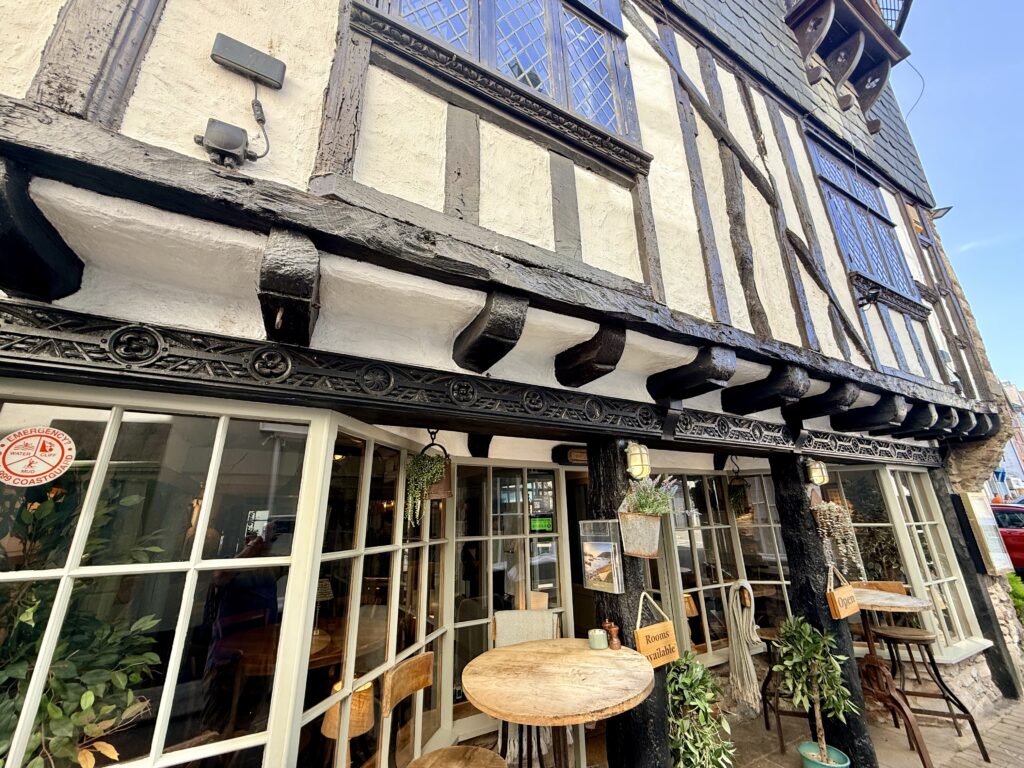
Dartmouth is a delight for food lovers, with some of the best places to eat in South Devon packed into a fairly small harbour town. Seafood is the obvious starting point, but you will also find pubs, cafés, bakeries, bistros, delis and relaxed places for coffee or lunch.
The Seahorse is one of Dartmouth’s best-known restaurants, with a waterside dining room and a menu led by fresh fish from Brixham. Rockfish Dartmouth is another excellent seafood choice, especially if you want something more informal.
For a smaller restaurant meal, Andria is often mentioned among Dartmouth’s better independent dining options. Kendricks is a long-standing town centre choice for steak, seafood and family-friendly dining.
Pontoon is worth considering for its setting. It occupies the old Dartmouth railway station building on the embankment, now operating as a terrace, bar and restaurant. When we passed on a Saturday afternoon, it had a lively feel, with an outdoor bar, river views and live music.
For a traditional pub, The Cherub is well worth listing. We have eaten there before and remember it as very traditional and very good.
Other places include Bayards Cove Inn and Café Al Fresco. In summer, book ahead for the better-known restaurants, and check recent reviews before choosing.
Where to Stay in Dartmouth, Devon

Dartmouth has a good range of places to stay, including historic inns, boutique hotels, guesthouses, B&Bs, self-catering cottages, and apartments. Staying in Dartmouth town centre is ideal if you want harbour views, restaurants, ferries and boat trips close by.
Accommodation can be very expensive in peak season, especially during school holidays, regatta week and summer weekends. Compare dates carefully, check recent reviews, and book early if you want a central room with a river view.
At the upper end, The Royal Castle is one of Dartmouth’s classic places to stay, central to all the action, overlooking the harbour from a historic town-centre building. Dart Marina Hotel is another higher-end choice, beside the River Dart and slightly away from the busiest streets.
Bayards Cove Inn is worth considering if you want atmosphere, with the lower waterfront and Dartmouth Castle walk nearby. If on a budget, look at smaller guesthouses, B&Bs, and rooms above pubs or restaurants.
Kingswear is also worth checking, with views back across the Dart and easy access by passenger ferry. For quieter or better-value stays, look around Stoke Fleming, Dittisham, Blackawton, Strete, Totnes or Torbay. These can reduce costs while keeping Dartmouth, the River Dart and the wider South Hams all within easy reach.
Weather in Dartmouth, Devon: When to Visit
Dartmouth has a mild South Devon coastal climate, with the best visitor weather usually from late spring to early autumn. May, June, July and September are often good choices if you want longer days without the busiest school-holiday crowds.
Summer is ideal for boat trips, beaches, outdoor eating and evenings around the harbour. It is also the busiest and most expensive time, especially during school holidays and regatta week.
If possible, we think Dartmouth is best enjoyed outside the main school holidays. The town is still lively, but ferries, parking, restaurants and narrow streets are usually easier to manage.
Spring is good for walking, gardens, and exploring quieter towns. Autumn can be excellent for Dartmouth Food Festival, river views and coast path walks, although daylight is shorter and the weather can change quickly.
Winter has a more local feel. Some boat services, cafés and seasonal places may reduce hours, so check before travelling.
Before setting off, it is worth checking the Met Office forecast for Dartmouth, BBC Weather for Dartmouth and a local Dartmouth webcam. The webcam allows a quick look at river conditions, visibility and how busy the waterfront appears.
Practical Information for Visiting Dartmouth, Devon
- 🛍️ Shops & Supermarkets – Independent shops, galleries, food stores and a market in and around the town centre
- 🏥 Nearest Hospital – Torbay Hospital for A&E; nearest Minor Injuries Unit at Totnes Community Hospital
- 🚔 Police – Dartmouth is covered by Devon & Cornwall Police; call 101 for non-emergency enquiries or 999 in an emergency
- 💊 Pharmacies – Available in and around Dartmouth town centre
- ✈️ Nearest Airport – Exeter Airport, around 45 miles away by road
- 🚆 Railway Station – No mainline station in Dartmouth; nearest mainline station is Totnes, with the heritage railway running to Kingswear for the ferry crossing
- ⛴️ Ferries – Passenger and vehicle ferries link Dartmouth with Kingswear across the River Dart
- 🚌 Bus Services – Local buses connect Dartmouth with Totnes, Kingsbridge and nearby South Devon towns
- 🅿️ Car Parks – Main parking includes town centre car parks and Dartmouth Park & Ride during busier periods
- ⛽ Petrol & EV Charging – Fuel and EV charging are available locally and in nearby South Devon towns
- 💵 Banks & ATMs – Banking services and cash points are available in the town centre
- 📮 Post Office – Available in Dartmouth town centre
- 🚻 Public Toilets – Found around the town centre, waterfront and main visitor areas
- 🚶 Tourist Information – Visitor information is available through Dartmouth’s local visitor websites and town information points
Other Helpful Links
- Booking.com – for most accommodation needs. Look out for options that include free cancellation.
- Easy Tide – Free UK tidal prediction service, providing tidal data and tide times for the current day and 6 days into the future.
- Expedia – good for flights and packages.
- GetYourGuide – find and book things to see. Includes unusual things to do.
- Hostelworld – Hostel-focused booking platform that fosters backpack connections.
- MetOffice – Weather forecasts from the UK’s official meteorological office.
- National Express – UK-based coach operator providing long-distance bus services
- Omio – Book travel tickets by comparing trains, buses and planes in one search.
- Rental Cars – to search out and book hire cars.
- Rome2Rio – Great for comparing local transport options (and for locating bus stops).
- Ticketmaster – What’s On – Major Events – Venues – Bookings
- Trainline.com – our go-to online platform for booking train and bus tickets, offering route planning, price comparisons, seat reservations, and ticket sales.
- Traffic England – for live traffic updates on major roads.
- Traveline SW – Comprehensive public transport information from A to B by bus, coach, train, ferry in South West England and Great Britain.
- TripAdvisor – for reviews of… pretty much everything. Our go-to before booking anything.
- Vrbo – Great for self-catering and vacation holiday home rentals.
Dartmouth FAQs
Planning a visit to Dartmouth? These quick answers cover transport, parking, beaches, accommodation, food and practical things to know before you travel.
Where is Dartmouth in Devon?
Dartmouth is in the South Hams area of South Devon, on the western side of the River Dart opposite Kingswear. It is close to the Start Bay coast and is around 25 minutes by road from Totnes, depending on traffic.
Is Dartmouth near Salcombe?
Yes. Dartmouth is around a 40-minute drive from Salcombe, depending on traffic and route. The two towns are often visited on the same South Devon trip, although Dartmouth usually has easier ferry links, more river trips and a wider choice of things to do around the River Dart.
What is parking like in Dartmouth?
Parking in Dartmouth can be limited, especially in summer, during school holidays and around major events. The town has narrow streets and steep approaches, so Dartmouth Park and Ride is often the easiest option if you are arriving by car. Mayor’s Avenue Car Park is the most central choice, but spaces fill quickly.
Where is the nearest train station to Dartmouth?
Dartmouth does not have its own mainline railway station. Totnes is the nearest national rail station, with bus links to Dartmouth. You can also travel by train to Paignton, then continue to Kingswear by bus or Dartmouth Steam Railway before crossing the River Dart by passenger ferry.
Are there beaches in Dartmouth?
Dartmouth itself is a deep-water harbour rather than a beach resort, but there are several beaches nearby. Blackpool Sands, Sugary Cove, Compass Cove, Slapton Sands and the wider Start Bay coast are all good options for a beach trip from Dartmouth.
Is there much accommodation in Dartmouth?
Yes. Dartmouth has historic inns, boutique hotels, guest houses, B&Bs, self-catering cottages and apartments. Accommodation can be expensive in peak season, so it is worth checking Kingswear, Stoke Fleming, Dittisham, Totnes or Torbay if you want more choice or better value.
Is there much to do in Dartmouth?
Yes. Dartmouth has plenty to fill a day, weekend or longer stay. The main things to do in Dartmouth include Dartmouth Harbour, Dartmouth Castle, Bayard’s Cove, River Dart boat trips, ferries to Kingswear, Dartmouth Museum, Greenway, watersports, independent shops and nearby walks.
Where can I eat in Dartmouth?
Dartmouth has a lively food scene for a town of its size. Seafood is a major part of the offer, with restaurants, pubs, cafés, bakeries and delis around the waterfront and town centre. In summer, it is worth booking ahead for better-known restaurants.
Is Dartmouth dog friendly?
Dartmouth is generally a good town for dog-friendly walks, ferries, pubs and nearby coast paths. Rules vary by business, beach and attraction, so check before travelling. Dartmouth Castle welcomes dogs on leads, and many ferry services allow dogs.
Is Dartmouth closed in winter?
No. Dartmouth is quieter in winter, and some seasonal boat services, cafés and visitor businesses may reduce hours. However, the town still has shops, places to eat, riverside walks, events and a close-knit local community. Winter can be a good time to visit if you prefer fewer crowds.
Is Dartmouth Worth Visiting?
Yes, emphatically. Along with Salcombe, Dartmouth is probably one of the most interesting and beautiful places to visit in South Devon, especially if you enjoy being outdoors.
We love Dartmouth for the scenery, the green hills around the River Dart, the boating, the ferries, the walking and the water itself. It has a history, harbour views, independent shops, good places to eat, river trips, nearby beaches, and some excellent days out.
Dartmouth can be expensive, especially in peak season, but it does not have to be. Some of the ferries give you fantastic views from the river without costing very much, and the bus links from Paignton and Totnes are surprisingly straightforward.
It is particularly good for couples, walkers, food lovers, history fans and anyone who enjoys boats or watersports. Families can also enjoy Dartmouth Castle, river trips, crabbing, nearby beaches and short walks.
The main drawbacks are summer crowds, parking pressure and the steep streets behind the waterfront. If you can visit outside school holidays, Dartmouth is easier to enjoy.
For a first visit, allow at least a full day. For a longer trip, stay one or two nights and combine the town with Kingswear, the River Dart, Blackpool Sands, Greenway, Dittisham or Coleton Fishacre.
Over to you … have you recently travelled to South West England? What worked for you? What advice would you give to others? Please leave your comments below or join in the discussion in our Facebook Group.
New to South West England or returning after a while? Start with our ‘Travel Basics’ – quick guides packed with tips to help you plan your trip.

