Category: Devon

  • Best Beaches in East Devon: Exmouth to Seaton Guide 2026

    Best Beaches in East Devon: Exmouth to Seaton Guide 2026

    This guide covers the best East Devon beaches for families, dog walks, swimming, sandy beaches, hidden coves and Jurassic Coast scenery, from Exmouth and Sidmouth to Beer, Branscombe and Seaton.

    East Devon stretches from the red sandstone headlands at Exmouth to the pale chalk cliffs near Lyme Regis. It’s one of the most distinctive and varied stretches among the beaches of Devon, with golden sands, pebble (shingle) bays, fishing coves and some of the best clifftop walking in southern England.

    From great family beach days out to quiet winter walks, this guide takes you from Exmouth to Seaton, beach by beach. We share local insight on tides, parking, swimming and seasonal conditions so you can enjoy the best beaches of the East Devon coast all year round.

    If you are choosing between the best beaches in East Devon, this guide compares sandy family favourites, dog-friendly stretches and quiet places along the Jurassic Coast.

    Best East Devon Beaches at a Glance

    Best sandy beach: Exmouth Beach
    Best quiet beach: Weston Mouth
    Best hidden cove: Salcombe Mouth
    Best dog friendly beach: Branscombe Beach
    Best beach for families: Exmouth Beach
    Best beach for swimming: Budleigh Salterton
    Best beach for photography: Beer Beach
    Best beach for fossils and geology: Hooken Beach

    Shallow water pools in the sand at low tide on Exmouth Beach, East Devon’s wide sandy shoreline, glistening in the sunshine.
    Exmouth – East Devon’s sandy beach (Credit: ThisIsSouthWest)

    Disclosure: Some of the outbound links on this page are affiliate links to sites that we use and would genuinely recommend. Using them doesn’t cost you extra, but it does help support this free guide. We also provide links to other sites where we believe their inclusion may be helpful to you.


    The East Devon Coast

    This is the western end of the UNESCO World Heritage Jurassic Coast, where 185 million years of geological history are on display. West of Sidmouth, the cliffs are composed of deep red sandstone, soft and sculpted, with broad sandy stretches revealed at low tide. East of Sidmouth, the rock changes to harder chalk and greensand, creating steep shingle shelves and clear turquoise water. The South West Coast Path runs along the entire length, linking beaches with viewpoints and picnic spots.

    The Geology of the Jurassic Coast: Exmouth to the Dorset Border

    The stretch of coast from Exmouth to the Dorset border tells an extraordinary geological story covering around 185 million years of Earth’s history. It forms the western gateway to the Jurassic Coast UNESCO World Heritage Site, England’s only natural World Heritage designation.

    Starting at Exmouth, the cliffs are made of deep red Triassic sandstones and mudstones, laid down about 250–200 million years ago when this area was part of a hot, arid desert. These layers give the cliffs around Orcombe Point, Budleigh Salterton and Ladram Bay their rich red colour and soft texture.

    Moving east toward Sidmouth and Beer Head, the rocks become (relatively) younger. Near Branscombe and Beer, the red Triassic beds give way to grey-green Jurassic limestones and clays, deposited between 200 and 145 million years ago when warm tropical seas covered southern England. These layers often contain fossils of ammonites, shells and ancient marine life.

    Beyond Seaton and Axmouth, the coast approaches the Dorset border and shifts again into pale Cretaceous chalk from about 145–66 million years ago. These are the striking white cliffs seen around Lyme Regis and beyond, marking the youngest rocks of the sequence.

    In just twenty miles, the coast from Exmouth to Dorset reveals the entire Mesozoic era – the Triassic, Jurassic and Cretaceous periods in perfect order, a geological timeline that draws scientists, walkers and fossil hunters from around the world.


    Best Beaches in East Devon

    From Exmouth and Sandy Bay to Budleigh Salterton, Sidmouth, Beer and Seaton, these are the best beaches in East Devon for classic days by the sea. Scroll for tips on tides, parking and year-round conditions.

    At a glance, sandy Exmouth and Sandy Bay suit families, Budleigh and Seaton shine for long swims, Beer is a sheltered cove with boats and cliffs, and Sidmouth brings a seafront promenade and gardens for easy days out.


    East Devon Beaches Map


    Sandy Beaches in East Devon

    East Devon’s coastline is best known for its long pebble and shingle beaches, but there are still several excellent sandy beaches and tidal sandy areas along the Jurassic Coast. Exmouth is the standout, with one of the largest sandy beaches in Devon, while smaller coves and low tide sands around Sidmouth and Sandy Bay provide quieter alternatives.

    Exmouth Beach

    Exmouth is the premier sandy beach in East Devon, with around two miles of golden sand stretching from the Exe Estuary towards Orcombe Point. The beach shelves gently into the sea and is popular for family days out, swimming, paddleboarding, kitesurfing and long walks. Large sandy areas remain exposed for much of the tide, making it one of the best beaches in Devon for traditional seaside holidays.

    Sandy Bay

    Just east of Exmouth, Sandy Bay is a more sheltered sandy cove backed by dramatic red cliffs. Access is mainly through Devon Cliffs Holiday Park or via the South West Coast Path. The beach can feel quieter than Exmouth and is particularly attractive at low tide, when wider sandy areas appear beneath the cliffs.

    Sidmouth Town Beach and Jacob’s Ladder

    Sidmouth is mainly a pebble beach, but large sandy areas are exposed at low tide, especially around Jacob’s Ladder and the western side of the town beach. Rock pools, shallow pools and firmer sand make this a surprisingly good option for families when the tide is out.

    Shelly Beach, Exmouth

    Shelly Beach lies close to the Exe Estuary and is popular for watersports, paddleboarding and dog walking. While smaller than the main Exmouth beach, it offers sandy and shelly areas with calmer water conditions near the estuary. It is also one of the best places in East Devon for sunset views across the Exe towards Dawlish Warren.

    Seaton Beach

    Seaton is predominantly shingle, although patches of sand and flatter areas appear at lower tides, particularly towards Seaton Hole. The beach is popular with swimmers and families looking for a quieter alternative to larger sandy beaches.

    Other East Devon Beaches

    Beer, Branscombe, Budleigh Salterton, Weston Mouth and Hooken Beach are mainly pebble or shingle beaches rather than sandy beaches. However, many reveal small sandy sections, rock platforms or rock pools at lower tides, particularly around the edges of the coves.

    If you are specifically searching for soft sand beaches in East Devon, Exmouth and Sandy Bay are the clear standouts, while Sidmouth can be excellent on a low tide day.


    Dog Friendly Beaches in East Devon

    Many East Devon beaches welcome dogs year-round, although seasonal restrictions apply on some of the main bathing beaches between 1 May and 30 September. During the summer season, dogs are usually restricted to designated zones or specific ends of the beach, while from 1 October to 30 April most beaches are fully open to dogs.

    Always check the latest local signage on arrival, as restrictions, boundaries and bylaws can occasionally change. Responsible dog ownership is especially important along the Jurassic Coast, where livestock, wildlife and unstable cliffs are common.

    Year-Round Dog-Friendly Beaches

    Branscombe Beach
    One of the best dog-friendly beaches in East Devon, Branscombe is a long shingle beach backed by dramatic cliffs and the South West Coast Path. Dogs are generally permitted year-round, making it particularly popular for coastal walks outside the busy summer resorts.

    Weston Mouth
    This remote Jurassic Coast cove is accessible only on foot and welcomes dogs throughout the year. The steep access and lack of facilities mean it is best suited to experienced walkers and confident dogs.

    Salcombe Mouth
    A quiet and secluded beach east of Sidmouth, popular with walkers and dog owners looking for a more peaceful stretch of coastline.

    Hooken Beach
    Reached via coastal paths between Beer and Branscombe, Hooken Beach is dog-friendly year-round and ideal for longer walks beneath the chalk cliffs.

    Beaches with Seasonal Dog Restrictions

    Exmouth Beach
    Dogs are allowed year-round at the far eastern end beyond the third groyne towards Orcombe Point, and at the western end beyond the Octagon area. Restrictions usually apply on the main central beach during the summer season.

    Sidmouth Town Beach and Jacob’s Ladder
    Seasonal restrictions normally apply along the central promenade beach during summer, although year-round dog access is generally available at Port Royal Beach towards the eastern end and sections west of Jacob’s Ladder.

    Seaton Beach
    Dogs are usually permitted year-round at the far western and eastern ends of the beach, while restrictions apply along parts of the main promenade beach between May and September.

    Beer Beach
    Dogs are normally allowed year-round on the eastern side of the beach near the fishing boats, with summer restrictions applying elsewhere on the main beach.

    Budleigh Salterton
    Seasonal restrictions apply along parts of the central beach in summer, although dogs are generally permitted year-round towards the eastern and western ends.

    Tips for Visiting East Devon Beaches with Dogs

    • Keep dogs under close control near cliff edges and livestock
    • Carry water during hot weather, especially on longer coast path walks
    • Check tide times before exploring remote coves
    • Bag and bin waste or take it home
    • Be aware that pebbles and shingle can become extremely hot in summer

    For the latest restrictions, maps and seasonal boundaries, check the official East Devon District Council beach dog guidance.


    Hidden Beaches in East Devon

    For quieter coves and more secluded stretches of coast, East Devon has several hidden beaches reached mainly on foot. Salcombe Mouth, Weston Mouth and Hooken Beach are among the best options, with dramatic Jurassic Coast scenery, fewer facilities and a wilder feel than the main resort beaches.

    These beaches are covered in more detail in the main East Devon Beaches: West to East listing below, which includes access, parking, tides, and safety advice.


    East Devon Beaches: West to East

    Shelly Beach (Exmouth)
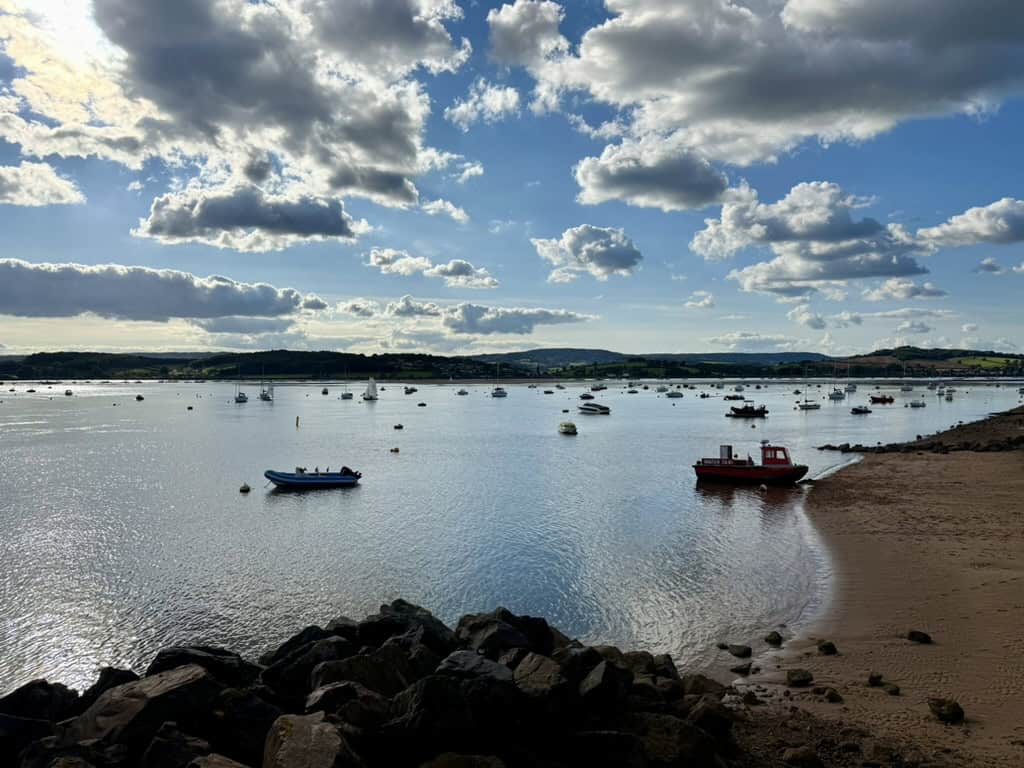
    Shelley Beach (Pirate Cove), Exmouth, looking across the Exe Estuary towards Dawlish Warren with boats moored on calm water beneath dramatic clouds and late afternoon sunshine.

    Shelley Beach, often known locally as Pirate Cove, sits beside the Exe Estuary at the western end of Exmouth. Sheltered by the marina’s sea walls, it offers a quieter alternative to Exmouth Beach and is popular for picnics, dog walking, photography and watching activity on the estuary.

    The beach is particularly known for its sunsets, with views west across the Exe towards Dawlish Warren and the Haldon Hills beyond. At low tide, extensive mudflats and sandbanks are exposed, attracting a variety of birdlife including oystercatchers, redshank, little egrets and wintering Brent geese.

    While Shelley Beach is not suitable for swimming due to strong estuary currents and boat traffic, it is a peaceful spot to relax, enjoy the scenery and watch boats moving between Exmouth Marina and the estuary. The beach is dog-friendly throughout the year and is one of the most distinctive and overlooked coastal spots in Exmouth.

    Exmouth Beach and Orcombe Point

    Orcombe Point in Exmouth, UK, seen at low tide with exposed sand and red cliffs marking the start of the Jurassic Coast.
    Orcombe Point, Exmouth, UK, at low tide (Credit: ThisIsSouthWest)

    Exmouth’s two-mile sweep of sand is the classic family beach of East Devon. Towards the town end, you will find a level promenade with cafés, ice cream kiosks, toilets, showers and watersports hire for paddleboards, kayaks and pedaloes. The beach shelves gently, the sand is firm for castles and cricket, and RNLI patrols usually operate in the main summer season.

    Head east towards Orcombe Point and the crowd thins. Here, the striking Geoneedle marks the official start of the Jurassic Coast, and at low tide, vast sands reveal rockpools. On breezier days, windsurfers and kitesurfers skim the water, while early mornings and evenings are calm for paddleboarding.

    There is step-free access from the promenade, beach wheelchair hire in season, and paid parking close by along Queen’s Drive and at Maer Road. The railway station and Exmouth town centre are a pleasant seafront walk away, and the Exe Estuary Trail links the beach with Topsham and Exeter for traffic-free cycling.

    Family facilities include play areas, amusement arcades, beach huts, showers and tap points for rinsing. Seasonal dog restrictions apply on the central section of the beach, with year-round dog-friendly areas at either end. Tides can run strongly near the estuary mouth, so swim between the flags and keep clear of watercraft lanes. On clear evenings, the sunset washes across the River Exe and Dawlish Warren, with pastel skies and mirrored wet sand that make this one of the best early evening walks in East Devon.

    Sandy Bay

    View of the Exmouth end of Sandy Bay from the South West Coast Path, showing golden sand, red cliffs and the curve of the East Devon coastline.
    Sandy Bay Beach (Credit: ThisIsSouthWest)

    Sandy Bay is the smaller, more tucked-away beach beyond Exmouth. You can walk there along the sand from Exmouth at a good low tide, or follow the South West Coast Path through the Devon Cliffs Holiday Park, where steps lead down to the shore. The bay sits beneath red cliffs and can sometimes feel more sheltered when Exmouth’s main beach is breezy. The sand is soft and gently shelving with clear, shallow water on calmer days.

    Lifeguard patrols operate seasonally. The RNLI staffs Sandy Bay on set dates through late spring and summer, with daily cover in the peak holiday period and typical patrol hours of 10 am to 6 pm. Always swim between the red and yellow flags and check the RNLI page for the current season dates before you go.

    Facilities on the beach are limited. You will find seasonal toilets, cafés and shops up in the holiday park, and opening times vary, so bring what you need and take your litter home. Dog restrictions usually apply during the peak season, with more flexibility outside the summer. Please follow the signs on arrival.

    At low tide, the sands open out, and you will find patches of rockpooling near the headlands. In the off-season, it is wonderfully quiet, making a peaceful coastal walk with just the ever-present seagulls and lapping waves for company. For a longer outing, combine Sandy Bay with the cliff top section of the South West Coast Path to Orcombe Point and return along the beach when the tide allows.

    Budleigh Salterton

    Budleigh Salterton beach, showing the pebble beach, the sea, the Otter Estuary and the red cliffs
    The pebble beach at Budleigh Salterton, England (Credit: ThisIsSouthWest)

    Budleigh Salterton offers two miles of perfectly rounded pebbles, big skies and notably clear, deep water. At the eastern end by the River Otter, you will find a large seafront car park, public conveniences and a café. This is where the river meets the sea beside the nature reserve, and at quieter times you can often see herons, egrets and wintering waders working the estuary. Traditional beach huts line stretches of the promenade and can be hired via the Tourist Information Centre. Even on busy summer days, there is plenty of room to spread out.

    The town backs the central section of Budleigh beach, so ice creams, fish and chips and shops are a stroll from the shingle. The water here drops off fairly quickly because the beach shelves steeply, which helps with clarity but can make entry and exit awkward in a swell. Other than during the peak season, there is usually no regular lifeguard cover, so treat it as an unpatrolled beach. Keep an eye on conditions and supervise children closely. Pebbles shift underfoot, so sturdy beach shoes are helpful for swimming or launching kayaks and paddleboards.

    The western edge grows wilder beneath tall red sandstone cliffs. These cliffs here are beautiful but unstable, with rockfalls possible year-round. Enjoy the views from a distance, keep well clear of the cliff base and avoid sitting directly below the slopes.

    Budleigh beach is dog-friendly, with restrictions on the busiest central stretch in summer and year-round dog-friendly areas towards either end. Always follow local signage. Accessibility is good along the level promenade. Parking is available at both ends of town, and regular buses link Budleigh with Exmouth and Sidmouth.

    For a longer outing, combine the beach with the flat paths of the River Otter nature reserve. It is a rewarding, accessible walk at any time of year, with changing birdlife through the seasons and sheltered sections on windy days. Whatever the weather, Budleigh delivers simple, timeless pleasures: wave watching on a blustery afternoon, a summer swim from the steep shingle, or a quiet winter walk as the low sun lights the pebble beach.

    Ladram Bay

    View from the South West Coast Path looking towards Ladram Bay on the left and across the coastline towards Sidmouth, with sea stacks and red cliffs along the shore.
    Ladram Bay (left) and across to Sidmouth from the South West Coast Path (Credit: ThisIsSouthWest)

    Ladram Bay is famous for its vivid red sea stacks, sculpted from Triassic sandstone and privately owned by Ladram Bay Holiday Park. The bay is a photographer’s favourite: at low tide, you can frame the stacks from the shore, while from the coast path, you get sweeping views back over the bay towards Sidmouth.

    There is no public car parking at Ladram Bay; access is restricted to holiday guests and residents. Public access is best via the South West Coast Path and a steep ramp down to the beach. There are toilets, a café, a shop and takeaways, plus a slipway and beach attendants during busy periods. Out of season, many services reduce or close, and the bay takes on a rugged, quieter feel.

    The coast path approach from Budleigh Salterton and Otterton is a highlight in its own right, with wide views west over High Peak and east towards Orcombe Point. For a fine half day, walk the Otterton to Ladram Bay loop, pausing at the clifftop benches for classic views over the stacks.

    Dog rules are seasonal and can change; follow current signage on arrival and keep dogs away from nesting or roosting seabirds on quieter headlands.

    Sidmouth Town Beach and Jacob’s Ladder

    Sidmouth Beach viewed from Connaught Gardens, showing the curved pebble shore, red cliffs and the seafront promenade below.
    Sidmouth Beach from Connaught Gardens (Credit: ThisIsSouthWest)

    Sidmouth’s long shingle bay sits against its elegant Regency esplanade. The main beach is predominantly pebbles, but at lower tides, patches of firm sand appear, especially towards the western end. In settled weather, the water is clear and inviting, though the beach shelves quickly in places, so take care with small children and in any swell.

    It is a classic summer spot for deckchairs and lazy swims, yet Sidmouth excels in winter too. Wrap up, grab a coffee from the promenade kiosks and watch waves break against the sea wall before retreating to the shelter of Connaught Gardens above the western end. These terraced lawns and flowerbeds feel like a clifftop balcony over the sea, with the Clock Tower café a great possibility for a post-walk treat.

    Round the western headland lies Jacob’s Ladder Beach, named for the white wooden stairway that drops from the gardens to the beach. At low tide, shallow rock shelves and pools appear here, perfect for gentle rockpooling and close-up views of the Triassic strata.

    Facilities along the front are good. You will find cafés, ice-cream kiosks, toilets and seasonal beach huts around Jacob’s Ladder. The town centre is moments away for fish and chips, cafes and independent shops. Parking options include seafront and town car parks, a short walk from the beach, and regular buses link Sidmouth with Exeter, Honiton, Seaton and Exmouth. Access is mostly level along the promenade; the steps to Jacob’s Ladder are steep, but you can also reach that beach by a steep ramp or, at lower tides, along a path in front of the headland.

    At higher water, the pebble beach narrows, while on a good low tide, the western end opens out with more sand and space to spread a towel. Paddlers and kayakers launch in calm conditions, and, in season, the independently operated Sidmouth Lifeboat provide lifeguards on the main beach. Seasonal dog restrictions usually apply on the busiest central stretch in summer, with year-round dog-friendly areas towards either end; always check local signs when you arrive.

    Stay for the light. Sunsets are a favourite here, with the cliffs glowing red, the promenade lamps flickering on. Whether you come for a blustery winter stroll and a hot chocolate in one of the town’s cafes or a summer swim beneath the Regency terraces, Sidmouth beach delivers the timeless pleasures of a truly traditional English seaside town on the Jurassic Coast.

    Salcombe Regis

    Salcombe Regis Beach near Sidmouth, East Devon, showing shingle shore, red cliffs and calm sea along the Jurassic Coast.
    Salcombe Regis Beach, Devon

    Salcombe Mouth is one of East Devon’s hidden beaches, a peaceful shingle beach between red cliffs east of Sidmouth. There’s no direct road access, which keeps it wonderfully quiet even in summer. The beach sits at the end of a green, wooded valley near the village of Salcombe Regis and rewards the effort of getting there with superb coastal views.

    Parking is limited. Most visitors leave their cars at St Peter’s Church in Salcombe Regis, where a small parking area operates on a donation basis. From here, a scenic footpath winds down through fields and woodland to the coast. The route is steep in places and can be muddy after rain, so sturdy shoes are a must. The walk forms part of the Salcombe Regis Circular Walk, described in detail on our site, which can easily be extended to include Weston Mouth or the Sidmouth Donkey Sanctuary.

    The beach itself is a mix of shingle and scattered rock shelves. At lower tides, wide flat sections appear where you can picnic, skim stones or paddle. The cliffs are part of the Triassic sandstone sequence of the Jurassic Coast. Note that it is not possible to walk along the beach to Sidmouth as the River Sid blocks the route. Check tide times carefully before exploring too far, as parts of the beach will become cut off at high tide.

    There are no facilities at Salcombe Mouth: no café, toilets, or lifeguard cover, and limited mobile signal, so come prepared with supplies and a good sense of tide times. This simplicity is part of its appeal. You might share Salcombe Mouth beach with a handful of walkers, a few swimmers or the occasional kayaker landing from Sidmouth. The sea can be calm on still days but quickly turns choppy when the wind blows onshore, so swim only in settled conditions and stay close inshore.

    Wildlife thrives here, with fulmars and kittiwakes nesting on the cliffs and peregrines sometimes seen overhead. In spring, the valley sides are rich with bluebells, and in autumn, the hedgerows drip with blackberries. The combination of wild scenery, quiet access and birdlife makes Salcombe Mouth one of the most atmospheric corners of the East Devon coast. A perfect detour for anyone exploring on foot from Salcombe Regis or following the South West Coast Path.

    Weston Mouth

    Steep wooden steps leading down through cliffs and vegetation to the shingle beach at Weston Mouth, East Devon, with sea views beyond.
    Steep steps down to the Weston Mouth beach (Credit: ThisIsSouthWest)

    Weston Mouth is another East Devon hidden beach. Reached only on foot along narrow lanes, footpaths and bridleways from Weston, Sidmouth or Branscombe, it feels a world away from the bustle of the nearby resorts. The descent from the inland plateau brings sweeping views over the red cliffs, wooded combes and the long, pebble beach stretched out below. There is no direct road access and no facilities, which keeps visitor numbers low even at the height of summer.

    The beach itself is formed of smooth pebbles and shingle, fringed by clear water and backed by steep cliffs of Triassic sandstone. At lower tides, the sea recedes to reveal firmer patches of sand and the remnants of low rock platforms. The soundscape is pure Devon coast: surf breaking on the stones, wind in the cliffs and the occasional cry of gulls. It’s a fine place to walk, swim or simply sit and take in the scale of the Jurassic Coast, especially on bright winter days.

    High above the eastern end of the beach are the Weston Plats, a series of old cliff-top market gardens now managed by the National Trust. From the mid-19th century until the 1960s, local families cultivated these tiny, terraced plots, growing early vegetables, flowers and even fruit in the thin coastal soil. The plots captured the sun and sea warmth, creating a unique microclimate that allowed crops to mature earlier than those on inland farms. Produce was carried by hand or pony to Sidmouth’s markets and further afield. Today, the site is partly conserved as a reminder of this small-scale coastal horticulture, and you can still see the outlines of the terraces and stone retaining walls from the coast path. Information boards along the National Trust’s Salcombe Hill and Weston Plats Walks explain this fascinating history.

    Weston Mouth is also known, discreetly, as an unofficial naturist beach. Visitors are mixed, and the beach is large enough for everyone to find their own space. Naturists typically use the western end, well away from the main access paths, especially outside the main summer weeks.

    There are no lifeguards and no amenities, so come prepared with water and food, and remember to take all litter home.

    Hooken Beach

    Hooken Beach, a secluded shingle and pebble cove between Beer and Branscombe on the Jurassic Coast, backed by high cliffs and undercliff woodland.
    Hooken Beach. A secluded spot between Beer & Branscombe (Credit: ThisIsSouthWest)

    Hooken Beach lies hidden beneath the towering Hooken Cliffs between Beer and Branscombe, one of the most dramatic sections of the Jurassic Coast. Formed by a huge landslip in 1790, it’s a peaceful beach enclosed by white chalk cliffs and tangled woodland.

    Access is only on foot, either along the shore from Branscombe at low tide or via a steep path from the South West Coast Path, making it one of East Devon’s most secluded spots. The descent from Beer Head offers spectacular views, though the route can be slippery and uneven.

    Branscombe Beach

    Branscombe Beach and village in Devon seen from the coast path, with the long shingle beach, green valley.
    Branscombe Beach, Devon (Credit: ThisIsSouthWest)

    Branscombe is a long shingle beach backed by a postcard-pretty village of thatched cottages. It suits year-round visits: swim on calm days, fish for mackerel and bass in season, or warm up after a winter walk at the beach café or a thatched pub up the valley. The South West Coast Path east to Beer via Hooken Cliffs is one of the best short hikes in Devon for views and variety. See our Beer and Branscombe guide for details.

    Facilities are simple. Toilets and a café operate at Branscombe Mouth in season.

    Parking is available by the beach and behind the village hall, with a pleasant streamside walk linking the latter to the sea. Spaces are limited on peak summer days and bank holidays, so arrive early. Branscombe is a year-round dog-friendly beach, but dog rules are seasonal; check signs on arrival.

    Beer Beach

    The beach at Beer in Devon, with fishing boats pulled up on the shingle and white chalk cliffs rising on either side.
    The Beach at Beer in Devon (Credit: ThisIsSouthWest)

    Beer is a working fishing cove set beneath bright chalk cliffs, with colour-washed boats pulled up on the shingle and nets drying by the beach. In summer, you can hire a boat for a short coastal run or a mackerel trip, or swim inside the shelter of the cove when the water is calm. The beach shelves quite steeply. On quieter days, like its near neighbour, Seaton Hole, it is ideal for a gentle paddle by the shore or a kayak launch when the sea is settled.

    The cliffs give real character and proper shelter. Beer often feels milder than neighbouring beaches in a westerly, though easterly winds can push a surprising chop into the bay. Low tide reveals rockpools towards the edges of the cove and clear water for snorkelling in settled weather.

    The facilities are good for a small village. Beach cafés, kiosks and deckchair or beach-hut hire operate through the season, and there are pubs, bakeries and shops a short walk up Fore Street. There are toilets close to the beach. Parking is in village car parks a few minutes’ walk away, with extra spaces at the clifftop; it can be busy on peak summer days, so arrive early if you can. Dog restrictions usually apply in summer on the main section of the beach; the eastern beach is dog-friendly year-round; check local signs.

    The setting rewards a more extended visit. Walk the South West Coast Path up to Beer Head for a classic view across Lyme Bay to Dorset, or continue east to Branscombe via Hooken Cliffs for one of Devon’s best short hikes. Off-season, the cove takes on a quieter feel: gulls screeching, the lap of waves on shingle. Whether you come for a swim, a short boat trip or a winter sketching day, Beer delivers a popular slice of the Jurassic Coast.

    Seaton Beach and Seaton Hole

    Beach huts lined up along Seaton Beach in Devon, with the pebble shore and sea stretching out beneath a bright sky.
    Beach Huts on Seaton Beach (Credit: ThisIsSouthWest)

    Seaton’s long pebble beach is the easternmost major beach in East Devon and one of the friendliest for year-round sea swimming. The water is often clear, the shoreline is easy to read, and the esplanade runs level for its full length, which makes winter walks and buggy or wheelchair outings straightforward.

    Facilities are close at hand. Cafés, kiosks and toilets sit along the seafront, with shops a short walk inland. Parking (pay and display) is available by the esplanade and in large car parks such as Harbour Road, which is handy for the eastern end and the tramway. Seasonal dog restrictions usually apply on the central stretch in summer, with year-round dog-friendly areas towards either end. Follow local signage on arrival.

    The western end, known as Seaton Hole Beach, tucks under the first rise towards Beer Head. At low tide, the sea leaves flat rock platforms and small pools that are fun to explore slowly.

    Away from the water, there is plenty to fill a day. The Seaton Wetlands sit just behind the town on the Axe estuary and draw birdwatchers through autumn and winter for wigeon, teal, redshank and egrets, with kingfisher and little grebe as regular highlights. Level paths and hides make it an easy add-on to a beach walk.

    The Seaton Tramway runs beside the estuary to Colyford and Colyton, and is a good rainy-day option with big-sky views across the marshes. On brighter days, the South West Coast Path climbs west towards Beer Head for huge views across Lyme Bay.

    Seaton is popular with year-round swimmers. In colder months, wear suitable thermal layers, limit your time in the water and warm up quickly after. On clear evenings, the light fades behind Beer Head and the beach throws long reflections across the pebbles, making Seaton as appealing for a sunset stroll as it is for a summer swim.

    Axmouth Harbour Mouth & Haven Cliffs Beach

    View of Seaton, Devon, seen from Axmouth Harbour with the town and seafront in the distance across the River Axe estuary.
    Seaton, Devon, and Axmouth Harbour from the beach under Haven Cliff (Credit: ThisIsSouthWest)

    Where the River Axe meets the sea, strong currents make this more of a lookout point than a bathing spot. On stormy days, it’s a spectacular place to watch waves smashing against the shingle bar from a safe distance.

    Further East and accessed through Axmouth Harbour, beneath the face of Haven Cliff, lies a quiet and little-visited stretch of beach. This section marks the point where the red Triassic rocks of Seaton give way to the chalk and greensand of the Jurassic Coast.

    The beach here is mostly shingle with patches of sand at low tide, backed by steep cliffs and low scrub. It’s a peaceful spot for those who prefer solitude. There are no facilities or lifeguards, and the cliffs are prone to rockfall, so it’s best enjoyed as a scenic end to a coastal walk rather than a swimming beach. The views back across Seaton Bay are superb, especially in the late afternoon light.


    Choosing the right beach for the day

    If the wind blows from the west (which is the prevailing direction), Beer and Ladram sit in sheltered bowls. For sandcastle days, Exmouth and Sandy Bay win every time. For calm, deep swims, Budleigh and Seaton shine when the sea settles. When the weather turns changeable, Exmouth or Sidmouth are ideal options because cafés, shops, gardens, and other attractions are just steps away. This short stretch of coastline is a microcosm of East Devon’s beaches, ranging from broad sandy beaches to quiet pebble beaches, offering a mix of family fun and solitude.


    Beach safety and tides

    The Royal National Lifeboat Institution (RNLI) lifeboat station on a sandy beach during summer, with clear skies and beachgoers nearby.
    The Royal National Lifeboat Institution (RNLI) life-saving station (Credit: ThisIsSouthWest)

    Cliffs along much of the Jurassic Coast are active, and erosion is constant. We recommend keeping a generous distance from both the cliff base and the edge. Rockfalls and landslides can happen without warning, especially after heavy rain, strong seas, or frost. Do not sit beneath overhangs or crumbly faces, and avoid walking on the beach too close to the cliffs. Stay on waymarked paths, obey any closures and keep children and dogs close.

    Many coves are tidal, so check a local tide table ( or the free-to-use Admiralty Easy Tide times ) before walking far along any beach to avoid the possibility of being cut off by the sea. The stretch from Sidmouth to Seaton is particularly prone to cut-offs at high tide. Lifeguard cover is generally limited to the main season, so assume self-reliance outside of October through to Easter. After rain or frost, coast paths can be slick and muddy; sturdy shoes and walking poles make a big difference. Mobile reception dips in sheltered valleys and coves.

    If you or someone you see gets into difficulty on the coast, dial 999 and ask for the Coastguard. Do not enter the water or attempt a rescue yourself; keep visual contact with the person in trouble and raise the alarm immediately.

    For beach safety advice, tides, and what to do if you see someone in danger, visit the RNLI beach safety pages or the HM Coastguard guidance. Keep an eye on tide times, wear suitable footwear, and let someone know your planned route before exploring remote stretches of the coast.


    Autumn and Winter on the Beaches of East Devon

    The harbour at Axmouth, Seaton, in winter 2024, showing moored boats, calm tidal water and low winter light along the East Devon coast.
    The Harbour, Axmouth, Seaton in winter 2024 (Credit: ThisIsSouthWest)

    Many people think the coast ‘closes’ when summer ends, but in many ways Devon’s beaches are at their best from October to March. The sea temperature in early autumn is towards its warmest, and sunny days are still possible. Late October brings lowering sunlight, the first storms of the season, and migrating birds. Winter rewards both visitors and locals with bracing walks in the wind and rain, or, perhaps best of all, the cold, crisp space, stillness, and spectacular winter sunshine on the coast that often follows bad weather.

    Walking:

    The coast path is quieter, and visibility is often better. Clear frosty mornings make for unbeatable views from High Peak near Sidmouth or Beer Head above Branscombe. Short days and more limited public transport mean planning circular walks with time to spare before dusk.

    Cold Water Swimming:

    Cold-water swimming has become increasingly popular. Wherever possible, join a local group; most seaside towns in East Devon have year-round swim groups. Wear neoprene gloves or a shorty wetsuit if you’re new to it, and always exit before you feel cold. Changing robes and thermos flasks are your best friends.

    Cold Water Safety

    Cold water swimming can be refreshing but also dangerous. Even in summer, sea temperatures around Devon rarely exceed 18°C, which is cold enough to trigger cold water shock – a sudden gasp reflex and rapid breathing that can cause panic or inhalation of water. Enter slowly to allow your body to adjust, never swim alone, and avoid jumping straight in. Wear a wetsuit in colder months and leave the water if you start to feel numb or disoriented. For more guidance, see the RNLI’s cold water safety advice.

    Storm Watching:

    When Atlantic systems roll in, Sidmouth’s seafront and Exmouth’s Orcombe Point cliffs put on a show. But this is when the sea is at its most dangerous. Keep well back and never walk under the cliffs or along sea walls near breaking waves. If waves are overtopping, they are best admired from above or, perhaps best of all, from inside a café window.

    Photography:

    Winter light, stormy seas, and late-afternoon sunsets are perfect for photography: long shadows, red cliffs against pale wintery skies, and sparkling sun on wet pebbles. Bring a lens cloth and keep a respectful distance from both the sea and the cliff bases

    Birdwatching:

    The Otter Estuary is rich in overwintering waders and ducks, and Beer Head is superb for seabird watching after gales. Add the Exe Estuary for big-tide spectacles of brent geese, avocets and godwits, with easy viewing from Bowling Green Marshes at Topsham, where hides overlook high-tide roosts. Closer to Axminster, Seaton Wetlands (between Seaton and Colyford) offers level paths, raised walkways and several hides across reedbeds and scrapes that attract kingfisher, snipe, teal and spring/summer warblers. Bring binoculars, check tide times for the estuaries, and tread quietly along marked paths; dawn and the couple of hours before high tide are often best.

    Car Parking:

    Out of season, parking is easier and cheaper. Some toilets and cafés close, but local towns stay open. Seaton and Sidmouth remain fully accessible all year.


    Weather-wise planning

    High Tide, Sidmouth, England (Credit: ThisIsSouthWest)

    A northerly breeze can give glassy seas, perfect for Budleigh or Seaton. South-westerlies funnel into Exmouth and Branscombe, but Beer and Ladram stay sheltered. After rain, river mouths carry silt, so pick coves like Ladram or Beer for clearer water.


    Exmouth to Budleigh (via the Geoneedle) offers gentle terrain and geological intrigue. Budleigh to Ladram and back via Otterton gives sea stacks, cliff-top drama and wildlife. Sidmouth to Beer is a full day’s workout. The Beer to Seaton route is shorter but stunning, with chalk cliffs and open views. Regular buses along the A3052 make one-way trips simple.


    Accessibility and facilities

    Exmouth, Sidmouth and Seaton have level promenades suitable for wheelchairs and pushchairs, plus year-round loos. Budleigh’s shingle makes water access tricky, but the promenade is flat. Beer and Branscombe are steeper, and both Salcombe and Weston Mouth are a hike. Many cafés close in winter, so carry water or a flask and something to eat.


    Eating and drinking by the sea

    In summer, you’ll find beach cafés at all of the larger beaches. Remember, though, no facilities at all at Salcombe and Weston Mouth. In winter, pubs and tearooms take over – try The Anchor at Beer, The Mason’s Arms at Branscombe, or the Clock Tower Café in Sidmouth’s Connaught Gardens for panoramic views. Our favourite in Exmouth for a traditional café feel with steaming mugs of tea is the Harbour View Café.


    Respecting a living coastline

    Cliff falls are frequent, especially after wet winters. Keep clear of cliff bases, stick to signed paths and never climb fallen sections. Keep dogs under control. A significant number of Coastguard and RNLI rescues each year involve dogs that have fallen from cliff tops, and owners who have tried to go after them. Always carry litter home.

    The Countryside Code – in summary

    Respect people: be considerate of those who live and work locally, park sensibly, follow signs and temporary restrictions.

    Protect the environment: keep dogs under control and bag and bin poo, stay on paths, leave gates as you find them, take litter home, and never light fires or disposable barbecues.

    Enjoy responsibly: plan ahead for tides and weather, take care around livestock and wildlife, and keep a safe distance from cliff edges and riverbanks.


    Quick picks by mood

    For easy days with facilities: Exmouth or Sidmouth
    For long, peaceful swims: Budleigh or Seaton
    For wild walks and solitude: Weston Mouth or Salcombe Regis
    For classic coastal photos: Beer or Ladram Bay


    FAQs

    Frequently Asked Questions

    Which are the best beaches in East Devon?

    East Devon has a varied coastline, from the long sandy beach at Exmouth to quiet Jurassic Coast coves beneath dramatic cliffs. Exmouth Beach is best for families and sand, Budleigh Salterton for swimming and big coastal views, Beer for traditional fishing village character, and Weston Mouth or Salcombe Mouth for quieter walks and hidden beaches.

    Which beaches are sandy in East Devon?

    Exmouth has the largest sandy beach in East Devon, with around two miles of golden sand ideal for families, swimming and watersports. Sandy Bay is another good sandy option, backed by red cliffs near Exmouth. Sidmouth also reveals sandy areas at low tide, especially around Jacob’s Ladder, although most other East Devon beaches are mainly pebble or shingle.

    Are East Devon beaches good for families?

    Yes. Exmouth, Sidmouth and Seaton are among the best family friendly beaches in East Devon because they have promenades, cafés, toilets, nearby parking and easier access. Exmouth is the classic choice for a sandy beach day, while Sidmouth and Seaton are good for seafront walks, paddling and relaxed days by the sea.

    Are beaches open in winter?

    Yes, East Devon beaches remain open throughout the year. Winter brings quieter walks, easier parking and excellent light for photography. However, lifeguard cover is seasonal, some cafés and toilets may reduce their opening hours, and daylight is limited. Always check tide times, weather forecasts and local notices before setting out.

    Can I swim in winter?

    Yes, but only if you are experienced, properly equipped and aware of the risks. Cold water swimming is popular at Exmouth, Budleigh Salterton, Sidmouth and Seaton, but cold water shock and strong currents can affect even confident swimmers. Wear suitable neoprene layers, swim with others, choose calm conditions and know your exit point before entering the water.

    Which East Devon beaches are dog friendly?

    Many East Devon beaches welcome dogs, although seasonal restrictions apply on some main bathing beaches in summer. Branscombe, Weston Mouth, Hooken Beach and Salcombe Mouth are among the best year round dog friendly beaches. Exmouth, Sidmouth, Seaton, Beer and Budleigh Salterton usually have designated dog friendly sections outside the busiest central areas. Always check local signage on arrival.

    Where are the best hidden beaches in East Devon?

    Salcombe Mouth, Weston Mouth and Hooken Beach are among the best hidden beaches in East Devon. These quieter coves are reached mainly on foot via the South West Coast Path or steep inland footpaths. They offer dramatic Jurassic Coast scenery, fewer facilities and a wilder feel than the main resort beaches.

    Where is best for storm watching?

    Sidmouth promenade, Budleigh Salterton seafront, Seaton esplanade and Orcombe Point at Exmouth are good places for storm watching in East Devon. Rough seas can be spectacular, but the coastline can become dangerous quickly. Stay well back from sea walls, cliff edges and breaking waves, and never walk beneath cliffs or along exposed sections of beach during storms.

    What outdoor activities can I try along the coast?

    The East Devon coast is ideal for paddleboarding, kayaking, sailing, sea swimming, fishing and walking the South West Coast Path. Exmouth is one of the main watersports centres in the South West, while Beer, Sidmouth and Seaton are popular for kayaking, swimming and coastal walks in calm conditions.

    How clean are the beaches?

    Many East Devon beaches have good bathing water quality and clean surroundings, especially the main beaches at Exmouth, Sidmouth and Seaton. Water quality can vary after heavy rain or storm overflow activity, particularly near river mouths. For live updates, check the Surfers Against Sewage Safer Seas map.

    What should I know about tides and beach safety?

    The East Devon coast is strongly affected by tides, and some beaches can become cut off at high water. Weston Mouth, Hooken Beach and stretches between Sidmouth and Seaton need particular care. Always check local tide times, keep away from unstable cliffs and swim between the red and yellow flags where lifeguards operate. If you see someone in difficulty, dial 999 or 112 and ask for the Coastguard.

    Where can I learn sailing or watersports?

    Exmouth is the main centre for sailing and watersports in East Devon, with providers offering paddleboarding, kitesurfing, kayaking and sailing lessons. Beginners should use qualified instructors, especially if they are unfamiliar with local tides, winds and estuary conditions.

    Can I bring my dog to the beach?

    Yes, but check seasonal restrictions before you go. Many East Devon beaches have summer dog restrictions on their central bathing areas, with year round dog friendly sections at either end. Keep dogs under control near wildlife, livestock and cliff edges, and follow the Countryside Code on coastal paths.

    Where can I check weather and sea conditions?

    For reliable local forecasts, use the UK Met Office for coastal weather and inshore waters reports. You can also check local tide tables, surf forecasts and the RNLI beach safety pages before visiting. Conditions can change quickly along the Jurassic Coast, especially in autumn and winter.

    What are the top tips for staying safe outdoors?

    Plan ahead, check the weather and tides, wear suitable footwear and carry water. Keep away from unstable cliffs, avoid exposed sea walls in rough weather and take extra care on remote beaches with no facilities or lifeguards. Carry a fully charged phone in a waterproof pouch, and let someone know your route if walking to quieter places such as Weston Mouth, Salcombe Mouth or Hooken Beach.


    Plan Your East Devon Coast Trip

    • Booking.com – for most accommodation needs. Look out for options that include free cancellation.
    • Easy Tide – Free UK tidal prediction service, providing tidal data and tide times for the current day and 6 days into the future.
    • Expedia – good for flights and packages.
    • Get Your Guide – find and book things to see. Includes unusual things to do.
    • Hostelworld – Hostel-focused booking platform that fosters backpack connections.
    • MetOffice – Weather forecasts from the UK official meteorological office.
    • National Express – UK-based coach operator providing long-distance bus services
    • Omio – Book travel tickets by comparing trains, buses and planes in one search.
    • Rental Cars – to search out and book hire cars.
    • Rome2Rio – Great for comparing local transport options (and for locating bus stops).
    • Ticketmaster – What’s On – Major Events – Venues – Bookings
    • Trainline.com – our go-to online platform for booking train and bus tickets, offering route planning, price comparisons, seat reservations, and ticket sales.
    • Traffic England – for live traffic updates on major roads.
    • Traveline SW – Comprehensive public transport information from A to B by bus, coach, train, ferry in South West England and Great Britain.
    • TripAdvisor – for reviews of… pretty much everything. Our go-to before booking anything.
    • Vrbo – Great for self-catering and vacation holiday home rentals.

    Over to you … have you recently travelled to South West England? What worked for you? What advice would you give to others? Please leave your comments below or join in the discussion in our Facebook Group.

    New to South West England or returning after a while? Start with our ‘Travel Basics’ – quick guides packed with tips to help you plan your trip.

    ThisIsSouthWest.com logo showing a golden map of South West England with a sun icon on a blue background and the tagline “Discover South West England”.
  • Things to Do in Axminster, Devon: A Complete Visitor Guide

    Things to Do in Axminster, Devon: A Complete Visitor Guide

    Axminster, Devon, is situated on the gentle River Axe, around twenty-eight miles east of Exeter, near the meeting point of Devon, Dorset and Somerset. It is located within easy reach of coastal towns such as SeatonBeer, and Lyme Regis on the Jurassic Coast.

    The town lies where the A35 crosses the Axe valley, and the railway line connects London Waterloo with Exeter St Davids. Axminster Station, just a short walk from the town centre, provides regular services operated by South Western Railway, making it one of the most accessible small towns in East Devon.

    Axminster at a glance

    Axminster is a historic East Devon market town set in the Axe Valley, close to the Jurassic Coast and within easy reach of Lyme Regis, Seaton and Beer.

    Known for its connection to Axminster Carpets, the town combines independent shops, a long market tradition and surrounding countryside with good rail and bus links across East Devon and West Dorset.

    Best for: Jurassic Coast exploring, countryside walks, car-free stays, food experiences at River Cottage and quieter breaks away from the busiest seaside resorts.

    Particularly popular with walkers, rail travellers and visitors looking for a practical base for exploring East Devon and the Jurassic Coast year-round.

    Disclosure: Some of the outbound links on this page are affiliate links to sites that we use and would genuinely recommend. Using them doesn’t cost you extra, but it does help support this free guide. We also provide links to other sites where we believe their inclusion may be helpful to you.


    Map of Axminster, England


    The History of Axminster, Devon

    Long before the name became synonymous with fine carpets, Axminster was a religious and trading settlement whose story stretches back nearly a thousand years. The name itself combines the River Axe with mynster, the Old English word for a large church, indicating early monastic importance.

    Early settlement

    Archaeological finds suggest that the valley was inhabited in Roman times, when the Fosse Way, the great Roman road linking Exeter (Isca Dumnoniorum) with Lincoln, passed just north of the present town.

    Its position on this ancient route, and later at the crossroads between Dorset and Devon, made Axminster a natural stopping point for travellers heading west. The first written record of the town appears much later, in the Domesday Book of 1086, where it is listed as Aixeministra, meaning “monastery on the River Axe”.

    Newenham Abbey, Axminster

    Alt text: Lower Abbey Farm near Axminster, standing on the former site of Newenham Abbey, with surrounding fields and farm buildings.
    Lower Abbey Farm, the former site of Newenham Abbey. (Credit: ThisIsSouthWest.com)

    Just south of the modern town and A35, Newenham Abbey was founded in 1247 by Reginald de Mohun, a powerful West Country lord and patron of the Cistercian order. Known as the “white monks”, the Cistercians prized quiet valleys, fertile land and running water, and the Axe Valley gave them all three.

    They laid out a self-sufficient precinct of church, cloister, and working buildings beside the river and established outlying farmsteads, known as granges, to manage their fields, meadows, and flocks. In keeping with the order’s practical bent, the monks brewed ale, tended orchards, maintained fishponds, and worked the mills, feeding travellers and the less well-off as part of their charitable duties.

    For nearly three centuries, the abbey shaped life around Axminster. It drew labour and trade into the valley, improved drainage and field systems, and acted as a steady landowner through both good and bad harvests.

    The abbey’s story ended with one of the most turbulent episodes in English history. In the sixteenth century, Henry VIII’s break with Rome swept away centuries of monastic life, closing communities across the country. Newenham Abbey was among them, and in 1539, the abbey’s lands passed into private hands.

    The estate was first leased to John Petre, later acquired by the Yonge family of Colyton, and the monastic buildings were gradually quarried for stone and reused in surrounding farms.

    The Dissolution of the Monasteries

    Between 1536 and 1541, King Henry VIII ordered the closure of monasteries, abbeys and priories across England, Wales and Ireland in one of the most dramatic upheavals in British religious history. Known as the Dissolution of the Monasteries, it followed his break with the Roman Catholic Church and the creation of the Church of England. The campaign began with smaller religious houses but soon reached even the great abbeys, including Newenham Abbey near Axminster. Monks were pensioned off, lands and treasures were confiscated by the Crown, and the buildings were stripped of valuables and stone. In Devon and across the South West, the impact was profound. Monastic estates that had long supported local economies and charitable work were sold or leased to loyal courtiers and wealthy gentry.

    Site of Newenham Abbey

    Today, the site lies on private farmland near Abbey Gate, its outlines visible in low earthworks and reused stone in nearby buildings. Aside from footpaths nearby, there is no public access. Axminster Heritage Centre includes displays and maps that help visitors visualise the abbey’s layout and the life of the Cistercian community that once flourished there.

    Axminster Market Town and Coaching Stop

    St Mary’s Church in Axminster, located just off Trinity Square, with its square tower and stone walls forming the historic centre of the town.
    St Mary’s Church, Axminster, sits at the heart of the town, just off Trinity Square (Credit: ThisIsSouthWest)

    By the later Middle Ages, Axminster had matured into a working market town, its weekly trading formally secured under King John. In 1204, the manor was granted to William Brewer, with the right to hold a weekly market, a right reaffirmed by a charter of 1210 and confirmed again in 1215, along with permission for an eight-day fair. Those charters underpinned a tradition that still lives on in today’s Thursday market.

    Market days filled what is now Trinity Square and the streets around the Minster, while livestock sales later moved from the Market Square to Trinity Square after the 1834 town-centre fire, and finally to a purpose-built site off South Street in 1912. The old cattle market closed in 2006, but Axminster Market, held in Trinity Square every Thursday, remains a lively showcase for local produce and crafts.

    Axminster also prospered as a stopping point on the road from London to Exeter. Coaching traffic brought steady trade to the town’s inns, carriers and workshops.

    Inns and coaching: The George Hotel

    The George is Axminster’s best-known inn. Manorial papers first mention a George-named inn in 1574 on a different site near South Street. The present premises date from 1760, when the Cross Keys on this site was destroyed by fire in 1759 and rebuilt as the George. Through the late eighteenth and early nineteenth centuries it became a principal coaching stop on the Exeter–London route, with multiple daily calls and busy stabling in the yard behind. Today’s building is Grade II listed and still has presence in the town centre. Later refurbishments retained the coaching inn footprint while updating the interiors.

    Axminster Carpets, Devon

    The modern Axminster Carpets factory featuring a large mural reading “Keep Calm and Carry On Weaving Axminster,” celebrating the town’s carpet-making heritage.
    The modern-day Axminster Carpets factory at Gamberlake: (Credit: ThisIsSouthWest)

    In 1755, the Axminster weaver Thomas Whitty set up a small workshop off Silver Street and produced his first hand-knotted carpet on Midsummer’s Day. Using a horizontal loom and natural dyes, he developed large, room-sized designs that matched imported Oriental pieces for detail and depth. The manufactory expanded quickly, employing local spinners, dyers and knotters. Whitty won early recognition from the Society of Arts and secured high-profile commissions; by the reign of George III, Axminster carpets were installed in royal residences and major country houses.

    The business passed to Whitty’s son and grandson, Samuel Rampson Whitty. A fire in January 1828 destroyed the principal looms and buildings. Production limped on, but the firm was declared bankrupt in 1835, and the original Axminster operation closed. The term “Axminster” persisted in the trade, but carpets were no longer made in the town.

    Manufacture returned in 1937 when Harry Dutfield founded Axminster Carpets at Gamberlake. The mill operated as a vertical plant, taking wool from raw fleece through carding, spinning, dyeing, and weaving on-site.

    During the Second World War, it switched to essential production and then resumed civilian output after 1945. Over the latter part of the twentieth century, the company became a key regional employer, supplying royal residences, Parliament, Downing Street, and landmark hotels such as the Savoy and Claridge’s, as well as prestigious venues worldwide.

    Today, the original Whitty premises house the Heritage Centre, while modern Axminster Carpets continues the town’s association with patterned, durable floor coverings.

    Victorian growth

    Axminster Train Station. Home now to the Ale Way micro pub and Railway Kitchen (Credit: ThisIsSouthWest)

    The railway reached Axminster in 1860 when the London and South Western Railway opened the Yeovil to Exeter section, providing the town with a direct link to London Waterloo. A compact station, goods yard and sidings followed, handling coal, agricultural produce and livestock alongside passenger traffic.

    The connection boosted the local industry, supported the carpet trade and made short breaks on the nearby coast practical for Victorian visitors.

    Axminster Railway Branch Lines

    Axminster later became the junction for the Lyme Regis branch. Opened in 1903, the branch ran south through Combpyne to a cliff-top terminus above Lyme Regis. Lightweight locomotives worked it due to its steep gradients and tight curves, and it closed in 1965.

    Two other branch lines lay just beyond the parish: the Seaton line diverged at Seaton Junction (for Seaton and Beer) and the Chard line at Chard Junction (for Chard and Taunton connections). Together, these lines formed a small web of East Devon and West Dorset routes that carried market-goers, schoolchildren, tourists and freight until mid-20th-century closures.

    Victorian Axminster grew steadily around its new transport hub. Shops filled Trinity Square and South Street, chapels and schools appeared, and neat brick terraces and villas spread along Lyme Street, West Street and Chard Road. St Mary’s Church was restored in the 1880s, and public buildings followed.

    Axminster Hospital

    The first Axminster Cottage Hospital opened in 1868 in a converted house on South Street, close to the present Heritage Centre. It relocated in 1874 to a new building on Chard Street, funded by local subscription, where it continued to serve the district for nearly 150 years.

    It gradually expanded with the addition of modern wards and outpatient facilities and provided a maternity unit for much of the 20th century. In recent years, inpatient services have been scaled back, and there is no longer a minor injuries unit. However, the hospital remains an important local healthcare centre, offering community clinics and physiotherapy services.

    Other landmarks from the same period include the former grammar school, opened in the 1890s and later merged into the comprehensive system; the Guildhall, built in 1931 as a municipal hall and event space; and the carpet factory buildings along Silver Street and Gamberlake.

    Axminster in the World Wars

    Pill boxes of the Taunton Stop Line in fields around Axminster, showing traces of wartime defensive structures in the East Devon countryside.
    The Taunton Stop Line, evidence of which can be found in fields surrounding Axminster (Credit: ThisIsSouthWest)

    First World War (1914–1918)

    Axminster’s war memorial, erected in 1921, originally recorded 66 local men who died in the First World War. A further 19 names from the Second World War were added later.

    Second World War (1939–1945)

    Axminster lay on the Taunton Stop Line, a defensive system constructed in 1940–41 to resist invasion. The line ran north–south from Seaton through Axminster along the River Axe towards Chard and beyond. It comprised a chain of pillboxes, anti-tank obstacles, ditches and other fieldworks. Recorded sites around the town included defensive positions and gun emplacements, some of which are still visible in the fields surrounding the town.

    Modern Axminster

    The Green in Axminster with St Mary’s Church in the foreground and Trinity House visible in the background.
    The green, St Mary’s Church, Axminster, with Trinity House in the background. (Credit: ThisIsSouthWest)

    Today, Axminster is a practical, well-connected small town with a strong sense of community. The Axminster Heritage Centre, located on Silver Street, brings together the stories of carpets, markets, and everyday life under one roof. At the same time, the Guildhall continues to host performances, meetings and local events. Independent shops, cafés and services cluster around Trinity Square and South Street, and the weekly Thursday market keeps the town’s trading tradition alive.

    Trinity House, Axminster

    Trinity House is the landmark building situated at the front of Trinity Square. Once a traditional department store, it remains a focal point for the centre of town, with ground-floor retail and upper-floor space that has hosted a mix of commercial and community uses over time. Its prominent frontage, together with the church and the Guildhall nearby, defines the square’s look and feel, providing a natural backdrop for markets and seasonal events.

    A35 Bypass

    Through-traffic on the old London–Exeter route used to funnel straight through the centre. The construction of the A35 bypass, opened in 1990, now carries most long-distance vehicles around the town, easing congestion on Trinity Square and South Street.

    Axminster Railway Station remains a key link, with direct services to Exeter, Salisbury and London. The reinstated passing loop and the second platform (in service since 2009) improved reliability and capacity and made car-free trips to the coast or the city straightforward.

    Services & Employment

    Local employment is a mix of retail, light industry, services and education, with small workshops and businesses on the town’s industrial estates and in surrounding farm units. Health services are centred on Axminster Hospital, which now operates as a community health hub offering outpatient and therapy clinics. Day-to-day needs are met in the centre, with larger stores and additional services available in nearby Honiton, Seaton and Lyme Regis.


    Things to Do in Axminster, Devon

    Interior of Axminster Heritage Centre showing historic carpets, weaving looms and carpet-making equipment displayed inside a restored heritage building.
    Axminster Heritage Centre (Credit: ThisIsSouthWest/Axminster Heritage Centre)

    Although compact, Axminster rewards exploration. Every corner reveals traces of its industrious past and glimpses of the Devon countryside beyond.

    Axminster Heritage Centre

    Without doubt, if you can, start your visit here. Displays of looms, weaving tools and Thomas Whitty’s original designs bring the carpet story to life. The friendly volunteers also double as the Tourist Information Centre, offering maps and local tips.

    St Mary’s Church

    Axminster’s parish church dominates the skyline with its square tower and mellow stone walls. Parts date back to the twelfth century, with later additions in the Perpendicular Gothic style. Inside are memorial tablets, stained-glass windows and a fine organ. The churchyard offers peaceful views across the rooftops.

    The Guildhall

    Built in 1931, this neoclassical building on West Street hosts community events, concerts and markets. It’s worth checking the noticeboard for upcoming theatre or craft fairs.

    Market Square

    Every Thursday, the town centre fills with stalls selling local cheeses, bread, plants, crafts and clothing. It’s one of Devon’s oldest continuous markets and still the social heart of town.

    Walks from town

    The East Devon Way passes nearby, linking Axminster with the coast at Lyme Regis and Exmouth. Shorter circular walks trace the River Axe or climb to Shute Woods for panoramic views. In spring, hedgerows burst with wildflowers and skylarks call from the fields.

    Forde Abbey & Gardens

    Forde Abbey in Somerset, showing the historic house and colourful summer gardens in full bloom during a July visit.
    Forde Abbey, Somerset – the gardens and house when we visited in July (Credit: ThisIsSouthWest)

    One of our favourites and local to us, Forde Abbey is only a 20-minute drive north of Axminster. Once a Cistercian monastery, it was later transformed into an elegant country house on the Devon–Dorset–Somerset border.

    You can tour richly furnished rooms, then wander through extensive formal and informal gardens with lawns, lakes, herbaceous borders, a walled kitchen garden and seasonal displays from snowdrops and tulips in spring to dahlias and autumn colour.

    Picnics are encouraged, and families enjoy it for the space that it offers, while gardeners come for the plant nursery and well-kept borders.

    There is a tearoom for lunches and cakes, a small gift shop, ample parking and signed waymarked walks around the grounds. Opening hours vary by season, and the house and gardens may operate at different times, so check before you travel.

    River Cottage HQ

    Just outside town, Hugh Fearnley-Whittingstall’s River Cottage HQ at Park Farm offers a café and runs hands-on cookery courses, seasonal feast nights and special events that showcase local produce and low-waste cooking. Expect small class sizes, garden and farm demonstrations, and menus built around what’s in season. Booking is essential, especially at weekends and during school holidays.

    The Jurassic Coast

    Although Axminster itself is inland, the sea is close. In twenty minutes, you can be on the beaches of Seaton, Beer or Lyme Regis, exploring the world-famous fossil cliffs and coastal paths.


    Axminster Town Centre: Shops, Markets & Things to Do

    The Bakehouse Bakery & Café in Axminster, one of the town’s independent shops selling freshly baked goods and coffee.
    The Bakehouse Bakery & Café – One of Axminster’s independent shops (Credit: ThisIsSouthWest)

    Axminster’s compact centre includes independent shops, cafés and long-standing local services within a short, walkable grid around Trinity Square and South Street.

    The high street retains its local character, featuring a traditional butcher, bakery, pharmacy, and small supermarkets alongside delis, homeware shops, and cafés. Just outside of town, there is a retail shop of Axminster Tools, the nationally recognised company that began as a small family workshop.


    What’s On in Axminster, Devon: Festivals & Seasonal Highlights

    Despite its size, Axminster has a busy year-round calendar of events, festivals and community celebrations across the town and surrounding East Devon countryside.

    Axminster Guildhall hosts theatre, comedy, live music and touring productions throughout the year, while the Axminster Heritage Centre regularly runs talks, exhibitions and local history events. Nearby River Cottage on Trinity Hill also stages seasonal food events, courses, and dining experiences that celebrate local produce and the surrounding countryside.

    Spring and summer bring a varied mix of food festivals, agricultural shows, markets and outdoor events across the Axe Valley and nearby East Devon towns. The surrounding area regularly hosts classic-vehicle gatherings, craft fairs, live-music events, and community celebrations, particularly during the warmer months.

    Popular recurring events in and around Axminster include:

    Nearby towns, including Lyme Regis, Seaton and Honiton, also contribute to the area’s busy events calendar, particularly during summer and early autumn.

    Later in the year, festive markets, Christmas lights switch-ons and late-night shopping events help create a lively atmosphere across Axminster and the surrounding East Devon towns and villages.

    Whenever you visit, it is worth checking local listings and the regularly updated “What’s On in South West England” guide for current event information and seasonal highlights.

    What’s On in South West England 2026 banner showing a live music festival crowd and stage lights, linking to festivals, events and days out across Devon, Cornwall, Somerset and Dorset.

    How to Get to Axminster and Travel Around

    Axminster Railway Station, which also serves as a stop for most local bus routes connecting the town with surrounding areas.
    Axminster Station, also a stop for most of the local buses (Credit: ThisIsSouthWest)

    Axminster’s location on major routes makes travel simple.

    By train

    Regular South Western Railway services link Axminster train station with Exeter St Davids, Salisbury and London Waterloo. The journey from Exeter takes approximately forty minutes; from London, it is roughly three hours. Axminster station is a five-minute walk from the town centre.

    By car

    The A35 connects Axminster to Honiton and Bridport, while the A358 leads north towards Chard and Taunton. Public car parks are signposted from the high street — West Street and Trinity Square are central and convenient.

    By bus

    Axminster is well served by local and regional bus routes connecting the town with surrounding villages, the Jurassic Coast and larger centres.

    The 885 service, operated by Axe Valley Mini Travel, links Axminster with Seaton, Colyton, and Beer, passing through Musbury, Whitford, and Colyford.

    The 44A run by Stagecoach South West connects the town to Honiton and Exeter, while the 30 operated by First Buses of Somerset travels north through Chard and Ilminster to Taunton.

    Coastal services on the X51 and X53 routes, part of First Wessex’s Jurassic Coaster network, link Axminster with Bridport, Lyme Regis and Weymouth.

    Rural areas are served by smaller community and market-day routes such as the 688, which connects nearby villages on limited days. Together, these services make it easy to explore East Devon and West Dorset without a car, with Axminster train station and town centre bus stops providing the main interchange for onward travel.

    By air

    Exeter Airport (23 miles) offers flights to the UK and Europe. From the terminal, you can hire a car or take a taxi to Axminster.

    On foot or by bike

    Once in town, everything is within walking distance. For cycling, quiet lanes radiate into the hills, though gradients can be steep. The East Devon Way and National Cycle Network Route 2 are close by.


    Where to Eat and Drink in Axminster, Devon

    The Railway Kitchen English Breakfast (Credit: ThisIsSouthWest)

    There are many great places to eat and drink in and around Axminster, with River Cottage’s influence keeping the focus on local produce and sustainability. Many local cafés and pubs now champion the same farm-to-table approach.

    The George Hotel sits at the heart of town, serving classic British dishes, steak pie, fish and chips, and Sunday roasts.

    Cinnamon’s Indian Restaurant is a local favourite for curries, while The Axminster Inn combines a traditional pub atmosphere with craft beers and live music nights.

    For daytime treats, The Waffle House, Railway Kitchen, Bakehouse Bakery and Café all serve high-quality coffee, homemade cakes and more.

    Just outside town, Miller’s Farm Shop in Kilmington combines a superb greengrocery, farm shop deli and fishmongers with a popular café.

    In the opposite direction, on Trinity Hill between Axminster and Lyme Regis, River Cottage Kitchen & Store (if open seasonally) showcases Hugh Fearnley-Whittingstall’s sustainable ethos, using organic vegetables, locally sourced meat and Devon cheeses.


    Where to Stay in Axminster, Devon

    Exterior of The George Hotel in Axminster, a historic coaching inn on the town’s main street with its traditional façade and hanging sign.
    The George Hotel, Axminster, Devon (Credit: ThisIsSouthWest)

    Axminster offers a range of accommodation from family-run B&Bs to countryside cottages.

    The George Hotel offers comfortable en-suite rooms above its restaurant, situated right in the centre of town, making it ideal for walkers and rail travellers.

    For a rural escape, Netherleigh Bed & Breakfast is nearby at Raymonds Hill with garden views, while Fairwater Head near Hawkchurch combines country-house elegance with woodland walks.

    Self-catering options are numerous, offering easy access to the surrounding countryside and the coast at Lyme Regis, Seaton, Beer or Sidmouth.

    If you prefer camping, Andrewshayes Holiday Park and Monkton Wyld Farm provide pitches, glamping pods and family-friendly facilities.


    Weather in Axminster, Devon: When to Visit

    Axminster enjoys a temperate maritime climate, moderated by its valley position. Summers are mild rather than hot, and winters are cool but rarely severe.

    • Spring (Mar–May): Blossom, bright mornings and ideal walking weather.
    • Summer (Jun–Aug): Average highs around 21 °C; occasional heatwaves but plenty of greenery.
    • Autumn (Sep–Nov): Misty mornings, autumnal colours and warm evenings by the fire.
    • Winter (Dec–Feb): Expect drizzle and chill rather than snow, though frosty mornings can paint the hills silver.

    Pack layers and waterproofs year-round!


    Practical Information for Visiting Axminster, Devon

    • 🛍️ Shops & Supermarkets – Independent stores around Trinity Square/South Street, plus small supermarkets in town.
    • 🏥 Hospital & MIU – Axminster Hospital (community outpatient services; no MIU). Nearest MIUs at Honiton Hospital and Seaton Community Hospital. Major A&E at RD&E Wonford (Exeter).
    • 🚔 Police – Devon & Cornwall Police (Axminster neighbourhood team). Emergencies 999/112; non-emergency 101.
    • 💊 Pharmacies – Several in and around the town centre (High Street/Trinity Square).
    • ✈️ Nearest Airport – Exeter International Airport (~23 miles by road).
    • 🚆 Railway Station – Axminster (direct to Exeter, Salisbury and London Waterloo). Nearby: Honiton and Crewkerne.
    • 🚌 Bus Services – AVMT 885 (Axminster–Seaton–Colyton–Beer), Stagecoach 44/44A (Axminster–Honiton–Exeter), First 30 (Axminster–Chard–Taunton), Jurassic Coaster X51/X53 (Bridport–Lyme Regis–Weymouth).
    • 🅿️ Car Parks – West Street, Trinity Square and South Street (check tariffs/time limits).
    • Petrol & EV Charging – Petrol on main approaches; public EV chargers available in central car parks (subject to change).
    • 💵 Banks & ATMs – ATMs in the town centre near Trinity Square/South Street.
    • 📮 Post Office – In the town centre (check current opening hours).
    • 🚻 Public Toilets – Near the Guildhall/Trinity Square and other central locations.
    • 🚶 Tourist Information – Axminster Heritage Centre, Silver Street (maps, local history, visitor advice).
    • Booking.com – for most accommodation needs. Look out for options that include free cancellation.
    • Easy Tide – Free UK tidal prediction service, providing tidal data and tide times for the current day and 6 days into the future.
    • Expedia – good for flights and packages.
    • Get Your Guide – find and book things to see. Includes unusual things to do.
    • Hostelworld – Hostel-focused booking platform that fosters backpack connections.
    • MetOffice – Weather forecasts from the UK official meteorological office.
    • National Express – UK-based coach operator providing long-distance bus services
    • Omio – Book travel tickets by comparing trains, buses and planes in one search.
    • Rental Cars – to search out and book hire cars.
    • Rome2Rio – Great for comparing local transport options (and for locating bus stops).
    • Ticketmaster – What’s On – Major Events – Venues – Bookings
    • Trainline.com – our go-to online platform for booking train and bus tickets, offering route planning, price comparisons, seat reservations, and ticket sales.
    • Traffic England – for live traffic updates on major roads.
    • Traveline SW – Comprehensive public transport information from A to B by bus, coach, train, ferry in South West England and Great Britain.
    • TripAdvisor – for reviews of… pretty much everything. Our go-to before booking anything.
    • Vrbo – Great for self-catering and vacation holiday home rentals.

    Axminster FAQs

    Where is Axminster and how far is it from the coast?
    Axminster is in East Devon on the River Axe, close to the Dorset and Somerset borders. The Jurassic Coast is a short drive: Seaton (about 8 miles), Lyme Regis (about 6–7 miles), and Beer (about 9 miles).
    Is Axminster part of the Jurassic Coast?
    No. Axminster is inland, but it’s an ideal base for visiting Jurassic Coast towns such as Seaton, Beer and Lyme Regis.
    How do I get to Axminster without a car?
    Take the train to Axminster Station on the London Waterloo–Exeter line. From the station it’s a short walk to the centre. Buses connect to nearby towns and the coast.
    Which bus routes serve Axminster?
    Key routes include AVMT 885 (Axminster–Seaton–Colyton–Beer), Stagecoach 44/44A (Axminster–Honiton–Exeter), First 30 (Axminster–Chard–Taunton), and coastal services on the X51/X53 Jurassic Coaster.
    When is market day?
    The traditional street market runs on Thursdays around Trinity Square and nearby streets.
    Where can I park?
    Central options include West Street, Trinity Square and South Street car parks. Check on-site tariffs and time limits.
    What are the best short walks from town?
    Riverside paths on the River Axe, loops toward Shute Woods, and segments of the East Devon Way. Coast walks at Seaton, Beer and Lyme Regis are a short bus or taxi ride away.
    Can I visit River Cottage HQ easily from Axminster?
    Yes. River Cottage HQ is just outside town at Park Farm. Most events use a designated car park with a short transfer; advance booking is essential.
    What is the Community Waffle House?
    A popular social-enterprise café on Church Street serving waffles and coffee while hosting community meet-ups, live music and local initiatives — a friendly hub for residents and visitors.
    Does Axminster have a Minor Injuries Unit?
    No. Axminster Hospital provides community outpatient services. The nearest Minor Injuries Units are at Honiton Hospital and Seaton Community Hospital; major A&E is at the RD&E in Exeter.
    Is Axminster good for families?
    Yes. It’s walkable, with parks, easy bus links to beaches, the Heritage Centre for local history, and family-friendly cafés and pubs.
    Where is the Tourist Information?
    Inside the Axminster Heritage Centre on Silver Street — useful for maps, local walks and town history.
    What’s special about Axminster Carpets?
    The town gave its name to a renowned style of patterned carpet first made here in the 18th century by Thomas Whitty. The Heritage Centre explains the story and displays historic pieces.

    Is Axminster Worth Visiting?

    Yes. Axminster is worth visiting if you are looking for a quieter and more practical base for exploring East Devon and the Jurassic Coast. While it lacks the busy seafront atmosphere of nearby Lyme Regis or Seaton, it offers a more traditional market town feel, surrounded by countryside and within easy reach of the coast.

    Axminster is a good choice for visitors looking for:

    • countryside walks in the Axe Valley
    • easy access to Lyme Regis and Seaton
    • a quieter base away from the busiest coastal towns
    • car-free travel using rail and bus connections
    • food experiences such as River Cottage
    • a traditional East Devon market town atmosphere

    The town’s railway station on the London Waterloo to Exeter line makes car-free stays surprisingly easy, with regular trains and bus links to nearby coastal towns and villages. From Axminster, you can take the bus to Lyme Regis or Seaton, walk sections of the Jurassic Coast, or travel west to Exeter for a day exploring the historic cathedral city.


    Over to you … have you recently travelled to South West England? What worked for you? What advice would you give to others? Please leave your comments below or join in the discussion in our Facebook Group.

    New to South West England or returning after a while? Start with our ‘Travel Basics’ – quick guides packed with tips to help you plan your trip.

    ThisIsSouthWest.com logo showing a golden map of South West England with a sun icon on a blue background and the tagline “Discover South West England”.
  • Things to Do in Topsham, Devon: A Complete Visitor Guide

    Things to Do in Topsham, Devon: A Complete Visitor Guide

    The River Exe from Topsham Goat at low tide.
    The Goat Walk, Topsham, UK (Credit: ThisIsSouthWest)

    Things to do in Topsham, Devon include riverside walks along the Exe Estuary, independent shops and antiques centres, birdwatching at Bowling Green Marsh and easy access to nearby attractions such as Powderham Castle.

    Located between Exeter and Exmouth, Topsham is a historic estuary town on the River Exe, known for its maritime past, relaxed pace and strong sense of local life. Once a busy port with shipyards and global trading links, it is now one of the most attractive places to visit in East Devon, well-suited to a car-free day out or a longer stay.

    The town has narrow streets, period buildings and a strong independent character. Antiques shops, galleries, cafés and traditional pubs line the centre, giving Topsham a slightly more refined feel than many coastal destinations, while still retaining its working riverside roots.

    Its setting on the Exe Estuary is central to its appeal. There are beautiful estuary views, opportunities for boating and watersports, and direct access to the Exe Estuary Trail, one of the best walking and cycling routes in Devon. The surrounding landscape adds to this, with Woodbury Common’s open heathland just to the east offering a very different contrast to the waterside.

    Although Topsham became part of the City of Exeter in the late 1960s, it continues to feel like a distinct town with its own identity and history. Strong transport links, including the Avocet Line railway, make it easy to reach without a car and simple to combine with walks or cycle routes along the estuary.

    This guide explores the best things to do in Topsham, along with practical advice on getting there, where to stay, and how to plan your visit.

    Topsham at a glance

    Topsham is a small estuary town near Exeter, known for its maritime history, independent shops, riverside pubs and walks along the River Exe.

    It is a popular choice for day trips, short breaks and longer stays, with easy access by car, bus, train and the Exe Estuary Trail.

    Best for: estuary walks, independent shopping, relaxed food and drink, and exploring East Devon from a well-placed base.


    Top Things to do in Topsham

    • Walk the Exe Estuary Trail between Exeter and Exmouth
    • Visit Topsham Museum
    • Watch the sunset from the Topsham Goat Walk
    • Browse Topsham Quay Antiques Centre
    • Explore RSPB Bowling Green Marsh
    • Take the Topsham Ferry across the River Exe, then follow the riverside path to the Turf Lock Hotel
    • Visit Darts Farm

    Disclosure: Some of the outbound links on this page are affiliate links to sites that we use and would genuinely recommend. Using them doesn’t cost you extra, but it does help support this free guide. We also provide links to other sites where we believe their inclusion may be helpful to you.

  • The Topsham Ten
  • Where to Stay in Topsham, Devon
  • Weather in Topsham, Devon: When to Visit
  • Practical Information for Visiting Topsham, Devon
  • Topsham, England FAQs
  • Is Topsham worth visiting?

  • Map of Topsham, England


    History of Topsham, Devon: From Port Town to Riverside Community

    In Roman times, Topsham was situated near Isca Dumnoniorum, which later became known as Exeter.

    In Roman times, the city stood at the upper reach of a wide estuary, and ships could sail upriver with relative ease. By the medieval period, Exeter was a thriving inland port. Small sailing vessels worked the tides to bring in wool, wine, salt and other goods from the Channel ports, while local exports such as cloth, leather and agricultural produce left the quayside for markets across southern England and abroad.

    Just downriver, Topsham developed as ‘Exeter’s outer harbour’, with deeper water and room for larger ships to load and unload. The two settlements were closely linked, but rivalry grew as Topsham’s trade flourished under the control of the powerful Courtenay family, Earls of Devon.

    In the late thirteenth century, Isabella de Fortibus (Countess of Devon) and her successor, Hugh de Courtenay, 9th Earl of Devon, built a series of weirs across the Exe at Countess Wear, a few miles below Exeter, to power their mills and assert control of navigation. The effect was devastating for the city: the river above the weirs silted up, and larger ships could no longer reach the quay.

    The canal basin at the head of the Exeter Canal in Exeter. Modern boats moored alongside historic warehouses.
    The Canal Basin, Exeter (Credit: ThisIsSouthWest)

    For the next two and a half centuries, Exeter’s merchants were forced to do business through Topsham, carting their goods down the rough road to the estuary.

    Exeter Ship Canal

    By the mid-sixteenth century, the city’s traders had had enough. In 1563, work began on the Exeter Ship Canal, designed by John Trew of Glamorgan. His narrow, three-mile channel curved through meadows and fields to rejoin the river above the weirs, allowing barges and small sailing ships to reach the city once again. The canal was a technical landmark, one of the first in Britain to use a pound lock, and it marked the rebirth of Exeter as a maritime port.

    In the seventeenth and eighteenth centuries, Topsham grew as a centre for wool exports, notably to Holland. Its quaysides were lined with merchants’ houses, some of which remain today, with Dutch gables reflecting links with the Low Countries. The town also played a role during times of war, with ships built here contributing to naval efforts.

    Houses showing the Dutch Gables and Topsham Museum gardens.
    Dutch Gables reflect Topsham’s links with Holland (Credit: ThisIsSouthWest.com)

    Trade between Topsham and Holland

    From the sixteenth to eighteenth centuries, Dutch and Flemish merchants were regular visitors to the Exe Estuary. They came to buy Devon’s famous serge cloth, a durable woven wool fabric that was in high demand across Europe. Ships from Topsham carried bales of serge, hides and grain to ports such as Rotterdam, Amsterdam, Middelburg and Antwerp, returning with bricks, tiles, timber, wine, and luxury goods.

    Because the Exe was tidal and shallow, larger vessels often anchored off Topsham while cargoes were lightered upriver to Exeter by barge. As the canal trade grew after 1563, Topsham became a busy trans-shipment point between ocean-going craft and the smaller canal barges heading into the city. Much of Exeter’s export wealth literally passed through Topsham’s quays.

    The Dutch bricks and architectural style

    One of the most visible legacies of this trade lies in the town’s buildings. The distinctive red-brown Dutch bricks seen along the quay and in nearby houses were used as ballast in ships returning from Holland. When the cargoes of cloth were sold, the ballast was unloaded and quickly put to use by local builders who admired its neat size and rich colour. These imported bricks, rare elsewhere in Devon at the time, gave rise to the Dutch-style gables and elegant merchant houses that line Topsham’s waterfront — features more reminiscent of Amsterdam than a West Country port.

    The Dutch House on The Strand, with its crow-stepped gable, is the best-known example, but many smaller houses show similar details: symmetrical façades, large sash windows and patterned brickwork. Together they create one of the most distinctive streetscapes in the South West.

    The River Exe at Countess Wear. No longer navigable, wide and shallow, geese on the water.
    The River Exe at Countess Wear (Credit: ThisIsSouthWest)

    By the Victorian era, the railway and changes in shipping reduced Topsham’s importance as a port.

    Gradually, it shifted from a working maritime hub to a quieter residential and local trading town. In the twentieth century, tourism and leisure began to assume a more significant role. Visitors were drawn to its peaceful riverside setting, antique shops and historic streets.

    Today, Topsham is both an affluent commuter town for Exeter and a destination in its own right. Its independent businesses, food scene, antiques centres and heritage make it an enjoyable place to visit throughout the year.


    Things to do in Topsham, Devon

    Entrance gateway for Topsham Museum Riverside Gardens.
    Topsham Museum Gardens. (Credit:ThisIsSouthWest.com)

    Topsham may be small, but it offers a variety of sights and activities. The best way to explore is on foot, allowing time to appreciate its history, independent shops, cafes, bars, and restaurants, as well as the river views and its unique independent spirit.

    The Topsham Museum, located near the quay, is an ideal starting point. Run by volunteers in a historic quayside house, it sets the scene with shipbuilding, estuary wildlife, local life and the stories of people connected to the town. Expect ship models, maritime tools, costumes and photographs that give helpful context before you head out to explore.

    The museum’s Topsham Town Trails leaflet is available for download (or pickup in person) and is highly recommended. It combines a clear map with two self-guided routes: one loops by the river and back via Fore Street, the other is a little longer, following the Goat Walk and returning past Bowling Green Marsh. Both give a gentle introduction to Topsham’s waterfront, lanes and bird-rich estuary views.

    Topsham Museum — Temporary Closure

    Topsham Museum is currently closed for major structural repairs. Work began in late 2024 after the discovery of significant issues with the building’s external render and timber frame. The closure includes the museum and tea room andand the restoration project is expected to continue through 2026.

    During the closure the volunteer team is running talks and online features, and regular updates are posted on the museum’s website at topshammuseum.org.uk. Visitors can still enjoy the museum’s setting from the riverside path and explore Topsham’s wider maritime heritage along The Strand and the quay.

    Topsham Quay Antique Centre (Credit: ThisIsSouthWest)

    A natural starting point for any visit is the quay, where you will see Topsham Antique Centre. This popular, multi-dealer space occupies a former (post-war) flour-storage building, now packed with furniture, glassware, ceramics, silver, paintings, and curios. It is a treasure trove where you can easily lose an hour or two browsing.

    The town’s location on the Exe makes it an excellent place to walk. A favourite short route follows the riverside north towards Exeter along the Exe Estuary Trail, which connects Exmouth and Exeter for walkers and cyclists. Cycle hire is available at Route2 Bikes, located on Holman Way (which, in itself, is interesting as the former route of the railway line to the quay).

    Another pleasant route crosses the river by the Topsham Ferry or Topsham to Turf Ferry (seasonal) before heading south towards the marshes and deer park opposite Powderham, Dawlish Warren and Dawlish (with return possible by train).

    Turf Locks Hotel (re-opening Spring 2026) makes for an interesting visit. Sitting right on the edge of the estuary and only accessible on foot, by bike or by water, it is a well-known spot for walkers and cyclists, offering a chance to pause for food or a drink with uninterrupted views across the Exe.

    Topsham Ferryman Slipway extebding into the River Exe at Low Tide.
    Topsham Ferryman Slipway (Credit ThisIsSouthWest)

    Birdwatchers will enjoy the estuary at low tide, when wading birds, curlews, and avocets feed on the mud. In winter, the area becomes a key stop for migratory species. RSPB Bowling Green and Goosemoor sit where the Exe meets the Clyst, a short walk from Topsham, and offer some of the easiest, closest birdwatching on the estuary.

    The wheelchair-accessible Lookout hide overlooks pools that brim with winter wigeon, dunlin, and black-tailed godwit, with regular avocets and little grebes. At the same time, the estuary viewpoint opens to big skies over mudflats and salt marsh. Paths are level and easy, and you can reach the reserve on foot or by bike via the Exe Estuary Trail; for the best spectacle, time your visit for a high tide in autumn or winter.

    The bird hide and wildlife garden at RSPB Bowling Green Marsh near Topsham.
    Bowling Green Marsh Nature Reserve and Bird Hide (Credit: ThisIsSouthWest)

    Sailing on the Exe is part of daily life in Topsham. Topsham Sailing Club runs active cruiser and dinghy fleets with evening and weekend racing, and the wider River Exe Regatta brings clubs together for estuary racing each summer.

    Paddle sports are a good fit with the calm upper estuary and the adjacent Exeter Ship Canal. From nearby Exeter Quay, you can hire kayaks, canoes and paddleboards or join guided trips that often reach the Topsham stretch and out toward Turf Locks. Exmouth also has hire and lesson centres if you want more open water or coastal routes.

    Just outside town is Darts Farm, a long-standing local favourite. Award-winning, it combines a farm shop, deli, café, gardens, gift shops and seasonal events. Whether you want to stock up on local produce or enjoy lunch on one of the picnic tables with a view of the fields, it is well worth including in your visit to Topsham Darts Farm.

    Heritage walks, museum open days and community events add texture to a stay. Topsham has a lively calendar of small markets and fairs, especially in spring and summer.


    Topsham Town Centre: Shops, Independent Stores and Local Shopping

    Fore Street, a charming but narrow one way street in Topsham, Devon with independent shops.
    Fore Street, Topsham

    Topsham’s town centre is a pleasure to explore. Unlike places that have become dominated by chains, Topsham retains many independent shops. Along the main street and surrounding lanes, you find galleries, craft shops, gift shops, homeware, clothing boutiques and local food specialists.

    The Topsham Quay Antique Centre is a strong draw for shoppers, but it is far from the only reason to browse. Small shops show a personal, local touch.

    Essential services are present too. There is a Topsham Pharmacy for health needs and a Topsham post office for stamps, parcels and other services. Everyday essentials are available at small convenience stores and local grocers, making Topsham feel like a lived-in place rather than a preserved set piece.


    What’s On in Topsham, Devon: Events and Local Highlights

    Autumnal purple flowers in woodland from the Goat Walk.
    From the Goat Walk (Credit: ThisIsSouthWest)

    The Exe Estuary influences the feel of the town throughout the year. In spring, birdlife returns to the shore and the first warmer days make the Goat Walk and riverside paths especially inviting.

    Summer brings a livelier atmosphere around the quay, with events such as the River Exe Regatta and Topsham Charter Day over the August Bank Holiday.

    Autumn suits slower estuary walks and includes Heritage Open Days, while winter brings a quieter, more atmospheric side of the town.

    There is also a steady calendar of community events. Regular favourites include the Saturday Market at Matthews Hall, the Topsham Christmas Lights switch-on and a Topsham Christmas Market in early December. In some years, Topsham Secret Gardens offers a chance to explore private gardens.

    Nearby, larger events within easy reach include the Darts Farm Summer Festival, Exmouth Festival, the Exeter Cathedral Christmas Market and the Devon County Show.

    For more ideas and up-to-date listings, see our What’s On in South West England page.

    What’s On in South West England 2026 banner showing a live music festival crowd and stage lights, linking to festivals, events and days out across Devon, Cornwall, Somerset and Dorset.

    How to get to Topsham and Travel Around

    South West Railway Train on a single track with autumnal trees either side.
    South West Railway Train (Credit: ThisIsSouthWest)

    Topsham is well-connected. By road, it lies just off the A376 between Exeter and Exmouth. It is only a short drive from the city, making it an easy day trip.

    Topsham station is on the Avocet Line, a scenic local railway running between Exeter and Exmouth. When it comes to visiting the towns and villages along the Exe, we are great fans of the train, which offers half-hourly departures, making it easy to reach Topsham without a car. The station is within easy and level walking distance of the town centre and quay.

    Bus services link Topsham with Exeter and the surrounding communities. Cycling is popular thanks to the Exe Estuary Trail. Walking is the best way to get around once you arrive, as both centres are compact.

    Parking can be minimal at busy times, particularly during the summer. The largest car park is located off Holman Way, with another one situated behind the Old Fire Station. Both are pay and display. On-street parking is similarly limited.


    Where to eat and drink in Topsham

    The Boat House – Topsham has a fine selection of places to eat and drink. (Credit: ThisIsSouthWest)

    Food and drink are part of the draw. In Topsham, there are numerous cafes offering high-quality coffee, homemade cakes, brunches, and light lunches. Route 2 Café is a reliable stop near the quay for all-day breakfasts, flat whites and cream teas, while Sara’s Petite Cuisine is loved for its patisserie-style cakes and friendly service. If you want waterside ambience, The Boathouse on the quay pairs coffee with estuary views, perfect after a riverside stroll.

    When it comes to restaurants, The Galley is the town’s long-standing fine-dining favourite with seafood-led menus. At the same time, The Restaurant at The Salutation Hotel serves polished Modern British dishes in elegant surroundings.

    Topsham’s Historic Pubs

    Just on the edge of Topsham and near Darts Farm, The Bridge Inn on Bridge Hill is a riverside classic with a nationally recognised historic interior and long-standing family stewardship; Queen Elizabeth II even visited in 1998, and cask ales are still served straight from the cellar.

    In the centre, The Globe is a 16th-century coaching inn offering rooms and a full restaurant menu, making it a good all-round choice after a town walk. A few doors away, The Salutation Inn has been in operation since at least 1720; today, it’s known for its polished dining and handsome Georgian frontage.

    The Lighter Inn with bicycles propped up against busy outside tables.
    The Lighter Inn (Credit: ThisIsSouthWest)

    Down on the quay, The Lighter Inn takes its name from the flat-bottomed boats that unloaded ships here; it remains a lively waterside spot for food and drinks after a stroll along the estuary.

    By Topsham Ferry, The Passage House Inn is situated in an 18th-century building on the waterfront, with a history tied to the old crossing; it’s a scenic spot for lunch or a pint, offering river views. The Lord Nelson adds a later-Victorian note to the line-up, long a locals’ favourite and still trading in the heart of town.

    The Topsham Ten

    The Topsham Ten is a local tradition once very popular with Exeter students that sees groups attempt a ‘ten pub challenge’ around the town, visiting every bar from the quay to the high street. It’s less of a race and more of a sociable wander, celebrating Topsham’s lively pub scene.


    Where to Stay in Topsham, Devon

    The entranceway to the Salutation pub in Topsham.
    The Salutation – One of the Topsham pubs to offer rooms. (Credit: ThisIsSouthWest)

    Topsham accommodation options include inns, B&Bs, and self-catering properties, all located right in the centre. The Salutation Inn and The Globe both offer rooms in historic buildings close to Fore Street, making them a convenient choice if you want to step straight out to the shops, quay, and pubs.

    For more independence, Route 2 Apartments by the quay offer kitchens and space to store bikes, making them handy for the Exe Estuary Trail.

    Just outside town, you will find more choices at different price points. Lympstone Manor is the high-end option with estuary views and fine dining. For straightforward parking and road access, Premier Inn Exeter Countess Wear and the Courtyard by Marriott at Sandy Park are practical bases a short drive away.

    B&Bs such as Riverdown in Exton provide home-cooked breakfasts and local advice, with easy access to trains on the Avocet Line.

    Book early for peak seasons and school holiday weekends, especially if you want a river view or a family room. Check the minimum-stay rules for cottages and apartments, ask about on-site parking in the historic streets, and confirm if pet-friendly or accessible rooms are available if needed. Trains and buses run regularly, making Topsham an ideal, car-free destination.


    Weather in Topsham, Devon: When to Visit

    The estuary shares a temperate maritime climate. Summers are mild and pleasant, making them ideal for walking, taking boat trips, and sitting outside cafés. Spring and autumn offer soft light, quieter streets and good walking conditions. Winters are cooler and can be wet or windy, but the landscape remains beautiful, and both places have a calm, reflective atmosphere at this time of year. If you plan estuary walks, keep an eye on the forecast and on the Topsham tide times to avoid flooded paths or sticky mud.


    Practical Information for Visiting Topsham, Devon

    Topsham Practicalities

    🛍️ Shops & supermarkets – independent stores along Fore Street; larger supermarkets and Darts Farm a short drive away.

    🏥 Nearest hospital – A&E at Royal Devon & Exeter (Wonford). Call 999/112 for emergencies, 111 for health advice.

    🚔 Police – served by Devon & Cornwall Police. Call 999/112 for emergencies, 101 for non-emergencies.

    💊 Pharmacies – Topsham Pharmacy, Fore Street for prescriptions and advice.

    🍽️ Restaurants – choice of riverside and town-centre dining, from pubs to refined modern British.

    ☕ Cafés & tea rooms – plenty of spots for coffee, cakes and cream teas.

    🍺 Pubs & bars – historic inns and waterside pubs around the quay and ferry.

    ✈️ Nearest airport – Exeter Airport (approx. 15–20 mins by car, traffic dependent).

    🚆 Railway station – Topsham station on the Avocet Line with regular services to Exeter and Exmouth.

    🚌 Buses – frequent services linking Topsham with Exeter, Exmouth and nearby villages.

    🅿️ Car parks – Holman Way, Matthews Hall and the Quay (check tides and signage at waterfront locations).

    ⛽ Petrol & EV charging – local fuel stations on main approaches; EV chargepoints signposted in town and at nearby sites such as Darts Farm.

    💵 Banks & ATMs – cash machines available in town and at nearby supermarkets.

    📮 Post Office – central Topsham for letters, parcels and other services.

    🛏️ Hotels & B&Bs – town-centre rooms, riverside inns and self-catering nearby.

    🚻 Public toilets – available at the quay.

    🚶 Visitor information – online via Visit Exeter and local venues; Topsham Museum provides heritage info (building currently under restoration).


    Topsham, England FAQs

    Is Topsham part of Exeter?

    Yes. Topsham sits within the City of Exeter boundary but keeps a distinct riverside character and town centre of its own.

    Is Topsham Museum open?

    The museum building is closed for restoration, with reopening not expected before 2026. Self-guided town trails and updates are available online.

    Does the Exe Estuary Trail pass through Topsham?

    Yes. The shared walking and cycling route links Topsham with Exeter, Lympstone and Exmouth, with level access near the quay and station.

    Are there ferries from Topsham?

    Seasonal ferries operate across the river towards Turf and to the opposite bank. Services are tide and weather dependent, so check times locally.

    Where can I park in Topsham?

    Holman Way and Matthews Hall are the main car parks. Quayside spaces are limited and can be affected by high tides; always check local signage.

    Is Topsham good for birdwatching?

    Yes. RSPB Bowling Green Marsh and Goosemoor sit on the edge of town. High tides in autumn and winter bring large flocks within easy viewing distance.

    Are dogs allowed on the estuary paths?

    Most paths are dog friendly. Keep dogs under close control, use leads around livestock and sensitive habitats, and follow any seasonal notices.

    What are the historic pubs in Topsham?

    The Bridge Inn, the Globe, the Salutation Inn, the Passage House Inn and the Lord Nelson are long-standing favourites, with food and drink in characterful settings.

    Can I do a self-guided walk?

    Yes. The museum’s downloadable town trails cover the quay, Fore Street and the Goat Walk, with easy variations to Bowling Green Marsh.

    When is the best time to visit?

    Late spring to early autumn suits riverside walks and café stops. Autumn light and winter birding are excellent; bring layers and check tide times.

    How do I get to Topsham without a car?

    Topsham station on the Avocet Line has regular trains from Exeter and Exmouth. Buses link nearby towns, and the Exe Estuary Trail makes cycling straightforward.

    Is the waterfront accessible?

    Many sections are level and step-free, including parts of the Exe Estuary Trail and the Bowling Green Marsh hide. Cobblestones and tides can affect access near the quay.


    Is Topsham worth visiting?

    Yes, Topsham is well worth visiting. Just a short journey from Exeter by car, bus or train, it feels like a different place altogether. The town is known for its independent shops, food scene, riverside pubs, parks and walks, along with easy access to the Exe Estuary Trail, making it a good choice for a day trip or a longer stay.

    It is a place that suits exploring on foot, starting at the quay and following the river or heading into the town for cafés and pubs. Topsham is lively in summer but quieter in winter, when the estuary and surrounding walks feel more peaceful. With its riverside views, historic buildings and an easy-going atmosphere, it stands out as a small town on the Exe Estuary.


    Over to you … have you recently travelled to South West England? What worked for you? What advice would you give to others? Please leave your comments below or join in the discussion in our Facebook Group.

    New to South West England or returning after a while? Start with our ‘Travel Basics’ – quick guides packed with tips to help you plan your trip.

    ThisIsSouthWest.com logo showing a golden map of South West England with a sun icon on a blue background and the tagline “Discover South West England”.
  • Things to Do in Budleigh Salterton, Devon: A Complete Visitor Guide

    Things to Do in Budleigh Salterton, Devon: A Complete Visitor Guide


    Budleigh Salterton beach, showing the pebble beach, the sea, the Otter Estuary and the red cliffs
    Budleigh Salterton, England

    Budleigh Salterton is a small seaside town on the East Devon coast in South West England, about fifteen miles southeast of Exeter and five miles east of Exmouth. Budleigh Salterton occupies a prime position within the East Devon National Landscape that forms part of the Jurassic Coast UNESCO World Heritage Site.

    Known for its long pebble beach, red cliffs, Otter Estuary Nature Reserve and relaxed charm, Budleigh is one of the most peaceful coastal towns in Devon.

    The town is set between high red sandstone cliffs to the west and the Otter Estuary Nature Reserve to the east. Its beach, made up entirely of rounded pebbles, runs for nearly two miles in a sweeping arc, backed by pastel-coloured houses, beach huts, and a promenade. Inland, the landscape quickly rises to rolling countryside dotted with farms, villages like Otterton, woodland plantations and Woodbury Common.

    The South West Coast Path passes through Budleigh along the seafront, giving walkers easy access in both directions: west toward Exmouth and Orcombe Point, or east toward Sidmouth and Ladram Bay. A converted railway line provides a level walking and cycling route inland, linking Budleigh with Exmouth and beyond.

    Budleigh Salterton is one of the quieter seaside towns in Devon and a good base for exploring the East Devon coast.

    Budleigh Salterton at a glance

    Budleigh Salterton is a quiet seaside town on the East Devon coast, known for its long pebble beach, red cliffs and the Otter Estuary Nature Reserve.

    It has a more relaxed feel than many Devon resorts, with a traditional high street, coastal walks and easy access to the South West Coast Path.

    Best for: coastal walking, nature and wildlife, quieter beach days, exploring the Otter Estuary and relaxed seaside breaks.

    Popular year-round, especially with walkers and those looking for a calmer alternative to busier nearby towns.

    Disclosure: Some of the outbound links on this page are affiliate links to sites that we use and would genuinely recommend. Using them doesn’t cost you extra, but it does help support this free guide. We also provide links to other sites where we believe their inclusion may be helpful to you.

    Map of Budleigh Salterton, England


    The History of Budleigh Salterton, Devon: From Salt Trade to Seaside Town

    Lobster pots, small boats, small-scale fishing from Budleigh Salterton beach
    Small-scale fishing, Budleigh Salterton beach (Credit: ThisIsSouthWest)

    Although Budleigh today is best known as a quiet and genteel holiday resort, its history stretches back centuries. As the name itself hints at its origins, “Salterton” is derived from the salt-making that once took place near the River Otter estuary. In medieval times, sea salt was a highly valued commodity, and the salt pans along this stretch of coast gave the settlement its distinct identity.

    Fishing

    Fishing also played a central role. Small boats launched from the pebble beach to catch mackerel and other local fish, supporting a modest but stable community. Budleigh never grew into a major port like Exmouth or Brixham, but its fishing heritage helped shape the town’s early feel.

    As for navigation, the lower River Otter was historically more tidal and less confined than it is today. Before embankments, weirs, and later flood-defence works altered the channel, shallow-draft boats could use spring tides to move upstream. Local records indicate that craft could once reach as far as Otterton, transporting coal and other supplies, and returning with farm produce and timber. Progressive silting, river engineering and the construction of weirs made such passages increasingly impractical by the 19th century, and navigation beyond the estuary effectively ceased.

    Tourism

    The Victorian and Edwardian periods transformed the town of Budleigh Salterton. With the rise of seaside holidays, visitors from Exeter and beyond were drawn by its mild climate, attractive coastline, and reputation for tranquillity. Unlike some neighbouring resorts that embraced amusement arcades and large hotels, Budleigh cultivated a genteel image. Villas, terraces, and public buildings from this period still line the town centre and seafront, giving Budleigh much of its architectural charm today.

    Even older is the story told by the cliffs and pebbles. The Budleigh Pebble Beds, exposed in cliffs east of town, date back over 250 million years to the Triassic period. These pebbles were once part of vast river systems flowing through deserts. Over time, they were rounded into smooth shapes and became embedded in sandstone. Erosion now releases them onto the beach, creating Budleigh’s unique shoreline.

    In the twentieth century, Budleigh retained its reputation as a refined, slightly quieter destination compared to larger seaside resorts. That quality remains today: a place of sea air, gentle shopping streets, cliff walks, and nature watching. Its history is one of continuity rather than dramatic upheaval, which is precisely why many people like it so much.

    Budleigh Salterton Pebble Beds

    The Budleigh Salterton Pebble Beds (Triassic, about 245 to 250 million years old) are the famous pink, red and purple shingle that defines Budleigh’s beach. Laid down by powerful braided rivers that crossed a desert, they are packed with hard, rounded quartzite pebbles, many washed down long ago from the Armorican highlands in Brittany, and set in a distinctive iron rich red matrix. You can see textbook exposures along the beach and low cliffs toward the Otter Estuary and on the South West Coast Path toward Exmouth. They form part of the Sherwood Sandstone Group within the UNESCO listed Jurassic Coast.

    Do enjoy the geology from safe, signed areas. The cliffs are actively eroding, rockfalls do happen, and tides can cut off sections of beach. The shoreline is protected as an SSSI and by local byelaws, so please leave pebbles where they are. Photographs make the best souvenirs.


    Things to do in Budleigh Salterton, Devon

    Budleigh Salterton may be compact, but it offers a variety of experiences that combine natural beauty, history, and relaxation.

    The Pebble Beach and Red Cliffs

    The town’s most outstanding feature is its sweeping beach of rounded pebbles. Stretching for over a mile, it’s a place for walking, paddling, launching a kayak, or simply sitting and watching the waves. Unlike sandy beaches, Budleigh’s pebbles create a distinctive sound as they shift underfoot and under the surf. Children enjoy skimming stones, while photographers capture the contrast between blue water and red cliffs.

    The cliffs themselves are striking. Rich in iron oxide, they glow deep red in low light, especially at sunrise or sunset. These rocks, part of the Triassic sequence, are among the oldest visible along the Jurassic Coast.

    The Otter Estuary Nature Reserve

    The River Otter estuary and Budleigh Salterton's pebble beach"
    The River Otter Estuary (Credit: ThisIsSouthWest)

    At the eastern end of Budleigh’s beach, the River Otter widens into a tidal estuary of creeks, reedbeds and salt marsh. It’s a year-round wildlife magnet: in winter, look for avocet, teal and wigeon; at lower tides, you’ll often see curlew and redshank probing the mud, little egrets hunting in the shallows, and mixed flocks of waders lifting and settling as the tide turns. Summer brings swallows over the marsh, warblers in the reeds and flowering salt marsh plants such as sea aster.

    Lower Otter Restoration Project

    Much of what you see today is the result of the Lower Otter Restoration Project, a recent “managed realignment” that reconnected the river to its floodplain, created new intertidal habitats, and future-proofed the valley against sea-level rise.

    Looking upstream, the River Otter with White Bridge in the distance at low tide.
    The River Otter Restoration Project – low tide (Credit: ThisIsSouthWest)

    As part of the work, sections of raised path and new footbridges now link both banks, and the South West Coast Path has been rerouted across the restored wetland. Level paths run along the embankments with multiple viewing points, making it easy for prams, most wheelchairs and walkers. Please check on-site notices: Very high spring tides can briefly cover some low-lying areas. Dogs should be kept on leads near livestock and during the bird-breeding season.

    Beaver Trial

    This valley is also famous for England’s first successful wild beaver trial. After a multi-year study, the resident beavers were allowed to remain, and their dams and ponds upstream now help slow flows, trap sediment, and boost biodiversity. You’re most likely to spot beavers (or just their signs, gnawed willow, slides and small dams) at dawn or dusk along the quieter stretches north of White Bridge and around Otterton.

    For a lovely, low-effort walk, start from Lime Kiln car park in Budleigh Salterton and follow the west-bank path upstream. Cross at White Bridge to return on the east bank, or carry on to Otterton (about 2 miles one way) for refreshments at Otterton Mill or at the Kings Arms before looping back. The whole Budleigh, White Bridge, Otterton circuit is broadly flat and scenic, with benches and interpretation boards along the way. Bring binoculars if you have them.

    Otterton Mill

    Otterton Mill – Mill, farm shop, bakery and gallery (Credit: ThisIsSouthWest)

    Just a short distance inland, Otterton Mill combines heritage and hospitality. Recorded in the Domesday Book, the mill still turns by waterpower and now operates as a working mill, café, bakery, shop, and gallery. Visitors can see the machinery in action on demonstration days, pick up stoneground flour and fresh bread, enjoy meals made with local produce on the riverside terrace, and browse changing displays of crafts and artwork. Opening hours and milling times vary throughout the year, so it is advisable to check before you visit.

    The mill sits at the edge of Otterton, one of East Devon’s prettiest villages. Expect thatched cottages, narrow lanes, and a handsome parish church. There is a friendly pub and a community-run shop and post office, which together keep Otterton feeling lived-in rather than purely for visitors. The village makes an excellent base for exploring the lower River Otter and the nearby coast at Ladram Bay.

    Walking the South West Coast Path

    On the South West Coast Path between Budleigh Salterton and Ladram Bay (Credit: ThisIsSouthWest)

    Budleigh is perfectly positioned for walkers. The South West Coast Path runs directly along the seafront so that you can step onto it with no preparation!

    Head west, and you’ll climb the cliffs, first through a wooded area before then reaching open fields with wide views along the coast each way. You then descend to Sandy Bay and Devon Cliffs Holiday Park (refreshments in season) before continuing onwards towards Exmouth. This route includes Orcombe Point, marked by the Geoneedle sculpture that commemorates the start of the Jurassic Coast.

    Head east, initially following a path inland and across the River Otter, and the path climbs steeply out of town toward Ladram Bay and Sidmouth. This section is more challenging but offers dramatic cliff-top views and glimpses of sea stacks and coves. We enjoy walking this way to Ladram Bay, then inland to Otterton and back to Budleigh by the river.

    Fairlynch Museum and Arts Centre

    The South West Coast Path between Budleigh and Ladram bay with views of the sea cliffs, Ladram Bay and Sidmouth in the distance.

    For those interested in heritage, the Fairlynch Museum is a must-visit. Housed in a whitewashed thatched cottage from around 1811, it’s one of the few thatched museums in England. Inside, exhibits cover geology, local history, and costume collections. Displays include geological samples from the cliffs, fishing tools from Budleigh’s past, and Victorian artefacts. The museum also hosts art exhibitions and community events. Check the website for opening hours and entrance fees (currently around £2.50)

    Bicton Park Botanical Gardens

    Bicton Park Gardens are situated three miles inland from Budleigh, making for an easy half-day visit. First laid out in the early 1700s for the Rolle family, the estate evolved through the Georgian, Regency, and Victorian eras, featuring long, formal avenues and axial views, Italianate terraces and water features, and later a Victorian passion for specimen trees. The elegant cast-iron and glass Palm House dates back to the early 19th century and is often cited as one of the earliest of its kind in Britain.

    Today, you’ll find those historic layers alongside lakes, a pinetum, and colourful borders through spring, summer, and autumn. It’s also very family-friendly, featuring the Bicton Woodland Railway, play areas, a small countryside museum, and a café. Paths are mostly level with signed accessible routes, though there are some slopes. Do check current opening hours and any dog policies before you go.

    Rolle Family in East Devon

    The Rolles were one of Devon’s leading landed families from the late medieval period into the nineteenth century, with main seats at Stevenstone and later Bicton. Their estates shaped Budleigh Salterton, Otterton, and the lower Otter valley. Notable figures include Sir Henry Rolle, a prominent jurist, and John Rolle, 1st Baron Rolle (1750 to 1842), a major benefactor who backed roads and the Rolle Canal and became a well known figure at Queen Victoria’s coronation. Denys Rolle (1725 to 1797) consolidated the East Devon holdings and anchored the family at Bicton.

    After Baron Rolle died without direct heirs, the estates passed to his nephew Mark Trefusis, who took the name Mark Rolle. In Victorian times he rebuilt churches and cottages, planted vast numbers of trees, and refined the landscape at Bicton. In the twentieth century much of the heritage passed into Clinton Devon Estates. Bicton House became an agricultural college and the formal gardens opened to visitors as Bicton Park Botanical Gardens, where the avenues, lakes, and elegant Palm House still reflect the Rolle legacy.


    Budleigh Salterton Town Centre: Shops, Cafés and Local Shopping

    The High Street in Budleigh in summer. Bunting overhead and local shops in view.
    High Street, Budleigh Salterton (ThisIsSouthWest)

    The town centre of Budleigh Salterton is small but distinctive. The High Street runs parallel to the seafront and contains a variety of independent shops, cafés, and galleries. Unlike many towns where chains dominate, Budleigh has retained its local character.

    Whilst there are a couple of major convenience stores, you will mostly find local stores. Delicatessens selling regional produce, bakeries with fresh bread and pastries, and butchers and greengrocers for everyday supplies. Galleries showcase local artists inspired by the coastline and countryside, while gift shops sell crafts, jewellery, and homewares. A handful of clothing, bookshops and charity shops complete the mix.

    This makes Budleigh ideal for leisurely browsing.


    What’s on in Budleigh Salterton, Devon: Events and Local Highlights

    Looking for what’s on in Budleigh Salterton? Events take place throughout the year, from traditional village celebrations to cultural festivals and seasonal highlights across the town and nearby Exe Estuary.

    Spring brings a mix of local traditions and early-season events. The East Devon coast and its beaches begin to feel busier as the season starts.

    Summer is the main events season. The Budleigh Salterton Music Festival, typically held in late June and early July, brings a programme of classical concerts to venues including St Peter’s Church, attracting both established performers and emerging talent. During this period, the wider area also hosts larger events such as Exmouth Festival and the River Exe Regatta, which extend the range of things to do across the estuary.

    Autumn sees a move towards culture and community. The Budleigh Salterton Literary Festival, usually held in September, attracts well-known authors, speakers and audiences for a programme of talks and readings across the town. The Budleigh Salterton Carnival, typically held in early October, adds a more traditional seaside celebration, with a procession, stalls and family-focused activities.

    In the surrounding area, events such as the Taste East Devon Festival bring a focus on food and local produce, with tastings, workshops and dining experiences taking place across multiple locations from the coast to the countryside.

    Event dates and formats can vary from year to year, so it is always sensible to check current listings before planning your visit. For the latest updates and a wider selection of events across Devon, Cornwall, Somerset and Dorset, see our regularly updated guide to What’s on in South West England.

    What’s On in South West England 2026 banner showing a live music festival crowd and stage lights, linking to festivals, events and days out across Devon, Cornwall, Somerset and Dorset.

    How to Get to Budleigh Salterton and Travel Around

    A Devon County Council describing the Budleigh Salterton to Exmouth cycle path.
    Budleigh to Exmouth Cycleway (Credit: ThisIsSouthWest/Devon County Council)

    Budleigh Salterton is accessible but remains slightly off the main routes, which helps preserve its character.

    By road, it is reached via the A3052, which runs east–west along the coast between Exeter and Sidmouth. From the A3052, local roads drop into the town. You can arrive from Exmouth by crossing Woodbury Common or from Newton Poppleford. Car parking is available at the Lime Kiln car park near the seafront and in smaller car parks around town. In the summer, spaces can fill up quickly, so it’s advisable to arrive early.

    By train, the nearest station is Exmouth, five miles away. Exmouth is directly connected to Exeter via the Avocet Line, with trains running approximately every half hour. From Exmouth Railway Station, you can take a taxi or bus (see the electronic information board located just outside the station).

    By bus, services connect Budleigh with Exmouth, Sidmouth, and Exeter. Buses are reasonably frequent in summer but less so on Sundays or in winter, so check timetables before planning a trip.

    Within Budleigh, everything is walkable. The town centre, beach, and estuary are all close together, and walking is the best way to explore. Cycling is also popular, especially on the old railway path, which is part of National Cycle Network Route 2.

    Budleigh to Exmouth Railway Cycle Path

    This route mixes quiet residential streets with sections of the old Budleigh Salterton Railway trackbed. From Budleigh you leave Lime Kiln car park or Station Road and use low-traffic roads through town before picking up the former railway. The old line gives a sheltered, mostly level path with tarmac and compacted gravel surfaces.

    The approach into Exmouth is similar. You leave the traffic-free railway section near Littleham and use quiet streets to reach the seafront, the town centre or the station. In total, expect roughly half the journey on roads and half on the old trackbed. Because of those on-road stretches, cycling the full route may not suit all ages. Families often choose only the traffic-free parts or pair the railway path with the Exe Estuary Trail.

    You are riding along National Cycle Network Route 2. The corridor is greener than you might expect, with hedges, embankments and birds along the way, and short detours to the River Otter and Otterton available from the Budleigh end. Carry a bell and lights for shaded sections, watch for pedestrians, keep dogs close, and take care at road crossings and junctions. A simple plan is to ride Budleigh to Exmouth for lunch by the beach, then return on the same path or loop back on signed lanes.


    Where to Eat and Drink in Budleigh Salterton

    The Feathers pub in Budleigh Salterton on a sunny day, one of several welcoming places to eat and drink in the town.
    The Feathers, Budleigh Salterton. Just one of the many places to eat and drink. (Credit: ThisIsSouthWest)

    Food and drink in Budleigh reflect the town’s balance of tradition and modern tastes.

    Right on the seafront, the Rockfish Seafood Cafe provides meals and refreshments with beach views (booking recommended), while smaller kiosks sell ice creams, drinks, and snacks during the summer. These are perfect for casual seaside dining.

    In the town centre, cafés like the Cosy Teapot serve traditional cream teas and homemade cakes. Just a few minutes from the beach, pubs such as the Salterton Arms or The Feathers offer local beers and cider, pub food and a friendly atmosphere. A range of small restaurants, takeaways, and delis provide further options.

    For those seeking something more unusual, Otterton Mill nearby offers freshly baked bread, regional produce, and meals made with local ingredients. On the other side of the River Otter, but just a short walk or drive away, you will find Pyne’s Farm Shop and lots of fresh local produce. For something different, try a vineyard tour at nearby Lily Farm.

    The emphasis in Budleigh is on fresh, local, and independent, fitting for a town that prides itself on character rather than mass tourism.


    Where to Stay in Budleigh Salterton, Devon

    Blue sea and sweeping views of Budleigh Salterton and the East Devon Coast seen from Devon Cliffs Holiday Park at Sandy Bay.
    Budleigh Salterton and the East Devon Coast from Devon Cliffs Holiday Park, Sandy Bay

    Budleigh Salterton offers a range of places to stay that reflect the character of the town: smaller-scale, comfortable and often family-run, rather than large resort-style hotels.

    Bed and breakfasts are a big part of Budleigh, many in Victorian and Edwardian houses near the seafront. Places such as The Lawns B&B and Stoneborough House B&B offer a friendly welcome, good breakfasts and helpful local knowledge.

    There are also a number of small hotels and guest houses, including The Long Range Hotel, which provides a slightly larger base while still keeping the quieter feel that suits Budleigh.

    Self-catering is widely available and popular, particularly for families and longer stays. Search for Budleigh Salterton on sites such as Booking.com, and you will find everything from period cottages with character to modern apartments, some with sea views or easy access to the beach. Across Budleigh Salterton and the East Devon area, there is a huge selection of self-catering options.

    Just outside the town, camping and caravan sites offer another way to stay close to the coast. Nearby options include Pooh Cottage Holiday Park, as well as larger holiday parks such as Devon Cliffs Holiday Park at Sandy Bay and Ladram Bay, both a short drive away or reachable on foot via the South West Coast Path.

    For a traditional pub stay, The King’s Arms in nearby Otterton is a good option, combining accommodation with food and a village setting a short distance from Budleigh.

    Larger hotels are limited in Budleigh Salterton, but that is part of the attraction. The focus is on smaller places to stay that match the town’s relaxed pace and coastal setting.


    Weather in Budleigh Salterton, Devon: When to Visit

    Budleigh enjoys a mild climate thanks to its south coast position.

    Summers are generally warm but not extreme, with average highs around 20–22°C in July and August. Sunshine is common, but sea breezes can make it feel cooler, so a light jacket is advisable in the evenings.

    Spring and autumn bring moderate temperatures, often ideal for walking. Expect highs in the low to mid-teens Celsius, with changeable conditions. These seasons are excellent for those who prefer quieter paths and fewer crowds.

    Winters are relatively mild compared to inland Devon, with average highs of 8–10°C. However, Atlantic storms can bring strong winds and heavy rain, which can occasionally cause cliff erosion or path closures. Winter visitors should dress for wet weather and check walking routes in advance.

    Before you set out, check tides, wind and the Budleigh live cam for real-time sea and beach conditions: the Met Office or BBC for Budleigh Salterton weather.


    Practical Information for Visiting Budleigh Salterton

    • 🛍️ Shops & Supermarkets – A good mix of independent shops, cafés, galleries and small supermarkets along High Street and Fore Street. There’s a Co-op Food for groceries plus smaller convenience stores.
    • 🏥 Nearest Hospital – Minor Injuries Unit at Exmouth Hospital, Claremont Grove, Exmouth EX8 2JN (around 5 miles). Nearest A&E is Royal Devon & Exeter Hospital, Wonford, Barrack Road, Exeter EX2 5DW.
    • 🚔 Police – Devon & Cornwall Police (nearest station in Exmouth, North Street EX8 1JZ). Emergencies 999/112; non-emergency 101.
    • 💊 Pharmacies – Budleigh Salterton Pharmacy, 7 High Street EX9 6LQ.
    • ✈️ Nearest Airport – Exeter International Airport (around 10–12 miles).
    • 🚆 Railway Stations – Budleigh no longer has a station. The nearest is Exmouth (about 5 miles) with services to Exeter and national connections. Honiton Station on the London Waterloo line is about 15 miles away.
    • 🚌 Bus Services – Stagecoach 157 (Exmouth–Budleigh–Sidmouth) plus connections to Exeter via 9/9A and local routes. Main stops are on High Street and Station Road.
    • 🅿️ Car Parks – Lime Kiln (seafront EX9 6JD). Check tariffs and seasonal restrictions.
    • ⛽ Petrol & EV Charging – Nearest petrol at Littleham, Exmouth (Budleigh Road EX8 2NX). EV charging points at Lime Kiln car park (subject to change).
    • 💵 Banks & ATMs – No banks in town but several ATMs on High Street including at the Co-op.
    • 📮 Post Office – Budleigh Salterton Post Office, 4 High Street EX9 6LD.
    • 🚻 Public Toilets – Station Road (Town Hall), on the beach near Lime Kiln car park, above the beach at 1 Cliff Terrace.
    • 🚶 Tourist Information Centre – 14 High Street, EX9 6NG near the seafront. Friendly volunteers provide maps, walking guides and local tips.
    • Booking.com – for most accommodation needs. Look out for options that include free cancellation.
    • Easy Tide – Free UK tidal prediction service, providing tidal data and tide times for the current day and 6 days into the future.
    • Expedia – good for flights and packages.
    • Get Your Guide – find and book things to see. Includes unusual things to do.
    • Hostelworld – Hostel-focused booking platform that fosters backpack connections.
    • MetOffice – Weather forecasts from the UK official meteorological office.
    • National Express – UK-based coach operator providing long-distance bus services
    • Omio – Book travel tickets by comparing trains, buses and planes in one search.
    • Rental Cars – to search out and book hire cars.
    • Rome2Rio – Great for comparing local transport options (and for locating bus stops).
    • Ticketmaster – What’s On – Major Events – Venues – Bookings
    • Trainline.com – our go-to online platform for booking train and bus tickets, offering route planning, price comparisons, seat reservations, and ticket sales.
    • Traffic England – for live traffic updates on major roads.
    • Traveline SW – Comprehensive public transport information from A to B by bus, coach, train, ferry in South West England and Great Britain.
    • TripAdvisor – for reviews of… pretty much everything. Our go-to before booking anything.
    • Vrbo – Great for self-catering and vacation holiday home rentals.

    Budleigh Salterton FAQs

    Where is Budleigh Salterton?

    Budleigh Salterton is a small seaside town on the East Devon coast in South West England. It lies between Exmouth and Sidmouth and sits within the East Devon National Landscape, making it a popular spot for coastal walks and relaxed holidays.

    Is Budleigh Salterton good for a holiday?

    Yes. Budleigh Salterton is known for its peaceful atmosphere, clean pebble beach, scenic walks, and traditional high street. It’s ideal for families, walkers, and anyone looking for a quieter coastal break. Its location makes it a good base for exploring East Devon and the Jurassic Coast.

    How do you get to Budleigh Salterton?

    Budleigh Salterton is around 15 miles from Exeter and is easy to reach by car via the A376 and B3178. The nearest railway station is in Exmouth, around 5 miles away, with frequent buses (Stagecoach 157) linking the two. Exeter Airport is about 10–12 miles from the town.

    Does Budleigh Salterton have a sandy beach?

    Budleigh Salterton’s beach is mainly made up of smooth, colourful pebbles, famous for their beauty. It shelves gently into the sea and is popular for swimming, paddling and kayaking. Sandy beaches can be found nearby at Exmouth.

    Are there public toilets and car parks in Budleigh Salterton?

    Yes. Public toilets are available on the seafront by Lime Kiln car park and on the cliff path and by the town hall. The main car park, Lime Kiln, is at the east end of the beach. Charges and seasonal restrictions may apply.

    Can you walk the South West Coast Path from Budleigh Salterton?

    Yes. Budleigh Salterton sits directly on the South West Coast Path. You can walk west towards Exmouth via Sandy Bay and Devon Cliffs, or east towards Sidmouth through the Otter Estuary Nature Reserve and Ladram Bay. Both sections offer stunning coastal scenery.

    Are there places to eat and drink in Budleigh Salterton?

    Budleigh has a good range of cafés, pubs and small restaurants along High Street and the seafront. Popular options include traditional tearooms, pubs such as The Feathers, and local bakeries. Many venues have outdoor seating in summer.

    Where can I find tourist information in Budleigh Salterton?

    The Budleigh Information Centre is in the main street (14 High Street). Volunteers offer free maps, walking leaflets and local advice. Opening hours are usually spring to autumn, with reduced winter hours.

    Is Budleigh Salterton Worth Visiting?

    Yes. For us, Budleigh Salterton is all about the Otter Estuary and its nature reserve. It’s peaceful, dog-friendly and ideal for easy, scenic walks that give you space to breathe.

    One of our favourite routes follows the coast path east towards Brandy Head or Ladram Bay, then turns inland to Otterton for a stop at the pub or Otterton Mill before walking back along the river. At around seven miles, it takes in some of the best views and countryside in East Devon.

    If you’re staying longer, there’s plenty to explore. The walk from Budleigh to Sandy Bay and on to Exmouth is another favourite, steeper in places but manageable, with wide views across Lyme Bay.

    For food, Rockfish is a good choice for the seafront setting, while Budleigh Fish and Chips does the classics well.

    Budleigh is worth visiting year-round, and has a real buzz in summer, but for us it’s particularly good on bright winter days, when the light is clear, and the town is quieter.

    Relaxed and refined, Budleigh Salterton suits a gentler kind of seaside holiday, whether you’re walking the coast, exploring the estuary, or simply spending time by the sea.

    Over to you … have you recently travelled to South West England? What worked for you? What advice would you give to others? Please leave your comments below or join in the discussion in our Facebook Group.

    New to South West England or returning after a while? Start with our ‘Travel Basics’ – quick guides packed with tips to help you plan your trip.

    ThisIsSouthWest.com logo showing a golden map of South West England with a sun icon on a blue background and the tagline “Discover South West England”.
  • Things to Do in Sidmouth, Devon: A Complete Visitor Guide

    Things to Do in Sidmouth, Devon: A Complete Visitor Guide

    This guide covers the best things to do in Sidmouth, Devon, including beaches, coastal walks, gardens, events and places to eat, helping you plan a relaxed visit to one of East Devon’s most distinctive seaside towns.

    Sidmouth lies on the East Devon coast, within the East Devon National Landscape, between Exmouth to the west and Lyme Regis to the east. It is around 14 miles from Exeter, making it an easy day trip or weekend base.

    The town sits at the mouth of the River Sid, from which its name derives. To the east rises Salcombe Hill, offering dramatic clifftop views, while to the west, Peak Hill and Mutters Moor provide equally striking landscapes. Sidmouth beach runs the length of the town, backed by the elegant Regency esplanade and a line of pastel-coloured buildings.

    From above, Sidmouth is a perfect picture of Devon’s coast: red sandstone cliffs, wooded hills, and the neat layout of a town that balances seaside fun with heritage charm. The South West Coast Path passes directly through, making Sidmouth both a destination and a gateway to some of the best walking in the county.

    Sidmouth at a glance

    Best for: coastal walks, gardens, relaxed seaside breaks and scenic views along the Jurassic Coast.

    Known for: its Regency character, red cliffs, pebble beach, Connaught Gardens and annual events such as the Sidmouth Folk Festival.

    Good for: couples, walkers, nature lovers and anyone looking for a quieter alternative to busier Devon seaside towns.

    Nearby highlights: Ladram Bay, Salcombe Hill, the Byes, Budleigh Salterton and the wider East Devon coast.

    Panoramic view of Sidmouth in Devon, showing the seafront, red cliffs and sweeping coastline of Lyme Bay, featured in our Things to Do in Sidmouth guide.
    Sidmouth, Devon (Credit:ThisIsSouthWest)

    Disclosure: Some of the outbound links on this page are affiliate links to sites that we use and would genuinely recommend. Using them doesn’t cost you extra, but it does help support this free guide. We also provide links to other sites where we believe their inclusion may be helpful to you.


    Map of Sidmouth, England


    History of Sidmouth, England: From Fishing Village to Regency Seaside Town

    As with its neighbours, Budleigh Salterton to the West and Seaton to the East, Sidmouth’s history is long and varied, reflecting the changing fortunes of Devon’s coastal settlements.

    The earliest records mention Sidmouth in Saxon times, when it was a modest fishing village at the mouth of the River Sid. The estuary provided shelter for boats, and the surrounding fertile countryside supported farming communities. During the medieval period, Sidmouth was never a major port; Exeter and Exmouth dominated trade, but it sustained itself through fishing and small-scale commerce.

    In the 18th century, Sidmouth began to attract visitors seeking the health benefits of sea air and bathing. The town’s transformation into a seaside resort was fuelled by the Regency fashion for coastal retreats. Sidmouth’s sheltered bay and dramatic cliffs provided both a healthy climate and scenic beauty.

    The Regency Period – a quick primer for Sidmouth

    The formal Regency ran from 1811–1820 (often widened to c.1795–1837 for its broader styles). With the Napoleonic Wars limiting Continental travel, English seaside resorts flourished as places for sea-bathing, promenades and assemblies.

    In Sidmouth this boom left a clear imprint: stucco villas, bow windows and iron balconies along graceful terraces. The Duke and Duchess of Kent, with the infant Princess Victoria, wintered here in 1819–1820. Strolling the seafront today, you’re walking through that Regency legacy.

    The town’s golden age came in the early 19th century. In 1819, the Duke and Duchess of Kent, parents of the infant Princess Victoria, spent several months in Sidmouth, staying at Woolbrook Cottage (now the Royal Glen Hotel).

    Tragically, the Duke died during their stay, but the royal connection firmly established Sidmouth as a fashionable destination. Elegant terraces and villas were built to accommodate wealthy visitors, many of which survive today along the esplanade and in the town centre.

    Royal Glen Hotel in Sidmouth, UK, showing its historic Regency facade on a quiet tree lined street, featured in our Sidmouth accommodation guide.
    The Royal Glen Hotel, Sidmouth (Credit: ThisIsSouthWest)

    Through the Victorian period, Sidmouth developed promenades, gardens, and theatres. Yet it has never succumbed to the mass tourism and amusement arcades that transformed some coastal towns. Its reputation was for gentility, refinement, and a quieter pace. That character persists today, making Sidmouth popular with those who prefer calm beauty to bustle.

    Geology adds another layer of history. The cliffs flanking Sidmouth are Triassic sandstones, laid down in desert conditions more than 200 million years ago. These cliffs are part of the Jurassic Coast, a UNESCO World Heritage Site that stretches from Exmouth to Dorset. They not only create stunning scenery but also reveal Earth’s ancient story.


    Things to do in Sidmouth, Devon

    Here is an SEO friendly alt text version tailored for your **Things to Do in Sidmouth** guide:

**Alt text:**
*Sidmouth seafront with red Triassic cliffs and a shingle beach, a signature view of the town featured in our Things to Do in Sidmouth guide.*
    Sidmouth and the beach. (Credit: ThisIsSouthWest)

    Sidmouth offers a balance of natural beauty, heritage, and cultural life. Whether you come for walking, relaxation, or exploration, there is plenty to see and do.

    Sidmouth Beach and Esplanade

    Sidmouth beach is a broad sweep of shingle with sand exposed at low tide. It runs from Jacob’s Ladder at the western end to Salcombe Hill at the east. Families enjoy paddling, swimming, and rock pooling here, and the beach is backed by the esplanade, a broad promenade lined with Regency and Victorian buildings.

    At high tide, the beach is mainly composed of shingle. At low tide, the sandy sections become visible, particularly towards the West by Jacob’s Ladder.

    Jacob’s Ladder and Connaught Gardens

    Sidmouth’s Clock Tower and Jacob’s Ladder overlooking the west beach, with red cliffs and sea beyond.
    The Clock Tower and Jacobs Ladder, Sidmouth (Credit: ThisIsSouthWest)

    The western end of the beach is dominated by Jacob’s Ladder, a long wooden staircase climbing from the sands to the clifftop. At the top, you’ll find the Connaught Gardens, named after the Duke of Connaught (son of Queen Victoria). These gardens are beautifully planted with flowerbeds, lawns, and terraces. They also offer some of the best views in Sidmouth, overlooking the bay to Salcombe Hill.

    The Clock Tower café in the gardens serves refreshments, making it a favourite spot for morning coffee or afternoon tea. During the summer, musical performances are occasionally held in the bandstand.

    The Byes Riverside Park

    Running inland from the town centre, the Byes is a ribbon of parkland following the River Sid from The Ham/Old Toll House near Salcombe Road to Sidford. Paths, meadows, and orchards provide a peaceful escape from the town. It’s popular with walkers, runners, and cyclists, and is particularly attractive in spring when wildflowers bloom.

    Sidmouth Museum

    Signpost for Riverside Walkway and Coast Path linking the seafront to The Byes, Sidmouth.
    The Riverside Walkway links to the Byes. (Credit: ThisIsSouthWest)

    Tucked just off Old Fore Street, the Sidmouth Museum is a small, volunteer-run space that provides a clear and engaging introduction to the town. Inside you’ll find bite-sized displays on the Jurassic Coast’s geology and fossils, local lace and costume, maritime stories, and everyday life in Sidmouth across the centuries. It’s friendly, low-key and well labelled.

    Families will find simple trails and hands-on bits to keep younger visitors busy, while history fans can dive deeper into Regency resort life and the town’s role in wartime. In the warmer months, the museum often leads short guided walks around the centre and promenade (check current days/times). It’s compact, affordable, and a great way to set the scene for exploring the rest of Sidmouth.

    The Norman Lockyer Observatory

    Historic telescope domes at Norman Lockyer Observatory, Sidmouth. One of many things to do and visit in Sidmouth.
    The Norman Lockyer Observatory, Sidmouth (Credit: ThisIsSouthWest)

    High above Sidmouth on Salcombe Hill, the Norman Lockyer Observatory is a volunteer-run centre for astronomy, featuring a cluster of historic telescopes, a small planetarium, and hands-on exhibits. The grounds are usually open to the public during daylight hours (small car park and gate to the East of the main car park). On public open evenings (typically weekends and special events), you can tour the domes, catch a short talk, and, weather permitting, look at the Moon, planets or deep-sky objects through the scopes.

    It’s friendly and informal, great for families, and because it sits on a dark ridge outside town, you get impressively starry skies when the clouds play ball. Please check the programme in advance and bring a warm layer; clear nights can feel chilly even in summer.

    Norman Lockyer Observatory – A Short History

    The observatory was founded in 1912 by Sir Norman Lockyer,the astronomer who first identified helium in the Sun’s spectrum to continue solar and atmospheric studies away from London’s smog. After his death the site evolved under new custodians and eventually took his name. Work tailed off in the late 20th century, but a local volunteer charity stepped in to restore the domes and historic refractors (including instruments relocated from Kensington) and to open the site to the public.

    Salcombe Hill

    Cliffs and beach at Salcombe Mouth from Salcombe Hill, Sidmouth
    Salcombe Mouth from Salcombe Hill, Sidmouth (Credit: ThisIsSouthWest)

    Right next door, the National Trust’s Salcombe Hill makes a superb short circular walk (about 1.5 miles). Start from the Salcombe Hill car park (National Trust charges apply) and follow the South West Coast Path along the cliff-top for huge views over Sidmouth’s red Triassic cliffs; on clear days you can pick out Peak Hill to the west, the coast curving towards Ladram Bay and all the way to Berry Head to the east and Portland Bill to the West.

    Either drop partway down towards Salcombe Mouth (steep, with steps) or loop inland through mixed woodland and meadows back to the car park. You could also combine it with a walk to the nearby Donkey Sanctuary.

    Expect a few gradients and muddy areas after rain; sturdy footwear is advisable. Keep a safe distance from cliff edges and keep dogs on leads near livestock.

    The Donkey Sanctuary, Sidmouth

    A short hop east of Sidmouth, The Donkey Sanctuary is one of Devon’s most loved days out and certainly one of ours. Founded in 1969 by Dr Elisabeth Svendsen, the charity now cares for hundreds of rescued donkeys and mules in peaceful fields above the Jurassic Coast. Entry (and parking) is free, with donations helping fund the welfare work in Sidmouth and beyond.

    It’s a gentle, feel-good place to wander, no matter the time of year. Waymarked, accessible paths loop between paddocks and shelters, with viewing points where you can pause, meet some of the residents and read about their story. Exhibits around the site explain how the charity rescues, rehabilitates and offers lifelong care, and you can even “adopt” a favourite to support the cause.

    Families will find it easy to spend several hours here, as there’s plenty of open space, numerous places to sit, and it’s great for picnics. There is also a superb on-site café serving ice creams, light lunches and cakes, as well as a shop stocked with donkey-themed gifts. Surfaces are mostly level and well-kept, making it a relaxed visit for buggies and most wheelchairs (check the sanctuary’s website for detailed accessibility info, dog policies, and current opening hours).

    If you’re exploring on foot, combine a visit with nearby coastal paths on Salcombe or Weston Hill for sweeping sea views; by car or bus, it’s an easy add-on to a Seaton, Beer or Branscombe itinerary. However you fit it in, the sanctuary is a calm and truly relaxing place, perfect for a slower morning or a leisurely afternoon.

    The South West Coast Path

    The South West Coast Path between Sidmouth and Budleigh Salterton, skirting green fields and red sandstone cliffs above the sea.
    Heading West. The South West Coast Path between Sidmouth and Budleigh Salterton (Credit: ThisIsSouthWest)

    Sidmouth sits in the middle of two superb stretches of the South West Coast Path. Head west and you’ll walk up Peak Hill and along clifftops to Ladram Bay’s red sea stacks and on to Budleigh Salterton. Go east, and the route climbs Salcombe Hill for grandstand views back over Sidmouth, then undulates past Weston Mouth towards Branscombe and, further on, Beer or Seaton. Both directions are steep in places but never dull.

    A handy way to do it is as a one-way walk with a bus back. For the westbound leg, walk from Sidmouth via Ladram Bay to Budleigh Salterton (≈5 miles / 2–3 hrs), then Stagecoach 157 back to Sidmouth (stops around Budleigh Town Hall).

    For the eastbound leg, walk from Sidmouth to Beer (≈6–7 miles total / 3-4 hrs). From Beer, you can catch the AVMT 899 back to Sidmouth (limited but very scenic). We prefer to take the bus first (to Budleigh, Branscombe or Beer) and walk back – no clock-watching (but in winter watch the daylight hours).

    Practical bits: good footwear (mud/steps), check tides if dropping to shingle beaches, carry water, and always check current timetables (services can be seasonal/limited). Useful look-ups: Stagecoach (routes 157 and 9/9A), AVMT (899), and Traveline South West.


    Sidmouth Town Centre & Shopping: Shops, Cafés and Independent Stores

    Fields of Sidmouth, independent department store on Fore Street
    Fields of Sidmouth – An independent department store (Credit: ThisIsSouthWest)

    Sidmouth’s town centre retains a distinctive charm. Its streets are lined with Regency and Victorian buildings, many of which house independent shops. Unlike some larger towns dominated by national chains, Sidmouth has managed to preserve its high street.

    Visitors will find clothing boutiques, art galleries, jewellery shops, and gift stores (we always duck into the charity shops first, which are especially good for browsing second-hand books), alongside a couple of excellent independent bookshops. Food lovers will appreciate the numerous delicatessens, bakeries, and independent butchers. Cafés are scattered throughout the centre, so shopping is as much about pausing for a coffee as about making purchases.

    For practical help, drop into the Sidmouth Tourist Information Centre, located near the seafront at The Ham (Ham Lane). We found the team here to be especially friendly and helpful, with up-to-date tips on walks, buses, and more.

    Sidmouth is not a place for frantic shopping sprees but for gentle browsing. Whether you’re picking up a gift, a local artwork, or simply enjoying the historic streets, shopping here feels more leisurely and personal.


    What’s On in Sidmouth, UK: Festivals and Events

    Connaught Gardens. Sidmouth (Credit: ThisIsSouthWest)

    Sidmouth has a busy year-round calendar, with events and seasonal changes. From spring festivals and summer highlights to autumn walking events and quieter winter visits, there is always something happening.

    Spring
    Spring is one of the best times to visit Sidmouth. The Byes and Connaught Gardens come into colour, the cliffs and estuary attract migratory birds, and conditions are ideal for walking. Early-season events help bring the town to life, including Sidmouth Sea Fest, a relaxed coastal festival celebrating local seafood, live music and maritime heritage, and the Sidmouth International Jazz & Blues Festival, which brings a lively programme of performances and community events across multiple venues.

    Summer
    Summer is Sidmouth’s peak season, when the town is at its busiest and most vibrant. The Sidmouth Folk Festival is the main event, transforming the town for a full week with music, dance, workshops and performances across the seafront and town centre. Later in the season, Sidmouth Regatta adds a more traditional seaside feel, with sailing events, family activities and a popular air display and fireworks over the bay during the August bank holiday period.

    Autumn
    Autumn is quieter, but still has things to do. The Sidmouth & East Devon Walking Festival offers a varied programme of guided walks along the Jurassic Coast and through the surrounding countryside, with routes for all abilities. The Sidmouth Carnival brings a lively atmosphere with a full day of entertainment and a well-known evening procession along the seafront. The season often ends with the Sidmouth Science Festival, which runs talks, workshops and hands-on events across venues in the town.

    Winter
    Winter in Sidmouth is calmer but still appealing. Christmas lights and seasonal events bring a gentle festive feel, while cafés and shops provide a welcome retreat on cooler days. Coastal walks are quieter, and winter seas can create dramatic views along the esplanade, though conditions can be changeable and waterproofs are often needed.

    What’s On in South West England 2026 banner showing a live music festival crowd and stage lights, linking to festivals, events and days out across Devon, Cornwall, Somerset and Dorset.

    How to Get to Sidmouth and Travel Around

    Sidmouth balances accessibility with seclusion.

    By road, take the A3052 from Exeter or Lyme Regis. The drive into Sidmouth descends steeply into the valley, giving visitors their first view of the town and bay. Car parks are located near the seafront and in the town centre, although they fill up quickly in the summer.

    By train, Sidmouth’s nearest station is Honiton, on the Exeter–London Waterloo line. From Honiton, buses (Stagecoach 9) connect to Sidmouth in about 25 minutes. Exmouth station is another option, though road connections are needed from there.

    By bus, Stagecoach runs services between Sidmouth, Exeter, Honiton, Seaton, and other local towns. Services are reliable but can be less frequent on Sundays.

    By rail and bus, it’s straightforward to reach Sidmouth, UK, from Exeter (train to Honiton, then Stagecoach 9/9A).

    Within Sidmouth, walking is the best way to get around. The town is compact, and all the main attractions are within easy reach. For those exploring further afield, cycling or local buses are practical.


    Where to Eat and Drink in Sidmouth

    Exterior view of Myca's Seafood & Grill.
    Mycas, Sidmouth (Credit: ThisIsSouthWest)

    Sidmouth offers a wide range of food and drink, from traditional to modern.

    Sidmouth’s seafront is ideal for simple food with a sea view. Around Jacob’s Ladder and along the Esplanade, you’ll find any number of cafés, ice cream kiosks and fish and chip shops. We especially like the Clock Tower Café at Connaught Gardens.

    In town, traditional tea rooms keep the cream-tea flame burning. Try The Dairy Shop or Someday Something for a coffee-and-cake stop, with scones, jam, and clotted cream, or a light lunch.

    For something more substantial, Sidmouth’s pubs—Dukes, The Swan Inn, The Anchor Inn, and The Volunteer Inn—serve hearty West Country staples and local ales.

    For a sit-down dinner in a Sidmouth restaurant that has a coastal slant, book Myca’s Seafood & Grill on Fore Street for day-boat fish and crowd-pleasing grills without straying far from the centre. We especially enjoy the fresh mussels here.

    You could also try The Courtyard, a botanically inspired, licensed café-restaurant on Sidmouth High Street with a secluded rear garden (vegan and vegetarian options) or The Pea Green Boat, which offers relaxed seafront dining on Sidmouth’s Esplanade with day-boat seafood (mussels, lemon sole, scallops), local drinks, and sea views.

    In all cases, booking is wise at weekends and at any time during the season.

    After white-tablecloth polish? Hotel dining rooms in town turn things up a notch: The Sidmouth Victoria Hotel and The Belmont Hotel both lean classic with multi-course menus and a focus on local produce and Lyme Bay seafood. At the same time, the Sidmouth Harbour Hotel’s Upper Deck offers a smarter, yet relaxed, take with refined coastal dishes and stunning sea views. Do check seasonal menus, dress codes, and book ahead – weekends fill quickly.


    Where to Stay in Sidmouth, Devon

    Sidmouth England Hotels - Steps leading to the Victoria Hotel at sunset.
    The Victoria Hotel, Sidmouth (Credit: ThisIsSouthWest)

    Sidmouth’s seafront is lined with handsome Regency/Victorian hotels that suit a “treat yourself” stay. Top picks include The Victoria Hotel (classic service, sea-view lounges, afternoon tea), The Belmont Hotel (polished, grown-up feel), Hotel Riviera (boutique, right on the Esplanade), and Sidmouth Harbour Hotel & Spa (modern coastal styling, terrace views). Book early for summer weekends, the Folk Festival and Airshow weeks.

    For something a touch more relaxed and on or near the front: Royal York & Faulkner Hotel or historic The Royal Glen Hotel (tucked just behind the seafront).

    If you prefer smaller places, Sidmouth has plenty of guesthouses and small hotels with a personal touch — Dukes also has simple rooms above the seafront restaurant. Woodlands Hotel (near Connaught Gardens) and Hunters Moon (a country-house-style hotel by The Byes) are also good examples.

    Town-centre apartments and cottages well serve self-caterers; Littlecourt Cottages are a long-time favourite within walking distance of the beach and gardens. For parks with big views a short drive away, try Ladram Bay Holiday Park (dramatic red-cliff setting), Oakdown Holiday Park, or Salcombe Regis Camping & Caravan Park.

    Practical tips: ask for a sea-view room if that matters, check parking (some properties rely on nearby car parks), and confirm lift/access details in advance – many buildings are historic.


    Weather in Sidmouth, UK: When to Visit

    Sidmouth’s climate is mild, influenced by its coastal location and the surrounding hills that provide shelter.

    Summer: Warm but not excessively hot, with average highs of 20–22°C. Sunshine is common, though sea breezes keep conditions fresh.
    Spring and autumn: Comfortable for walking, with highs in the low to mid-teens. Changeable weather is likely, but often accompanied by long periods of fine conditions.
    Winter: Mild compared to inland Devon, with temperatures ranging from 8–10°C. Storms are possible, bringing rain and dramatic seas.

    Sidmouth is often praised for its microclimate, which supports lush gardens and long growing seasons. Visitors should still pack for variety, as sun, wind, and rain can all occur on the same day.

    Before you set out, check Sidmouth tide timetables, wind and the Sidmouth live cam for real-time sea and beach conditions: the Met Office or BBC for weather.


    Practical Information for Visiting Sidmouth

    • 🛍️ Shops & Supermarkets – Independent boutiques plus small supermarkets in town.
    • 🏥 Nearest Hospital – Sidmouth (Victoria) Hospital Minor Injuries Unit; major A&E at RD&E Wonford, Exeter.
    • 🚔 Police – Devon & Cornwall Police (Sidmouth). Emergencies 999/112; non-emergency 101.
    • 💊 Pharmacies – Several along the High Street and nearby streets.
    • ✈️ Nearest Airport – Exeter International Airport (~10–12 miles).
    • 🚆 Railway Stations – Honiton (London Waterloo line) & Exeter St Davids (national links).
    • 🚌 Bus Services – Stagecoach 9/9A (Exeter–Sidmouth–Honiton), 157 (Exmouth–Budleigh–Sidmouth) + local routes.
    • 🅿️ Car Parks – Ham East/West (seafront), Manor Road, Bedford Lawn (check tariffs/seasonal limits).
    • Petrol & EV Charging – Petrol in Sidford; EV chargers at Ham East/Manor Road (subject to change).
    • 💵 Banks & ATMs – ATMs around High Street/Fore Street.
    • 📮 Post Office – On the High Street.
    • 🚻 Public Toilets – Seafront (Ham), Manor Road gardens, and around town.
    • 🚶 Tourist Information Centre – In Ham East car park by the Esplanade (friendly, very helpful).

    • Booking.com – for most accommodation needs. Look out for options that include free cancellation.
    • Easy Tide – Free UK tidal prediction service, providing tidal data and tide times for the current day and 6 days into the future.
    • Expedia – good for flights and packages.
    • Get Your Guide – find and book things to see. Includes unusual things to do.
    • Hostelworld – Hostel-focused booking platform that fosters backpack connections.
    • MetOffice – Weather forecasts from the UK official meteorological office.
    • National Express – UK-based coach operator providing long-distance bus services
    • Omio – Book travel tickets by comparing trains, buses and planes in one search.
    • Rental Cars – to search out and book hire cars.
    • Rome2Rio – Great for comparing local transport options (and for locating bus stops).
    • Ticketmaster – What’s On – Major Events – Venues – Bookings
    • Trainline.com – our go-to online platform for booking train and bus tickets, offering route planning, price comparisons, seat reservations, and ticket sales.
    • Traffic England – for live traffic updates on major roads.
    • Traveline SW – Comprehensive public transport information from A to B by bus, coach, train, ferry in South West England and Great Britain.
    • TripAdvisor – for reviews of… pretty much everything. Our go-to before booking anything.
    • Vrbo – Great for self-catering and vacation holiday home rentals.

    Sidmouth FAQs

    Where is Sidmouth and how far is it from Exeter?
    Sidmouth sits on the East Devon coast, about 14 miles from Exeter. It lies between Exmouth to the west and Lyme Regis to the east, at the mouth of the River Sid.
    Is Sidmouth part of the Jurassic Coast?
    Yes. Sidmouth’s red Triassic cliffs are within the Jurassic Coast UNESCO World Heritage Site. Expect classic red sandstone toward Peak Hill and Ladram Bay, and rolling cliffs toward Salcombe Hill and Branscombe.
    Is the beach sandy or shingle?
    Mostly shingle with sand at lower tides, especially near Jacob’s Ladder at the west end. At high tide it is mainly pebbles.
    What is the best time to visit?
    Spring and autumn are ideal for walking and quieter stays. Summer brings the Sidmouth Folk Festival, the Regatta and Air Show, and long beach days. Winter is quieter and scenic. Pack layers year round.
    Is there a Sidmouth live cam?
    Yes — the Sidmouth live cam on the seafront shows current beach and weather conditions. It’s handy for checking tide levels and visibility before a walk.
    How do I get to Sidmouth without a car?
    Train to Honiton on the London Waterloo–Exeter line, then Stagecoach 9 or 9A bus to Sidmouth (about 25 minutes). From Exmouth or Budleigh Salterton use Stagecoach 157. Check current timetables before you travel.
    Where can I park?
    Seafront options include Ham East, Ham West, and Bedford Lawn. For Connaught Gardens and Jacob’s Ladder use Manor Road. These fill quickly on sunny days and during events, so arrive early.
    Are dogs allowed on the beach?
    Seasonal restrictions apply on parts of the main beach. Check seafront signs and East Devon District Council guidance. There are year-round dog-friendly sections nearby.
    What are the best short walks?
    Salcombe Hill loop for big bay views, Peak Hill to Ladram Bay on the South West Coast Path, and The Byes riverside park for flat, easy paths.
    Can I walk one way on the Coast Path and take a bus back?
    Yes. Two popular options: Sidmouth to Budleigh Salterton via Ladram Bay, then Stagecoach 157 back. Or Sidmouth to Branscombe or Beer, then AVMT 899 back (limited and often seasonal). Many people bus first and walk back.
    Is the sea safe for swimming?
    In settled conditions many people swim near the main beach. Always assess conditions on the day, avoid cliffs, follow local signs and flags, and be cautious of swell and currents. If in doubt, do not go out.
    What can I do in Sidmouth if it rains?
    Try Sidmouth Museum, check the Norman Lockyer Observatory’s open evenings, enjoy the Clock Tower Café at Connaught Gardens, browse independent shops and charity book finds, and settle into tea rooms in town.
    Can I visit The Donkey Sanctuary without a car?
    Yes. Buses toward Branscombe and Seaton stop within walking distance, but services can be sparse or seasonal. A taxi from town is about 10 minutes. Check the Sanctuary site and live bus times before you go.
    Where is the Tourist Information Centre?
    At The Ham by the seafront (Ham Lane). The team is friendly and up to date on walks, tides, buses, and events. We recommend dropping in.
    Is Sidmouth good for families?
    Yes. Easy promenade, rock pooling at lower tides, parks like The Byes, cafés, and gentle day trips such as the Donkey Sanctuary, Beer and Branscombe, and Budleigh Salterton.
    Is Sidmouth accessible?
    The esplanade is step free and The Byes paths are mostly flat. Clifftop paths are steep and uneven. For current beach access, toilets, and blue-badge info, check council pages and on-site signs.

    Is Sidmouth Worth Visiting?

    Yes. It’s the combination of a lively but unhurried town centre, independent shops you can browse for an hour, and that wide sweep of coastline always in view.

    One of our favourite simple routes is the beach path (tide permitting) to Jacob’s Ladder, then up into Connaught Gardens for views back across Sidmouth and the bay. For something gentler, the riverside path from the estuary into The Byes is an easy and quieter option.

    If you only have one meal, go for the mussels and fries at Myca’s Seafood & Grill. Sidmouth is worth visiting at any time of year, but spring stands out, when the gardens come into colour, and the whole town feels that little bit brighter and gets ready for a busy summer ahead.

    Over to you … have you recently travelled to South West England? What worked for you? What advice would you give to others? Please leave your comments below or join in the discussion in our Facebook Group.

    New to South West England or returning after a while? Start with our ‘Travel Basics’ – quick guides packed with tips to help you plan your trip.

    ThisIsSouthWest.com logo showing a golden map of South West England with a sun icon on a blue background and the tagline “Discover South West England”.

  • Things to Do in Exmouth, Devon: A Complete Visitor Guide

    Things to Do in Exmouth, Devon: A Complete Visitor Guide

    Exmouth Beach in Devon on a sunny day, with wide sandy shoreline stretching under a bright blue sky.
    Exmouth Beach, Devon

    Exmouth is one of Devon’s best-known seaside towns, set on the River Exe and the edge of the Jurassic Coast. This guide to things to do in Exmouth highlights its two-mile sandy beach, watersports, the Exe Estuary Trail and easy access to coastal and countryside walks. It suits families, walkers and short breaks, offering a mix of beach days, outdoor activities and year-round events in a relaxed seaside setting.

    Unlike smaller East Devon neighbours, such as Sidmouth or Budleigh Salterton, Exmouth is a larger town, with a population of around 35,000, offering visitors a wide, sandy beach, markets, independent shops, and a lively town centre, alongside opportunities for watersports, walking, and nature.

    Exmouth makes an ideal base for exploring the coast and countryside of East Devon. It’s also a destination in its own right, with attractions ranging from the famous Exmouth Beach to the nearby World of Country Life, plus accommodation choices from Exmouth Haven Devon Cliffs Holiday Park, to seafront hotels like the Imperial Hotel Exmouth Devon or Exmouth Premier Inn.

    This guide will introduce you to Exmouth: how to get there, what to do, where to shop, and how to make the most of your visit.

    Exmouth at a glance

    Exmouth is a popular seaside town in East Devon, known for its long sandy beach, watersports and position where the River Exe meets the sea.

    It can be busy in summer, particularly along the seafront and around the beach, with a great family holiday atmosphere.

    Best for: sandy beach days, swimming, watersports, cycling on the Exe Estuary Trail and family-friendly seaside breaks.

    Popular out of season with visitors and locals.

    Disclosure: Some of the outbound links on this page are affiliate links to sites that we use and would genuinely recommend. Using them doesn’t cost you extra, but it does help support this free guide. We also provide links to other sites where we believe their inclusion may be helpful to you.


    Map of Exmouth Town Centre


    History of Exmouth, Devon: From Fishing Port to Seaside Resort

    Exmouth has a long history, stretching back centuries and shaped by the sea that surrounds it. Lying at the mouth of the River Exe, it has always been a place defined by water: first as a fishing village, later as a maritime trading port, and eventually as one of Britain’s earliest seaside resorts.

    Early Origins and Fishing Life

    Although the town we know as Exmouth took shape much later, the estuary itself has been used by humans since prehistoric times. Archaeological finds indicate settlement in the surrounding hills, while the sheltered waters of the Exe provided rich fishing grounds. By the medieval period, Exmouth was already recognised as a working community of fishermen and boatmen.

    Its location gave it a natural advantage: the wide estuary allowed small craft to beach safely, and the proximity to Exeter meant fish and shellfish could be sold inland quickly. Salmon, oysters, and other shellfish were particularly valued. The Exe was once renowned for its salmon runs, which supported generations of fishermen in Exmouth and the nearby town of Topsham.

    A Trading Point on the Exe

    By the 11th century, Exmouth was developing beyond fishing into maritime trade. Ships sailed up the estuary to Exeter, which acted as the region’s leading commercial centre. But Exmouth’s position at the river mouth meant it was also a practical stopping point in its own right. Coastal trade flourished, with cargoes of wool, stone, and agricultural produce moving in and out of the estuary.

    Relations with Exeter, however, were not always easy. Exeter jealously guarded its trading rights, and on several occasions, Exmouth’s ambitions to expand its harbour were curtailed by the city’s influence. Even so, Exmouth developed into a small but lively community, with inns, boatyards, and houses clustered around the shoreline.

    Pirates and Seafarers

    The exposed position of the estuary mouth meant that Exmouth also attracted less savoury visitors. During the 14th and 15th centuries, pirates occasionally operated in the area, capitalising on the open sea routes. Coastal raiding was not uncommon, and Exmouth gained a reputation as a place of both opportunity and danger.

    At the same time, legitimate seafarers from Exmouth ventured further afield. By the Tudor period, men from the town were sailing on voyages of exploration and trade, and the harbour itself was a point of departure for wider enterprises. Sir Walter Raleigh, one of Devon’s most famous adventurers, is recorded as beginning several of his voyages from Exmouth, linking the town to the age of discovery and England’s earliest ventures across the Atlantic.

    The 18th Century: A Seaside Discovery

    The Royal Beacon Hotel in Exmouth, a Regency-style building overlooking the seafront with stucco façade and tall sash windows.
    The Royal Beacon Hotel – an example of Regency architecture.

    The most significant change in Exmouth’s identity came in the 18th century. With the Napoleonic War making overseas travel difficult or impossible, the wealthy turned to English resorts as alternatives. This was the era when bathing in the sea became fashionable, promoted by doctors as a cure for a wide range of ailments, from melancholy to poor digestion. Coastal towns that had once been functional fishing villages suddenly found themselves fashionable destinations.

    Exmouth was ideally placed to benefit. It was close to Exeter, so wealthy families from the city could visit easily. Its beach stretched for two miles, offering plenty of space for bathing machines, promenades, and leisurely walks. Its climate was mild, sheltered by surrounding hills, and the town began to attract seasonal visitors.

    Grand houses, terraces, and hotels soon appeared along the seafront. Lodging houses catered to those who came for the season, and guides extolled the virtues of Exmouth’s sea air. By the late 18th century, the town had become firmly established as a holiday retreat, rivalling other early resorts such as Weymouth and Sidmouth.

    The Victorian Boom

    Exmouth Railway Station, the terminus of the Avocet Line, with platforms and trains serving the route to Exeter.
    Exmouth Railway Station – terminus for the Avocet Line

    The arrival of the railway in 1861 transformed Exmouth from a genteel retreat into a bustling seaside town. Suddenly, visitors could reach the town in just a few hours from London or the Midlands. Working-class families, previously excluded from coastal holidays, began to arrive in large numbers.

    To cater for this influx, Exmouth expanded rapidly. The seafront promenade was developed, with gardens, shelters, and amusements. Theatres, concert halls, and later cinemas entertained visitors on rainy days. Bathing continued to be popular, but so too did donkey rides, boat trips, and other amusements, many of which are still available today.

    Victorian Exmouth retained a reputation for elegance, but it also embraced the bustle of mass tourism. Its wide beach became one of its greatest assets, drawing families who returned year after year. By the end of the century, Exmouth had firmly established itself as a classic English seaside town.

    The History of Exmouth Docks and Marina

    Exmouth Marina, with both leisure boats and working vessels; the fishing boat Becci of Ladram is still berthed here.
    Exmouth Marina – Still used by commercial craft, including Becci of Ladram, which is still berthed here.

    Alongside tourism, Exmouth remained a working harbour. In the 1860s, local businessmen launched an ambitious project to create a formal dock, which led to the formation of the Devon Dock, Pier, and Steamship Company. An Act of Parliament authorised the scheme, and remarkably, the docks were built and operational within a year.

    For more than a century, Exmouth Docks bustled with activity. Coal arrived from South Wales, while herring and shellfish were landed by local boats. Other cargoes, such as timber and agricultural produce, also passed through the quays. A dedicated railway link carried goods to Exeter and beyond, and a thriving dockside community, including 125 privately owned chalets, grew up around the basin.

    The docks thrived well into the 20th century. At their peak, more than 600 vessels a year used the harbour. But as ships grew larger, Exmouth’s basin and entrance channel proved too small to accommodate them. By the late 1980s, surveys revealed the dock walls were at risk of collapse. In 1990, the 700-ton Star Libra became the last commercial vessel to sail, closing a chapter in Exmouth’s history as a working port.

    The story didn’t end there. The docks were redeveloped into the Exmouth Quay Estate, a modern residential and leisure complex of more than 300 waterfront homes and flats. The basin was converted into Exmouth Marina, with pontoons for yachts and pleasure craft. Today, the marina is a lively part of the town, lined with restaurants and cafés, yet it retains a link to its heritage. Fishing boats, such as Becci of Ladram, still berth here, and the Exmouth Mussels Company continues to operate from the dockside, keeping a thread of continuity with centuries of maritime life.

    The 20th Century: Challenges and Change

    Exmouth War Memorial on The Strand, surrounded by vibrant flower displays in full bloom.
    Exmouth War Memorial on The Strand

    The 20th century brought mixed fortunes for Exmouth. The outbreak of the two World Wars disrupted tourism and daily life, but the town played an important role in wartime defence and supply. During the First World War, local men served at sea and along the coast, while the estuary was utilised for training purposes. The Second World War brought heavier impacts: air raids damaged parts of the town, and troops trained on the beaches in preparation for D-Day.

    In the interwar years, however, Exmouth thrived as a seaside destination. The expansion of the railway made affordable excursions possible, drawing thousands of day-trippers from Exeter and beyond. The seafront bustled with visitors enjoying theatres, tea rooms, and bathing machines, while guesthouses and hotels benefited from a steady trade.

    After 1945, the rise of foreign package holidays posed stiff competition, and like many English resorts, Exmouth faced a period of adjustment. The town responded with investment in new leisure facilities, including modern attractions and improvements to the promenade. In later decades, the creation of the marina further revitalised the waterfront, drawing both visitors and boating enthusiasts.

    Exmouth Today

    Today, Exmouth is a town that has changed with the times. Fishing boats still operate from the estuary, and the redeveloped docks now serve as a marina and residential quarter. The Georgian terraces and Victorian gardens remain as elegant reminders of the town’s heyday, while watersports, festivals, and nature tourism add new dimensions.

    For visitors, Exmouth offers both history and recreation. The two-mile sandy beach remains the centrepiece, just as it has for generations. At the same time, the town’s rich history, from fishing village to pioneering Victorian resort, from working port to modern marina, gives it a unique character.


    What’s On in South West England 2026 banner showing a live music festival crowd and stage lights, linking to festivals, events and days out across Devon, Cornwall, Somerset and Dorset.

    Things to Do in Exmouth, Devon

    Exmouth Beach: What to Expect and Things to Do

    One of the biggest reasons to visit Exmouth is its beach – two miles of golden sand that stretch along the seafront. What is there to do at Exmouth Beach? Plenty:

    • Swimming and paddling in safe, shallow waters.
    • Kitesurfing and windsurfing (Exmouth is one of the UK’s top spots).
    • Stand-up paddleboarding and kayaking.
    • Cycling – A cycle path extends the length of the seafront.
    • Rock-pooling at low tide.
    • Walking the promenade – lined with cafés, amusements, and ice cream stands.
    • Dog walking – some areas are dog-friendly year-round.

    The beach is family-friendly, with RNLI lifeguards on duty during the summer, and facilities include toilets, lockers (provided by the lifeboat station), water refill points, beach huts, beachside cafés, and equipment hire.

    Just some of the watersports and outdoor activity providers:

    • Exmouth Watersports – Offers windsurfing, paddleboarding, kayaking, mega SUPs, lessons and equipment hire.
    • Edge Watersports — Provides lessons, hire and events in kitesurfing, paddleboarding, and related watersports.
    • Exewake — Specialist centre for wakeboarding and waterskiing on the Exe Estuary, with towable water sports and floating barge setups.
    • Exe Powerboat & Ski Club – RYA-affiliated club at Exmouth Marina offering powerboating, water-skiing, wakeboarding, and social facilities.
    • Exe Sailing Club – Established club on Shelly Road with dinghy and cruiser racing, training, and strong youth programmes.
    • Sail Exmouth – RYA centre providing sailing and powerboat tuition for all ages, from beginners to advanced courses.
    • Exmouth Cycles / Exmouth Cycle Hire — Centrally based shop offering bikes for hire (including e-bikes), local route advice, child seats, trailers etc.
    • The Cycle Hive — Operates a click & collect bike hire service (they bring the bikes to you) for more flexibility.

    Cycling Routes in Exmouth and the Exe Estuary

    <

    Exe Estuary Trail
    One of Devon’s most popular routes, this largely flat, traffic-free trail runs from Exmouth to Exeter, around 11 miles, and continues to Dawlish Warren on the opposite bank. Hugging the estuary, it offers wide views, bird-watching opportunities and passes through villages like Lympstone and Topsham, making it ideal for family rides.

    Exmouth to Budleigh Salterton Railway Cycle Track
    This 5-mile trail follows the route of a disused railway line. Shaded by trees and sheltered from traffic, it’s a peaceful route connecting Exmouth to the charming seaside town of Budleigh Salterton. Perfect for a short ride or as part of a longer East Devon exploration.

    Exmouth Seafront Cycle Route
    Running the length of Exmouth’s two-mile sandy beach, this flat, paved path is perfect for leisurely cycling. It connects the town with the estuary and Orcombe Point, offering plenty of spots to stop for ice cream, cafés or simply to admire the sea views.


    Front view of Exmouth Lifeboat Station, with RNLI boats just visible inside the building.
    Exmouth Royal National Lifeboat Institute Station

    Exmouth RNLI & Lifeboat History

    Exmouth’s lifeboat legacy began in 1803 when a Greathead-designed lifeboat was first stationed, though that early service lapsed after the original boathouse was lost in a storm in 1814. The RNLI revived the station in 1858, and over the years the crews have earned seven medals for bravery.

    In 2009, a modern station opened on Queen’s Drive, giving direct access to the beach for faster launches. The current all-weather lifeboat is the Shannon-class R & J Welburn, and the inshore craft is George Bearman II (D805), which can reach speeds of up to 25 knots.

    The Shannon Class

    The Shannon is the newest generation of RNLI all-weather lifeboat. Introduced in 2013 and named after the River Shannon in Ireland, it is the first RNLI lifeboat powered by waterjets rather than propellers. This gives it excellent manoeuvrability and allows it to operate safely in shallow waters. The Shannon has a top speed of 25 knots, a range of 250 nautical miles, and can carry up to 23 survivors alongside its crew of six volunteers. At Exmouth, the R & J Welburn entered service in 2014, replacing the older Mersey-class boat.

    Before 2009

    For much of the 20th century, Exmouth’s all-weather lifeboat was moored afloat in the River Exe near the docks, with crews ferried out by a smaller boat. The old beach boathouse, first built in 1903, later became a display centre and from 1966 housed the inshore lifeboat. By the 1990s, shallow water at the river mouth and outdated facilities made launches difficult, so temporary structures supported operations until the purpose-built station opened on Queen’s Drive in 2009.

    Visiting

    The Visitor Centre and RNLI shop are usually open daily (times vary seasonally). Inside you’ll find interactive displays, souvenirs, and information about the crews. From the seafront you can often watch lifeboat training launches, and during special open days visitors can meet the crew and see the boats up close.

    👉 For current opening hours and events, check exmouthlifeboat.org.uk or the RNLI website.


    Orcombe Point, Exmouth: Jurassic Coast Views and Walks

    Orcombe Point, Exmouth, with wide sands exposed at low tide beneath a clear blue sky.
    Orcombe Point, Exmouth

    Geological Landmark
    Orcombe Point marks the westernmost end of the Jurassic Coast, a UNESCO World Heritage Site that stretches from Exmouth to Poole in Dorset. Because of the tilt and erosion of rock layers, it’s one of the few places you can literally walk through 185 million years of geological time, from the Triassic, through the Jurassic, to the Cretaceous periods.

    The Three Great Periods of the Jurassic Coast

    • Triassic (252–201 million years ago)
      Red desert sandstones were laid down when this part of the world was a hot, arid desert. Their colour comes from iron oxide, giving the cliffs around Exmouth and Orcombe Point their striking red hue.
    • Jurassic (201–145 million years ago)
      Famous for fossils, this period saw warm seas cover much of southern England. Clays, limestones, and shales from this era preserve ammonites, marine reptiles, and even traces of ancient forests.
    • Cretaceous (145–66 million years ago)
      The youngest rocks of the coast formed in shallow seas rich with life. Chalk and limestone cliffs, such as those at Beer Head, belong to this period, marking the age of dinosaurs and the first flowering plants.

    Together, these layers record 185 million years of changing climates, landscapes, and life on Earth, which is why the Jurassic Coast is a UNESCO World Heritage Site.

    The Geoneedle

    The Geoneedle at Orcombe Point, Exmouth, with blue sky above and the sea in the background.
    The Geo Needle at Orcombe Point, Exmouth


    A striking modern sculpture called the Geoneedle stands atop the cliffs at Orcombe Point. It was unveiled by Prince Charles in 2002 and is composed of various rock types collected along the Jurassic Coast, symbolising the geological sequence in this area. Approaching the Geoneedle, you’ll find a “Jurassic Coast hopscotch” path, featuring different stones that represent various geological ages—a fun and educational way to walk through the timeline of Earth’s history.

    Walking & Views – Exmouth to Budleigh Salterton on the South West Coast Path.

    Starting from Exmouth seafront, this beautiful walk follows the South West Coast Path eastwards, climbing past the Geoneedle at Orcombe Point and the holiday park at Ladram Bay before continuing up and along striking red sandstone cliffs with panoramic sea views. The path winds gently down into Budleigh Salterton after about five miles, a journey that usually takes two to three hours at a steady pace.

    Once in Budleigh, you can either hop on a Stagecoach bus back to Exmouth (the bus stop is opposite the Town Hall), a ride of around twenty minutes, or return more leisurely on foot along the old railway line. This tree-lined track provides a flat and sheltered route of roughly five miles, taking around two and a half hours. Together, the two routes create a varied and enjoyable circular outing, combining dramatic coastal scenery with a gentler inland return.

    Connecting Beaches
    To the west is Exmouth Beach, and to the east lies Sandy Bay and the Haven, Devon Cliffs Holiday Park. The coast path walk between the two is about 2 miles (3.2km) and not too strenuous. At low tide, the strand between them can be crossed, linking these two beaches beneath Orcombe Point.

    Wildlife & Nature
    The cliff and meadow habitats support a diverse array of wildlife, including butterflies, wildflowers, and coastal birds, which are often seen. Especially in spring and summer, the meadows burst into colour, and the cliffs are a lovely place for nature lovers and photographers alike.

    Devon Cliffs Holiday Park viewed from the South West Coast Path, with caravans overlooking the coastline.
    Devon Cliffs Holiday Park seen from the South West Coast Path.

    Other Activities

    World of Country Life

    Located near Sandy Bay, Exmouth, World of Country Life is an award-winning, all-weather family attraction. Visitors can enjoy hands-on farm encounters, from feeding lambs and goats to walking among deer, alongside fascinating vintage transport and farming displays. With indoor and outdoor play areas, seasonal events, and easy access from the Jurassic Coast, it’s a fun day out for all ages.

    Boat Trips

    A Stuart Line Cruises boat on the River Exe, part of their year-round sightseeing and leisure cruises.
    Stuart Line Cruises operate year-round.

    Based in Exmouth, Stuart Line Cruises has been sailing Devon’s waters for over 50 years, offering a wide range of boat trips throughout the year. Their cruises explore the River Exe, the South Devon coastline, and the UNESCO-listed Jurassic Coast, giving passengers the chance to enjoy spectacular scenery, spot wildlife, and learn about local history from onboard commentary. With everything from relaxing daytime sailings to themed evening events and private charters, Stuart Line Cruises provides a memorable way to experience the region from the water.

    The Exe Estuary Trail

    For walkers and cyclists, the Exe Estuary Trail is unmissable. Running from Exmouth to Exeter (and on the opposite bank Exeter to Dawlish Warren, the trail follows the water’s edge, passing bird reserves, picturesque villages such as Lympstone, Topsham and pubs. It’s popular with birdwatchers – waders and wildfowl thrive here.

    The Starcross to Exmouth Ferry

    Linking to the Exe Estuary Trail on the opposite side of the River Exe, the Starcross to Exmouth Ferry offers a scenic 15–20 minute crossing of the Exe Estuary, running seasonally between Starcross Pier (by the railway station) and Exmouth Marina. It’s a practical shortcut for walkers and cyclists as well as a leisurely trip with great views of local wildlife and estuary landscapes.

    A La Ronde

    Just outside Exmouth, A La Ronde is an unusual 16-sided Georgian house built in the 1790s by cousins Jane and Mary Parminter after they travelled in Europe. Now cared for by the National Trust, the property is filled with quirky collections, including the famous Shell Gallery, and surrounded by gardens with sweeping views over the Exe estuary. A La Ronde offers a fascinating glimpse into eccentric design, women’s history, and life in 18th-century Devon.


    Exmouth Town Centre: Shops, Markets and Things to Do

    The Strand in Exmouth with outdoor cafés and people enjoying the lively café culture.
    The Strand. Café culture, alive and well in Exmouth.

    Yes, Exmouth has a lively town centre focused around The Strand. This pedestrian-friendly square, with its almost continental feel, is home to a variety of cafes, shops, and events.

    What shops are there in Exmouth, Devon?

    Exmouth’s shopping mix includes:

    • High street names like Boots and New Look.
    • Supermarkets for essentials.
    • Independent boutiques and gift shops.
    • Bookshops, bakeries, and local delis.

    While it’s not a major retail destination like Exeter, Exmouth is good for browsing, picking up beach essentials, or finding unique gifts.

    Exmouth Market

    Exmouth Indoor Market has been part of the town’s life since 1980. It was founded by local garage owner Michael Miller, who transformed his business premises into a community indoor market. Over time, his son, Jerry, took on management, and the market became known as a place where new businesses and entrepreneurs could start small before expanding into bigger ventures.

    Today, the market features around 30 stalls under one roof, offering a diverse range of products, including fresh local produce, artisanal foods, crafts, clothing, gifts, and everyday essentials. The friendly, undercover setting makes it a great spot to browse, regardless of the weather.

    Exterior view of Exmouth Indoor Market building from the outside.
    Exmouth Indoor Market – Well worth a visit

    What’s On in Exmouth, Devon: Festivals and Seasonal Highlights

    Looking for what’s on in Exmouth? These events take place throughout the year, from seaside festivals to community days and major summer highlights.

    Spring begins with practical and community-focused events such as the Exmouth Boat Jumble (typically held in April at the RNLI on Queen’s Drive), where boating equipment, marine bargains and local fundraising come together in a relaxed seafront setting. Early May brings the Exmouth Funfair at the Imperial Recreation Ground, a traditional bank holiday event with classic rides, family attractions and a lively holiday atmosphere close to the seafront.

    Late May sees the Exmouth Beach Rugby & Netball Festival, a sociable beach sports weekend combining tag rugby, netball, live music and food, creating a festival feel by the sea.

    Summer is the busiest season. The Celebration of Speed at nearby Lympstone Manor (usually held in July) brings together supercars, classic vehicles and luxury experiences in an estuary setting, while Exmouth Festival, one of the largest free arts festivals in the South West, takes over the town each summer with live music, theatre, workshops and performances across multiple venues including Manor Gardens, The Strand and Sideshore.

    In autumn, the focus shifts to food and local produce. The Taste East Devon Festival (typically held in September) runs across multiple locations throughout the district, including Exmouth, showcasing local producers, dining experiences, tastings, and workshops from the coast to the countryside.

    Event dates and formats can change from year to year, so it is always sensible to check current listings before planning your visit. For the latest updates and a wider selection of events across Devon, Cornwall, Somerset and Dorset, see our regularly updated guide to What’s On in South West England.


    What’s On in South West England 2026 banner showing a live music festival crowd and stage lights, linking to festivals, events and days out across Devon, Cornwall, Somerset and Dorset.

    How to Get to Exmouth and Travel Around

    • By Train: Enjoy a scenic journey alongside the River Exe on the Avocet Line. This offers direct services from Exeter (around 25 minutes). From London, change at Exeter St Davids.
    • By Car: Follow the M5 to Exeter, then the A376 to Exmouth.
    • By Bus: Regular services connect Exmouth with Exeter, Sidmouth, and Budleigh Salterton.
    • On Foot/Bike: The South West Coast Path and Exe Estuary Trail make walking and cycling popular.

    Once in town, most attractions, the beach, the town centre and the marina are walkable.


    Where to Eat and Drink in Exmouth

    The Rockfish Restaurant in Exmouth, a modern seafood restaurant located on the waterfront.
    The Rockfish Restaurant

    Exmouth’s dining scene now combines a strong coastal identity with a growing list of standout venues. Fresh seafood remains at the heart of the offer – Rockfish serves day-boat fish and shellfish in a chic waterfront setting; the town now also offers sophisticated alternatives. Saveur, with its two AA rosettes, provides an intimate, fine-dining European experience in the town centre.

    The River Exe Café is a floating, seasonal restaurant that operates from spring through to the autumn, but closes during the winter months. Guests can enjoy fresh local seafood and panoramic estuary views, reached only by water taxi. Its off-season closure makes it a summer highlight and one of Exmouth’s most memorable dining experiences.

    By complete contrast, on the more casual side, the Harbour View Café & Chip Shop is dog-friendly and popular with winter walkers, offering beach views, fresh fish and chips, and simple café fare. Meanwhile, The Ocean’s bar (The Engine Room / The Deck above) bridges the gap between relaxed and refined, serving local beers, elevated small plates, and full dinners with panoramic sea views.

    Exmouth’s Sideshore development on the seafront, featuring modern eco-friendly buildings with cafés, restaurants, and watersports facilities.
    Exmouth’s Sideshore development

    You could also try Heydays, located at Exmouth’s Sideshore development, which offers stylish all-day dining with sweeping sea views and generous outdoor seating, creating a refined yet relaxed setting for everything from leisurely breakfasts to sunset cocktails by the water. Alongside Heydays, Sideshore is also home to Hangtime Café. This welcoming spot specialises in locally roasted coffee, fresh juices, ice creams and wholesome bites in a laid-back beachfront setting.

    Both venues are part of the wider Sideshore community hub — a not-for-profit eco-development designed to give back to Exmouth. With sustainable design, solar power, and a programme of community events, Sideshore has become more than just a dining destination: it’s a space where visitors and locals come together to enjoy food, watersports, and the seafront in a way that celebrates both people and place. We particularly appreciate the water bottle refill tap!

    Altogether, these and the many other venues help shape Exmouth’s evolving reputation as a seaside town that’s just as serious about food as it is about the sunshine and sea.

    A British Tradition – Fish & Chips

    Fish and chips are more than just a meal, they’re a British tradition not to be missed. In seaside towns like Exmouth, the experience is as important as the food itself. The classic order is cod or haddock, fried until golden, served with thick-cut chips and a choice of salt and vinegar. Mushy peas, curry sauce, or gravy are popular extras, though opinions on the “right” side can be fiercely defended.

    Takeaway is part of the ritual. Many prefer their fish and chips wrapped in paper, eaten outdoors by the beach or harbour. The key is to eat them hot and fresh, ideally straight from the box, with a wooden fork or simply with your fingers. Just remember to guard your portion from opportunistic seagulls.

    Finally, “etiquette” is simple: queue patiently, don’t expect fine-dining formality, and embrace the informality that makes fish and chips so beloved. Whether enjoyed from a bench overlooking the sea or in a traditional chippy with Formica tables, the meal is a shared slice of British culture.


    Where to Stay in Exmouth, Devon

    The Imperial Hotel, Exmouth, a white building with a lawn in front, set against a bright blue sky.
    The Imperial Hotel, Exmouth

    Accommodation in Exmouth suits every budget and style of stay. Families often gravitate towards Devon Cliffs Holiday Park, a popular Haven resort set above the cliffs with pools, restaurants, nightly entertainment, and direct access to Sandy Bay beach.

    For those who prefer the convenience of a town-centre base, the Premier Inn Exmouth offers reliable comfort right on the seafront and within easy walking distance of the town centre. Couples and visitors seeking period charm may choose the Imperial Hotel, a Victorian landmark overlooking the Esplanade, where sea-view rooms add a touch of grandeur to a coastal break.

    Smaller guesthouses and B&Bs provide more intimate experiences, each with its own character. Self-catering cottages and serviced apartments are also available, offering flexibility for more extended stays or family groups seeking a home-from-home by the sea.

    For those travelling on a tighter budget or with a love of the outdoors, caravan and camping parks around Exmouth and nearby East Devon countryside offer excellent value and a chance to enjoy the area’s natural beauty up close.


    Motorhome Parking in Exmouth: Overnight Stops and Facilities

    Motorhome parking in Exmouth is available at a limited number of designated locations, making it one of the few places in East Devon where overnight stopovers are permitted. Parking is restricted to specific council-managed car parks and is not allowed along the wider seafront or on surrounding streets.

    Where you can stay
    Overnight motorhome parking is currently available at Queen’s Drive Echelon and Maer Road. Queen’s Drive Echelon offers a more seafront setting within easy reach of the beach, while Maer Road is slightly inland and generally better suited to larger vehicles and longer stays.

    Costs and stay limits
    Overnight parking costs £20 per night. Stays are limited to a maximum of two consecutive nights, with no return permitted within 72 hours. Payment is typically made via RingGo. Always check on-site signage for the latest tariffs and conditions.

    Facilities
    Maer Road provides the main motorhome facilities in Exmouth, including fresh water, grey water disposal and chemical toilet waste points. Queen’s Drive Echelon is more basic and is best suited to simple overnight stays close to the seafront.

    Things to know
    Queen’s Drive Echelon has more limited space and is generally better suited to smaller motorhomes. Maer Road offers more room and designated bays for larger vehicles. Foxholes car park is not part of the overnight motorhome scheme.

    Regulations, facilities and charges can change. For the latest official guidance, visit the East Devon District Council motorhome parking page before you travel.


    Weather in Exmouth, Devon: When to Visit

    Exmouth enjoys one of the UK’s mildest climates. Summers are warm but not (usually) extreme, while winters are relatively gentle. For a reliable weather forecast, check out BBC Weather Exmouth Devon before planning trips. The Exmouth webcam is another handy tool for viewing beach conditions in real-time.


    Practical Information for Visiting Exmouth, Devon

    • 🛍️ Shops & Supermarkets – A mix of high street chains, independents, and markets
    • 🏥 Nearest Hospital – Royal Devon & Exeter Hospital; Minor Injuries Unit at Exmouth Hospital, Claremont Grove, EX8 2JN
    • 🚔 Nearest Police Station – Exmouth Police Station, 19 Market Street
    • 💊 Pharmacies – Several located in the town centre
    • ✈️ Nearest Airport – Exeter International Airport, around 12 miles away
    • 🚆 Railway Station – Exmouth Station, terminus of the Avocet Line
    • 🚌 Bus Services – Stagecoach routes connect Exmouth with Exeter and coastal towns
    • 🅿️ Car Parks – Multiple sites in town and along the seafront
    • Petrol & EV Charging – Available within the town
    • 💵 Banks & ATMs – Clustered in and around The Strand
    • 📮 Post Office – Situated in the town centre
    • 🚻 Public Toilets – Found along the seafront and within town
    • 🚶 Tourist Information Centre – The Strand, Exmouth
    • Booking.com – for most accommodation needs. Look out for options that include free cancellation.
    • Easy Tide – Free UK tidal prediction service, providing tidal data and tide times for the current day and 6 days into the future.
    • Expedia – good for flights and packages.
    • Get Your Guide – find and book things to see. Includes unusual things to do.
    • Hostelworld – Hostel-focused booking platform that fosters backpack connections.
    • MetOffice – Weather forecasts from the UK official meteorological office.
    • National Express – UK-based coach operator providing long-distance bus services
    • Omio – Book travel tickets by comparing trains, buses and planes in one search.
    • Rental Cars – to search out and book hire cars.
    • Rome2Rio – Great for comparing local transport options (and for locating bus stops).
    • Ticketmaster – What’s On – Major Events – Venues – Bookings
    • Trainline.com – our go-to online platform for booking train and bus tickets, offering route planning, price comparisons, seat reservations, and ticket sales.
    • Traffic England – for live traffic updates on major roads.
    • Traveline SW – Comprehensive public transport information from A to B by bus, coach, train, ferry in South West England and Great Britain.
    • TripAdvisor – for reviews of… pretty much everything. Our go-to before booking anything.
    • Vrbo – Great for self-catering and vacation holiday home rentals.

    Exmouth, England FAQs

    Where is Exmouth?

    Exmouth is in East Devon on England’s south coast, about 12 miles south of Exeter, at the mouth of the River Exe and the western end of the Jurassic Coast.

    What to see in Exmouth

    Start at the Geoneedle at Orcombe Point, stroll the long sandy seafront and promenade, explore the marina cafés, enjoy Exe Estuary views and visit A La Ronde (National Trust).

    What to do in Exmouth

    Swim and paddleboard on the main beach, walk the South West Coast Path towards Budleigh Salterton, cycle the Exe Estuary Trail to Lympstone or Exeter, and take river or coastal cruises.

    Where to stay in Exmouth

    For a central, budget-friendly base, Premier Inn Exmouth (seafront) is steps from the promenade. For period charm, the Imperial Hotel Exmouth overlooks the Esplanade with sea-view rooms. Choose seafront hotels and guesthouses near the promenade, town-centre B&Bs for easy dining, self-catering apartments by the marina, or holiday parks around Sandy Bay and Littleham.

    How long is Exmouth beach?

    About two miles (roughly 3.2 km) from the River Exe mouth to Orcombe Point.

    When is the best time to visit Exmouth?

    Late spring to early autumn suits beach days and boat trips. Autumn light is ideal for walks; winter is quieter and good for birdwatching on the estuary.

    Is Exmouth good for families?

    Yes. The main beach is wide and sandy with level promenades, nearby play areas and plenty of cafés and facilities within a short walk.

    How do I get to Exmouth without a car?

    Use the Avocet Line train from Exeter St Davids or Exeter Central (about 25–35 minutes). Frequent buses also link Exmouth with nearby towns and villages.

    Where can I park?

    Town-centre and seafront car parks serve most sights. Long stay by Exmouth Railway Station. Spaces fill quickly on sunny weekends and school holidays, so arrive early and follow local signage.

    Are dogs allowed on Exmouth beach?

    Yes, with seasonal zones. Dogs are welcome year-round on signed sections at each end of the main beach; summer restrictions apply in central areas.

    Does the Exe Estuary Trail run through Exmouth?

    Yes. It links Exmouth with Lympstone and Exeter for walking and cycling, mostly on level, shared-use paths with big estuary views.

    Can I walk to Budleigh Salterton from Exmouth?

    Yes. Follow the South West Coast Path over the headland or use the inland shared-use route towards Littleham and on to Budleigh Salterton.

    Are there boat trips or a ferry?

    Seasonal river and coastal cruises run from the marina and seafront. The Starcross foot and cycle ferry operates seasonally across the estuary. Check times locally.

    Is the seafront accessible?

    Promenades are largely level and step-free. Some access points use ramps, although soft sand can make wheelchair access difficult away from paths.

    Where can I eat and drink?

    Seafront cafés, casual dining and pubs cluster around the marina and town centre, with more options in side streets just off the beach.

    What about tides and safety?

    Check tide times before long beach walks or estuary trips. Follow lifeguard advice where present and be mindful of currents and mudflats.


    Is Exmouth Worth Visiting?

    So, is Exmouth, Devon, worth visiting? Absolutely. With its golden sands, thriving town centre, lively markets, and welcoming community, Exmouth is one of Devon’s standout seaside towns.

    • For holidaymakers, it offers beaches, attractions, and affordable accommodation.
    • For shoppers, the town centre, independent retailers, and markets offer a diverse range of options.
    • For outdoor enthusiasts, the estuary, coast path, and watersports make it an ideal destination.

    Whether you’re spending a day at Exmouth Beach, a week at Exmouth Devon Cliffs Holiday Park, Exmouth combines history, natural beauty, and modern holiday convenience in one destination. We love it!


    Over to you … have you recently travelled to South West England? What worked for you? What advice would you give to others? Please leave your comments below or join in the discussion in our Facebook Group.

    New to South West England or returning after a while? Start with our ‘Travel Basics’ – quick guides packed with tips to help you plan your trip.

    ThisIsSouthWest.com logo showing a golden map of South West England with a sun icon on a blue background and the tagline “Discover South West England”.

  • Things to Do in Beer & Branscombe, Devon: A Complete Visitor Guide

    Things to Do in Beer & Branscombe, Devon: A Complete Visitor Guide


    Beer, Devon. Signposts to the Beach, Pecorama and local attractions.
    Beer, Devon (Credit: ThisIsSouthWest)

    Things to do in Beer and things to do in Branscombe include coastal walks along the Jurassic Coast, quiet beaches, historic attractions and some of East Devon’s most scenic countryside.

    Located between Seaton and Sidmouth, these neighbouring villages offer one of the most attractive stretches of coastline in East Devon, combining a working fishing village, dramatic cliff walks and peaceful rural landscapes.

    If you are looking for the best things to do in Beer, Devon, this guide covers the beach, key attractions and popular walking routes, making it a useful starting point for exploring this part of the Jurassic Coast.


    Beer & Branscombe, Devon at a glance


  • Beer and Branscombe on the Jurassic Coast: What Makes Them Different

    Heading west from Seaton along the South West Coast Path, the character of the coastline shifts quickly. The flat pebble beach of Seaton gives way to steep chalk cliffs, tucked-away coves, and two villages that together capture the spirit of East Devon’s coast. Beer and Branscombe, only a couple of miles apart, are among the prettiest places on the Jurassic Coast.

    They have some things in common: both still have links to fishing, both have a past that includes smuggling, stone and lace making, and both are interesting bases for walkers. Yet they feel very different. Beer is compact and lively, a sizeable fishing village built around a single cove, where fishing boats are still hauled up onto pebbles and quarry caves lie hidden above.

    Branscombe is stretched, sleepy, relaxed and truly timeless, a Devon valley tumbling down to the sea, its thatched cottages sitting along lanes that have barely changed in centuries. Together, they form a natural pair: Beer for a bit more bustle (and here all things are relative), Branscombe for quiet lanes, historic buildings and local pubs. Both, of course, have popular pebble beaches.


    Disclosure: Some of the outbound links on this page are affiliate links to sites that we use and would genuinely recommend. Using them doesn’t cost you extra, but it does help support this free guide. We also provide links to other sites where we believe their inclusion may be helpful to you.


    Map of Beer, Devon


    Beer: A Village of Stone, Sea, and Smugglers

    Origins and Early Days

    Fore Street, Beer looking towards the sea.
    Fore Street, Beer, Devon (Credit: ThisIsSouthWest)

    Despite the name, “Beer” has nothing to do with the drink, though the coincidence is not always lost on thirsty visitors. It originates from the Old English word “bearu,” meaning “grove” or “wooded place.” This is fitting because before the land was cleared for farming, the sheltered valley behind the beach was thick with trees. Archaeological finds suggest activity in the area from prehistoric times, but it was during the Anglo-Saxon period that a small settlement began to take shape.

    By the time of the Domesday Book (1086), Beer was already established as a village. Its location on the south-facing coast provided fertile soil inland and access to rich fishing grounds offshore, a dual economy that would sustain the community for centuries.


    The Gift of Beer Stone

    Beer’s most famous export, next perhaps to lace, was not fish but stone. The chalk cliffs flanking the beach conceal layers of a fine-grained limestone that became known as “Beer stone.” Easily worked when freshly quarried, it hardened with age into a durable building material. By the 12th century, masons recognised its value, and Beer stone began to travel far beyond Devon and can be seen today in Exeter Cathedral, Westminster Abbey and even the Tower of London.

    Today, Beer Quarry Caves make an interesting place to visit. You can still sense the scale of this industry: vast vaulted chambers carved by hand, that flickering lanterns would have lighted, echo with centuries of labour. For generations, quarrying provided steady employment for men from Beer and Branscombe, who often split their time between the stone trade, farming, and the sea.

    Exploring Beer Quarry Caves

    Hidden beneath the village of Beer, the vast underground labyrinth of Beer Quarry Caves tells a story stretching back nearly 2,000 years. First quarried by the Romans, the caves provided the famous Beer Stone, prized for its fine quality and used in cathedrals, abbeys, and castles across Britain, including Exeter Cathedral and Westminster Abbey. A guided tour takes you through the echoing chambers once worked by candlelight, where stonemasons laboured in dangerous conditions to extract the stone blocks. Alongside its industrial heritage, the caves have sheltered smugglers, Catholics during the reformation, and even served as a refuge during wartime, making them a fascinating blend of history and geology for visitors to uncover.

    The caves are just a short drive or a pleasant 20–25 minute walk from the centre of Beer village, though the route includes some narrow country lanes that can be busy during summer. Tours are guided only, so it’s best to check opening times in advance. Inside, the temperature remains cool year-round, and the ground can be uneven and damp, so sturdy footwear and a warm layer are recommended.


    Fishing and Village Life in Beer

    Colourful fishing boats on the pebble beach in Beer, Devon, one of the most recognisable Beer Devon attractions.
    Beer, Devon: Fishing boats were hauled up by winch. (Credit: ThisIsSouthWest)

    Fishing was never just an occupation in Beer (or indeed anywhere else in the South West of England); it was the lifeblood of the community. The sheltered cove and pebble beach made an ideal landing place, and because there is no harbour, boats were hauled up onto the pebbles by hand or by winch, a practice that continues to this day.

    Through the medieval and early modern periods, Beer fishermen landed mackerel, cod, pollack, and conger eels, supplying both local markets and those further inland. Families passed down boats and gear from father to son, and entire households were tied to sea and tide: men went to sea, women mended nets, and children helped sell the catch.

    Fishing encouraged a strong sense of cooperation and community. Winching boats up the beach required many hands, and when storms threatened, everybody would rally to rescue vessels from the waves. Although there is far less fishing today, you do still feel the real sense of community in Beer.


    Smuggling in Beer

    White chalk cliffs, blue sea and Hooken Beach between Beer and Branscombe.
    Hooken Beach from the South West Coast Path. Looking west towards Branscombe. (Credit: ThisIsSouthWest)

    In the Westcountry, wherever there is a rugged coastline, there was smuggling, and Beer was no exception. The village’s isolated coves, caves, and cliff paths made it a natural base for contraband in the 18th and 19th centuries.

    Kegs of brandy, bales of tobacco, and bolts of silk were landed under cover of darkness, often with the tacit approval of the locals, who saw smuggling as a way to supplement the hard life of fishing and quarrying.

    Government customs men, known as “Preventive Officers,” kept a watchful eye, but they were often outnumbered or outwitted. Tales abound of villagers in Beer (and other coastal communities in the South West) hiding brandy beneath church pews or distracting officers while cargo was spirited away inland.

    Smuggling on the Devon Coast

    In the 18th and early 19th centuries, high taxes on tea, brandy, tobacco, and silk made smuggling a lucrative trade. Devon’s rugged coast, riddled with caves and coves, offered perfect landing spots, and whole communities often lent a hand. In Beer, quarry caves doubled as hiding places, while fishermen could earn more in one night running contraband than in weeks at sea.

    The government’s revenue men struggled to police the vast coastline, and many locals saw smuggling not as crime but as “free trade.” By mid-Victorian times, falling import duties and stronger coastguard patrols ended the trade.

    Smuggling along Devon’s coast today looks very different from the days of brandy kegs and hidden caves. Modern contraband tends to be large hauls of drugs, tobacco, and even people. The South West’s long, exposed coastline and its proximity to busy shipping lanes still make it attractive to smugglers, and occasional high-profile seizures remind us that the practice hasn’t vanished.


    The Delicate Craft of Lace

    While men hauled stone and nets, in their small cottages, the women of Beer gained renown for a very different skill: lace-making. Introduced to Devon in the 16th century, bobbin lace became a vital cottage industry in the region. Beer lace, made with painstaking precision, was especially admired for its delicacy.

    By the 19th century, Beer lace had achieved international fame. Queen Victoria herself chose Beer lace for her wedding dress in 1840, a decision that sparked a craze and secured the village’s place in the history of fashion. Lace-making brought in much-needed income to households and gave Beer’s women an economic role as vital as the men’s. Today, demonstrations at local heritage centres keep this tradition alive for curious visitors. For those interested in lace-making, Honiton Museum, which holds one of the largest regional collections, is well worth a visit.

    Beer Lace vs. Honiton Lace

    Beer lace is not the same as Honiton lace, though the two are often confused. Honiton lace refers to a distinctive bobbin lace style named after the market town of Honiton, which acted as the trading hub for lace from surrounding villages. Beer, one of those villages, produced lace of such high quality that it gained its own fame.

    Beer lace was usually taken to Honiton for sale, and even royal commissions, including Queen Victoria’s wedding dress would have been labelled “Honiton lace” though made in Beer. In truth, Honiton describes the style, while Beer refers to the place of origin.


    The Victorian Seaside

    Looking down at Beer Beach with Beer Head and the caravan park in the background.
    Beer Beach and Beer Head, Devon. (Credit: ThisIsSouthWest)

    As Britain industrialised and railways extended into nearby Seaton, Beer entered a new chapter. While fishing and quarrying continued, the village also began to attract holidaymakers. The Victorians, with their passion for seaside air and picturesque scenery, found Beer irresistible.

    Guidebooks of the time praised its dramatic cliffs and sheltered beach, noting that it offered “a more rustic and authentic experience” compared to nearby resorts like Sidmouth or Lyme Regis. Boarding houses and small hotels sprang up, while villagers supplemented their income by taking in visitors or running tearooms.


    Wars and the 20th Century

    Both World Wars left a lasting mark on Beer. In the First World War, many local men joined both the Royal Navy and the army, and the community grieved the loss of 28 men. A further 12 were lost during WWII, and a memorial cross for both wars can be found in St Michael’s Churchyard. During the Second World War, the south coast braced for invasion: Beer’s cliffs were fortified, the beach was closed to civilians, and the village caves, once quarried for stone and used by smugglers, were repurposed as air-raid shelters and storage depots.

    To honour all those who served in WWI, the community later created Beer Village Remembers and established the Beer Memorial Avenue at Beer Head (EX12 3AH). Thirty lime trees now line the clifftop, each marked with plaques for the fallen or for those who returned, with benches, wildflowers, and information boards providing a peaceful setting for reflection. Together, the history and the memorial ensure that Beer’s contribution and sacrifice in both wars will never be forgotten.

    Post-war, fishing declined as larger ports and modern fleets took over the trade, but Beer clung to its traditions. The village reinvented itself as something of a heritage destination, celebrating its past industries rather than abandoning them. By the late 20th century, Beer had become a favourite stop for travellers exploring the newly designated Jurassic Coast World Heritage Site.


    Beer, Devon Today

    Pecorama gardens in Beer, Devon, showing a flowerbed and sign, with the attraction closed for the 2026 season except for selected events.
    Pecorama, Beer, Devon, a popular family attraction known for its miniature railway and gardens. (Credit: ThisIsSouthWest)

    Modern Beer balances tourism with tradition. Beer beach remains home to a small but active fleet of fishing boats, brightly painted and winched onto the pebbles each day. Visitors can still buy freshly caught crab, scallops, and mackerel straight from Beer Fisheries right down on the beach.

    In summer, deckchair hire makes it easy to spend the day by the water, while the cliffs above offer some of the best viewpoints of the beach. The gardens are also the starting point for the South West Coast Path Beer-to-Seaton walk.

    South West Coast Path walks from Beer to Seaton, Branscombe and Lyme Regis

    A popular South West Coast Path Beer to Seaton walk follows the cliffs east to Seaton, while the South West Coast Path Beer to Branscombe walk heads west to one of Devon’s prettiest villages. More experienced walkers often walk from Beer to Lyme Regis, tackling a longer stretch of the Jurassic Coast. A Beer to Seaton coastal walk bus return makes one-way walks easy.

    Some of the best things to do in Beer, East Devon, include the Beer Quarry Caves, where you can take guided tours into the labyrinth of stone chambers, revealing 2,000 years of quarrying history.

    Above the village is Pecorama in Beer, one of Devon’s best-known family attractions, with its miniature steam railway, gardens and play areas. In 2026, Pecorama will be open only for select special events and will not operate daily. Visitors are advised to check dates in advance to avoid disappointment. The PECO model railway shop remains open.

    The Beer Village Heritage Centre tells the story of lace-making, smuggling, and village life. Festivals, from the Beer Regatta to the Beer Rhythm and Blues Festival, draw crowds while celebrating the village’s unique character.

    There are also plenty of places to visit near Beer, including Seaton Tramway, Branscombe village, and the Seaton Wetlands.

    Perhaps most remarkable is that Beer has retained its identity. While tourism is vital, and yes, there are holiday homes aplenty, it does not entirely feel like it has completely overwhelmed the community. Walk through its narrow streets, lined with flint cottages and flower-filled gardens, and you can still sense a village influenced by the sea and stone.


    Branscombe, Devon: A Valley Spilling to the Sea

    Looking down from the South West Coast path to Branscombe Beach and the Sea Shanty Cafe. The village of Branscombe is in a valley to the right.
    Branscombe Mouth and Beach. To the right, and stretching away in the valley, is the village of Branscombe. (Credit: ThisIsSouthWest)

    Branscombe is often described as one of the longest villages in England, its scattered hamlets threading down a wooded valley towards the Channel. Unlike the tight, sea-facing settlement at Beer, Branscombe developed as a farming community, straggling along narrow lanes that lead to the church at its centre.

    Early Settlement and the Church

    Like Beer, the valley was occupied long before written records. Archaeological finds suggest both prehistoric and Roman presence, and by the time of the Domesday Book in 1086, Branscombe was firmly established as an agricultural manor. Its parish church, St Winifred’s, dates mainly from the 12th century, though Saxon stonework hints at an even earlier site of worship.

    Berry Camp – Branscombe’s Ancient Cliff Fort

    High on the cliffs just west of Branscombe lies Berry Camp, an Iron Age hillfort dating back over 2,000 years. Built around the 4th century BC, this rectangular fort once enclosed about three hectares, protected on three sides by imposing banks and ditches, while the sheer cliff edge provided a natural defence to the south. From here, its ancient inhabitants could keep watch over the coastline and inland valleys, a strategic position for controlling movement and trade along the Jurassic Coast.

    Although coastal erosion has claimed part of the site, visitors can still walk among the surviving ramparts and take in sweeping sea views.

    Farming and Village Life

    A footpath winding through an old apple orchard in Branscombe.
    An old apple orchard, Branscombe, Devon. (Credit: ThisIsSouthWest)

    Branscombe’s history is mainly rural. For centuries, its economy was centred on mixed farming, with grain for bread, orchards for cider, and sheep and cattle grazing the hillsides. The village’s dispersed layout reflects a dependence more on the land than the sea. Blacksmiths kept tools sharp and horses shod, while millers ground local grain into flour.

    The National Trust’s preservation of the Old Bakery, Beer Forge, and Manor Mill gives a sense of this self-sufficiency. These working buildings capture a time long before mass transport and supermarkets, when most of life’s necessities could be produced within the valley itself.

    Branscombe Mouth Beach

    Though farming dominated, the sea always played a role. At Branscombe Mouth, small fishing boats would have worked the inshore waters, supplying the villagers and local markets with crab, mackerel, and lobster. Unlike the busier and more commercial pebble beach at Beer, Branscombe’s fishing remained modest, focusing more on supplementing farm incomes and food supplies than playing a significant role in the village economy. Branscombe beach also served as the natural outlet for trade: lime, timber, and agricultural produce could be shipped out, while coal and salt were imported.

    Shipwrecks and the Coastline

    Branscombe’s shoreline, like much of Devon’s, saw its share of wrecks. Tales linger of “wreckers”, villagers lured by fortune to scavenge cargo from ships driven onto the rocks. Whether or not such stories are exaggerated, the sea could be both a provider and a threat. The most dramatic modern reminder came in 2007, when the container ship MSC Napoli was deliberately beached off the coast. Debris washed up along Branscombe Mouth, from motorbikes to wine barrels, and scavengers descended, scenes that echoed older legends of wrecking.

    Branscombe, Devon Today

    National Trust properties. The Forge, Branscombe with a sign also to the Old Bakery.
    Branscombe Forge (top right). The Old Bakery is along the path to the left. (Credit: ThisIsSouthWest)

    Today, Branscombe is a peaceful place where time genuinely seems to stand still. The church and village hall are still at the centre of community life. Colourful thatched cottages line narrow, winding lanes, and the working forge and Branscombe mill are preserved for visitors. Farming has, of course, modernised, while fishing has declined, and tourism has become an increasingly important source of income. Still, the village’s character remains deeply rural.

    St Winifred’s Church – Branscombe’s Historic Heart

    At the centre of the long village and in the steep valley just inland from the beach, St Winifred’s Church is among Devon’s oldest. Built in the Norman period, with parts dating back to the 11th or early 12th century, it has been expanded and adapted over the centuries, blending Romanesque doorways, medieval carvings, and later Gothic features.

    Inside, visitors will find fine stonework, ancient memorials, and a sense of continuity stretching back almost a thousand years. St Winifred’s remains an active place of worship.


    The South West Coast Path Between Beer & Branscombe

    South Down Common between Beer and Branscombe. (Credit: ThisIsSouthWest)

    The best way to experience Beer and Branscombe together is on foot. Beer is located between Seaton, approximately two miles to the East, and Branscombe, two miles to the West. The South West Coast Path joins all three, giving some tremendous walking opportunities and some of the best views in East Devon.

    Seaton & Axmouth

    Explore Seaton’s seafront, wetlands and the Jurassic Coast Discovery Centre, then cross the river to Axmouth for its thatched cottages, historic pubs, and views over the tidal harbour.

    Heading east from Beer, you walk through the delightful Jubilee Memorial Gardens, complete with benches and sea view, soon getting one of the best views of Seaton. Heading west, the path climbs out towards Beer Head, then onwards to Branscombe and the open cliff tops, with huge views across Lyme Bay. On a clear day, you can see almost the entire Jurassic Coast.

    Neither is a particularly difficult walk; however, it can be wet and muddy during winter or wet periods, so sensible trainers or walking boots are certainly required. There are steep climbs and descents, as well as steps, particularly in Branscombe, but it is hugely rewarding. In one direction, the view takes in Branscombe’s long bay, with red Triassic cliffs beyond. In the other, you see Beer’s compact cove and the sweep of Lyme Bay all the way to Portland on a clear day.

    Many walkers make a day of it: start in Beer, explore the caves, take coffee on the beach, then walk to Branscombe for lunch at the Masons Arms. Spend the afternoon exploring the village, the blacksmiths, the mill or sitting on the Branscombe beach, then return by the same path or perhaps the narrow lane that links the villages.


    Things to do in Beer and Branscombe, Devon

    Things to do in Beer, Devon

    The Anchor Inn, Beer
    The Anchor Inn, Beer – It has a popular terrace overlooking the sea. (Credit: ThisIsSouthWest)

    Beer is one of those rare places where history and everyday life are inextricably intertwined. The heart of it lies on the pebble beach, still lined with fishing boats that are hauled up daily by tractor or winch. Watching the boats return in the early morning, perhaps laden with crab, lobster, and mackerel, is an activity that hasn’t changed in centuries. Visitors can buy seafood straight from the huts on the beach or settle into one of the cafés where crab sandwiches taste best with salt spray in the air.

    For another leisurely experience, walk up to the Anchor Inn, perched directly above the beach. Its cliff-top terrace faces east across Lyme Bay, making it perfect for both sunrise breakfasts and long summer evenings when the cliffs turn golden in the light. For something more inventive, the Smuggler’s Kitchen serves modern, locally inspired menus, while both the Dolphin and Barrel Of Beer keep to a more traditional feel with open fires, pub food and local beers. When it comes to it, you are spoilt for choice of where to eat in Beer.

    Families will find Beer surprisingly rich in attractions. Pecorama, set high above the village, is a whimsical counterpoint to the rugged cliffs below. Part model railway museum, part landscaped garden, and part adventure playground, it has been delighting generations of visitors since the 1970s. Children ride miniature trains through flower beds and tunnels, while adults stroll terraces with wide views over Lyme Bay.

    Is Pecorama Open in 2026?

    Following PECO’s announcement that Pecorama will be closed for the 2026 season, Pecorama in Beer, Devon is not operating as a full visitor attraction in 2026. However, it has not closed completely. A limited programme of special events is taking place on selected dates, including occasional steam train running days, alongside tours and experiences, while the PECO model railway shop remains open. Visitors should check the latest updates before planning a visit.

    Beer Quarry Caves remain one of the village’s signature sights. Though technically underground, they are an essential part of Beer’s story, as this is where the famous Beer stone was quarried and exported to build cathedrals and castles across England. Guided tours reveal vast vaulted chambers carved by hand, telling tales of masons, smugglers, and even bats. The cool, echoing spaces contrast vividly with the brightness of the beach outside.

    Beer is also a village of traditions. Each August, Beer Regatta Week brings rowing races, raft-building, tug-of-war contests, beach sports, music, and fireworks. It’s a lively reminder of how coastal communities have celebrated summer for centuries. The rest of the year is slower-paced: fishermen repairing their nets, church bells ringing from St Michael’s, and walkers pausing on the South West Coast Path, which rises steeply west towards Branscombe and east towards Seaton.

    St Michael’s Church, Beer, Devon (Credit: ThisIsSouthWest)

    Places of Worship in Beer

    The heart of Beer’s spiritual life is St Michael’s Church, an attractive Victorian building completed in the mid-19th century, it replaced an earlier medieval chapel and today its tower and stained glass windows are a familiar landmark. Inside, you’ll find fine stonework and memorials reflecting Beer’s long maritime and quarrying heritage.

    Alongside St Michael’s, the village is also home to the Beer Congregational Church on Fore Street and a small Baptist Chapel, both of which continue Beer’s tradition of welcoming visitors as well as serving the local community.


    Things to do in Branscombe, Devon

    If Beer is compact and bustling, Branscombe is stretched and scattered, often described as one of the longest villages in England. It straggles for nearly two miles along a wooded valley, with cottages appearing at intervals between orchards, hedgerows, and meadows. The result is a place that feels less like a single settlement and more like a series of hamlets linked by narrow lanes. For visitors, that means Branscombe rewards exploration on foot: each turn reveals a new thatched roof, a garden bursting with flowers, or an orchard heavy with apples in autumn.

    At the heart of the village, dating back to Norman times, is St. Winifred’s Church. It is open to visitors during daytime hours. The National Trust (which also owns much of the land in the village) preserves three key working buildings in Branscombe, each offering a glimpse into a past rural life.

    Branscombe Bakery, dating back to the 18th century, is now a picture-perfect tearoom housing a collection of baking equipment. The still-working Branscombe Forge recalls centuries when blacksmiths served the valley, hammering on an anvil, shoeing horses, and repairing tools. The Manor Mill (one of four that would have been in the village), powered by a leat that diverts water from the stream, shows how grain was once ground into flour, completing the cycle of local food production. Together, these sites remind travellers that Branscombe was for centuries a community able to provide almost everything it needed without looking far beyond the valley.

    The Old Mill, Branscombe, Devon with the stationary water wheel in the photograph.
    The Old Mill, Branscombe, Devon. (Credit: ThisIsSouthWest)

    Down at Branscombe Mouth, the valley widens into a spacious pebble beach. Fishing boats once worked the inshore waters here. Still, today the mood is calmer: children skim stones, walkers rest with tea and cake at the Sea Shanty Beach Café, and the cliffs rise steeply on either side, carrying the South West Coast Path towards Beer in one direction and Sidmouth in the other. The climb eastwards to Beer on the South West Coast Path is one of the most rewarding sections, with views back over chalk cliffs and the broad sweep of Lyme Bay. Inland paths also wind through orchards, bluebell woods, and meadows, linking the scattered hamlets that make up the village.

    Branscombe has its share of drama as well. In January 2007, the container ship MSC Napoli was deliberately beached just offshore after being damaged in a Channel storm. Nearly 2,400 containers were on board, carrying goods from motorbikes to wine barrels, and when several broke loose, the beach was briefly transformed into a free-for-all scavenging ground. The sight of people hauling away cargo echoed older tales of wreckers and shipwrecks along the Devon coast. Today, the beach is tranquil again, but the Napoli incident remains part of Branscombe’s modern history, and you can see the ship’s anchor just outside the café.


    What’s On in South West England 2026 banner showing a live music festival crowd and stage lights, linking to festivals, events and days out across Devon, Cornwall, Somerset and Dorset.

    What’s on in Beer & Branscombe: Festivals & Seasonal Highlights

    Looking for what’s on in Beer and Branscombe? While quieter than larger towns, this stretch of the East Devon coast has a steady stream of events throughout the year, with a mix of traditional village celebrations, heritage days and nearby coastal festivals.

    Spring marks the start of the season. Events at nearby Pecorama, including the Beer Heights Light Railway Gala (typically held over the May half term), bring visiting locomotives, extended train services and family-friendly activities to the hillside above Beer. Early May also sees events in nearby Seaton, such as the Seaton Cider Bash, which adds live music and a lively indoor festival atmosphere.

    Summer is the busiest time. The Beer Regatta, usually held in August, is one of the highlights, combining traditional boat races with a full week of community events, games, live entertainment and fireworks along the seafront. Nearby, the East Devon Soul Festival (typically in July) and the Natural Seaton Festival add music, arts and environmental themes to the wider area, creating a broader programme of things to do along the coast.

    Autumn brings a more traditional feel. Events such as Seaton Carnival and the Colyford Goose Fayre offer classic East Devon celebrations, with processions, local crafts, food and community activities. These smaller-scale events reflect the area’s strong local character and long-standing traditions.

    Throughout the year, smaller events, markets and seasonal activities take place across Beer, Branscombe and the surrounding villages. The pace is slower here, but that is part of the appeal, with events that feel more tied to the community than to large-scale tourism.

    Event dates and formats can vary from year to year, so it is always sensible to check current listings before planning your visit. For the latest updates and a wider selection of events across Devon, Cornwall, Somerset and Dorset, see our regularly updated guide to What’s On in South West England.


    How to Get to Beer | How to Get to Branscombe

    Signpost to Branscome (light vehicles only) with another stating "Unsuitable for Caravans."
    Branscombe, Devon (Credit: ThisIsSouthWest)

    Beer is reached either from the A3052 or by a short drive west from Seaton along the coast road. Branscombe is trickier: even by Devon standards, the lanes are narrow and wind steeply into the valley. Owners of larger cars, motorhomes and caravans need to exercise a little caution here. We would suggest using only the signposted routes from the A3052. Caravaners may wish to obtain prior advice from their campsite regarding the best route to take.

    There are public car parks in Beer, but these fill quickly during the peak season. Car parking in Branscombe is limited. The National Trust have some parking next to Branscombe Forge. Next door is Branscombe village hall, which has parking (and public conveniences) to the rear. Charges are by donation (a wishing well by the entrance). From here, it is a lovely walk of less than a mile to Branscombe Beach along a pushchair-friendly path. Parking (pay-and-display) is also available at Branscombe Beach; expect to pay about £1 per hour.

    Public transport is sparse but workable. A local bus connects Seaton, Beer, Branscombe, and Sidmouth, though timetables are sparse in the winter and in the evenings. Many visitors walk one way and take the bus back. For drivers, combining Beer and Branscombe in a single day is easy, provided you don’t mind Devon’s narrow lanes.


    Where to Eat & Drink in Beer & Branscombe

    Where to Eat & Drink in Beer, Devon

    The Barrel O' Beer, a popular Branscombe Pub.
    The Barrel Of Beer is on Fore Street, close to the beach. (Credit: ThisIsSouthWest)

    If you’re wondering where to eat in Beer, Devon, the village has a good mix of traditional pubs, cafés and restaurants. From bakeries to beachside cafés, pubs to proper restaurants, Beer has something for everybody.

    The first stop for many visitors is the Anchor Inn, perched directly above the beach. Its terrace is one of the best on the Jurassic Coast: an east-facing sweep across Lyme Bay where breakfasts come with sunrise, and long summer evenings stretch into glowing sunsets on the cliffs. The Anchor offers classic pub meals, fish and chips, pies, and burgers, but the real treat is the location.

    In the heart of the village, the Smuggler’s Kitchen takes a more adventurous approach, serving modern European dishes with a local focus. Expect seasonal specials, fresh fish from Beer’s own boats, and imaginative vegetarian options. The atmosphere blends rustic charm with contemporary style, making it a favourite among couples and foodies seeking something beyond standard pub fare.

    Beer’s pubs are its social hubs. A little further up the main street, the Dolphin Hotel keeps the traditional spirit alive, with low beams, open fires in winter, and pints poured for both locals and visitors alike. The Barrel of Beer often has live music or events, and prides itself on a rotating selection of craft beers alongside local favourites.

    Down on Beer beach, cafés keep things perfect and straightforward. Ducky’s and its neighbours serve English breakfasts, crab sandwiches, fish baps, and cream teas that taste best when eaten with feet in the pebbles. On warm days, you’ll see families picnicking on the beach with takeaway boxes of chips, or walkers cooling off with ice cream before tackling the cliffs again. The beachside huts are also the best place to buy freshly landed crab, lobster, and scallops to cook at home if you’re self-catering.


    Where to Eat & Drink in Branscombe, Devon

    The Masons Arms, Branscombe. A very tradiional Devon pub.
    The Masons Arms, Branscombe. (Credit: ThisIsSouthWest)

    Branscombe’s food and drink scene reflects the village’s slower, more rural atmosphere. The Masons Arms, a 14th-century inn that looks almost too perfect to be real: thatched roof, climbing roses in summer, a crackling fire in winter. Inside, the low ceilings and flagstone floors create a warm and friendly atmosphere, while the menu focuses on West Country classics with a modern twist. Local beef and lamb, freshly caught fish, and homemade puddings are highlights, all washed down with well-kept ales and a strong wine list. For many visitors, dining at the Masons Arms, Branscombe, is as much a part of the Branscombe experience as walking its lanes.

    The Fountain Head, further up the village, is another historic pub dating back centuries. Smaller and more rustic than the Masons, it is beloved for its unpretentious charm, local ciders, and simple but satisfying food. Local gatherings keep it lively, and in summer, the garden is a great place to linger over a pint of scrumpy.

    For lighter fare, The Old Bakery offers lunches and teas with a side order of history. You can sit in the old thatched rooms or in the garden while enjoying homemade cakes, sandwiches, and Devon cream teas. At Branscombe Mouth, the Sea Shanty Beach Café provides another option, serving substantial breakfasts, lunches, snacks and sandwiches, and ice creams with the pebbles underfoot and cliffs rising around you. It’s informal, cheerful, and perfectly suited to walkers who have just tackled the coast path.


    Where to Stay in Beer & Branscombe, Devon

    Where to stay in Beer, Devon

    Beer is compact, and whilst its accommodation reflects the scale: small, personal, and often tucked into converted fishermen’s cottages or flint-walled houses that line the narrow lanes, it is surprisingly plentiful. Don’t expect grand hotels or big chains, but do expect quality. The village’s charm lies in the fact that you wake up within sight or sound of the sea.

    Both the Anchor Inn and Dolphin Hotel offer traditional pub accommodation.

    Bed & Breakfasts are the backbone here. Many family-run guesthouses offer rooms with sea views, Devon breakfasts, and personal touches that larger hotels can’t match. Expect whitewashed cottages with flower-filled gardens, creaky staircases, and the kind of hospitality where the owner not only serves you breakfast but also recommends a favourite cliff walk. Some B&Bs are directly above the beach, while others are back from the shore in quieter lanes.

    For those who prefer independence, Beer holiday cottages abound. Former fishermen’s houses have been converted into holiday lets, complete with slate floors, wood-burning stoves, and patios overlooking Lyme Bay. These are ideal for families or walkers who want space to cook with local seafood bought straight from the beach huts. Booking ahead in summer is essential — Beer is popular, and the best cottages vanish quickly.

    On the edge of the village, campsites and caravan parks offer more budget-friendly options, catering to families who prefer a mix of seaside freedom and simple facilities. Beer Head Holiday Park is one of the best-known, well-placed, with easy access to the South West Coast Path and coastal walks, offering views across Lyme Bay.

    If you prefer more choice in hotels or guesthouses, the neighbouring town of Seaton (just over a mile away) offers a bigger selection, including the Seaton Premier Inn, but many visitors find Beer’s intimacy more than worth the trade-off. There are still plenty of places to stay in Beer.


    Where to Stay in Branscombe, Devon

    Branscombe’s accommodation mirrors its long, stretched-out character. Rather than a dense cluster, options are scattered along the valley, each with its own setting among orchards, meadows, or thatched hamlets. Staying here feels less like booking into a resort and more like putting the brakes on and slowing down to Branscombe life.

    For accommodation with more than a touch of style, the Masons Arms, a 14th-century inn at the heart of the village. Its rooms, set in thatched cottages around a central courtyard, combine rustic charm with modern comfort: low beams, stone fireplaces, thick duvets, and views of gardens or rolling hills. Staying here is comfortable, especially in winter when the fires are lit, and the pub downstairs buzzes with life. For many visitors, a night at the Masons is the essence of Branscombe.

    Beyond the inns, Branscombe holiday cottages and farm stays are good options. Thatched cottages along the lanes offer self-catering holidays with postcard-perfect charm, often with private gardens and log fires. Farmhouses further up the valley offer B&B rooms where you wake to the sounds of birdsong. Branscombe is an ideal place with things to do for families or couples seeking quiet seclusion.

    At Branscombe Mouth, there are a few simple guesthouses and chalets close to the beach. For something a little different, and beachside chalets, take a look at Sea Shanty Holiday Park, Branscombe Beach.

    There are also campsites in and around the village. Branscombe Campsite adjoins the small but active Branscombe airfield, home to light and vintage aircraft.


    Weather in Beer & Branscombe, Devon: When to Visit

    Beer and Branscombe enjoy a mild coastal climate, with warmer, drier conditions than many inland areas. Summers are generally pleasant rather than hot, while winters are wetter with occasional storms rolling in from Lyme Bay. For the latest forecast, check the Met Office or BBC Weather for Beer or Branscombe before heading out, especially if you’re planning coastal walks. Meteo Blue also provide links to local Beer and Branscombe webcams.


    Practical Information for Visiting Beer & Branscombe

    Practicalities

    🛍️ Shops & Supermarkets – Beer has a small selection of village shops. The nearest supermarket is Seaton. For more specialist items, the nearest city is Exeter. Taunton (Somerset) and Dorchester (Dorset) are also about the same distance.

    🏥 Nearest Hospitals – Honiton Hospital Minor Injuries. Call 999/112 for emergencies & 111 for health advice.

    🚔 Nearest Police Station – 167 High Street, Honiton, EX14 1LQ. Call 999/112 for emergencies & 101 for non-emergencies.

    💊 Pharmacies – Nearest is in Seaton for medical advice, prescriptions and over-the-counter medicines.

    🍽️ Restaurants – sit-down meals ranging from local cuisine to international.

    ☕ Cafés & Tea Rooms – casual spots for coffee, cakes, and cream teas.

    🍺 Pubs & Bars – traditional inns and modern places to drink.

    ✈️ Nearest Airport – domestic and European connections from Exeter Airport.

    🚆 Railway Station(s) – Axminster or Honiton: connections to London, Exeter and beyond.

    🚌 Bus Services – Local and regional routes. Use Rome2Rio for information and bus stop locations.

    🚕 Local Taxis – A small number of services operate in Seaton; pre-booking is advisable, especially in the evenings and at peak holiday times.

    🅿️ Car Parks – short and long-stay parking options.

    ⛽ Petrol Stations & EV Charging – fuel and charging points.

    💵 Banks, ATMs, and Currency Exchange – cashpoints and currency exchange.

    📮 Post Office – sending letters, parcels, and other services.

    🛏️ Hotels & B&Bs – places to stay in and around town.

    🚶 Tourist Information Centre – Esplanade, Seaton EX12 2LT


    Frequently Asked Questions: Beer & Branscombe

    Is Beer in Devon worth visiting?

    Beer (along with Branscombe) is one of our favourite East Devon coastal villages, known for its working fishing beach, cliff walks and relaxed atmosphere. It is ideal for a day out or as a base for exploring the Jurassic Coast.

    What is Beer in Devon known for?

    Beer is known for its shingle beach, historic fishing traditions and the nearby Beer Quarry Caves. It also offers easy access to scenic coastal walks along the South West Coast Path.

    Can you walk from Beer to Branscombe?

    Yes, the South West Coast Path connects Beer and Branscombe with a well-known coastal walk. The route includes some steady climbs but rewards with wide views across Lyme Bay.

    Is Pecorama open in 2026?

    Pecorama is not operating as a full visitor attraction in 2026 but remains open on selected dates for special events, tours and experiences. The PECO model railway shop is open, and visitors should check ahead before planning a visit.

    Is Beer Beach sandy?

    Beer Beach is a shingle beach rather than sandy, with clear water and a traditional fishing setting. It is popular for its scenery and quieter feel compared to larger resorts.

    Can you visit Beer without a car?

    Yes, Beer can be reached by bus from nearby towns such as Seaton, Axminster and Sidmouth. It works well as part of a car-free day out, especially when combined with coastal walks.

    Where can you park in Branscombe?

    Parking in Branscombe is available near the beach at Branscombe Mouth and behind Branscombe Village Hall (donations) further inland. There is also a small car park near Branscombe Forge. Spaces in all can be limited in summer, so arriving early is recommended, especially on sunny days.

    Where can you park in Beer, Devon?

    Beer has several car parks close to the village centre and beach, including options within walking distance of the seafront. Parking can fill up quickly during peak periods, so early arrival is advisable.

    Is Branscombe worth visiting?

    Branscombe is one of England’s oldest villages, known for its long valley setting, historic forge and quiet beach. It offers a more peaceful and rural alternative to nearby coastal towns.

    How long is the walk from Beer to Branscombe?

    The walk from Beer to Branscombe along the South West Coast Path is around 2 miles (3 km) and typically takes 1 to 1.5 hours, depending on pace and stops along the way.


    Is Beer & Branscombe Worth Visiting?

    Yes. For us, it’s the combination of coast, walking and a slower pace that makes this stretch of East Devon stand out.

    We love the walk from Seaton to Beer, and on to Branscombe. It’s one of those routes where the landscape keeps changing just enough to hold your attention, with views along Lyme Bay, sections of open cliff top and quieter, more sheltered places such as Seaton Hole.

    Beer Beach feels traditional and tucked away beneath the white cliffs. It’s sheltered, pebbled and rarely feels overcrowded. Branscombe beach is more open to the elements, but there is far more space, and it often feels quieter still. Both are favourite East Devon beaches, formed by the coastline rather than built around tourism.

    Branscombe itself feels like a step back in time. The long valley, thatched cottages and old inns create a slower pace. It’s the kind of place that genuinely encourages you to pause, take your time and simply enjoy where you are. The deep greens of the valley, especially in spring and early summer, make it one of the most beautiful places along this part of the coast.

    Beer, by contrast, while still reliant on tourism, remains a working fishing village beneath the chalk cliffs, with a strong sense of its past in quarrying and the sea. Together, they show two very different sides of the same coastline.

    Along with nearby Seaton and Colyton, they create a natural combination of coast, countryside and local Devon life. Spend time here, walk the coast path, stop for food along the way, and it becomes clear why this part of East Devon is so often returned to.


    Over to you … have you recently travelled to South West England? What worked for you? What advice would you give to others? Please leave your comments below or join in the discussion in our Facebook Group.

    New to South West England or returning after a while? Start with our ‘Travel Basics’ – quick guides packed with tips to help you plan your trip.

    ThisIsSouthWest.com logo showing a golden map of South West England with a sun icon on a blue background and the tagline “Discover South West England”.
  • Things to Do in Colyton & Colyford, Devon: A Complete Visitor Guide

    Things to Do in Colyton & Colyford, Devon: A Complete Visitor Guide

    Colyton and Colyford in East Devon are historic villages in the Axe Valley, just inland from Seaton. This visitor guide covers local history, things to do, where to eat, places to stay and how to visit by tram from Seaton.

    A few miles from the coast, their histories are closely linked. Colyton, known as “the most rebellious town in Devon,” and neighbouring Colyford, once a planned medieval borough, are now peaceful places rich in history and character, offering a quieter way to explore East Devon beyond the seaside.

    Colyton & Colyford at a glance

    Colyton and Colyford are historic East Devon villages in the Axe Valley, just inland from Seaton, known for their long history, countryside setting and connection to the Seaton Tramway.

    They offer a quieter contrast to the nearby coast, with historic streets, traditional pubs and easy access to wetlands, walking routes and surrounding villages.

    Best for: history, walking, tram rides, countryside escapes, local pubs and exploring the Axe Valley.

    Popular year-round with walkers, day visitors and those looking for a peaceful base near the Jurassic Coast.

    A station sign saying Colyton at the Seaton Tram stop.

    Disclosure: Some of the outbound links on this page are affiliate links to sites that we use and would genuinely recommend. Using them doesn’t cost you extra, but it does help support this free guide. We also provide links to other sites where we believe their inclusion may be helpful to you.


    Map of Colyton


    History of Colyton, Devon: Prosperity, Rebellion, and the Courtenays

    The River Coly, Colyton, Devon

    Colyton takes its name from the River Coly, which winds through water meadows before joining the River Axe. The settlement appears in the Domesday Book of 1086, listed as part of the estates of Robert, Count of Mortain, half-brother of William the Conqueror. By then, it was already a small but significant community.

    Through the medieval and Tudor periods, Colyton prospered. Its fertile land and access to the tidal River Axe made it a natural centre for trade and agriculture. The town grew wealthy, especially from wool, and its merchants and gentry left behind fine houses and civic buildings. The crowning glory is St Andrew’s Church, with its striking 92-foot tower. Step inside and you’ll find medieval carvings, 15th-century bench ends, and impressive monuments to local families.

    St Andrew’s Church Colyton

    A short walk from the town brings you to the site of Colcombe Castle, once the grand seat of the powerful Courtenay family, Earls of Devon. Built in the late medieval period, Colcombe was a favoured residence until the 17th century. During the English Civil War, much of it was destroyed, and today only fragments survive, incorporated into Colcombe Farm. Yet in its day, it rivalled Powderham Castle as a Courtenay stronghold, demonstrating the influence Colyton once commanded.

    But Colyton’s history is not only about prosperity and nobility. It is also a story of defiance. In 1539, after Henry VIII dissolved the monasteries, lands around Colyton were seized from the Courtenays, fuelling local discontent. The town’s ancient charitable trust, the Feoffees of Colyton (that still exists today), emerged in this period, managing land and funds for the benefit of local people.

    That independent spirit endured, and in 1685 it surfaced dramatically during the Monmouth Rebellion. When the Duke of Monmouth landed at Lyme Regis to challenge King James II, Colyton sent 105 men to join his cause, a huge number for such a small town. The rebellion failed and many paid dearly, but this act of defiance earned Colyton its lasting nickname: “the most rebellious town in Devon.”

    The Monmouth Rebellion (1685)

    After Charles II’s death in 1685, the crown passed to his brother James II. Monmouth, encouraged by Protestant supporters who opposed James’s Catholicism, landed at Lyme Regis in Dorset with a small force. His aim was to claim the throne as Charles II’s rightful heir (he even falsely claimed his parents had been secretly married, which would have made him legitimate).

    His army of West Country supporters grew but was poorly trained compared to the king’s forces. The rebellion ended in disaster at the Battle of Sedgemoor, the last pitched battle fought on English soil.

    Capture & Execution: Monmouth fled but was captured hiding in a ditch. Despite pleading for mercy, he was executed on 15 July 1685 on Tower Hill, London. His death was followed by the infamous Bloody Assizes, overseen by Judge Jeffreys, in which many of his supporters from places like Colyton were executed or transported.

    By the 18th and 19th centuries, Colyton had settled into life as a market town. The arrival of the Seaton Branch Line in 1868 brought about significant changes, as it directly linked Colyton and Seaton with the main London–Exeter railway at Axminster. Suddenly, visitors from the capital could reach the seaside in hours rather than days, and the line brought a steady stream of holidaymakers to the Axe Valley. Colyton’s station, just outside the town centre, became a busy hub, with trains carrying both passengers and farm produce.

    Like many rural branch lines, however, it fell victim to the Beeching cuts of the 1960s. Passenger services ceased in 1966, the track south of Colyton was lifted, and the station buildings were left derelict.

    Tram at Colyton Station

    But the story didn’t end there. In the 1970s, enthusiasts revived part of the route as the Seaton Tramway, laying narrow-gauge track over the old formation. Today, instead of steam engines, bright electric trams make the 3 miles (4.8 km), 25-minute journey from Seaton to Colyton, carrying families and walkers through wetlands alive with birdlife. The tramway has turned what might have been a forgotten line into one of East Devon’s best-loved attractions.

    The tram draws thousands of visitors each year, many of whom ride all the way to Colyton specifically because it’s the end of the line. For a small town, that steady flow of day-trippers has been hugely beneficial, keeping many cafés, pubs, and small shops in business.

    Modern-day Colyton is a small but quietly lively town of just over 3,000 people, bigger than a village, but still with the feel of a close-knit community.

    The Market Square, Colyton, Devon

    Walking through the narrow lanes around the Market Place, you become aware that history is all around you. The market square still stands at the centre, surrounded not only by old cottages and timber-framed houses but also by cafés, small shops, and the bustle of everyday life. Anton’s, a traditional local butcher’s, and The Colyton Bear Bakery, along with antique shops and galleries, widen its appeal to visitors. There’s a post office, a couple of convenience stores, hairdressers, and a smattering of independent businesses that make Colyton very self-sufficient for its size.

    Volunteers staff the Colyton Heritage Centre, which tells the story of the town’s past, the Monmouth Rebellion, the lace industry and the days of the railway. It organises guided walks through the season, usually on a Thursday, that would really bring history to life. See their website for details.

    For visitors, Colyton is often first experienced through the tram station at the northern edge of town. The station, with its café and picnic gardens, makes a welcoming arrival point. Many people make a day of it, combining a walk to or from Seaton along the river and through the Seaton Wetlands with a tram trip.

    Its setting also shapes Colyton. The Axe Valley surrounds it with farmland and wooded hillsides. Within minutes, you can be on the East Devon Way, walking footpaths that link Colyton with Musbury, Northleigh, or the wetlands at Seaton.

    Views across the Axe Valley from a scenic position above Colyton.

    Modern Colyton hasn’t been swamped by tourism in the way some West Country towns have. It’s busier in summer, of course, when trams are full and walkers fill the pubs, but it retains the air of a lived-in place.


    History of Colyford, Devon: The Borough That Might Have Been

    A mile downstream sits Colyford, whose history is defined by ambition and change. In 1207, Thomas Bassett, Lord of Colyton Manor, obtained royal permission to hold a seven-day fair at Colyford during Michaelmas.

    By 1230, borough status was granted, and a “new town” was laid out along the old road between Dorchester and Exeter, where it forded the River Coly.

    Plots of land called burgage plots were sold to free tenants and tradespeople. Owning one freed you from manorial obligations, creating a settlement of independent townsfolk. Colyford developed quays accessible from the tidal Axe, allowing sea-going vessels to reach the village. For a time, it seemed Colyford might outshine Colyton.

    Fate intervened. The Black Death, which occurred in the 14th century, devastated the population. The Axe estuary gradually silted up, cutting off maritime trade. By the early modern period, Colyford’s dreams of borough greatness had faded, and it became a quiet rural community.

    Yet Colyford kept reinventing itself. In 1868, the Seaton & Beer Railway opened a station here, bringing new visitors to the valley. The line closed in the 1960s but was reborn as the Seaton Tramway in 1971.

    Decorative cage mounted on an old hand-pulled wooden cart, containing two model geese, part of the Colyford Goose Fayre display.
    Colyford Goose Fayre

    One tradition, however, never died. The Goose Fayre, first held in 1207, continues every September. Locals (and visitors) put on medieval costumes, (model) geese are paraded through the streets, and in a field overlooking the River Axe, stalls recreate the bustle (and flavour) of a medieval fair. For one day a year, Colyford’s old borough status is vividly revived.

    Michaelmas and the Goose Fayre

    Michaelmas, celebrated at the end of September, marked the end of the harvest season and was traditionally the time when rents were settled and geese were eaten. It was one of the four medieval “quarter days” that structured the English year, alongside Lady Day, Midsummer, and Christmas. In farming communities, Michaelmas was a moment of transition – when summer’s work gave way to autumn and the long nights of winter.


    Things to Do in Colyton and Colyford, Devon

    The Chapel of St Michael, Colyford, Devon
    • St Andrew’s Church, Colyton: The landmark lantern tower dominates the valley. Inside, admire medieval bosses, woodwork, and Courtenay memorials.
    • Colcombe Castle site: Now part of Colcombe Farm, it hints at the grandeur of the Courtenays’ lost residence.
    • The Old Town Walk, Colyton: Wander narrow lanes lined with timber-framed houses, Georgian facades, and informative plaques.
    • St Michael’s Chapel, Colyford: Built in 1888–89 and consecrated in 1903, this small Victorian chapel has a warm, intimate character.
    • Seaton Tramway: Take the scenic ride between Seaton, Colyford, and Colyton, passing through nature reserves teeming with birdlife.
    • Goose Fayre (Colyford): A September highlight, reviving 800 years of history with pageantry and plenty of feathers.
    • Seaton & Axmouth: Explore Seaton’s seafront, wetlands and the Jurassic Coast Discovery Centre, then cross the river to Axmouth for its thatched cottages, historic pubs, and views over the tidal harbour.
    • Beer & Branscombe: Discover Beer’s fishing beach, quarry caves, and Pecorama gardens, then follow the coast path to Branscombe’s timeless valley of thatched cottages, historic church, and welcoming pubs.

    How to Get to Colyton and Colyford

    Restored 1920s petrol pumps outside the Old Filling Station in Colyford — a rare slice of motoring history.

    By road, the town lies just a couple of miles north of Seaton, linked by the A3052 coast road and some smaller lanes. Drivers coming from Exeter or Sidmouth usually follow the coast before turning inland; from the east, Lyme Regis and Axminster are the natural gateways. Parking in the centre of Colyton is limited, so many visitors prefer to leave their car at the Seaton Tramway terminus, where a large car park sits just a short walk from the town square.

    Rail travellers should aim for Axminster station, about seven miles away on the main London Waterloo–Exeter line. From there, local buses or taxis make the final stage – check options on Rome2Rio.

    Perhaps the best way to arrive, however, is aboard the Seaton Tramway.

    Once in Colyton, the best way to get around is simply on foot. The historic centre is compact: narrow lanes radiate from the Market Place, with St Andrew’s Church, the heritage centre, and pubs all within a few minutes’ stroll. For exploring further afield, footpaths thread into the Axe Valley and connect with the East Devon Way, making Colyton a natural base for walkers.

    Taxis are available locally, but in limited numbers; booking ahead is advisable, especially in the evening. Buses link Colyton with Axminster, Seaton, and Sidmouth, but services become more limited in the evening and on Sundays. If you want complete flexibility, a car is practical; however, many visitors find that the combination of trams, footpaths, and the occasional bus makes Colyton perfectly manageable without one.

    Where to Eat and Drink in Colyton and Colyford

    The Wheelwright Inn, Colyton, Devon

    There are quite a few places to eat and drink in Colyton and Colyford, as a search on Tripadvisor will reveal. Both villages lean more toward pubs and cafés than restaurants, and much of the appeal lies in the opportunity to dine and drink in centuries-old buildings that remain at the heart of community life.

    In Colyford, the Wheelwright Inn offers a traditional welcome, with local ales and classic pub food served in a cosy interior that reflects the village’s slower pace. An excellent place to end a wetlands walk with a pint of local beer or cider in hand. Amy’s at the Filling Station is great for breakfast, lunch, coffee and a snack. Conveniently located near the tram station is The White Hart, a dog- and family-friendly pub. Colyford Post Office stocks delicious, locally made pies and pasties.

    Colyton, being larger, has a few more options. For something of a treat, Colcombe Castle Hotel in Colyton blends historic charm with refined flavours. Guests can enjoy classic British dishes with a modern twist at Restaurant 1685 or opt for a more relaxed meal in the brasserie. Seasonal, locally sourced produce ensures every plate is fresh and full of character.

    A popular pub is the Kingfisher, set just off the Market Place. It serves well-prepared pub classics in a friendly setting, with a reputation for generous portions and a broad selection of local ciders. Nearby, the Gerrard Arms in St Andrew’s Square offers real ales, a great atmosphere, and a tucked-away beer garden that’s popular in summer.

    Beyond the pubs, Colyton hides a handful of small cafés and bakeries in its lanes. The Tram Stop Café, located at the Seaton Tramway terminus, is a popular option. Enjoy all-day breakfasts, toasted sandwiches, cream teas, and cakes while taking in the view of trams arriving and departing. You could also visit Finn’s, a boutique deli, bakery and coffee shop by the River Coly, while The Garden Shop combines a garden centre with a cafe and farm shop.

    The town also has a few takeaways and a fish and chip shop, which double as practical options if you’re self-catering.

    Colyton and Colyford offer a welcoming food scene with a surprisingly wide variety of options, all rooted in Devon comfort, tradition, and local flavour.

    Where to Stay in Colyton & Colyford, Devon

    Colyton White Cottage B&B

    Colyton and Colyford don’t have quite the range of accommodation you’ll find in Seaton, but what they offer is full of character. Stays here tend to be in country cottages, traditional pubs, or family-run bed-and-breakfasts (B&Bs) rather than large hotels.

    Both Colyton and Colyford have several options, including some self-catering cottages, often with crooked beams, stone fireplaces, and steep staircases. These are perfect if you want independence and the chance to “live like a local” for a few days.

    In Colyford, consider The Old Bakehouse, Colcombe Castle Hotel (a small boutique hotel) and Colyton White Cottage, all of which get excellent reviews. Other options are scattered around the edges of town, often on small farms where you wake to valley views and breakfasts built on local produce..

    For families or those on a budget, there are also caravan and camping sites dotted through the Axe Valley, within a few minutes’ drive of Colyton. These offer easy access to both the tramway and the coast while keeping costs lower.

    If you prefer a wider range — from small hotels to seafront stays or branded chains — basing yourself in Seaton is another practical choice. From there, you can visit Colyford and Colyton by tram, bus, or a short drive.

    The key tip is to book early for peak times, especially summer and during local events like the Colyford Goose Fayre. Rooms in and around Colyton go quickly, and self-catering cottages are often reserved well in advance by repeat visitors who return year after year.


    Practical Information for Visiting Colyton and Colyford, Devon

    Practicalities

    🛍️ Shops & Supermarkets – A good selection of local shops. Nearest supermarket is Seaton. For more specialist items, the nearest city is Exeter. Taunton (Somerset) and Dorchester (Dorset) are also about the same distance.

    🏥 Nearest Hospitals – Honiton Hospital Minor Injuries. Call 999/112 for emergencies & 111 for health advice.

    🚔 Nearest Police Station – 167 High Street, Honiton, EX14 1LQ. Call 999/112 for emergencies & 101 for non-emergencies.

    💊 Pharmacies – for medical advice, prescriptions and over-the-counter medicines.

    🍽️ Restaurants – sit-down meals ranging from local cuisine to international.

    ☕ Cafés & Tea Rooms – casual spots for coffee, cakes, and cream teas.

    🍺 Pubs & Bars – traditional inns and modern places to drink.

    ✈️ Nearest Airport – domestic and European connections from Exeter Airport.

    🚆 Railway Station(s) – Axminster: connections to London, Exeter and beyond.

    🚌 Bus Services – Local and regional routes. Use Rome2Rio for information and bus stop locations.

    🚕 Local Taxis – A small number of services operate in Seaton; pre-booking is advisable, especially in the evenings and at peak holiday times.

    🅿️ Car Parks – short and long-stay parking options.

    ⛽ Petrol Stations & EV Charging – available in Seaton or nearby Kilmington.

    💵 Banks, ATMs, and Currency Exchange – cashpoint.

    📮 Post Office – sending letters, parcels, and other services.

    🛏️ Hotels & B&Bs – places to stay in and around town.

    🚻 Public Toilets – Dolphin Street.

    🚶 Tourist Information Centre – Esplanade, Seaton EX12 2LT

    • Booking.com – for most accommodation needs. Look out for options that include free cancellation.
    • Easy Tide – Free UK tidal prediction service, providing tidal data and tide times for the current day and 6 days into the future.
    • Expedia – good for flights and packages.
    • Get Your Guide – find and book things to see. Includes unusual things to do.
    • Hostelworld – Hostel-focused booking platform that fosters backpack connections.
    • MetOffice – Weather forecasts from the UK official meteorological office.
    • National Express – UK-based coach operator providing long-distance bus services
    • Omio – Book travel tickets by comparing trains, buses and planes in one search.
    • Rental Cars – to search out and book hire cars.
    • Rome2Rio – Great for comparing local transport options (and for locating bus stops).
    • Ticketmaster – What’s On – Major Events – Venues – Bookings
    • Trainline.com – our go-to online platform for booking train and bus tickets, offering route planning, price comparisons, seat reservations, and ticket sales.
    • Traffic England – for live traffic updates on major roads.
    • Traveline SW – Comprehensive public transport information from A to B by bus, coach, train, ferry in South West England and Great Britain.
    • TripAdvisor – for reviews of… pretty much everything. Our go-to before booking anything.
    • Vrbo – Great for self-catering and vacation holiday home rentals.

    Colyton and Colyford FAQs


    Is Colyton worth visiting?

    Yes. Colyton is worth visiting for its historic market square, St Andrew’s Church, independent shops, pubs and strong links with the Seaton Tramway. It offers a quieter inland contrast to the nearby East Devon coast.

    Is Colyford worth visiting?

    Yes. Colyford is smaller and quieter than Colyton, but it has an interesting medieval history, a tram stop, nearby wetlands and the long-running Colyford Goose Fayre.

    What is Colyton known for?

    Colyton is known as “the most rebellious town in Devon” because 105 men from the town joined the Monmouth Rebellion in 1685. It is also known for St Andrew’s Church, the Seaton Tramway terminus and its attractive historic centre.

    What is Colyford known for?

    Colyford is known for its history as a former medieval borough, its Michaelmas Goose Fayre, the Seaton Tramway and its location close to the Axe Valley wetlands.

    Can you get to Colyton by tram?

    Yes. The Seaton Tramway runs from Seaton through Colyford to Colyton, following part of the former railway line through the Axe Valley wetlands.

    How far is Colyton from Seaton?

    Colyton is about three miles inland from Seaton. You can travel between the two by car, bus, tram or on foot using local walking routes through the Axe Valley.

    What are the best things to do in Colyton and Colyford?

    Top things to do include riding the Seaton Tramway, visiting St Andrew’s Church in Colyton, exploring the historic streets, stopping at local pubs and cafés, walking in the Axe Valley and visiting Colyford Goose Fayre if you are there in September.

    When is Colyford Goose Fayre?

    Colyford Goose Fayre is usually held in late September, around Michaelmas. The event celebrates local history with a medieval-style procession, stalls, food and traditional entertainment.

    Can you visit Colyton and Colyford without a car?

    Yes. Colyton and Colyford can be visited without a car using the Seaton Tramway, local buses or taxis from Seaton and Axminster. Services may be less frequent outside peak periods, so check times before travelling.

    Where can you stay near Colyton and Colyford?

    Accommodation includes country cottages, B&Bs, traditional inns and small hotels in and around Colyton and Colyford. Nearby Seaton offers a wider choice, including seafront stays and larger accommodation options.


    Is Colyton (and Colyford) Worth Visiting?

    Yes. Colyton and Colyford are two traditional East Devon villages that offer a quieter contrast to the nearby coast.

    Both are within easy reach of Seaton, linked by the Seaton Tramway and local buses, making them ideal for a short visit or a longer stay.

    Colyton, often called “the most rebellious town in Devon”, has a long history dating back to the Domesday Book. It played a role in the Monmouth Rebellion of 1685 and is still centred around its attractive market square, historic church, independent shops and pubs, along with the inland terminus of the Seaton Tramway.

    Colyford is smaller, a former medieval borough where long-standing traditions remain part of village life. The annual Goose Fayre continues historic Michaelmas customs, while the surrounding wetlands and passing trams add to its charm.

    Together, Colyton and Colyford offer a glimpse of East Devon beyond the seaside, with history, countryside and a slower pace of life all close at hand.

    Over to you … have you recently travelled to South West England? What worked for you? What advice would you give to others? Please leave your comments below or join in the discussion in our Facebook Group.

    New to South West England or returning after a while? Start with our ‘Travel Basics’ – quick guides packed with tips to help you plan your trip.

    ThisIsSouthWest.com logo showing a golden map of South West England with a sun icon on a blue background and the tagline “Discover South West England”.
  • Things to Do in Seaton, Devon: A Complete Visitor Guide

    Things to Do in Seaton, Devon: A Complete Visitor Guide

    Axmouth Harbour at Seaton, Devon, with boats moored along the quiet estuary and views toward the surrounding countryside.
    Axmouth Harbour, Seaton, Devon

    Seaton, Devon, on the Jurassic Coast, is a small seaside town of about 8,000 people influenced by the sea, the River Axe, and the surrounding cliffs. Unlike its livelier neighbours, Lyme Regis to the east and Sidmouth to the west, Seaton offers everything a visitor might need, but in a calmer, more considered way.

    Seaton makes an ideal base for exploring the coast and countryside that surround it, enjoying everything the small town has to offer, and walking to nearby Beer and Branscombe, or inland to Colyton.

    Discover a history that stretches from the Romans to the Victorians. This guide will introduce you to Seaton and Axmouth, how to get there, where to stay, what to eat, and how to make the most of your time.

    Seaton at a glance

    Seaton is a quieter seaside town on the East Devon coast, known for its wide shingle beach, Jurassic Coast setting, Seaton Tramway and nearby wetlands.

    It has a calmer feel than nearby Lyme Regis or Sidmouth, with the focus on coastal walks, wildlife, the River Axe and easy access to Beer, Branscombe and Colyton.

    Best for: beach walks, birdwatching, tram rides, relaxed seaside days, coastal paths and exploring the Axe Valley.

    Popular year-round with walkers, nature lovers and visitors looking for a quieter East Devon base.

    Disclosure: Some of the outbound links on this page are affiliate links to sites that we use and would genuinely recommend. Using them doesn’t cost you extra, but it does help support this free guide. We also provide links to other sites where we believe their inclusion may be helpful to you.

    Map of Seaton


    History of Seaton, Devon: From hillforts to harbour town

    Seaton’s story begins in prehistory. The Axe Valley has been inhabited for at least 6,000 years, with Neolithic, Bronze, and Iron Age remains found in the surrounding landscape. Its ancient past is still visible in the ramparts of Hawkesdown Hill Fort, Blackbury Camp and Berry Camp, Iron Age hillforts that once defended and controlled this coastline. In 2014, Seaton’s long history made headlines again with the discovery of the Seaton Down Hoard, more than 22,000 Roman coins, one of the most significant finds of its kind in Britain.

    Seaton’s Ancient Treasures

    • Blackbury Camp: found in woodland just a few miles inland from Seaton, Blackbury Camp, now an English Heritage site, is one of the best-preserved Iron Age hillforts in Devon. Built around 2,500 years ago by the Dumnonii tribe, it was a defended settlement with imposing earthwork ramparts and a large central enclosure where families lived, farmed, and traded.
    • Berry Camp: High on the cliffs to the west of Branscombe, Berry Camp shows just how strategic the East Devon coast was in ancient times. Although most of the site has been lost to erosion by the sea, its commanding position would have allowed Iron Age inhabitants to watch over both inland valleys and the sea. The fort’s location highlights the importance of controlling trade and movement along this vulnerable coastline.
    • Hawkesdown Hill Fort: Overlooking the Axe Estuary near Axmouth, Hawkesdown Hill Fort was another Iron Age stronghold. Though now largely reduced to earthworks, its position would have offered extensive views across the valley and out to the coast, making it a key defensive site for controlling movement along the river and surrounding lands. It adds to the rich network of hillforts that once defined the Seaton area.
    • The Seaton Down Hoard: In 2014, a local metal detectorist uncovered the Seaton Down Hoard, an astonishing collection of more than 22,000 Roman coins buried in a field just outside town. Dating mostly from the 4th century AD, during the reign of Constantine, it is one of the largest coin hoards ever found in Britain. The discovery confirms the wealth and significance of Roman activity around Seaton, with theories ranging from the hoard being a soldier’s savings to a ritual deposit for protection. Now conserved at Exeter’s Royal Albert Memorial Museum, the coins provide an extraordinary link between Seaton today and its Roman past.
    Seaton, Devon, with the River Axe estuary in view, boats moored along the water and the village of Axmouth upstream.
    Seaton, Devon and the River Axe. Looking upstream towards the village of Axmouth.

    The River Axe once marked a tribal boundary between the Durotriges and the Dumnonii Celts, and may have even been visited by Phoenician traders seeking tin. With the Roman invasion in AD 43, Seaton became part of the empire’s coastal network. Villas, mosaics and bathhouses have been unearthed locally, and the town lay just within the western boundary of the Roman Empire, linked to the great Roman road, the Fosse Way.

    By Saxon times, the settlement was known as Fleet, from Fluta, meaning creek. It appears in the Domesday Book of 1086 and in a papal bull of 1146, the first time the name Seaton itself was recorded. In the Middle Ages, the town thrived as a harbour, with ships sailing upriver as far as Axmouth and onto Colyford. A major landslip at Haven Cliff in the 14th century began to silt up the estuary, reshaping the coastline into the broad shingle beach we know today.

    What is a Papal Bull?

    A papal bull is an official document issued by the Pope, named after the lead seal (the bulla) that was attached to authenticate it. From the Middle Ages onwards, papal bulls were used to record important decisions, grants, and privileges, often with legal or spiritual authority across Christendom. In the case of Seaton, its first recorded mention comes in a papal bull issued by Pope Eugenius III in 1146, which formally recognised the settlement. These documents carried enormous weight at the time and are now invaluable historical records.

    During the Tudor era, Seaton and nearby Beer belonged to Sherborne Abbey until the Dissolution of the Monasteries. Henry VIII later granted the land to Catherine Parr. A seafront fort was built in 1544, inspected by the king himself, though later demolished to make way for the Esplanade. Seaton’s oldest surviving building is St Gregory’s Church, parts of which date to the 13th century. Its graveyard contains the unmarked resting place of notorious local smuggler Jack Rattenbury.

    St Gregory’s Church, Seaton

    By the 17th century, Seaton was known for salt production, fishing, and shipbuilding. The Manor House on Fore Street, dating back to the 1500s, passed into the hands of the Trevelyan family in 1656, marking the beginning of an association that lasted for centuries.

    The real turning point came with the railway in 1868, linking Seaton to London and Exeter. Shipbuilding declined, but tourism flourished. Villas, boarding houses and tea rooms sprang up, and the town earned its reputation as a genteel seaside resort. A toll bridge across the River Axe, built in 1877, still stands today as England’s oldest surviving concrete bridge.

    Seaton, Devon, showing England’s oldest surviving concrete bridge built in 1877 across the River Axe, with small boats moored in the foreground.
    Seaton, Devon: England’s oldest surviving concrete bridge. Built in 1877 to cross the River Axe.

    The 20th century brought upheaval and loss. In the 1930s, Harry Warner opened a holiday camp here with the help of Billy Butlin, but it was soon requisitioned as an internment camp during WWII. Defences were thrown up along the seafront (some of which you can still see today), while American, Polish and Republican Spanish troops were stationed locally before D-Day. The Taunton Stop Line, a defensive barrier that stretched across Devon and Somerset, began here at the Axe estuary; its route now survives as the Stop Line Way cycle path.

    The End of Seaton’s Holiday Camp

    Seaton’s Warner Holiday Camp, first opened in 1935 and later expanded as Lyme Bay Holiday Village, was for decades a major seaside destination and local employer. Changing tastes in travel and competition from overseas gradually reduced its popularity, and the camp finally closed in January 2009, with more than 200 jobs lost.

    The site was later cleared and redeveloped. Part became home to a Tesco supermarket and petrol station, while the remainder is being redeveloped for housing. The camp’s closure marked the end of an era, but appears to have spurred wider re-generation not just of the estuary area but of Seaton itself. Seaton has seen steady regeneration in recent years.

    After the war, Seaton returned to the tourism industry. Guesthouses reopened, seaside holidays boomed, and although its branch line railway closed in 1966, the Seaton Tramway kept the spirit of travel alive from 1970, using part of the old trackbed.

    Seaton Tramway and Seaton Wetlands.

    Today, Seaton is best known as a gateway to the Jurassic Coast World Heritage Site, the only town where rocks from all three significant Mesozoic periods, the Triassic, Jurassic, and Cretaceous, are exposed. Its wetland nature reserves attract birdwatchers, its tramway delights families, and its esplanade still retains an air of Victorian grandeur.

    Things to do in Seaton, Devon

    A Robin, seen here at Seaton Wetlands.

    Things to do in Seaton, Devon include coastal walks, wildlife watching at Seaton Wetlands, riding the Seaton Tramway and exploring the Jurassic Coast.

    • Seaton Tramway: More than just a novelty, the tram gives you time to see the landscape change slowly – from marshes and birdlife to the estuary, and then to farmland. The terminus station in Seaton was rebuilt recently (2018) with a modern building, exhibitions, a pleasant café, and viewing. Your ticket is typically valid for unlimited travel on the day of purchase, allowing you to ride up and down the line as many times as you like. In peak season, trams run every 20 minutes, while in quieter months the service is less frequent.
    • Seaton Wetlands: From the tram or just a short walk from the town, the Wetlands covers several nature reserves: Seaton Marshes, Black Hole Marsh, Colyford Common and Stafford Marsh. Walk among reed beds, lagoons, and hides. For birders, there are regular sightings of herons, egrets, migratory waders, and kingfishers. Otters are sometimes seen in river sections.
    • Colyton & Colyford: To the north, these inland villages are steeped in history, from Colyton’s medieval streets to Colyford’s rural charm, and are connected to Seaton by the much-loved Seaton Tramway that glides through wetlands and estuary landscapes.
    • The Jurassic Coast Discovery Centre: A family-friendly dinosaur attraction where visitors can explore the Last Day of the Dinosaurs exhibition with life-sized, roaring animatronic dinosaurs, wander through the newly opened Jurassic Garden, including a Dino Dig area, enjoy soft play for kids, and relax in the on-site café.
    • Beer & Branscombe: Just west of Seaton, Beer’s fishing heritage, quarry caves, and attractions like Pecorama sit alongside Branscombe’s timeless valley of thatched cottages and historic pubs, two villages that capture the true spirit of the Jurassic Coast.
    • Beer Quarry Caves: Guided tours run from spring to late October, lasting about an hour through vast man-made caverns first quarried by the Romans. The caves remain a steady 7–9°C year-round, so be sure to bring warm layers and sturdy shoes.
    • Pecorama: A family-friendly attraction above the village of Beer, featuring the Beer Heights Light Railway, model railway exhibition, award-winning gardens with sea views, play areas and woodland walks. It’s open mainly from spring through to early November, with trains running throughout the day (the last ride usually takes place in mid-afternoon), as well as cafés and refreshments on site.
    • The cliffs and coast around Seaton change quickly in character. To the west, the path climbs towards Beer Head, with open views across Lyme Bay. To the east, the South West Coast Path becomes very different, passing into the Undercliff towards Lyme Regis, one of the most unusual stretches of coastline in England. Formed by a vast landslip, the Undercliff is a dense, wooded landscape of fallen rock, narrow paths and hidden clearings. It feels remote and enclosed, a world away from the open cliff tops further west.
    • Axmouth village & harbour: Axmouth feels quieter. Thatched cottages, a Grade II listed pub, hints of the old harbour, boats, creeks, and mudflats. We enjoy sitting at the picnic benches overlooking the river.
    • Gateway Theatre: Built in 1904 in an Italianate style, Seaton Town Hall has been central to civic life. Today, it houses the Gateway Theatre, which stages plays, music, and community events.
    • Axmouth Harbour is fascinating. Watch the boats navigate the narrow and fast-flowing entrance, which is only navigable for a few hours each side of high tide.

    What’s On in Seaton, Devon: Festivals & Seasonal Highlights

    What’s On in South West England 2026 banner showing a live music festival crowd and stage lights, linking to festivals, events and days out across Devon, Cornwall, Somerset and Dorset.

    Looking for what’s on in Seaton? Events take place throughout the year, from community festivals and live music to traditional seaside celebrations and nature-focused days out along the Jurassic Coast.

    Spring begins with a lively start to the season. Seaton’s Cider Bash (early May) brings live music, local cider, and street food to an indoor festival at the Gateway Theatre, creating a relaxed yet energetic atmosphere. As the weather improves, smaller community events and activities begin to appear across the town and the surrounding East Devon area.

    Summer is the busiest period. The East Devon Soul Festival (usually held in July) transforms Seaton into a multi-venue music destination, with live bands, DJs and performances stretching from the seafront to local venues including the Gateway Theatre and Seaton Tramway. Later in the summer, the Natural Seaton Festival celebrates the area’s unique environment with family-friendly activities, stalls and events across the beach, amphitheatre and town centre. Nearby, the Beer Regatta (August) adds to the wider local calendar, bringing a full week of traditional seaside events, races and entertainment just along the coast.

    Autumn continues the community feel. Seaton Carnival (typically early September) is a highlight, featuring a full day of activities followed by a traditional evening procession along the seafront. Later in the month, the Colyford Goose Fayre offers something completely different, a historic-style event with a medieval theme, procession, crafts and local food, reflecting long-standing East Devon traditions.

    Throughout the year, smaller events, markets and seasonal activities take place in Seaton and nearby villages. The pace is more relaxed than in larger resorts, but that is part of the attraction, events that are closely tied to the local community.

    Event dates and formats can change from year to year, so it is always sensible to check current listings before planning your visit.

    For the latest updates and a wider selection of events across Devon, Cornwall, Somerset and Dorset, see our regularly updated guide to What’s On in South West England.

    Seaton Tramway Events

    • Story Tram – family-friendly rides with stories, songs, and activities for young children
    • The Polar Express Tram Ride – festive Christmas ride with hot chocolate, decorations, and Santa visits
    • Trick or Treat Tram – spooky Halloween fun on board
    • Bird Watching Tram – guided nature trips along the estuary and wetlands
    • Driver Experiences – a hands-on chance to drive a tramcar with instructor guidance
    • Depot Tours – behind-the-scenes tours of the tramway’s Riverside Depot

    Seaton Town Centre: Shops, Markets and Things to Do

    Seaton’s town centre is simple, practical and easy to get around, centred on Fore Street and the seafront. Everything is close by, making for a relaxed wander between the beach, shops and cafés.

    Seaton offers a small but useful choice of everyday shops and local businesses. In the centre, there are independent shops, gift stores, bakeries and cafés. In addition, you’ll find a large Tesco Superstore near the beach and town centre (with parking), alongside an Aldi, making it easy to pick up essentials.

    Seaton Chamber Independent Market runs on the last Saturday of each month from March to November in Windsor Gardens, bringing a welcome market atmosphere back to the town. Focused on supporting local traders, it features a mix of produce, crafts and handmade gifts, offering a chance to browse, meet makers and pick up something a little different while spending time in the centre of Seaton.

    For something a little different, Miller’s Farm Shop at Kilmington, just outside Axminster, is well worth the short drive. It combines a farm shop, café and fresh local produce, and is popular with both locals and visitors.


    How to Get to Seaton and Travel Around

    Axminster Station – A Bus or Taxi Journey Away

    Seaton and Axmouth are easily accessible, yet part of the attraction lies in the feeling that you’ve finally escaped the rush of main roads into one of the quieter parts of East Devon.

    From Exeter, the most direct route is the A3052, which winds along the coast past Sidmouth. Alternatively, you can approach from the east via Lyme Regis on the Dorset border. Inland routes follow the A358. These are scenic drives, but the summer traffic sometimes slows the pace, so it’s worth factoring in if you’re arriving on a holiday weekend.

    Seaton lost its own railway station in 1966, when the branch line closed. The nearest is now Axminster, about seven miles north, with regular services to London Waterloo and Exeter. From there, local buses or a short taxi ride bring you into town. Buses also link Seaton with Sidmouth, Colyton, Beer and Axminster, though timetables change seasonally. For bus times and directions to bus stops, we highly recommend Rome2Rio.

    Once in Seaton, it is best explored on foot. The esplanade, the tramway terminus, and the Wetlands are all within walking distance. A short walk takes you over the bridge to Axmouth or onto the South West Coast Path. The village of Beer is about a 30-minute walk west. There is also a delightful walk north to Colyton, which can be combined with a return journey on the Seaton Tramway. To best explore the outlying villages, countryside lanes, or longer sections of the Coast Path, having a car is useful. Local taxis are available, but in limited numbers, so it’s advisable to book ahead if you’re relying on them.


    Where to Eat and Drink in Seaton, Devon

    The Harbour Inn, Axmouth, Devon

    Seaton and Axmouth offer a surprisingly varied food scene for their size, with restaurants increasingly focusing on seasonal, locally sourced ingredients.

    On the edge of the Axe at Axmouth, The Harbour Inn is one of the area’s most atmospheric pubs. Thatched and Grade II listed, with a 12th-century fireplace still in use, it offers meals centred on West Country produce, including Lyme Bay fish, local game, and organic salads. The menu shifts with the seasons, from lighter dishes in summer to richer fare in winter, and the estuary setting makes it a memorable place to eat.

    Down by the seafront, Harbour Road and the Esplanade are lined with classic cafés and takeaways where you can enjoy fish and chips, ice cream, and simple seaside meals with the shingle beach just steps away. Favourites of ours include Quayside Cafe (Axmouth Harbour) for proper harbour-side English breakfasts. At the very Western end of the beach walk, try The Hideaway (where we particularly enjoy lunch or a cream tea).

    Le Pisani is a family-run restaurant that brings a Mediterranean flavour to Seaton with classic pasta dishes, fresh seafood, and stone-baked pizzas. Its relaxed atmosphere makes it popular with both locals and visitors. The Shed Steakhouse & Grill is renowned for its locally sourced steaks, but the menu also features daily fish specials and vegetarian options, ensuring there’s something for everyone.

    For those self-catering or looking to bring home a taste of Devon, the Seaton Chamber’s monthly market, other seasonal fairs, and farm shops are excellent places to find cheeses, chutneys, and honey. Local shops and delis in Seaton and nearby Colyton, Colyford and Beer stock regional specialities, worth browsing alongside a pub lunch or coastal walk.


    Where to Stay in Seaton

    The Esplanade, Seaton. This hotel has sea views.

    Seaton and Axmouth have more accommodation options than their size might suggest. Visitors can choose between seafront hotels with views across Lyme Bay, friendly B&Bs hidden away on side streets, self-catering cottages in town and village settings, or peaceful countryside retreats. Whatever your travel style or budget, there will be something for you.

    On the seafront, The Mariners Hotel offers one of the best locations in town, with many rooms overlooking the bay and some with private balconies.

    For a national brand, Premier Inn Seaton is situated close to the centre of town, offering family rooms, Wi-Fi, and a reputation for consistent value. It makes a practical base for exploring Seaton itself or catching the tram up the Axe Valley.

    Smaller guesthouses and B&Bs offer a wealth of local character, often combining personal touches with stunning views of the sea or estuary. Those planning longer stays might prefer one of the many self-catering cottages scattered around Seaton, Axmouth, and Beer, which are popular with walkers and families looking for flexibility.

    Budget and family-friendly options are also available on the outskirts of town, including caravan and holiday parks like Axe Vale Caravan Park, which offer practical amenities, on-site parking, and easy access to Seaton’s beaches, countryside walks, and the Jurassic Coast.

    Ultimately, the decision comes down to preference: whether you want sea views and a short walk to the beach, the homeliness of a B&B, the independence of a cottage, or the comfort of a larger hotel. Thanks to Seaton’s compact size, almost everywhere feels close to the coast.

    A couple of extra tips:

    • Book early for Easter and during the school summer holidays (mid-July to the end of August). Rooms fill up quickly, and accommodation becomes more limited.
    • Check for parking if staying in Axmouth or central Seaton. Car park spaces can be limited and expensive during peak season.
    • Ask for a sea-view room or a room overlooking the estuary; sometimes a small added cost, but it’s a great reward.


    Weather in Seaton, Devon: When to Visit

    Seaton enjoys a mild coastal climate, influenced by its position on Lyme Bay along the Jurassic Coast. Summers are generally warm and comfortable rather than hot, while winters are cooler but rarely extreme compared to inland areas.

    Spring and early autumn are often ideal for visiting, with good walking conditions along the South West Coast Path and fewer crowds than the peak summer months. Summer brings longer days and the best chance of settled weather, making it perfect for the beach, Seaton Tramway and exploring the surrounding coastline.

    For a reliable forecast before your visit, check BBC Weather Seaton Devon or the Met Office. For up-to-date Seaton weather, Meteo Blue have some useful links to local webcams.


    Practical Information for Visiting Seaton, Devon

    Practicalities

    🛍️ Shops & Supermarkets – Well served. For more specialist items, the nearest city is Exeter, Taunton (Somerset) and Dorchester (Dorset) are also about the same distance.

    🏥 Nearest Hospitals – Honiton Hospital Minor Injuries. Call 999/112 for emergencies & 111 for health advice.

    🚔 Nearest Police Station – 167 High Street, Honiton, EX14 1LQ. Call 999/112 for emergencies & 101 for non-emergencies.

    💊 Pharmacies – for medical advice, prescriptions and over-the-counter medicines.

    🍽️ Restaurants – sit-down meals ranging from local cuisine to international.

    ☕ Cafés & Tea Rooms – casual spots for coffee, cakes, and cream teas.

    🍺 Pubs & Bars – traditional inns and modern places to drink.

    ✈️ Nearest Airport – domestic and European connections from Exeter Airport.

    🚆 Railway Station(s) – Honiton or Axminster: connections to London, Exeter and beyond.

    🚌 Bus Services – Local and regional routes. Use Rome2Rio for information and bus stop locations.

    🚕 Local Taxis – A small number of services operate in Seaton; pre-booking is advisable, especially in the evenings and at peak holiday times.

    🅿️ Car Parks – short and long-stay parking options.

    ⛽ Petrol Stations & EV Charging – fuel and charging points.

    💵 Banks, ATMs, and Currency Exchange – cashpoints and currency exchange.

    📮 Post Office – sending letters, parcels, and other services.

    🛏️ Hotels & B&Bs – places to stay in and around town.

    🚻 Public Toilets – A number of options in and around town and the beach.

    🚶 Tourist Information Centre – Esplanade, Seaton EX12 2LT

    • Booking.com – for most accommodation needs. Look out for options that include free cancellation.
    • Easy Tide – Free UK tidal prediction service, providing tidal data and tide times for the current day and 6 days into the future.
    • Expedia – good for flights and packages.
    • Get Your Guide – find and book things to see. Includes unusual things to do.
    • Hostelworld – Hostel-focused booking platform that fosters backpack connections.
    • MetOffice – Weather forecasts from the UK official meteorological office.
    • National Express – UK-based coach operator providing long-distance bus services
    • Omio – Book travel tickets by comparing trains, buses and planes in one search.
    • Rental Cars – to search out and book hire cars.
    • Rome2Rio – Great for comparing local transport options (and for locating bus stops).
    • Ticketmaster – What’s On – Major Events – Venues – Bookings
    • Trainline.com – our go-to online platform for booking train and bus tickets, offering route planning, price comparisons, seat reservations, and ticket sales.
    • Traffic England – for live traffic updates on major roads.
    • Traveline SW – Comprehensive public transport information from A to B by bus, coach, train, ferry in South West England and Great Britain.
    • TripAdvisor – for reviews of… pretty much everything. Our go-to before booking anything.
    • Vrbo – Great for self-catering and vacation holiday home rentals.

    Seaton, Devon FAQs

    Is Seaton, Devon a good place to visit?

    Yes. Seaton is a quieter seaside town on the Jurassic Coast, known for its wide beach, coastal walks and easy access to nature. It suits visitors looking for a relaxed base rather than a busy resort.

    What is Seaton in Devon known for?

    Seaton is known for its position on the Jurassic Coast, the Seaton Tramway, Seaton Wetlands nature reserves and its long shingle beach. It is also a gateway to nearby villages such as Beer, Branscombe, Colyton and Axmouth.

    Can you walk from Seaton to Beer or Branscombe?

    Yes. The South West Coast Path links Seaton with Beer and Branscombe. The walk includes some climbs but offers excellent coastal views across Lyme Bay.

    Is Seaton beach sandy?

    No. Seaton beach is mainly shingle, with a long, wide seafront that is popular for walking, swimming, picnics and summer barbecues.

    What are the best things to do in Seaton?

    Top things to do include riding the Seaton Tramway, visiting Seaton Wetlands, walking the South West Coast Path, exploring nearby villages, and spending time on the beach and esplanade.

    Can you visit Seaton without a car?

    Yes. Seaton can be reached by bus from Axminster, Sidmouth and Exeter. The nearest railway station is Axminster, with connections to London and Exeter, followed by a short bus or taxi journey.

    Where can you park in Seaton?

    There are several car parks near the seafront and town centre, including long-stay options. Spaces can fill quickly during summer and on sunny weekends, so arriving early is recommended.

    When is the best time to visit Seaton?

    Spring and early autumn are ideal for walking and exploring with fewer crowds. Summer brings the best weather for the beach and events, while winter offers quieter coastal walks and dramatic sea views.

    Is Seaton good for walking and wildlife?

    Yes. Seaton is one of the best bases in East Devon for walking and wildlife. The South West Coast Path, Seaton Wetlands and the Axe Valley offer excellent routes for walking, birdwatching and nature.

    What towns and villages are near Seaton?

    Nearby places include Beer and Branscombe to the west, Colyton and Colyford inland, Axmouth at the estuary, and Sidmouth and Lyme Regis within easy driving distance.


    Is Seaton, Devon, Worth Visiting?

    Yes. Seaton is one of those places that requires a slower pace, where the focus is on the beach, coastline and countryside with easy access to nature rather than busy attractions.

    Alongside Budleigh Salterton, it is one of the quieter East Devon seaside towns. The beach is wide and spacious, with shelter from the cliffs towards the west and a more open feel to the east. In summer, it becomes a relaxed spot for picnics and barbecues, popular with locals and visitors.

    What really sets Seaton apart is how much you can do on foot. The South West Coast Path links the town to Beer and Branscombe, while inland routes follow the River Axe through Seaton Wetlands towards Colyford and Colyton. Between the coast, the wetlands and the surrounding countryside, there is plenty to explore in every season.

    Over to you … have you recently travelled to South West England? What worked for you? What advice would you give to others? Please leave your comments below or join in the discussion in our Facebook Group.

    New to South West England or returning after a while? Start with our ‘Travel Basics’ – quick guides packed with tips to help you plan your trip.

    ThisIsSouthWest.com logo showing a golden map of South West England with a sun icon on a blue background and the tagline “Discover South West England”.
  • Things to Do in Honiton, Devon: A Complete Visitor Guide

    Things to Do in Honiton, Devon: A Complete Visitor Guide


    View of Honiton town seen from Dumpdon Hill Fort, with rolling green hills, scattered trees, and fields stretching into the distance under a broad sky.
    Honiton from Dumpdon Hill Fort.

    Honiton is one of East Devon’s most interesting market towns. Once a staging post on the London–Exeter road, it grew into a centre for lace-making, rebuilt itself after devastating fires, and today holds a reputation as Devon’s antiques capital. Its long Georgian High Street still carries the energy of a market town, lined with antiques centres, shops, cafés, and pubs, while surrounding hills and valleys offer rewarding walks. With direct trains from London and Exeter, and easy access to the Blackdown Hills and the Jurassic Coast, it is both a practical base and a destination in its own right.

    This guide covers the best things to do in Honiton, including antiques, markets, museums, walks, nearby attractions, places to stay and practical visitor information for exploring East Devon.

    Honiton at a glance

    Honiton is a traditional East Devon market town, known for its long Georgian High Street, lace-making heritage, antiques shops and regular street market.

    Best for: antiques browsing, market days, local history, countryside walks, car-free stays and exploring East Devon, Exeter and the Jurassic Coast.

    A good base for visitors who want a quieter inland town with strong transport links, historic character and easy access to both coast and countryside.

    Disclosure: Some of the outbound links on this page are affiliate links to sites that we use and would genuinely recommend. Using them doesn’t cost you extra, but it does help support this free guide. We also provide links to other sites where we believe their inclusion may be helpful to you.


    Map of Honiton


    History of Honiton, Devon: Lace, Coaching Inns and Market Traditions

    View over Honiton, Devon, with the Parish Church of St Paul’s visible in the background among the town buildings.
    Honiton Town, Devon. The Parish Church of St Paul’s in the background. (Credit: ThisIsSouthWest)

    Honiton’s history is much older than its neat terraces suggest. On the surrounding ridges stand Dumpdon Hill and Hembury Hillfort, reminders that people defended and farmed this land in the Iron Age. Later, the Romans passed through, leaving traces of their roads.

    The medieval town secured its role with a Royal Charter in 1257, granting the right to hold markets. Two fires in the eighteenth century destroyed much of the old, medieval town, but what rose in their place formed the basis of Honiton today: a wide, straight main street lined with Georgian buildings, ideal for coaching inns and traders.

    Honiton’s Royal Charter

    Honiton received its royal charter in 1257 from King Henry III, which granted the town the right to hold a weekly market and an annual fair. This recognition established Honiton as an important local centre for trade and commerce, attracting merchants and farmers from across Devon. The charter not only boosted the town’s economy but also confirmed its growing status and independence under royal authority. These rights helped shape Honiton’s development through the Middle Ages, laying the foundations for its later prosperity as a market and lace-making town.

    Honiton Lace

    Allhallows Museum in Honiton, a free-to-visit local museum with welcoming volunteers and varied exhibits on display.
    Allhallows Museum, Honiton. Free to visit, friendly volunteers and lots to see.

    Honiton is renowned for its lace, a form of bobbin lace characterised by delicate motifs, often inspired by flowers and leaves, which were joined together to form larger pieces. The craft provided vital income for families from the seventeenth to the nineteenth centuries.

    The lace gained international recognition in 1840 when Queen Victoria’s wedding dress featured an Honiton lace flounce. At its peak, thousands in East Devon were employed in making it, though each piece was painstakingly slow (a skilled worker could complete about one square inch per day).

    Although the skill of lacemaking has not entirely died out, its production today is no longer commercially viable.

    The Allhallows Museum, however, preserves the heritage, holding one of the world’s largest collections of Honiton lace. Demonstrations and displays keep the tradition alive for visitors.

    Allhallows Museum in Honiton, a free-to-visit local museum with welcoming volunteers and varied exhibits on display.
    Honiton Lace and more at Honiton Museum. This is just one of the galleries available to visit.

    Honiton Pottery

    Honiton is also known for its pottery, which gained popularity in the late 19th and early 20th centuries. Produced at the Honiton Pottery works, these hand-painted ceramics often featured bright floral and geometric patterns inspired by the town’s lace designs. At its height, the pottery was both a major local employer and a source of colourful souvenirs for visitors to Devon. The factory closed in the 1990s, but original pieces are now collectable, valued for their charm and connection to the town’s craft heritage. Today, the Honiton Pottery Workshop on the High Street keeps that tradition alive, offering pottery classes, paint-your-own sessions, and the chance to buy vintage Honiton pottery.

    The War Years

    Honiton has also played its part in more recent history. During the Second World War, nearby RAF Upottery was used by US forces in the build-up to D-Day. Paratroopers of the 101st Airborne departed from here for Normandy in June 1944, a story told at the Upottery Airfield Heritage Centre. Close by, Dunkeswell Aerodrome adds another layer: built in 1943, it initially served as a US Navy base and later as a base for anti-submarine patrols. Today, it remains active as a busy general aviation airfield, featuring a café, heritage centre, and displays about its wartime role. Aviation enthusiasts should combine a visit here with Upottery to gain a fuller picture of East Devon’s contribution to the war effort.

    Wolford Chapel

    Canadian flag flying outside Wolford Chapel near Honiton, a historic 18th-century chapel gifted to Canada in the 1960s
    The Canadian Flag, Wolford Chapel, Nr Honiton

    Another interesting site lies just a short distance away: Wolford Chapel, a small 18th-century Anglican chapel near Dunkeswell, once part of the estate of the Canadian-born Governor General of British North America, Sir Guy Carleton (Lord Dorchester). Gifted to Canada in the 1960s, the chapel is maintained as Canadian territory and serves as a memorial to the historic links between Devon and Canada. It makes an interesting detour for those keen on transatlantic history and offers a peaceful contrast to the bustle of Honiton’s markets.


    What to see and do in Honiton

    Honiton Antiques

    Street view of Honiton, Devon, noted for its many antique shops and outlets lining the town centre.
    Antique Shop, Honiton, Devon. (Credit: ThisIsSouthWest)

    Honiton Antiques

    Honiton is well known for its long-established antiques trade, with antique shops and centres spread throughout the town. Honiton has developed a reputation as one of the better-known antiques destinations in Devon, attracting collectors, browsers and day visitors throughout the year.

    Popular spots include the Fountain Antiques Centre, which brings together multiple dealers under one roof, and Marwood House, known for fine furniture and traditional antiques. Visitors can browse everything from ceramics and glassware to vintage collectables, books, jewellery and decorative pieces.

    Even without buying, exploring Honiton’s antiques shops is part of the experience, often combined with independent cafés, lunch stops and a relaxed walk around the historic town centre.

    Honiton Market

    Honiton still retains the atmosphere of a traditional East Devon market town, with Honiton Market continuing to play an important role in the town centre. Held on Tuesdays and Saturdays along the High Street, the market brings together stalls selling fresh produce, local food, plants, clothing, antiques and household goods.

    Market days are among the liveliest times to visit Honiton, giving the town a busy, sociable atmosphere while continuing a trading tradition that dates back centuries.

    Honiton Museum

    Allhallows Museum (also known as Honiton Museum) is best known for its internationally significant collection of Honiton lace, one of the finest in the world. The museum preserves examples from the seventeenth century through to modern times, including rare motifs and complete garments. Alongside lace, the museum also explores Honiton’s wider history, with displays on local industries, archaeology, wars and community life. It serves as both a heritage centre and an educational resource, keeping alive the town’s cultural traditions for visitors and researchers alike.

    The Parish Church of St Paul’s in Honiton, with its prominent tower and traditional stone architecture.
    The Parish Church of St Paul’s, Honiton

    Allhallows Chapel, Honiton

    The origins of Allhallows Chapel in Honiton go back to the thirteenth century. It was founded as a chapel of ease, meaning it was built to serve townsfolk who lived at a distance from the main parish church of St. Michael’s at the top of the hill. At the time, Honiton was growing as a settlement along the old road, and the chapel provided more convenient access to worship in the busy town centre.

    The dedication to “All Hallows” (meaning All Saints) was common in medieval England, reflecting a desire to honour all saints rather than a single patron. Over the centuries, the chapel’s role changed. After the Reformation, it was no longer used for regular worship, and by the seventeenth century, it had been adapted for secular uses, including as a school. Its survival through these shifts in purpose allowed it eventually to become the home of the Allhallows Museum.

    Just minutes away from the shops on Dowell Street, and tucked away behind the long-stay car park, you will find the Thelma Hulbert Gallery. Housed in the Georgian townhouse where the artist lived and worked, it now serves as the town’s public art gallery, presenting changing exhibitions of contemporary art and craft, as well as a permanent connection to Hulbert herself.

    Thelma Hulbert Gallery in Honiton, a contemporary art gallery housed in a historic building.
    The Thelma Hulbert Gallery, Honiton

    Thelma Hulbert: Artist and Legacy

    Thelma Hulbert (1913–1995) was a British painter associated with the progressive Euston Road School in London. She became known for her precise still lifes and landscapes, painted directly from observation.

    After years in London, she moved to Honiton, where she lived and worked in a Georgian townhouse on Dowell Street. When she died, she left her home and studio to East Devon District Council, requesting it be used to support the arts.

    That building is now the Thelma Hulbert Gallery (THG), Honiton’s public art space. It shows a programme of contemporary art and craft exhibitions, alongside displays of Hulbert’s own work, and runs workshops and community events — continuing her legacy of making art accessible to all.

    Things to do Around Honiton, Devon

    Beyond the town and within the East Devon Area of Outstanding Natural Beauty, walkers can explore Dumpdon Hill Fort, now managed by the National Trust, for sweeping views over the Otter Valley. The East Devon Way, a long-distance path running from Exmouth to Lyme Regis, passes nearby and might offer inspiration for shorter circular routes suitable for day walks.

    Families will enjoy Wildwood Devon at Escot Park, where British species such as lynx, wolves, and red squirrels live in spacious woodland enclosures. Also popular with families is the Aviator Café at Dunkeswell Aerodrome, where, weather permitting, it’s possible to watch a wide range of aeroplanes and helicopters take off and land up close. For the more adventurous, there are trial flying lessons, wing walking and Spitfire experiences (see the website for details)

    Aviation history enthusiasts will enjoy the fascinating heritage centres run by the South West Airfields Heritage Trust at Dunkeswell and nearby Upottery, while those with an eye for international connections will enjoy the quiet dignity of Wolford Chapel.

    View from the fields above Honiton, looking toward Dumpdon Hill Fort, the highest hill, with the sweeping Otter Valley stretching out below.
    Dumpdon Hill Fort (the highest hill) and the stunning Otter Valley are viewed from the fields above Honiton. (Credit: ThisIsSouthWest)

    What’s On in Honiton: Festivals, Highlights and Annual Events

    What’s On in Honiton reflects both its historic market-town heritage and the surrounding East Devon countryside. Throughout the year, the town and the surrounding area host agricultural shows, traditional celebrations, music festivals, vintage rallies and seasonal events, helping to create a lively programme across the region.

    One of the best-known local traditions is Honiton Charter Day, which celebrates the granting of the town’s royal charter in 1257 with entertainment, stalls, music and community events across the town centre. Closely linked to this is the long-running Honiton Hot Pennies tradition, in which pennies are thrown from windows and balconies along the streets, a custom dating back centuries.

    Honiton Hot Pennies

    The tradition of Honiton Hot Pennies dates back over 800 years, when tolls were collected from people entering the town’s markets and fairs. To mark the opening of the annual fair, the wealthy would throw heated pennies from the windows of the town’s inns onto the streets below, where the less well off would scramble to collect them despite the risk of being burnt. Today the custom survives as a colourful local festival each July: pennies are still thrown—though no longer hot—celebrating Honiton’s heritage as a historic market town.

    Popular recurring events in and around Honiton include:

    The nearby East Devon countryside and villages also host agricultural fairs, food festivals, live music events and seasonal celebrations throughout the year, particularly during spring, summer and early autumn.

    Honiton Show remains one of the largest agricultural events in the South West, attracting visitors from across Devon and beyond with livestock competitions, rural crafts, food stalls and countryside displays. Meanwhile, events such as the Beautiful Days Festival at Escot and the Honiton Hill Rally bring larger festival-style weekends to the surrounding area.

    Later in the year, Honiton Carnival and nearby traditions such as the Ottery St Mary Tar Barrels help round off the events calendar with autumn and Bonfire Night celebrations.

    Whenever you visit, it is worth checking local listings, and our regularly updated “What’s On in South West England” guide on This Is South West for current dates and seasonal highlights across East Devon.

    What’s On in South West England 2026 banner showing a live music festival crowd and stage lights, linking to festivals, events and days out across Devon, Cornwall, Somerset and Dorset.

    How to Get to Honiton and Travel Around

    Honiton is well connected by road and rail. The town is on the West of England Railway Line, with trains from London Waterloo taking around three hours and Exeter, a little more than half an hour. Services are operated by South Western Railway, and Honiton train station is just a short walk from the town centre.

    Drivers will find Honiton at the junction of the A30 and A35. From Exeter, it is a twenty-mile drive, while from Dorset, the A35 brings you in past Lyme Regis and Axminster. For those travelling by air, Exeter Airport is about twenty minutes away by car, with domestic and European flights.

    Honiton High Street is at the centre of Honiton and contains many of the town’s main attractions, shops, cafés and antiques centres, making it easy to explore on foot. Car parks are located close to the centre, but can be busy on market days. Public transport connects Honiton to Exeter, Axminster, and the surrounding villages. However, a car helps explore the Blackdown Hills and coastal towns like Sidmouth, Beer, and Seaton.


    Where to Eat and Drink in Honiton, Devon

    The Otter Inn in Weston near Honiton, an 18th-century riverside pub with traditional character and a large garden by the River Otter.
    The Otter Inn, Weston, Honiton

    Honiton offers a range of dining options. Close to the town centre, The Holt combines inventive menus with local ales from Otter Brewery. The Yellow Deli serves homemade soups and sandwiches in a distinctive rustic setting, though it closes on Saturdays. For pub classics in a traditional setting, the thatched Heathfield Inn provides traditional pub meals and a family-friendly garden. The Otter Inn, located near Honiton, is a historic 18th-century riverside pub situated beside the River Otter. It is renowned for its pub food, traditional character, and spacious, family-friendly beer garden.

    For something special, a short drive leads to THE PIG-at Combe, an Elizabethan manor house hotel and restaurant known for its kitchen-garden philosophy. The menu changes daily, reflecting what is grown or sourced nearby, making it one of the area’s standout dining experiences.


    Where to Stay in Honiton, Devon

    Accommodation suits a range of budgets. In town, the Heathfield Inn offers rooms above its pub, ideal for those who want to be within walking distance of shops and markets. There is also the Premier Inn, Honiton, a 10-minute walk from the town centre. A few miles away in Dunkeswell, Lakeview Manor offers hotel rooms and self-catering lodges set within landscaped grounds featuring fishing lakes. For an indulgent stay, THE PIG-at Combe offers stylish rooms, extensive gardens, and a focus on comfort and cuisine.


    Places to Visit Near Honiton

    **Alt text:**
Green fields and blue skies overlooking the wide Otter Valley and Honiton, seen from the ramparts of Dumpdon Hill Fort on the Blackdown Hills.
    The Otter Valley and Honiton from Dumpdon Hill Fort on the Blackdown Hills (Credit: ThisIsSouthWest)

    Honiton makes a handy base for exploring East Devon’s countryside and coast. Within half an hour, you can combine Iron Age hilltops, bluebell woods, seaside villages and family days out on the Jurassic Coast.

    Blackdown Hills AONB
    North of town, the Blackdown Hills roll away in quiet ridges and valleys. Hembury Fort and Dumpdon Hill offer sweeping views and a real sense of ancient Devon, with waymarked paths through pasture and woodland.

    Blackbury Camp and the bluebells
    A short drive south brings you to Blackbury Camp, an Iron Age earthwork hidden in oak woods. Free to visit, it is famous for its carpets of bluebells in late April and May, and is a peaceful, almost secretive place for a picnic at any time of year.

    Bicton Park Botanical Gardens
    Between Honiton and the coast, Bicton’s historic glasshouses, formal gardens and little woodland railway make a gentle day out. Families love the play areas; gardeners come for the collection of trees and seasonal borders.

    Wildwood Devon at Escot
    Set in parkland east of Ottery St Mary, Wildwood combines wildlife enclosures with woodland trails and a Saxon village. Expect to find lynx, wolves, and wild boar alongside a maze and adventure play area, making it a good all-weather choice.

    The Donkey Sanctuary, Sidmouth

    Donkeys standing in a sun-filled barn at The Donkey Sanctuary near Sidmouth, East Devon.
    The Donkey Sanctuary in Sidmouth is a free attraction that is worth visiting. (Credit: ThisIsSouthWest)

    Free to visit and open daily, the Donkey Sanctuary’s hillside paths overlook the sea, and there are hundreds of rescued donkeys to meet. The café and visitor centre make it easy to linger, and dogs on leads are welcome on most paths.

    Jurassic Coast: Sidmouth, Branscombe, Beer and Seaton
    Honiton is minutes from the coast. Sidmouth offers Regency seafront charm and red cliffs, with Jacobs Ladder and the Connaught Gardens for classic views. Branscombe hides thatched cottages and a long shingle beach backed by green valleys. Beer is a working fishing cove with brightly painted boats, caves and cliff walks. Seaton is the place for a level promenade, the Seaton Wetlands nature reserve and easy access to family-friendly attractions.

    Beer Quarry Caves and Pecorama
    Pair an underground tour of Beer’s famous stone quarries with an afternoon among model railways and landscaped gardens at Pecorama above the village. Both sit on the hillside with big sea views and plenty to entertain children.

    Seaton Tramway
    The heritage electric tram runs between Seaton seafront, Colyford and Colyton across open wetlands rich in birdlife. It is a simple, scenic ride that works in sunshine or showers, and Colyton’s old streets make a relaxed stop for tea.

    Otter Estuary and Budleigh Salterton
    Follow the River Otter down to the restored salt marshes at the estuary, a haven for wading birds and winter flocks. Budleigh’s long pebble beach curves beneath red cliffs and colourful beach huts, with level walking and cafés along the promenade.

    Exmouth and the South West Coast Path

    Exmouth Beach & Orcombe Point (Credit: ThisIsSouthWest)

    For a classic seaside day, combine Exmouth’s vast sands with a short section of the South West Coast Path for headland views towards the Exe Estuary. A La Ronde, a quirky National Trust house above the town, adds an easy cultural stop.

    Killerton, National Trust
    Just west of Honiton, Killerton’s Georgian house, parkland, and waymarked trails are ideal for a gentle stroll under veteran trees. Seasonal trails, orchards and exhibitions keep it fresh for repeat visits.

    Lyme Regis, over the border
    Ten miles east into Dorset, Lyme Regis rewards the short hop with fossil-rich beaches, the historic Cobb harbour and independent shops. It pairs well with a countryside walk above the town for views across the bay.


    Practical Information for Visiting Honiton, Devon

    Practicalities

    🛍️ Shops & Supermarkets – Well served. For more specialist items, the nearest city is Exeter.

    🏥 Nearest Hospitals – Honiton Hospital Minor Injuries. Call 999/112 for emergencies & 111 for health advice.

    🚔 Police Station – 167 High Street, Honiton, EX14 1LQ. Call 999/112 for emergencies & 101 for non-emergencies.

    💊 Pharmacies – for medical advice, prescriptions and over-the-counter medicines.

    🍽️ Restaurants – sit-down meals ranging from local cuisine to international.

    Cafés & Tea Rooms – casual spots for coffee, cakes, and cream teas.

    🍺 Pubs & Bars – traditional inns and modern places to drink.

    ✈️ Nearest Airport – domestic and European connections from Exeter Airport.

    🚆 Railway Station(s) – Honiton: connections to London, Exeter and beyond.

    🚌 Bus Services – Local and regional routes. Use Rome2Rio for information and bus stop locations.

    🅿️ Car Parks – short and long-stay parking options.

    Petrol Stations & EV Charging – fuel and charging points.

    💵 Banks, ATMs, and Currency Exchange – cashpoints, Banking, and Currency Exchange.

    📮 Post Office – sending letters, parcels, and other services.

    🛏️ Hotels & B&Bs – places to stay in and around town.

    🚻 Public Toilets – Lace Walk Car Park, EX14 1LT and King Street Honiton, EX14 1DA.

    🚶 Tourist Information Centre – Dowell Street, Honiton, EX14 1LT.

    • Booking.com – for most accommodation needs. Look out for options that include free cancellation.
    • Easy Tide – Free UK tidal prediction service, providing tidal data and tide times for the current day and 6 days into the future.
    • Expedia – good for flights and packages.
    • Get Your Guide – find and book things to see. Includes unusual things to do.
    • Hostelworld – Hostel-focused booking platform that fosters backpack connections.
    • MetOffice – Weather forecasts from the UK official meteorological office.
    • National Express – UK-based coach operator providing long-distance bus services
    • Omio – Book travel tickets by comparing trains, buses and planes in one search.
    • Rental Cars – to search out and book hire cars.
    • Rome2Rio – Great for comparing local transport options (and for locating bus stops).
    • Ticketmaster – What’s On – Major Events – Venues – Bookings
    • Trainline.com – our go-to online platform for booking train and bus tickets, offering route planning, price comparisons, seat reservations, and ticket sales.
    • Traffic England – for live traffic updates on major roads.
    • Traveline SW – Comprehensive public transport information from A to B by bus, coach, train, ferry in South West England and Great Britain.
    • TripAdvisor – for reviews of… pretty much everything. Our go-to before booking anything.
    • Vrbo – Great for self-catering and vacation holiday home rentals.

    Frequently Asked Questions About Visiting Honiton, Devon

    Why is Honiton famous?

    Honiton is best known for Honiton lace, a fine form of handmade bobbin lace that gained international recognition when it was used in Queen Victoria’s wedding dress. The town is also known for its antiques trade, historic market traditions and long Georgian High Street.

    Is Honiton good for antiques?

    Yes. Honiton has developed a strong reputation as one of Devon’s best-known antiques towns, with antiques centres, dealers and collectables shops spread along the High Street and surrounding side streets. Browsing the shops is one of the most popular things to do in Honiton.

    Does Honiton have a market?

    Yes. Honiton Market takes place on Tuesdays and Saturdays along the High Street and continues a trading tradition dating back to the town’s royal charter of 1257. Stalls typically include fresh produce, local food, plants, clothing, antiques and household goods.

    Can you visit Honiton without a car?

    Yes. Honiton is well suited to car-free visits thanks to direct rail services to Exeter and London Waterloo, along with local bus connections across East Devon. The High Street, antiques shops, cafés, museums and many attractions are easy to reach on foot from Honiton railway station.

    Are there dog-friendly places in and around Honiton?

    Yes. Walks around Dumpdon Hill, the Blackdown Hills and the surrounding East Devon countryside are popular with dog walkers, and many nearby beaches allow dogs either year-round or outside peak summer restrictions. Always check local signage and keep dogs under control near livestock and wildlife.

    What are the must-see attractions in Honiton?

    Popular attractions include Allhallows Museum and its internationally important Honiton lace collection, the Thelma Hulbert Gallery, Honiton’s antiques centres and the views from Dumpdon Hill Fort. Nearby highlights include Wildwood Devon at Escot, Dunkeswell Aerodrome and the Upottery Airfield Heritage Centre.

    What annual events should I plan for?

    Honiton’s best-known annual events include Honiton Charter Day, the Hot Pennies Festival and Honiton Show. The surrounding area also hosts larger events such as the Beautiful Days Festival at Escot, the Honiton Hill Rally and the Devon Truck Show near Smeatharpe.

    Where can I eat, drink and stay?

    Honiton has a good selection of cafés, pubs, restaurants and independent food spots around the High Street and surrounding area. Accommodation ranges from traditional inns and B&Bs to countryside hotels and self-catering stays, with THE PIG-at Combe nearby for a more luxurious break.

    Are there free or low-cost things to do?

    Yes. Walking around the historic High Street, browsing Honiton’s antiques shops, exploring local churches and visiting surrounding countryside viewpoints are all inexpensive ways to enjoy the area. Countryside walks around Dumpdon Hill and the Blackdown Hills are particularly popular.

    What easy day trips can I do from Honiton?

    Honiton is well placed for exploring East Devon and the Jurassic Coast. Easy day trips include Sidmouth, Beer, Branscombe, Seaton and Lyme Regis, while inland attractions include the Blackdown Hills, Bicton Park Botanical Gardens, Wildwood Devon and the Otter Valley.


    Is Honiton Worth Visiting?

    Yes. Honiton is worth visiting if you are looking for a traditional East Devon market town with good transport links, independent shops and easy access to both the countryside and the coast.

    Its location makes it a practical base for exploring East Devon, with Exeter, Sidmouth, Beer, Seaton and the Jurassic Coast all within easy reach. Honiton is also well-suited to car-free stays thanks to its railway station, regular bus services and walkable town centre.

    Known for its lace-making heritage and long-established antiques trade, Honiton combines history, markets and local character with a relaxed small-town atmosphere. Visitors can explore antique centres and independent cafés, learn about the town’s lace industry, or use Honiton as a base for exploring nearby countryside, coast and historic sites.

    The surrounding area also adds variety, from the Blackdown Hills and East Devon countryside to nearby Second World War heritage sites at Dunkeswell and Upottery, and the internationally connected Wolford Chapel near Dunkeswell.

    Whether you are visiting for a market day, antique hunting, countryside walks or a quieter base for exploring East Devon, Honiton offers a practical and enjoyable alternative to the busier coastal towns.


    Over to you … have you recently travelled to South West England? What worked for you? What advice would you give to others? Please leave your comments below or join in the discussion in our Facebook Group.

    New to South West England or returning after a while? Start with our ‘Travel Basics’ – quick guides packed with tips to help you plan your trip.

    ThisIsSouthWest.com logo showing a golden map of South West England with a sun icon on a blue background and the tagline “Discover South West England”.